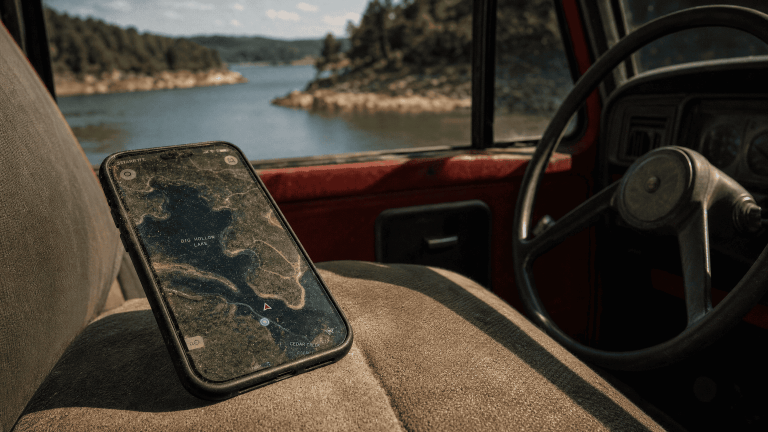
Three trucks at the pullout before sunrise, where there used to be one or none, and something goes sour in me before the tailgate’s even down. That reaction is worth looking at, because it’s the only part of the morning I actually control.
Public water changes without asking anybody. Access gets improved. A campground opens. A strong year-class starts producing fish worth photographing, somebody posts one with a recognizable bridge in the background, and the place I thought of as a discovery turns out to have been findable the whole time.
I can burn the morning being annoyed that other people know where the water is. It’s an easy mood to sit in. It has never once moved a fish.
Crowded, or just less private
One extra angler on a big shoreline is not six people casting across the same small current seam. Only the second one is really a problem.
So I count workable space. Can everybody cast without crossing lines, and land a fish without it turning into an argument? Is anybody wading through water somebody else is fishing, or are trucks and trailers making the launch unsafe and blocking access?
If there’s still room to fish safely and courteously, what’s changed is that the place feels less private than it did. That’s a real loss, and I don’t pretend it isn’t. It’s also not the same thing as unusable.
I go earlier
Pressure on popular water is usually predictable — weekends, holidays, warm afternoons, the convenient hour after work, the obvious seasonal peak. If my schedule bends at all, I bend it: earlier, later, midweek, or into weather that’s less comfortable but still safe.
I try not to let it turn into an arms race, though. If holding a parking spot takes a headlamp and a 2:47 a.m. alarm, I’ve stopped fishing and started competing for gravel. At that point I’d rather go somewhere else.
The edges of the obvious spot
Crowds pile onto whatever’s visible from the parking lot: the point beside the lot, the creek mouth, the dock, the first pool below the bridge, the one stretch of bank you can reach with dry feet.
I look one step past the attraction. Where does the current soften above or below that pool? Where does the weed edge keep running once it leaves the popular bank? Is there a secondary point, shade line, gravel transition, or depth change a short walk away?
Fish haven’t read the reviews. A duller feature nobody’s touched all morning will often beat the textbook spot getting hit from every angle.
Walking, and where I’m actually allowed to do it
A short walk filters out pressure, mostly because it’s less convenient than fishing next to the truck.
Before I assume I can just walk around the crowd, I check public access, property boundaries, closures, and any rules that apply. Fences, posted land, restoration areas, nesting closures, private docks and shorelines — those aren’t obstacles I route around, and quiet water bought by trespassing is exactly how access gets closed for everyone who comes after.
Approach before tackle
Heavily fished water tends to pay for a better approach before it pays for a different lure.
I stay back where the water’s clear enough that fish can see me. I wade less. I quit landing the first cast right on the most obvious target, and I look for an angle the people standing in the default spot can’t use. Fewer casts, better ones.
If fish are seeing a constant parade of big, loud presentations, something smaller or quieter is worth testing. It’s not a rule, though — pressured fish don’t automatically want tiny tackle. I try to match the change to the water and the forage in front of me, not to a formula.
I don’t crowd somebody just because crowds annoy me
More people means etiquette matters more, not less.
I ask before I step into a close lane. I leave room to cast and to land a fish. I don’t anchor on top of a boat already working a small feature, and I don’t leapfrog so tight that both of us spend the day shuffling around each other.
Local customs vary by water and by style of fishing. The floor doesn’t move for me: I don’t take away another angler’s practical ability to fish safely. If there isn’t room, I move.
Where I fished, minus the pullout
I can tell the story without publishing the parking pullout, the bend, the creek mouth, or live timing on water that can’t take the traffic.
I give the pattern instead — shallow windblown rock, a shaded inside seam, a weed edge next to deeper water, a public reservoir somewhere in the region. That travels, and somebody else can use it on their own water. A coordinate only works once.
This matters most on fragile access, small waters, spawning areas, and places that genuinely can’t absorb much more traffic.
When the spot stops being what I wanted
Not every fix is tactical. If quiet was the reason I loved the place and it isn’t quiet anymore, scheduling around it is just a slower way of missing it.
I research another public access. I walk a shoreline I don’t know. I learn a lake nobody brags about, or fish a city pond on a cold morning, or take a stretch that photographs badly and gives me room to think.
That can feel like giving up. It’s also how anybody’s list of water gets longer.
Everybody found it from somebody
Missing the old version of a place is fair. Deciding that the people who showed up later are intruders on public water is not, and left alone that mood hardens into the kind of posture that treats a boat ramp like a membership.
From somebody else’s tailgate, I’m the third truck. Nobody gets to be first on public water forever, and showing up later than someone doesn’t make you what’s wrong with the place. I try to learn the water, give people room, and figure that in a couple of years I’ll be the one who remembers when it was quieter.
So I fish the water that’s actually in front of me — more people, different timing, and a set of edges nobody’s bothering with. And I keep a second place in mind for the morning the parking lot answers the question before I’ve even unloaded the rod.
FIELD OBJECT
This one should leave the page.
The article is the long version. These are the pieces worth carrying into the next trip.
The 30-second version
Three trucks where there used to be one, and the morning sours before the tailgate’s down. Better timing and the duller edges nobody’s fishing get most of it back.
What to watch
- Crowded, or just less private
- I go earlier
- The edges of the obvious spot
- Walking, and where I'm actually allowed to do it
Field card
- Crowded, or just less private
- I go earlier
- The edges of the obvious spot
- Walking, and where I'm actually allowed to do it
- Approach before tackle
RIGHT TOOL, NEXT
Field Ops Desk
Turn the field note into a pre-trip, on-water, or debrief decision instead of leaving it as reading.