SAFETY & STEWARDSHIP · EMBEDDED FISHHOOKS
A hook in skin isn’t a knot problem anymore.
It stopped being one the second it went in. The first decision isn’t which removal trick you’ve seen somewhere. It’s whether the hook is in a spot where field removal is even reasonable to try.
If I’m not sure where it is or how deep, I get medical care
Eye involvement needs urgent ophthalmic care, full stop — I don’t attempt anything there myself. Some hooks shouldn’t get treated like an ordinary shallow hand or arm hook. That includes hooks near the eye, face, neck, genitals, major blood vessels, tendons, nerves, joints, or other delicate structures. I stop for any of these: deeply embedded hooks, multiple embedded points, uncontrolled bleeding, numbness, loss of movement, severe pain, or any real uncertainty about where the point and barb actually sit.
This is general safety information, not a substitute for medical evaluation, and I’d rather say that before anything else. The Merck Manual specifically warns that hooks can lie near nerves, vessels, and tendons, and that advancing a deep hook through an important structure can cause real damage. That warning is why this part comes before any technique does.
What I check before any removal attempt
- Stabilize the person and the hooked body part. I don’t let a lure swing from the embedded hook.
- Secure or cut away unused points on a treble hook so a second barb can’t catch the patient or whoever’s helping.
- Remove fishing line, bait, and dangling lure components when that can be done without moving the embedded point.
- Clean the accessible area and figure out where the barb is likely sitting.
- Use eye protection and keep bystanders out of the hook’s possible flight path. A hook removed by string-yank can leave fast.
- If the anatomy, hook path, or required force isn’t clear to me, I stop and get care instead of guessing.
If it’s your buddy with the hook in his hand and everybody’s looking at you to fix it, taking a minute to go down that list doesn’t make you slow. Rushing is how a small hook injury turns into a bigger one.
String-yank: what the method is actually doing
The string-yank method is a modification of backing a hook out. I loop strong line or string around the bend of the hook. Downward pressure on the shank rotates the hook so the barb disengages from tissue. A quick pull parallel to the shank then removes it along the same path it went in on.
American Family Physician describes string-yank as a commonly used field method. It’s one of the least traumatic approaches, because it doesn’t create a new exit wound. Merck describes the same basic method for shallow fishhooks, and also stresses protecting the patient and bystanders, because the hook can fly free once it lets go.
Advance-and-cut: why this is a different level of intervention
Advance-and-cut works by pushing the hook point and entire barb forward through the skin. The barbed point gets cut off. The now-barbless shank backs out through the original entry wound. It’s often effective, including on larger hooks. But it deliberately creates an exit wound, and it requires actually knowing what lies between the hook point and the skin surface — which is exactly the part I can’t always tell from the outside.
Merck’s current professional guidance for deep hooks includes cleansing, locating the point, and confirming that no important neurovascular structure or tendon sits in the path. Neurovascular just means nerves and blood vessels. The guidance then covers local anesthesia, advancing the hook, cutting the barb with strong cutters, and backing out what’s left. That sequence is a medical procedure, and I don’t treat it as a reason to improvise when the anatomy is uncertain.
I don’t push a deep hook through just because the barb shows up as a bump under the skin. A bump that looks convenient says nothing about what’s sitting between it and the hook point.
String-yank fits
Superficial, uncomplicated soft-tissue hooks. The shank can be depressed, I understand the barb path, the body part is stable, and no delicate structure is involved.
Advance-and-cut is more invasive
It’s highly effective when correctly selected. But it needs safe anatomy, the right tools, wound preparation, and usually local anesthesia. If those aren’t available, professional care is the better call, not a workaround.
Treble hooks need extra control
I secure exposed barbs before doing anything else. Multiple embedded points can make the ordinary single-hook techniques the wrong tool. They may need clinical removal instead.
After the hook is out
I clean the wound, get out any obvious foreign material like bait debris, and cover it with a simple clean dressing. Then I check tetanus vaccination status. Current Merck guidance says to go back for medical evaluation if pain, redness, swelling, or other signs of infection increase — I don’t wait that out at home.
Routine antibiotics aren’t automatically required after an uncomplicated fishhook removal. Patient factors and wound circumstances matter here. Immunocompromised people and contaminated or complicated wounds deserve actual medical judgment, not a blanket rule I picked up on a boat somewhere.
What I actually keep in a boat or bank safety kit
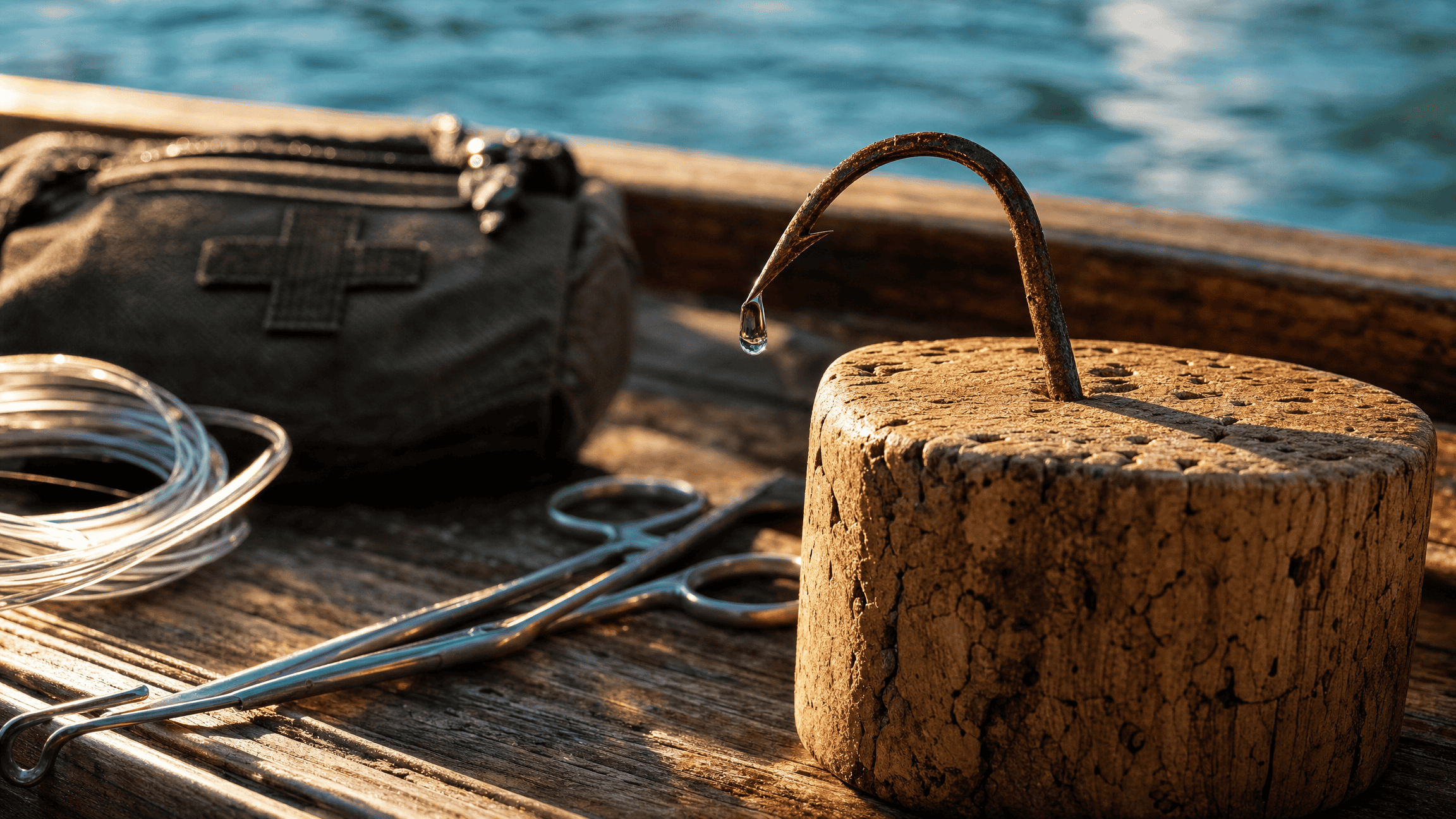
This isn’t a shopping list for performing surgery on a cooler lid. It’s a reminder that prevention and stabilization are most of the job. I carry eye protection, basic wound-cleaning supplies, and clean dressings. Tape or something to secure spare treble points. Sturdy cutters that actually match the hooks I fish — strong hooks will beat small hobby cutters every time.
I also carry the information that’s easiest to forget once someone’s actually hurt and everyone’s adrenaline is up: emergency contacts, medical conditions that affect wound risk, and when the last tetanus booster happened if I know it.
Why I don’t file these under knots
The old fishing-knot list here had “Hook Removal — String Yank” and “Hook Removal — Advance & Cut” sitting right next to actual knots. I kept the information and moved it, because these aren’t knots. They’re ways of managing an injury, so they live in Safety & Stewardship now instead of padding out a knot count.
What I checked before writing this
FIELD OBJECT
This one should leave the page.
The article is the long version. These are the pieces worth carrying into the next trip.
The 30-second version
A hook stuck in skin starts with deciding whether to touch it at all. After that come the two field methods, how they actually work, and what I watch for once the hook’s out.
What to watch
- A hook in skin isn't a knot problem anymore.
- If I'm not sure where it is or how deep, I get medical care
- What I check before any removal attempt
- String-yank: what the method is actually doing
Field card
- Stabilize the person and the hooked body part. I don't let a lure swing from the embedded hook.
- Secure or cut away unused points on a treble hook so a second barb can't catch the patient or whoever's helping.
- Remove fishing line, bait, and dangling lure components when that can be done without moving the embedded point.
- Clean the accessible area and figure out where the barb is likely sitting.
- Use eye protection and keep bystanders out of the hook's possible flight path. A hook removed by string-yank can leave fast.
RIGHT TOOL, NEXT
Tackle Link Analyst
Follow the load path and find the part of the setup that actually limits the rest.