WALLEYE · SPECIES PROFILE
FIELD PLATE · LOW LIGHT
For walleye, add light to the three things meeting on this drawing.
The eyes are not decoration.
Walleye are built to make more use of dim water than a lot of the fish around them. That is why dawn, dusk, chop, stain, shade and depth keep showing up in walleye fishing. The useful question is not “how deep are walleye?” It is where light, temperature, structure and forage overlap today.
Profile basis: Minnesota DNR · New York DEC · Lester et al. 2004

IDENTIFICATION
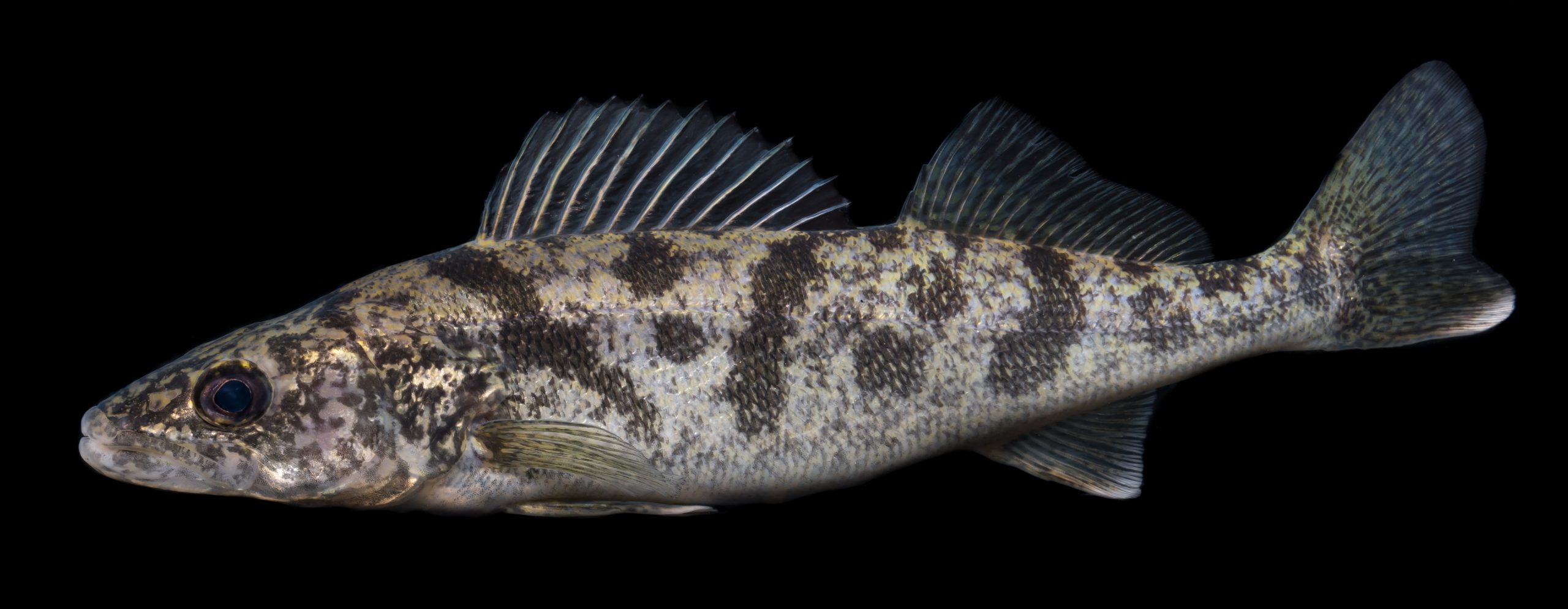
Check the first dorsal and the tail before you argue about color.
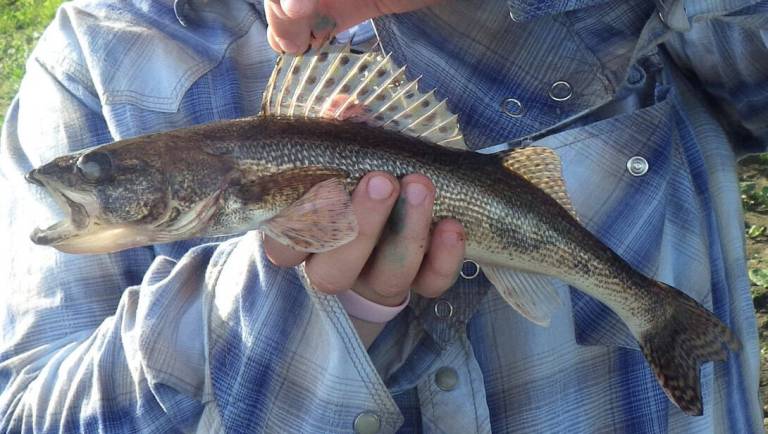
Walleye can run olive, gold, silver or gray depending on the water. The cleaner field marks are structural: a large reflective eye, two separate dorsal fins, canine teeth, a dark blotch at the rear base of the first dorsal and a white patch on the lower lobe of the tail.
Walleye vs sauger
Sauger have rows of distinct dark spots across the first dorsal fin; walleye do not. Walleye carry that dark rear-base blotch and usually the much clearer white lower-tail tip. Sauger also tend to have rougher, more fully scaled cheeks and stronger saddle marks running down the sides.
Walleye vs saugeye
Saugeye are hybrids and look inconveniently intermediate. They can keep the walleye-like white tail tip while adding bars or spots in the first dorsal and darker side blotches extending below the lateral line. If the water is stocked with both, one field mark is not enough.
The useful part is not becoming a fish-identification lawyer. It is slowing down long enough not to put the wrong fish against the wrong regulation.
Sources: Kansas Wildlife and Parks — walleye/sauger/saugeye ID · Ohio DNR
LIGHT
Bright water can move the fish without moving the structure.
Walleye eyes contain a reflective layer that improves vision in low light. Agency guidance consistently connects that advantage to dawn, dusk, night, shade and turbid water. Minnesota puts the practical result simply: fish often retreat toward darker water around cliffs, boulders and logs during bright daylight, then use shallower feeding water when light falls.
That does not mean every walleye waits until sunset. Wind chop, suspended sediment, algae, cloud and depth all change how much light reaches the fish. A gray afternoon on stained water can produce a completely different shallow-water window from a bluebird day on a clear lake.
Research also shows there is such a thing as too dark. Walleye do not gain infinite advantage as visibility falls. The useful habitat tends to be moderate light where they can detect prey without competing in full brightness.
So before changing lures because “the bite died,” ask whether the light changed the useful depth.
Sources: Minnesota DNR · Lester et al. 2004
DEPTH & STRUCTURE
Bottom-oriented is not the same as glued to bottom.
Walleye use reefs, rocky points, hard-bottom transitions, channel edges, humps, current breaks, wood and deeper pools. In rivers they often choose the lower-energy water beside current rather than the heaviest flow itself. Daytime telemetry in the Tombigbee drainage found extensive use of wooded structure.
But forage can pull them off structure. Smelt, ciscoes, shad and other open-water prey can suspend, and walleye follow. If bait and fish marks are fifteen feet down over forty feet of water, dragging a jig on bottom is not “staying walleye-like.” It is fishing twenty-five feet under them.
The simplest depth rule is the one electronics and line control can actually answer: know where the fish or forage are, then know where the presentation is. If either number is imaginary, lure choice is premature.
Thermoclines can matter in stratified lakes because they concentrate temperature and oxygen bands, but “fish the thermocline” is not a universal summer answer. Some systems do not stratify strongly, some forage lives elsewhere, and river walleye are solving a different problem entirely.
SPRING RIVERS
The famous river fish may spend most of the year somewhere else.
Plenty of rivers get famous for a few weeks every spring and go quiet the rest of the year. That stops being a mystery once you remember many walleye populations move into tributaries or shallow reef and shoal habitat to spawn, then leave.
Spring spawning happens over clean rock, gravel and rubble in shallow water, often in tributary riffles, lake shoals or reefs. The exact calendar moves with latitude and water temperature; state sources commonly place the main activity in the roughly 40–50°F / 4–10°C range.
Those runs can concentrate huge numbers of fish in very little water, which is why some states close specific spawning areas even when the general walleye season is open. The closure is part of the fishing information, not paperwork you check after the truck is loaded.
After spawning, fish redistribute. A spring river pattern can therefore disappear because the fish left, not because everybody suddenly forgot how to jig.
Sources: Minnesota DNR — seasonal closures · Minnesota DNR — spawning biology
FOOD
Find the bait before you build the walleye story around the shoreline.
Young walleye begin on zooplankton and insect larvae, then shift toward fish as they grow. Adults are strongly piscivorous. Yellow perch, gizzard shad, emerald shiners, alewives, ciscoes, smelt and other locally abundant fish all appear in diet work.
That is why the “best walleye depth” can change dramatically among lakes. In one lake the forage is over rock. In another it is suspended over a basin. In a reservoir it may follow a creek channel. In a river the delivery path may be the current edge itself.
Green Bay diet research also shows prey composition changing sharply by month. A fish can be the same species, in the same broad water body, and still be eating a different dominant prey a month later.
Follow the food relationship, not the memory of where last season’s fish happened to be.
Sources: USGS — Green Bay diet · Ohio DNR
PRESENTATION
The useful presentation is the one whose depth you can defend.
Jigs, live-bait rigs, crankbaits, stickbaits, spinner harnesses, spoons and blade baits all appear in state-agency walleye guidance. That list is accurate and still avoids the decision.
When you get a tap, short contact or repeatable mark at one depth, keep the depth in the explanation. Five color changes with five unknown running depths are not five tests.
SUMMER
Deeper is common. “Deepest water in the lake” is not the rule.
Summer often moves walleye toward deeper structure, cooler water and deeper forage. In reservoirs that can mean channel edges, points, humps and thermocline-adjacent bands. In clear lakes it may also mean low-light shallows at dawn, dusk or night.
Daytime does not automatically mean inactive. Cloud, wind chop and stain reduce light, and Minnesota specifically notes more daytime activity under those conditions. Missouri also reports consistent daytime summer fishing in some reservoirs.
The practical choice is not “shallow or deep” in the abstract. Compare where temperature, oxygen, forage and usable light overlap. If the deep basin has no oxygen, depth stopped being an advantage. If the shallow flat is bright and empty, shade and depth get more interesting.
AUTUMN
Two good sources disagree on whether autumn means shallow or deep. Keep both.
New York DEC tells anglers walleye move toward shallower water as it cools. One year of Lake Ontario telemetry found the tracked fish deepest in October, averaging about 15 meters, while activity also peaked.
Those observations are not necessarily measuring the same thing. Anglers notice catchable shallow fish. Telemetry averages the whole tagged population. Forage location and lake shape differ. Still, the disagreement is useful because it stops “fall walleye go shallow” from becoming a law.
Autumn is a good time to let bait and structure settle the argument on the water you actually have.
Sources: New York DEC · Adult walleye telemetry — eastern Lake Ontario
ICE & DEEP RELEASE
A fish coming up from deep water may not be a release fish anymore.
South Dakota Game, Fish and Parks studied ice-caught walleye from roughly 7 to 42 feet and found 20% overall mortality among released fish. Their model put predicted mortality around 1.5% for fish taken shallower than 30 feet and about 15% deeper than 30 feet; most of the fish that died showed signs of barotrauma.
That is not a universal 30-foot biological wall. Fish size, water temperature, capture speed and fishery conditions vary. It is a strong enough signal to plan the trip differently, though.
If you are fishing deep water where legal harvest is an option, decide beforehand whether you are prepared to keep a legal fish. If you intend to release everything, shallower fish are the safer target. Catching first and developing an ethics plan while the fish floats beside the hole is late.
Sources: South Dakota GFP — ice-fishing hooking mortality · North Dakota Game and Fish — barotrauma
NATIVE HERE, HIGH-RISK THERE
A flagship fishery in Minnesota can be an invasive predator farther west.
Walleye are native across much of the Great Lakes, upper Mississippi and Canadian interior and have been stocked far beyond that range. Inside their native range they support major fisheries and extensive stocking programs.
Outside it, the management story can flip. U.S. Fish and Wildlife Service classifies walleye as high risk in its ecological screening summary, citing predation on native fish and documented impacts in western systems. USGS specifically documents predation on Pacific salmon smolts in the Columbia River system.
So “protect walleye” and “remove walleye” can both be correct management instructions. First ask whose drainage you are standing in.
Sources: USFWS ecological risk screening · USGS NAS
DEEP REFERENCE · THE PARTS THAT REALLY DO CONFLICT
The research arguments can stay without becoming the profile.
How much light is “optimal”?
Lester et al. built a lake-scale abundance model around roughly 8–68 lux at depth. A newer laboratory prey-capture study found feeding success peaking at much dimmer 0.05–1 lux. One measures whole-lake habitat associated with populations and harvest; the other measures individual prey capture in a tank. They are not directly interchangeable, and the source set does not reconcile them.
How turbid do walleye want the water?
Some summaries call high turbidity preferred; Ohio calls clear to slightly turbid water preferred; the USFWS habitat model lands between them with moderate turbidity and roughly 1–2 meters Secchi transparency as an optimum. The useful conclusion is a hump-shaped relationship: too clear can reduce usable low-light habitat, and too dirty can also reduce feeding.
Does lure color change with the kind of turbidity?
A Lake Erie charter-captain study found white doing better in clear water, yellow under sediment turbidity and black during algal conditions. That’s more specific than the usual agency color list, and worth keeping as a documented local result — not a color chart for every walleye lake in North America.
The disputed world record
The 25-pound Mabry Harper Tennessee fish was removed and later reinstated by the Freshwater Fishing Hall of Fame after arguments over the photograph, length and surviving scale evidence. Good argument to have in a boat. It won’t change a thing about where you drop the jig.
The weather-switch theories
Nobody has shown a universal walleye bite response to barometric pressure, cold fronts, cloud cover by itself, angling pressure or one exact “optimal feeding temperature.” Those conditions can change light, forage, water temperature and fish position without acting as standalone switches.
FEEDING · LIGHT SETS THE TABLE
Perch and shiners get eaten once the light drops far enough that the walleye sees better than they do. Wind chop and stained water can pull that off at noon.
The profile deliberately does not claim one universal optimal feeding temperature.
SOURCES
The source shelf.
- Minnesota DNR — Walleye biology
- New York DEC — Fishing for Walleye
- Missouri Department of Conservation — Walleye
- Kansas Wildlife and Parks — Walleye, Sauger and Saugeye Identification
- U.S. Fish and Wildlife Service — Habitat Suitability Information: Walleye
- Lester et al. 2004 — light, temperature and production
- Environmental Biology of Fishes — low-light foraging study
- Animal Biotelemetry — annual movement and depth
- USGS — adult walleye diet in Green Bay
- South Dakota GFP — ice-fishing release mortality
- North Dakota Game and Fish — barotrauma
- USFWS — Ecological Risk Screening Summary
- Journal of Great Lakes Research — turbidity and successful lure color
Profile reviewed 2026-09-02. Walleye seasons, spawning closures, size limits, harvest rules and fish-consumption advisories are water-specific. Check the current managing agency before the trip.
FIELD OBJECT
This one should leave the page.
The article is the long version. These are the pieces worth carrying into the next trip.
The 30-second version
Walleye eyes are built for dim water, and light moves these fish around more than most lure boxes want to admit. When the bite dies, check whether the light changed the useful depth before you change anything else.
What to watch
- The eyes are not decoration.
- Check the first dorsal and the tail before you argue about color.
- Walleye vs sauger
- Walleye vs saugeye
Field card
- Minnesota DNR — Walleye biology
- New York DEC — Fishing for Walleye
- Missouri Department of Conservation — Walleye
- Kansas Wildlife and Parks — Walleye, Sauger and Saugeye Identification
- U.S. Fish and Wildlife Service — Habitat Suitability Information: Walleye
RIGHT TOOL, NEXT
Species & Presentation
Carry the species behavior and presentation question into a narrower water-to-fish-to-presentation handoff.