Vermilion Rockfish Might Be Sunset Rockfish, and Your Eyes Can’t Tell
The red rockfish everybody calls vermilion can be a hidden second species that only genetics can separate. Depth changes the odds, and a fish from deep water needs a descending device to go back down.
By HunterUpdated September 23, 2026Read 8 min
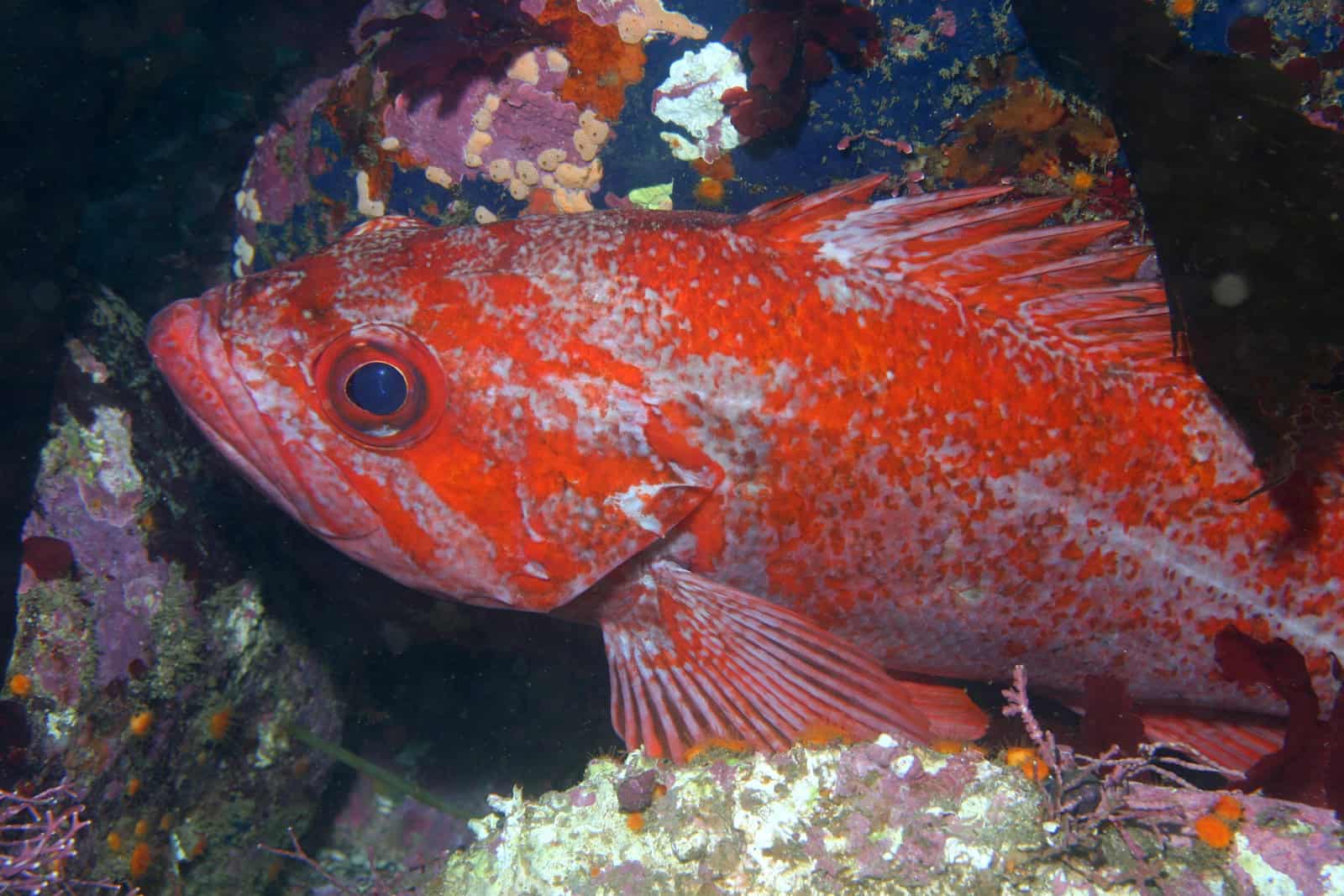
Vermilion Rockfish (Sebastes miniatus) near Point Lobos, California. Photo: Chad King / SIMoN / Monterey Bay National Marine Sanctuary; public domain.
Call a bright red rockfish a vermilion and you might only be half right. Sebastes miniatus is still Vermilion Rockfish, but the fish anglers have always called vermilion can include a cryptic second species, Sunset Rockfish, Sebastes crocotulus. The two overlap heavily in Southern California and can’t be separated for sure by eye, so California manages them together. That makes depth, and what a fish goes through on the way up from it, matter about as much as the color does.
At a glance · The short version
Scientific name
Sebastes miniatus
Cryptic pair
Sunset Rockfish, Sebastes crocotulus; genetic testing is the definitive separator.
Habitat
Rocky reef and hard structure from shallow nearshore water into deep shelf habitat; Vermilion is generally more common shallower than Sunset in overlapping Southern California waters.
Life history
ADF&G lists Vermilion Rockfish to about 60 years, maturity around age 5, and maximum size about 76 cm / 30 in.
Which red rockfish is this?
Identification
Bright red is only the start
NOAA’s field guide describes Vermilion Rockfish as dark red with gray mottling on the back and sides, red fins, a rough scaled underside of the jaw, and an anal fin with a strong anterior slant. Those characters help separate the vermilion/sunset pair from Canary or Yelloweye Rockfish, but they do not reliably separate Vermilion from Sunset.
The 2026 Pacific Coast stock-definition analysis notes that what was once treated as one Vermilion Rockfish species is actually a cryptic pair: S. miniatus and Sunset Rockfish S. crocotulus. NOAA’s Southern California survey states that genetic analysis is currently the definitive way to distinguish them.
California specifically publishes an identification flyer grouping Yelloweye, Vermilion/Sunset, and Canary Rockfish because red-orange color alone is not enough. Use the current CDFW key at the rail rather than turning “very red” into a legal identification.
ADF&G’s current rockfish identification program lists Vermilion Rockfish to about 76 cm / 30 in, maximum age around 60 years, and maturity around age 5. Newer genetic work suggests Vermilion and Sunset differ in growth and maximum age, which is exactly why historical pooled data need care.
The current Pacific Coast analysis gives Vermilion Rockfish a range from Prince William Sound, Alaska, to central Baja California, with strongest abundance from central Oregon south into Mexico. A broad range does not make every part of that coastline equally productive.
Every vermilion-colored fish was long treated as one reef resident. Current work adds a much more useful distinction: where Vermilion and Sunset overlap, Vermilion tends to be more common in shallower water, often under roughly 100–130 m, while Sunset is strongly represented deeper and on offshore banks, including water to at least 300 m. Depth cannot prove the species, but it changes the odds.
Vermilion are rocky-reef/hard-bottom fish. NOAA’s recreational rockfish program samples them with hook-and-line surveys on fixed rocky reef sites because structure is central to their distribution. The practical search is not “red fish live deep”; it is structure plus the right depth band plus current regulations.
The 2026 stock-definition analysis notes that larvae and juveniles can spend months in the water column before recruiting to benthic habitat. Adult site fidelity and larval dispersal therefore operate on different scales, which helps explain why a reef can feel local even though the life cycle is not confined to that reef.
Vermilion Rockfish are livebearers. Females retain developing young and release larvae into the water column rather than depositing guarded egg masses on a reef. California biological summaries describe a pelagic larval period before settlement into benthic habitat.
A roughly 60-year maximum age means a large fish can represent decades of survival and repeated reproductive opportunity. NOAA’s broader rockfish research also shows why older females matter: fecundity and reproductive performance often increase with age in rockfish, though the exact relationship is species- and population-specific.
Much of the historical “Vermilion Rockfish” literature pooled what we now know can be Vermilion and Sunset Rockfish. The 2025 genomics study separated more than 30,000 specimens and found meaningful differences in distribution and life history. Older averages are not automatically wrong, but they may describe the pair rather than pure S. miniatus.
Evidence level. Habitat, depth patterns, life history and identification limits are sourced. The presentation choices below translate that biology into field decisions and are not presented as personal Vermilion Rockfish experience.
Fish the mark, not the seafloorinference
Rocky reef is the address, but a school can sit above the relief. Use the sounder to determine whether fish are on the face, over the high spot, or suspended. Dropping below the marks because “rockfish are bottom fish” wastes both time and release mortality.
Depth changes the species oddsinference
In Southern California, a very deep red-rockfish school may contain more Sunset Rockfish than the same-looking school on shallower reef. Because the pair is managed together, that does not change the California bag line today, but it matters for truthful species reporting and for interpreting biology.
Stop before a release problem compounds
If a drift is producing non-retainable fish, a filled sublimit, or uncertain Yelloweye/Canary identifications, move. Continuing to fish the same deep school is not neutral once every additional fish needs recompression.
Deep release is part of the rig
Barotrauma & Handling
Descending device required in California boat fisheries
California’s current groundfish summary states that no one may take or possess federal groundfish from a boat or other floating device in ocean waters without a descending device in possession. That puts release gear in the same pre-trip category as hooks and leaders.
Rockfish brought from depth can show barotrauma because gases expand as pressure falls. CDFW’s barotrauma guidance recommends returning affected fish to depth with a descending device rather than leaving a floating fish at the surface and assuming the release succeeded.
Historical fishing records and older biological studies often treated every fish as S. miniatus. Current genetics recognizes Vermilion and Sunset Rockfish. Use older data with a note when the specimens were not genetically assigned.
Visual identification
Field keys can separate the Vermilion/Sunset pair from Yelloweye or Canary, but NOAA’s current survey program says genetics is the definitive way to tell Vermilion from Sunset.
Not established here
Still unproven, so it stays blank
a visual trait that conclusively separates Vermilion from Sunset
a coastwide spawning month
a guarantee that a red fish from deep Southern California is S. miniatus
a universal diet percentage
that historical “vermilion” datasets contain only Vermilion Rockfish
One visual limit · Two biological species
When Your Eyes Cannot Finish the Identification
Vermilion versus sunset
Do not invent confidence from shade, blotches, or a photograph taken under deck lights. California’s combined management reflects the practical identification problem.
Count conservatively
Treat an uncertain vermilion/sunset fish under the current combined rule. Confirm the live limit and management area before the first drop, not after the cooler is open.
Depth return
Deep capture makes release equipment part of the rig. Use the barotrauma field guide, and compare the different Alaska identification problem in Silvergray Rockfish.
— · Sources
FEEDING · DEPTH BEATS COLOR
It hunts tight to the ledge and just above it. Which of the two lookalikes you hooked changes nothing about where it was eating.
What it eats
Fishes, squid and octopus, crabs and other crustaceans are important prey.
How and where it hunts
A reef-oriented predator using rocky structure, ledges and hard bottom, feeding close to structure and in the water immediately above it. Depth and prey layer matter more than color or the generic label “rockfish.”
When it feeds
The profile does not establish one universal daily feeding window. Depth, current, prey and local reef structure provide stronger feeding context.
What changes as it grows
Not established with enough detail in the current Vermilion/Sunset source set to state a fixed juvenile-to-adult sequence.
Because Vermilion and Sunset Rockfish can be cryptic by eye, feeding claims are not assigned more narrowly than the evidence permits.
Species Split, Barotrauma, and California Rules
Color used to do the identifying. Depth does more of it now: where the two overlap, Vermilion tends to hold shallower than roughly 100 to 130 meters, while Sunset is strongly represented deeper and out on offshore banks, down to at least 300. It took genetics on more than 30,000 specimens to sort them out, so a shallow red fish is a fair bet and one off a deep mark is mostly a guess. California still manages them as one, which is fine for your bag and not so great for honest species records. I’ve never dropped a jig on a vermilion school, so on this fish I’m leaning on the genetics work and the agencies, not a deck.
Reviewed 2026-09-14. California manages vermilion and sunset rockfish together for retention because visual separation is unreliable. The 2026 groundfish summary applies a combined sublimit and requires a descending device to be immediately available aboard vessels taking or possessing federal groundfish. Check the live table because seasons and depth boundaries vary by management area.
FIELD OBJECT
This one should leave the page.
The article is the long version. These are the pieces worth carrying into the next trip.
The 30-second version
The red rockfish everybody calls vermilion can be a hidden second species that only genetics can separate. Depth changes the odds, and a fish from deep water needs a descending device to go back down.
What to watch
Identification
Range, Depth & Habitat
Life History & Reproduction
Field Decisions
Field card
a visual trait that conclusively separates Vermilion from Sunset
a coastwide spawning month
a guarantee that a red fish from deep Southern California is S. miniatus
a universal diet percentage
that historical “vermilion” datasets contain only Vermilion Rockfish
RIGHT TOOL, NEXT
Species & Presentation
Carry the species behavior and presentation question into a narrower water-to-fish-to-presentation handoff.
We use necessary cookies to operate the site. With your choice, we may also use analytics and advertising cookies. Choose Accept All, Reject, or Preferences.
Contains information related to marketing campaigns of the user. These are shared with Google AdWords / Google Ads when the Google Ads and Google Analytics accounts are linked together.
90 days
__utma
ID used to identify users and sessions
2 years after last activity
__utmt
Used to monitor number of Google Analytics server requests
10 minutes
__utmb
Used to distinguish new sessions and visits. This cookie is set when the GA.js javascript library is loaded and there is no existing __utmb cookie. The cookie is updated every time data is sent to the Google Analytics server.
30 minutes after last activity
__utmc
Used only with old Urchin versions of Google Analytics and not with GA.js. Was used to distinguish between new sessions and visits at the end of a session.
End of session (browser)
__utmz
Contains information about the traffic source or campaign that directed user to the website. The cookie is set when the GA.js javascript is loaded and updated when data is sent to the Google Anaytics server
6 months after last activity
__utmv
Contains custom information set by the web developer via the _setCustomVar method in Google Analytics. This cookie is updated every time new data is sent to the Google Analytics server.
2 years after last activity
__utmx
Used to determine whether a user is included in an A / B or Multivariate test.
18 months
_ga
ID used to identify users
2 years
_gali
Used by Google Analytics to determine which links on a page are being clicked
30 seconds
_ga_
ID used to identify users
2 years
_gid
ID used to identify users for 24 hours after last activity
24 hours
_gat
Used to monitor number of Google Analytics server requests when using Google Tag Manager
1 minute
Jetpack's built-in visitor analytics. It records page views, referring sites, search terms, and outbound link clicks, and also carries the shared visitor-tracking library used by Jetpack Instant Search and WooCommerce Analytics.