Range: Western Atlantic, centered on the Gulf and the southeastern United States
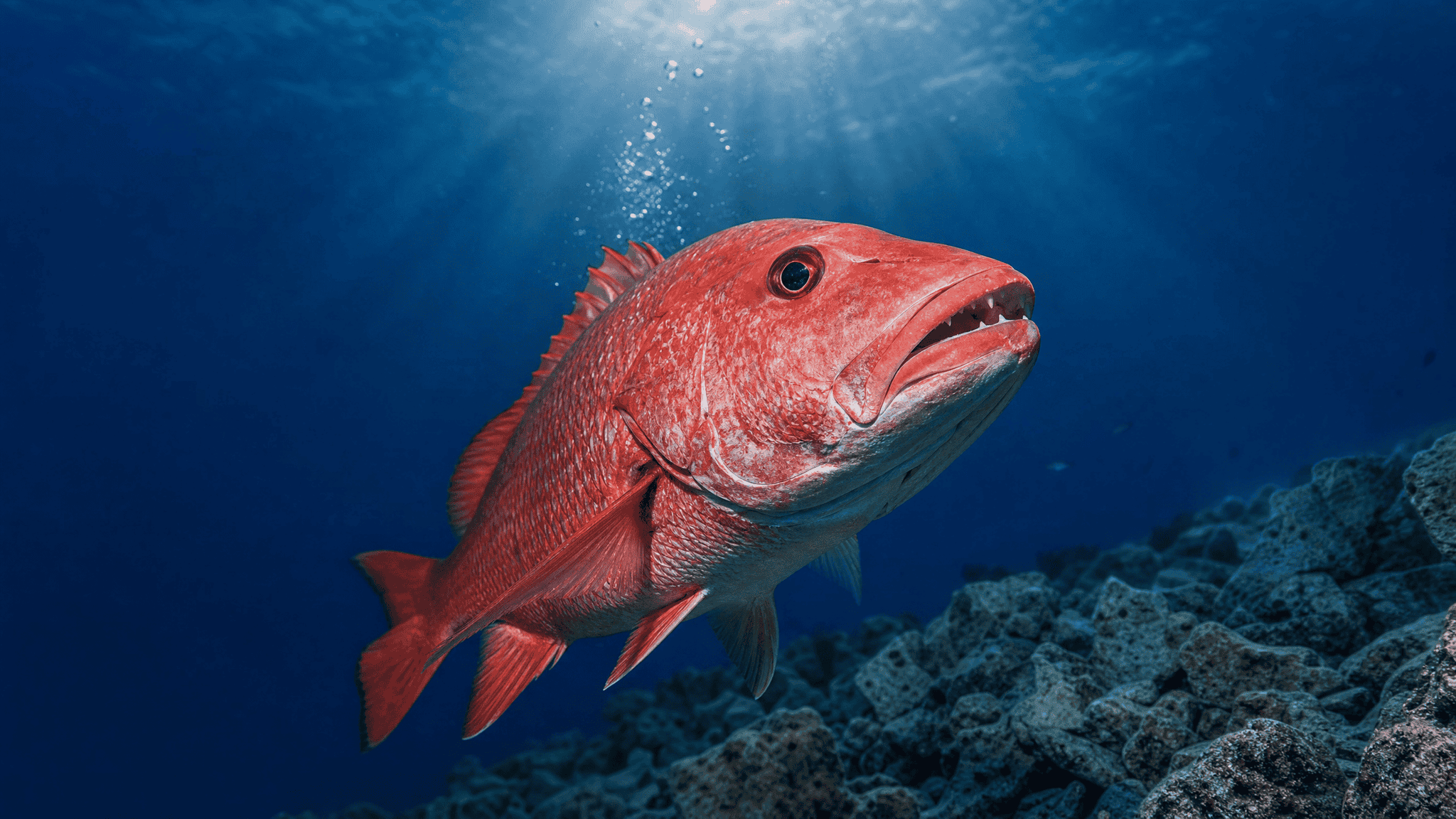
Best clue: A red fish with a long triangular face, a slightly projecting lower jaw, and no dark side spot
Core habitat: Hard bottom, reefs, wrecks, ledges, petroleum structures, and nearby slopes from roughly 30 to 620 feet
Fishing problem: Finding the part of the structure the fish are using without turning every legal or undersized release into a barotrauma emergency
Management reality: Gulf and South Atlantic fish belong to separate managed stocks; season, sector, state, and exact landing port all matter
The red snapper problem starts after the color check. Plenty of offshore fish are red. The hard work is deciding whether the mark on the sounder is actually snapper, whether the school is on the wreck or above it, how much bait reaches that level, and whether the crew can return a released fish to depth quickly. A limit is only one part of the plan. On this species, the descending device belongs beside the dehooker before the first bait goes down.
01. Identify the fish before the cooler opens
An adult Red Snapper is rosy to brick red above and paler below. The body is moderately deep, the face is long and triangular, and the lower jaw is equal to or slightly beyond the upper jaw. The mouth carries pointed canine teeth, but the fish does not have the outsized fang display of some tropical snappers. Young fish may show a dark spot high on the side; that mark usually fades as the fish grows.
Do not identify a red offshore fish by hue alone. Vermilion Snapper are slimmer, with a more forked tail and yellowish lines or spotting. Queen Snapper carry a deeply forked tail with long lobes. Silk Snapper have yellow eyes. Blackfin Snapper show a dark blotch near the pectoral-fin base. Red Snapper typically have red eyes and a comparatively plain red body. Light, depth, stress, and a camera can all change color, so use body shape, tail, eye, jaw, and marks together.
Take the identification photograph while the fish is controlled and horizontal, not after several minutes of debate. If retention is uncertain, keep the gills wet and prepare to release. An identification question should not create a handling injury.
02. One common name, two managed stocks
Federal managers assess a Gulf stock and a South Atlantic stock separately. NOAA’s current species page says the Gulf stock is not overfished and is not subject to overfishing, yet it remains in a rebuilding plan with a 2032 target. The South Atlantic stock is also listed as not overfished and not subject to overfishing under the 2024 assessment, with rebuilding aimed at 2044. Those sentences are not contradictory. “Not overfished” describes the current biomass threshold; “rebuilding” describes the path toward the management target.
That distinction matters at the dock. A healthy-sounding headline does not erase a short season, a state allocation, a sector closure, or a gear rule. Gulf states can manage private recreational harvest differently in state and federal waters under their programs. In the South Atlantic, 2026 recreational access used state-issued exempted fishing permits rather than one ordinary coastwide federal season. The management map must be checked before the chartplotter route.
03. A long life changes the math
Red Snapper can live for decades—NOAA reports ages to 57 in the Gulf and 51 in the South Atlantic. Females may reproduce as early as age two, and spawning can run from May into October depending on location. Older, larger females can contribute far more eggs than young adults. That is why a pile of legal fish is not biologically interchangeable with a population that retains broad age structure.
For anglers, longevity changes what “replaceable” means. A large fish lifted from a deep reef may represent several decades of survival through fishing pressure, storms, warm years, and weak year classes. The right question is not only whether it measures. Ask whether it fits the current bag, whether the crew already has enough, and whether releasing it from that depth can be done well.
04. Habitat shifts as the fish grows
Juveniles commonly use shallower sand and mud bottoms, often around low relief. As fish grow, reefs, wrecks, ledges, rock, limestone, and artificial structures become more important. Adults can also occupy sloping soft bottom near relief. The mistake is reducing the species to “the dot on the wreck.” Fish may hold on the up-current edge, behind the relief, over scattered rubble, or suspended well above the highest steel.
Build a spot as a three-dimensional shape. Note the top, base, surrounding apron, current direction, and the height of bait. A wreck rising 25 feet from the seabed creates more than one feeding lane. On a strong tide, the usable lane may start well up-current. On slack water, fish may settle tighter. On a pressured reef, the largest marks may sit off the obvious waypoint.
05. Read the school before choosing the drop
A dense stack close to bottom calls for a different first presentation than scattered arches 30 feet above it. Set the sounder range manually enough to preserve the bottom and the water column. Watch repeated passes. A mark that appears on one line and vanishes on the next may be bait, boat angle, or noise; a school that repeats at the same height deserves a deliberate drop.
Use the chartplotter trail to learn where the boat actually crosses the target. Wind and current may pull in different directions. Instead of dropping the instant the icon touches the waypoint, start far enough up-current for the bait to arrive at fish depth while it is still near the feeding lane. If every rig lands in the wreck, the starting point is late. If every bait reaches bottom fifty yards beyond the marks, it is early or too slow.
06. Put bait at fish height, not merely on bottom
Red Snapper eat fish, shrimp, crabs, worms, cephalopods, and some plankton. That broad diet does not mean every bait works equally. A fresh strip, whole small baitfish, or compact chunk that survives the descent is useful when the school is deep and pickers are active. Match hook and bait so the point remains exposed. A beautiful bait folded over the gap is decoration.
When marks suspend, stop the rig above the bottom. Count reel turns from contact or use a line-counter reference. Holding five turns up is a repeatable instruction; “somewhere off bottom” is not. If the bite comes during descent, note the line angle and depth instead of automatically dropping through the school. The best zone may be the last twenty feet before the sinker touches.
07. Choose a rig for the current and the release plan
A knocker rig keeps the package compact. A fish-finder rig gives bait some separation from the sinker. A two-hook bottom rig can sample height, but it also doubles tangles and can complicate release. Use enough weight to reach the chosen level with control, not the heaviest lead on the boat. Excess weight tires anglers, buries hooks in structure, and makes a suspended presentation harder.
Metal jigs can find aggressive fish quickly and avoid bait theft. Drop to the upper edge of the marks, engage, and work short lifts before racing the lure through the school. Heavy tackle is justified where fish can reach wreckage, but “heavy” should include a smooth drag and a leader the angler can control at the rail. The rig also needs to coexist with the descending device: leave one rod or dedicated handline ready rather than stripping the working outfit apart after every release.
08. The first seconds decide the fight
A Red Snapper bite may feel like a firm load, a series of taps, or a bait intercepted on the fall. With an appropriate circle hook, keep winding into pressure instead of swinging as if driving a nail. Once loaded, gain line smoothly through the first part of the fight. Near hard structure, delay gives the fish a path back into relief.
Later in the fight, avoid turning the drag into a winch. A fish coming from depth is already undergoing pressure change. Pumping wildly can tear a larger hole, and lifting it by leader can end at the surface with a broken knot and a floating fish. Use a net or controlled leader-and-grip sequence appropriate to fish size and sea state. Decide who handles the fish before it reaches color.
09. Barotrauma is not proof that a fish is dead
Gas in a fish’s swim bladder expands as pressure falls during ascent. Signs can include bulging eyes, a swollen abdomen, stomach tissue protruding from the mouth, distended intestines, or an inability to swim down. The fish may still be capable of recovery if it is returned rapidly to an appropriate depth. Throwing it over and watching it float is not a release method.
A descending device carries the fish back down, where pressure recompresses the gas. Venting punctures the swim bladder with a proper tool; it is not the same as stabbing the protruding tissue. Rules and agency recommendations differ by region, and descending generally avoids making a new wound. Learn the device on land, match its weight to fish and current, and keep it attached to a dedicated line. Our barotrauma and descending-device guide covers the sequence in detail.
10. Build a release station, not a tackle drawer
Before fishing, place the dehooker, measuring tool, gloves, camera, and descending rig where one person can reach them. Set a release weight heavy enough to beat current. Mark useful depths on the line. Assign one person to control the fish and another to operate the device. If the fish is clearly undersized or the limit is filled, skip the hero photograph.
- Bring the fish aboard under control and keep it shaded.
- Identify and measure only if necessary.
- Remove or cut the hook without tearing tissue.
- Clip or invert the fish securely on the descending device.
- Lower it promptly to the required or suitable depth and trigger the release.
- Confirm the device returned empty and reset it before the next drop.
If sharks or dolphins are taking released fish, moving is part of release care. Repeatedly feeding predators at the same waypoint is not fixed by faster dehooking.
11. Regulations are a route, date, and sector problem
Regulation snapshot checked September 15, 2026: never treat this paragraph as the rulebook. Start with the NOAA Red Snapper hub, then follow the live link for the exact region and sector. Confirm state waters, federal waters, private recreational, for-hire, or commercial status separately. Check size, bag, aggregate, season, landing requirements, closed areas, and mandatory gear on the day of the trip.
The 2026 South Atlantic recreational fishery shows why. NOAA authorized state-managed fishing through exempted fishing permits, with different dates and conditions for Florida, Georgia, South Carolina, and North Carolina instead of one ordinary federal season. A trip generally had to begin and end in the same participating state, and state license or federal permit requirements still applied. Read the 2026 NOAA state-management bulletin and the landing state’s current notice. Do not copy another state’s calendar or confuse a commercial closure with recreational access.
12. A short failure board
- No bites, marks glued to bottom: shorten the leader, reduce bait spin, and hold within a few feet of the marks.
- Bites only on the fall: stop dropping through the school; engage above it and repeat that depth.
- Every fish reaches steel: move the boat’s start point, increase early pressure, or fish the outer apron instead of the center.
- Constant small fish: leave the nursery-sized school rather than trying to “sort through” it with deeper hooking and more releases.
- Missing bait, clean hooks: toughen or reduce the bait and verify that the hook point is exposed.
- Floating releases: stop fishing until the descending station is working and the crew can use it quickly.
- Rules still unclear at the ramp: the trip plan is incomplete. Save the current agency page and closure notice before leaving service.
13. Follow the family without flattening it
Compare this offshore, school-and-structure problem with Mutton Snapper, where pointed-fin identification and sand–reef edges matter more. Hawaii’s Onaga or Longtail Red Snapper is another lutjanid, but it is a deep-slope fish with a different range, silhouette, fishery, and management system. Shared family does not create interchangeable tactics.
For the boat-positioning side, continue to bottom fishing wrecks and reefs. The useful handoff is from species biology to a repeatable drift—not from one red fish name to another.
14. Primary references and live rule gates
- NOAA Fisheries — Red Snapper biology, stock status, habitat, gear, and regional management
- NOAA Fisheries — 2026 South Atlantic recreational state-management EFPs
- NOAA Fisheries — 2026 South Atlantic commercial closure notice
- Gulf Fishery Management Council — live Red Snapper regulations gateway
- South Atlantic Fishery Management Council — Red Snapper species and regulation gateway
Taxonomy, stock status, and rule links were reviewed September 15, 2026. Fishing rules can change by emergency action or quota closure; the live agency notice controls.