CHANNEL CATFISH · SPECIES PROFILE
The Fish and Wildlife Service calls this one a swimming tongue.
Go through the agency pages on channel catfish and something odd shows up: every one describes a bait fishery, and not one recommends an artificial. It stops being odd once you know how this fish eats. It finds food by smell and taste in water where seeing anything was never the plan, so the guidance goes vague on presentation and gets very specific about what’s on the hook.
Profile basis: SRAC 180, Life History and Biology · Missouri Department of Conservation · Iowa DNR
TELLING IT FROM A BLUE CAT
Count the fin. The spots will lie to you.
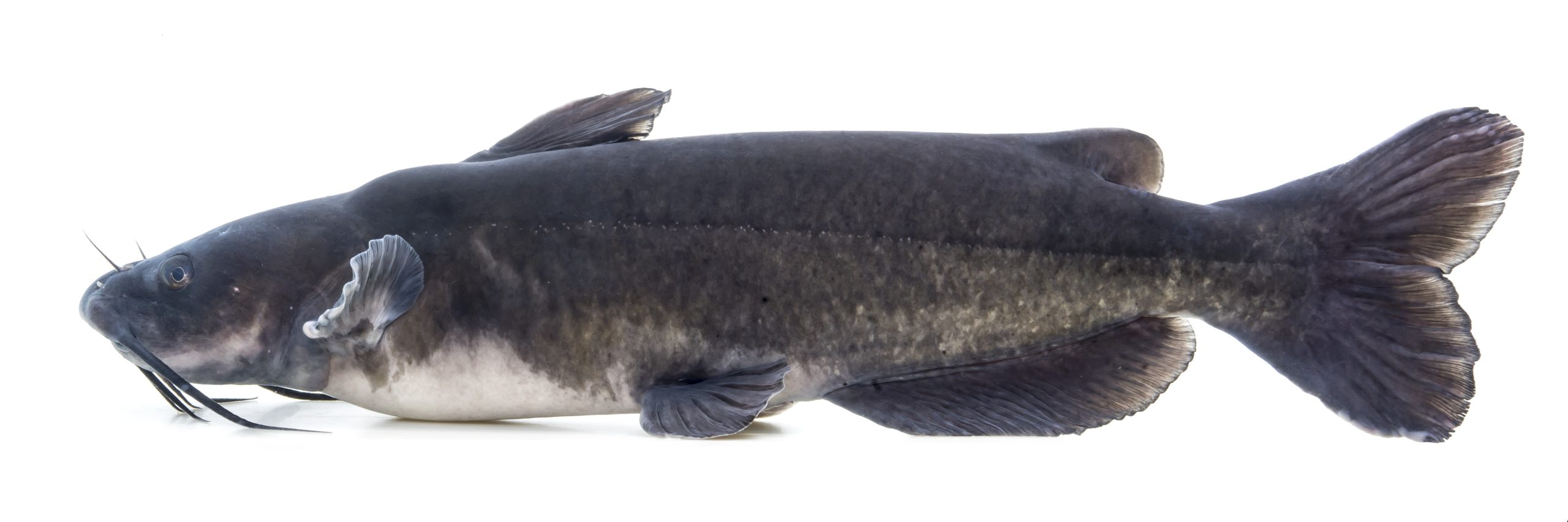
Spots and a forked tail get you most of the way, and the anal fin is the tiebreaker — shorter and rounded here, long and straight-edged on a blue catfish. Large channel cats lose their spots, which is precisely the moment people start guessing, so learn the fin rather than the pattern.
The ray count is the part that works at any size. Channel catfish run twenty-four to twenty-nine rays in the anal fin; a blue catfish runs thirty to thirty-five. The ranges don’t overlap, which is rare enough in fish identification that it’s worth learning properly. The shape follows the count: a shorter fin with a rounded, convex outer edge here, a longer one with a straight edge there.
Spots are the trap. A young channel cat is covered in scattered round black spots and nothing else looks like it. A big one often has none at all, and people take the bare flank as proof of a blue. It isn’t. Absence of spots tells you nothing except that the fish got old.
The forked tail is more useful than it looks, just not for the job people give it. It won’t separate a channel from a blue, because both are deeply forked. It will instantly rule out every bullhead, which carry squared or rounded tails, and a flathead, which is squared or barely notched. And if you have a spotted fish with a deeply forked tail in North America, there is only one thing it can be.
One more, for the flathead: its lower jaw sticks out past the upper. On a channel cat the upper jaw is the one that projects. That takes about a second and it is the only trait you need.
Sources: Missouri Department of Conservation · Ohio DNR
WHAT IT IS ACTUALLY DOING DOWN THERE
Taste first, and eyesight almost not at all.
Taste buds are not confined to the mouth on this fish. They are spread over the whole body, which is where the Fish and Wildlife Service gets the swimming tongue line, and it is not a cute way of putting it — a channel catfish is reading chemistry off its skin the entire time it is in the water.
SRAC states it flatly: in turbid water, taste is the primary way catfish locate food. Minnesota says the same thing from the other direction, that the fish feeds effectively in darkness and murky conditions using senses that have nothing to do with vision. So the dark is not a handicap it overcomes. The dark is the working condition.
Which is why the movement and the feeding both peak just after sunset and just before sunrise, and why the daytime entry in almost every source is a version of the same sentence: deep water, not much happening. Michigan puts the best fishing from dusk until midnight and I have no reason to argue with that.
It also explains why every one of these pages goes strangely quiet when you get to technique. There is no retrieve to describe. The fish is not watching anything.
Sources: USFWS · Minnesota DNR · Michigan DNR
THE NUMBER THAT RUNS THE SEASON
Seventy degrees on, fifty degrees off.
Above about seventy, channel catfish feed consistently. Below it the feeding gets patchy, and by the time the water is at fifty or under they have more or less stopped. That is a commercial pond finding rather than an angling one, which is exactly why I trust it — nobody was trying to sell anyone a fishing trip when they measured it.
The bottom end is not zero, though. Iowa records feeding picking up again once the water reaches forty, and Missouri gives the nicest practical version of the whole thing: riprap shorelines are worth fishing when the water hits sixty-five. That is a number you can check with a thermometer and act on the same afternoon.
One correction worth making, because the figure gets misused. Eighty-five degrees is the optimum for growth in this species, and it turns up all over the place quoted as though it were the temperature at which they feed hardest.
The eighty-five degree growth optimum remains a growth value, not a universal feeding-temperature optimum. They are answers to two different questions and only one of them is about fishing.
Underneath all of it is the reason temperature matters this much to a cold-blooded animal: the metabolic rate roughly doubles or halves for every eighteen degrees the water moves. The fish isn’t deciding to be less interested in November. It is running at a different speed.
Sources: SRAC 181 · SRAC 180 · Missouri Department of Conservation
WHAT GOES ON THE HOOK
The retrieve is mostly waiting.
No lure list here, because none of the agencies gave one. If you were hoping for a retrieve, you already read the headline. The decisions that matter happen before the cast — what’s on the hook and where the current is going to carry the scent — and after that it’s how long you’ll give one spot before you move. Less exciting than a lure breakdown, and a lot closer to how channel cats actually get caught.
So the real decision is bait size, and there is a clean number behind it. Iowa puts the diet switch at around fourteen to sixteen inches — below that the fish is eating bottom invertebrates, above it it is eating mostly fish. SRAC agrees and pushes it slightly further: past eighteen inches, fish make up as much as three quarters of the diet. That is the whole argument for why a nightcrawler catches you a steady stream of pan-sized cats and a dead bluegill catches you one good one.
For the small end, prepared cheese and dough baits and the various stink baits are at their best in June, July and August, once the water is over seventy. For the big end it is dead bluegill, live chubs, crayfish, frogs. In between, everything works because everything smells: worms, leeches, chicken liver and blood, grasshoppers, live and dead minnows, cut bait, dead shad. Somebody figured out that a ribbed rubber worm dipped in prepared bait holds scent well, which is the closest thing to a lure in the entire record and it is still just a scent delivery device.
The tackle is deliberately unremarkable. Ten-pound line is Iowa’s recommendation, and Missouri’s advice is to downsize whatever you would use for a serious catfish. Fish it on the bottom on a slip-sinker rig with the lightest weight that will hold, and tighten the line once the bait lands so you can feel what happens next. Circle hooks for live and cut bait; a treble is genuinely the right answer for liver or dough, because nothing else keeps it on.
Sources: Iowa DNR · Missouri Department of Conservation · SRAC 180
THEY GATHER
Thirty minutes with nothing, and you should be somewhere else.
Iowa makes one observation that changes how you fish more than any bait recommendation on the page: channel catfish gather in specific locations rather than spreading evenly through a body of water. Most of the lake has none in it. That turns the whole thing from a soaking game into a searching game, and it is where the thirty-minute rule comes from — if a spot has produced nothing in half an hour, the problem is probably that there are no fish there.
In a lake, start at ten to fifteen feet on structure: submerged timber, rock-protected shorelines, drop-offs. In a big river it is the slow water — between the dikes, behind them, in backwaters and side channels. Missouri notes they sit shallower than blue or flathead catfish do, and that shallow sand flats are worth fishing in summer, which is not where most people look for a catfish. Add riffles just above pools, cut banks, snags, the outside edge of a bend, wing dikes, and the dark water below rock dams and concrete aprons.
Season moves them predictably. At ice-out they are in backwaters and on shallow mudflats where the winter-killed shad have piled up, which is about as close to free food as a river gets. In winter they drop into the deepest holes and go subdued — subdued, not absent, and that distinction is worth holding onto in February.
Then there’s rain.
A rising river after rain is the one condition on this list I’d act on immediately, rod already rigged or not.
Wisconsin records heavy feeding following rains and Michigan ties its best fishing directly to rising water. It fits everything else on this page: more water means more scent moving and more food washed loose, and a fish that hunts by smell in the dark has just had its conditions improved in every direction at once.
Sources: Iowa DNR · Missouri Department of Conservation · Wisconsin DNR
IT NEEDS A HOLE
This fish cannot spawn in open water, which makes it a fact about rivers more than about fish.
Channel catfish are obligate cavity spawners. Not “prefer” a cavity — require one. A hollow log, a log jam, an undercut bank, a rock crevice, a stump, a muskrat burrow. Something enclosed and semi-dark, and if there isn’t one, there is no spawn.
The supply of those cavities is the documented limit on how many channel catfish a river produces. That is a genuinely interesting thing to know, because it means a stretch of water that has been cleared of wood can have a channel catfish problem that has nothing at all to do with how many people are fishing it. The fish are fine. The furniture is gone.
Timing runs April to July depending on latitude, usually late May through mid-July in the middle of the country. The temperature trigger in the sources spans about fifteen degrees, from Ohio’s seventy up to the seventy-five-to-eighty-five range the hatchery literature gives, and I don’t think that is a contradiction so much as two different questions: the low number is when spawning is first observed and the high one is when it works best. Eggs hatch in five to ten days, about eight at seventy-eight degrees. The male guards the eggs and then stays with the fry for another week or so. Eight to fifteen thousand eggs in a mass.
Iowa gives a spawn-period tactic that is worth knowing and worth thinking about. Switch off the bottom: float a live fish, a crawler or a leech under a bobber along riprap and rocky structure, and set the hook fast, because the strikes in that window are aggressive.
They are aggressive because the fish hitting your bait is a male sitting on a nest full of eggs, defending them. I couldn’t find a single agency page willing to say whether pulling him off matters, and as far as I can tell nobody has written it down. If I hooked one in that window, he’d go back quickly, right where he came from. That’s a personal call, not a sourced one.
Sources: SRAC 180 · Ohio DNR · Iowa DNR · Michigan DNR
EATING ONE
The lowest-mercury tier, which is not a sentence you often get to write about a big fish.
The FDA and EPA put catfish in Best Choices, the top category on their chart — two to three servings a week for people who are pregnant or breastfeeding, at four ounces a serving, and two a week for kids with the portion scaled by age. For a fish that gets to fifty pounds and lives in the mud, that is genuinely surprising, and it is mostly because a channel cat is not eating other predators for long enough to stack anything up.
SRAC describes the meat as extremely versatile, mild flavored, and difficult to overcook, which reads like marketing until you remember they wrote it for producers and not for anglers.
The part that varies is your particular water. Consumption advisories are set river by river and lake by lake, so the national chart is the floor and your state agency has the actual answer. If you’ve never looked one up, start with how fish consumption advisories work. That is one page to look at before you plan on keeping any, and then you are done thinking about it.
Sources: FDA / EPA advice about eating fish · SRAC 7304
WHERE THE SOURCES ARGUE
Missouri says all day.
Channel catfish get stocked into nearly everything, from big rivers to farm ponds, and the sources below are describing populations living very different lives. Where growth rate, size and seasonal movement conflict, the water is usually the explanation rather than the research. A pond fish and a river fish of the same species will not hand you the same numbers, and neither one is lying.
The live disagreement is about daylight. Nearly every source has this fish moving and feeding after dark. Missouri says plainly that channel catfish, unlike flatheads, can be caught throughout the day. Both are agency sources and neither is careless.
Missouri’s the outlier saying these bite all day; everyone else says after dark. I’d bet on the dark, with the daytime bites explained by water too dirty for eyes to matter anyway.
Age is a softer kind of argument. Forty years from SRAC, twenty-four from FishBase, about fifteen from the Smithsonian, and most Wisconsin fish under eight. Those are four different quantities — an all-time record, a database maximum, a typical ceiling, and what a fished population actually contains — and averaging them would produce a number that describes nothing. Maturity splits the same way, two to three years in warm fed ponds against five to eight in Michigan, and the gap is real rather than sloppy.
Then the venom question, which I enjoyed more than I expected to. Wisconsin’s own sheet calls them three sharp venomous spines. A 2009 survey in BMC Evolutionary Biology went looking and the answer was mixed: madtoms had venom glands, but the black bullhead and flathead catfish it cut open had none — and I couldn’t find channel catfish in its results, so for this species the claim is neither confirmed nor refuted. It barely matters in practice: the spine puts a deep puncture in you either way, and infection afterward is well documented. Keep your hands clear of those three spines, and clean any stab like it matters. But it is a good reminder that an agency page and a peer-reviewed paper are not the same kind of object.
No agency source consulted describes what a channel catfish actually does on the end of the line — no runs, no jumps, no strength-for-size comparison. That’s a real gap, not an oversight, and I’d rather leave it blank than guess at something I can’t source.
Sources: Missouri Department of Conservation · FishBase · Smithsonian National Zoo · Wright 2009, BMC Evolutionary Biology
WHERE THIS CAME FROM
Sources
- SRAC 180 — Channel Catfish: Life History and Biology
- SRAC 181 — Feeding Catfish in Commercial Ponds
- SRAC 1803 — Broodfish and Hatchery Management
- SRAC 7304 — Farm-Raised Channel Catfish
- Missouri Department of Conservation — Channel Catfish
- Missouri Department of Conservation — Catfish Fishing Tips
- Missouri Department of Conservation — Big River Catfishing
- Iowa DNR — Channel Catfish
- Ohio DNR — Channel Catfish
- Michigan DNR — Channel Catfish
- Minnesota DNR — Catfish Biology
- Minnesota DNR — Catfish
- Wisconsin DNR — Catfish
- US Fish and Wildlife Service — Channel Catfish
- FishBase — Ictalurus punctatus
- Smithsonian National Zoo — Channel Catfish
- FDA — Advice About Eating Fish
- Wright, J. J. (2009), BMC Evolutionary Biology
Compiled 2026-09-11. Consumption advisories and creel limits are set per water and per state and change between seasons — your state agency has the current answer for wherever you are standing.
FIELD OBJECT
This one should leave the page.
The article is the long version. These are the pieces worth carrying into the next trip.
The 30-second version
A channel catfish tastes with its whole body and does its best work in water too dark to see in. That’s why the agency pages all talk bait, and not one of them mentions a lure.
What to watch
- The Fish and Wildlife Service calls this one a swimming tongue.
- Count the fin. The spots will lie to you.
- Taste first, and eyesight almost not at all.
- Seventy degrees on, fifty degrees off.
Field card
- SRAC 180 — Channel Catfish: Life History and Biology
- SRAC 181 — Feeding Catfish in Commercial Ponds
- SRAC 1803 — Broodfish and Hatchery Management
- SRAC 7304 — Farm-Raised Channel Catfish
- Missouri Department of Conservation — Channel Catfish
RIGHT TOOL, NEXT
Species & Presentation
Carry the species behavior and presentation question into a narrower water-to-fish-to-presentation handoff.