BROWN TROUT · SPECIES PROFILE
FIELD PLATE · HOLDING WATER
Look for the place that pays the fish back.
The good-looking pool isn’t worth much if the fish already watched you walk up to it.
Spend enough time on pressured brown trout water and you start to suspect the fish remember you. I can’t prove that, and I’m not going to pretend I can. What agency guidance and telemetry do back up matches what I keep running into anyway: older and pressured browns get wary, lean hard on low light, and reward stealth almost as much as pattern choice.
Profile basis: National Park Service — Shenandoah · New York DEC · Slavík et al. telemetry
IDENTIFICATION
Dark spots on light ground. Don’t let the word “brown” do all the work.
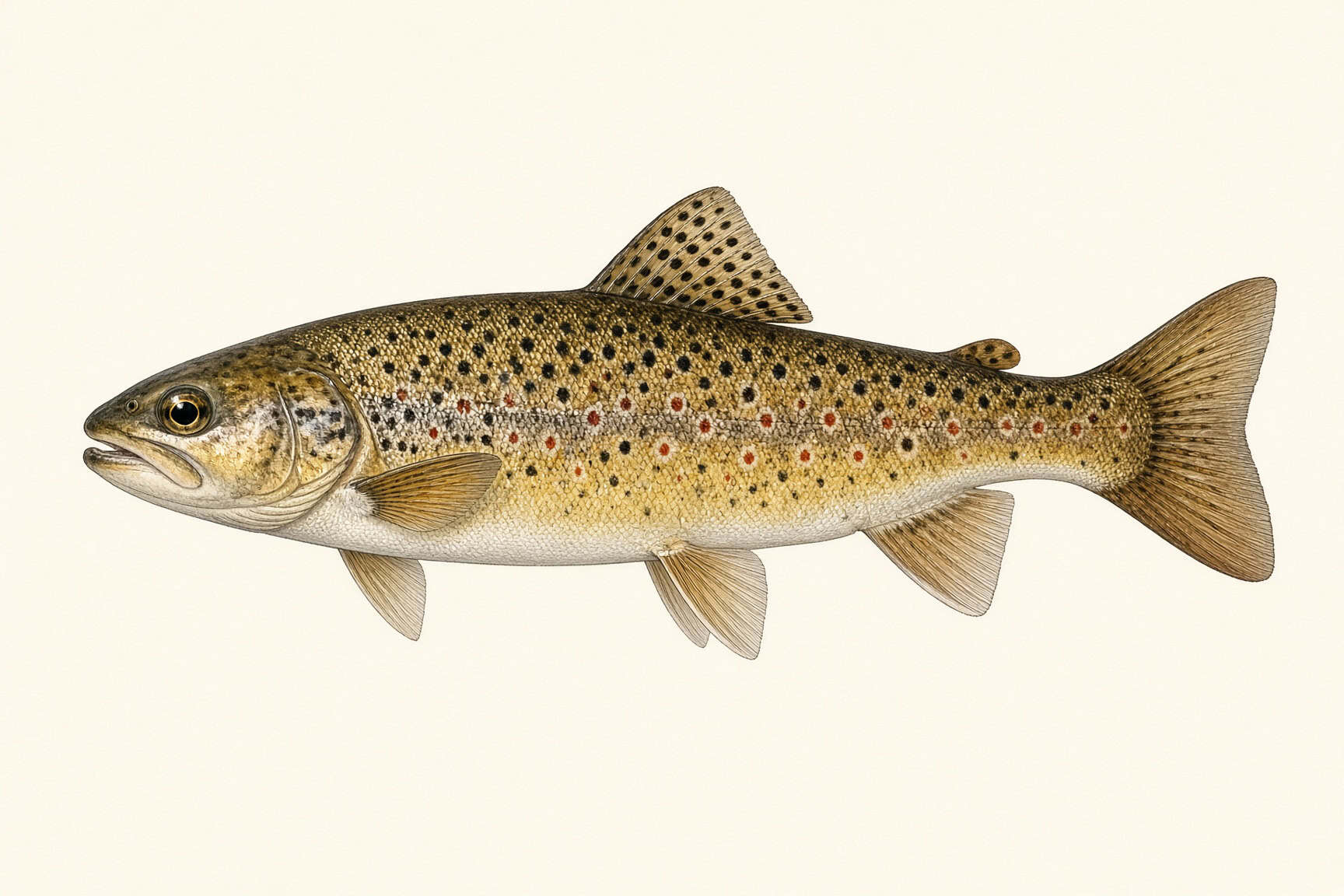
Brown trout can be olive, gold, yellow-brown, silver or almost lake-run chrome. The useful field pattern is darker spots on a lighter body, often with red or orange spots carrying pale or bluish halos. The tail is square or only slightly forked and usually has few spots compared with a rainbow trout.
Brook trout flip the pattern: light spots and pale worm-like markings on a dark background, with white leading edges on the lower fins. Rainbow trout usually carry a pink lateral band and black spots extending heavily onto the tail.
Atlantic salmon are the harder relative. Landlocked salmon and brown trout can look frustratingly similar, especially when both are silver. A salmon’s tail tends to be more forked and its caudal peduncle thinner; brown trout usually have the heavier peduncle and square tail. Vomerine tooth pattern can settle it, but that isn’t a check most people want to run on a live fish. If the water holds both and the rule depends on the species, use several traits instead of confidence.
Sources: Maine IFW · Massachusetts Division of Fisheries and Wildlife · Virginia DWR
PRESSURE SHOWS UP AS BEHAVIOR
Wary is more useful than “smart.”
Anglers love calling big brown trout educated. It sounds better than admitting the fish saw the line, the shadow, the boot on the bank or the same bad drift three times.
National Park Service guidance says brown trout in heavily fished water may become increasingly wary and nocturnal. West Virginia says older fish are more nocturnal and harder to catch. New York describes them as more wary and challenging than brook or rainbow trout, while Massachusetts simply calls them easy to spook.
None of those sources proves a brown trout is sitting under a root wad remembering the exact fly that caught it last June. They do support a fishing approach that assumes the fish can respond to disturbance and pressure.
That changes the first move. Stay lower. Keep unnecessary line off the water. Use the bank and shade as cover for yourself. If you can reach the lie without wading through the tail of the pool first, do that. A better pattern cannot unmake the first five minutes. Cold-looking water is not the qualification here either — shelter and oxygen do more of the deciding than temperature alone.
Sources: National Park Service — Shenandoah · West Virginia DNR · New York DEC
LOW LIGHT IS PART OF THE HABITAT
Dusk is not a magic clock. It is a change in how exposed the fish has to be.
Telemetry gives the low-light story more weight than fishing folklore alone. Belgian stream work found a dusk activity peak through the year. Czech telemetry found the least movement during daylight and during full moons, with movement increasing through twilight and night.
That full-moon result is useful because it points away from “night automatically good” and toward illumination. A bright night can remove some of the cover darkness normally provides. South Carolina likewise describes brown trout using deeper pools, undercut banks and low-light areas; Michigan recommends overcast or rainy stream days.
Larger brown trout also become increasingly fish-eating and nocturnal. That is why streamer fishing at dawn, dusk or night has a biological argument behind it for large fish. It is not proof that a mouse pattern at midnight is universally better than a nymph at noon.
Cloud, shade, stain and low sun can all open water a trout might not use as confidently in full light. Watch the fish’s security before turning the wristwatch into the explanation.
Sources: Ovidio et al. 2002 · Slavík et al. · South Carolina DNR
COVER BEFORE PATTERN
The fish needs somewhere to be hard to see.
Brown trout use deeper pools, woody debris, undercut banks, boulders, low-light pockets and protected eddies. Compared with brook and cutthroat trout, they often occupy lower-gradient, deeper and somewhat warmer downstream reaches where the current is slower and the water more productive.
The important part is the relationship between security and food. A root wad beside dead water is only cover. A root wad with a soft pocket beside a current lane is cover with delivery. A pool is not automatically good because it is deep; the head and tail may be where feeding fish can intercept drift without leaving the security of the pool entirely.
New York’s stream-trout guidance is practical here: fish pockets behind current breaks, pool heads and tails, logs, rock and vegetation; approach upstream when possible because trout usually face into the current. Iowa specifically points brown-trout anglers toward slower protected eddies.
That is enough structure to start without turning the river into a habitat spreadsheet.
TWELVE INCHES CHANGES THE MENU
The fish gets big enough to make other fish worth the effort.
Brown trout eat aquatic and terrestrial insects, crustaceans, mollusks, salamanders, frogs and fish. The important shift is size.
Shenandoah’s National Park Service profile gives a clean angler-useful threshold: smaller trout consume drifting insects, while fish over about 12 inches increasingly take larger prey such as crayfish and other fish. West Virginia describes mature browns becoming top predators, and Montana notes larger fish hunting other fish, crayfish and invertebrates especially at night.
So a 14-inch brown isn’t just a six-inch brown that needs a bigger version of the same fly. The menu, the hunting hours and the useful water can all change.
This is also one reason big browns can become serious predators where they’re introduced. In Grand Canyon, National Park Service work documents brown trout consuming native fishes; other western programs remove brown trout to protect native cutthroat and other species.
Sources: National Park Service — Shenandoah · West Virginia DNR · National Park Service — Grand Canyon
PRESENTATION
The approach gets a vote before the fly does.
Brown trout can be caught on dry flies, nymphs, streamers, spinners, spoons, small plugs and legal natural bait. The list is true. It’s also not where I’d start.
A flash, refusal, short take or fish that bolts before the fly arrives all count as response. A refusal may mean profile, drag, depth or speed. A bolting fish may mean you. Pattern choice is only one suspect.
WARM WATER
Brown trout tolerate more warmth than brook trout in many rivers. That doesn’t make them warm-water fish.
Agency pages commonly place brown trout farther downstream and in somewhat warmer water than brook trout. South Carolina uses about 68°F / 20°C as a practical upper habitat figure; West Virginia says they can tolerate water into the low 70s. Laboratory and state thermal reviews contain much higher acute survival limits.
Again, those are different questions. A fish surviving an acute laboratory temperature isn’t a release recommendation.
Arkansas Game and Fish advises extra caution beginning in the mid-60s°F and warns that around 68°F, added fight stress can increase mortality substantially. New York DEC advises avoiding trout fishing during elevated summer stream temperatures. Local rules and local fish conditions come first.
Low dissolved oxygen compounds warm-water stress. Heavier gear, shorter fights, less air exposure and the decision to stop can matter more than one more cast at a favorite pool.
Sources: Arkansas Game and Fish Commission · New York DEC · Nevada DEP thermal review
AUTUMN REDDS
The clean gravel at the tail of the pool can be full of fish you can’t see yet.
Brown trout spawn in autumn, generally as water cools into the single digits Celsius. Depending on latitude and system, agency sources place spawning from September through December. Females cut redds in clean gravel, often around the tail of pools or the transition between pool and riffle where flow keeps oxygen moving through the substrate.
The adults leave. The eggs don’t.
That makes wading the ethical issue long after the dramatic spawning fish are gone. Iowa advises anglers to avoid active redds, visible as cleaned gravel, and notes eggs remain in them until late winter or early spring. Minnesota closes some specific spawning areas seasonally.
Fishing to visible spawning fish may be legal in some waters and closed in others. Either way, a fish that’s bunched up, colored up and easy to find doesn’t mean the river quit needing the next generation.
VALUED HERE, REMOVED THERE
North American brown trout are immigrants with an unusually complicated reputation.
Brown trout are native to Europe, parts of North Africa and western Asia. They were introduced across North America and became one of the continent’s most valued trout fisheries. Great Lakes states stock and manage them heavily; Colorado collects eggs from wild runs for restocking; many naturalized stream populations support famous fisheries.
They’re also documented competitors and predators of native salmonids. USGS links brown trout to declines of brook trout, cutthroat trout, Arctic grayling, Atlantic salmon and other native fish in various systems. Grand Canyon National Park actively removes them from Bright Angel Creek and the Colorado River corridor to protect native fishes.
So there is no honest continent-wide conservation sentence that ends with “brown trout are good” or “brown trout are bad.” The drainage decides. A fish can be prized, stocked and protected in one river while managers are electrofishing it out of another.
That tension belongs in the profile because it changes what responsible angling means.
Sources: USGS Great Lakes NAS · National Park Service — Grand Canyon · Colorado Parks and Wildlife
DEEP REFERENCE · WHERE THE SOURCES ACTUALLY ARGUE
The messy numbers can stay down here where they belong.
Do brown trout really tolerate warmer water than brook trout?
Most state and agency descriptions say yes in the ecological sense: brown trout commonly occupy warmer, lower-gradient downstream reaches and can displace brook trout there. Parallel Nevada thermal reviews complicate the physiology: some acute brown-trout thresholds are not higher than brook-trout thresholds, and the recommended chronic thresholds differ. Competition and habitat use may explain part of the field pattern; the source set does not reduce it to one tolerance number.
Preferred temperature: Michigan 50–65°F, Wisconsin 65–75°F
Those public agency ranges do not even overlap. Michigan is describing broad brown-trout habitat; Wisconsin’s page focuses Lake Michigan fish. That difference in context is probably important, but neither source resolves it directly. The profile therefore avoids giving one “preferred temperature” card.
How big and how old?
USGS and FishBase disagree substantially on maximum length, and longevity ranges from ordinary stream lives measured in years to exceptional records measured in decades. Water type, sea-run or lake-run life history, food and methodology all matter. Extreme records add little to the fishing decision and no longer occupy the top of this profile.
How many eggs?
Agency and database fecundity figures span from hundreds to thousands, with much higher counts reported for large sea-run females. Body size and life-history form likely explain much of the range, but the original sources do not provide one conversion that justifies averaging them.
Do brown trout naturally reproduce in North America?
Yes in many places, despite one USGS summary saying natural reproduction is low or nonexistent in most states. Montana, Minnesota, Colorado, Shenandoah and many Great Lakes tributaries document naturalised or wild reproduction. The discrepancy likely reflects differing geographic scope and stocking dependence; the source set does not fully reconcile the wording.
What this profile deliberately does not claim
The original research did not establish universal brown-trout bite responses to barometric pressure, cold fronts, wind, water level or one exact feeding-temperature range. Low light, cover, current, temperature stress, prey and angling pressure have much stronger support.
SOURCES
FEEDING ECOLOGY · STANDARDIZED
How this fish gets fed.
Conflicting public-agency temperature ranges are not merged into a single preferred feeding band.
The source shelf.
- National Park Service — Shenandoah Brown Trout
- New York DEC — Stream Trout
- West Virginia DNR — Brown Trout
- South Carolina DNR — Brown Trout
- Massachusetts — Trout Identification and Fishing Tips
- Maine IFW — Brown Trout / Landlocked Salmon ID
- Ovidio et al. 2002 — seasonal activity telemetry
- Slavík et al. — diel movement telemetry
- U.S. Fish & Wildlife Service — Brown Trout Habitat Suitability Model
- Nevada DEP — Brown Trout Thermal Tolerance Analysis
- Arkansas Game and Fish — warm-water trout handling
- USGS Great Lakes NAS — Brown Trout
- National Park Service — Grand Canyon trout reduction
- Colorado Parks and Wildlife — Brown Trout
- Utz & Hartman — trout diet / terrestrial prey context
Profile reviewed 2026-09-02. Brown-trout seasons, spawning closures, harvest rules and warm-water restrictions are local. Check the current managing agency for the water you are actually fishing.