Arctic Grayling Cover More River Than That Fin Lets On
Everybody notices the sail fin. The more useful part is that some grayling travel tens of miles between spawning, summer and winter water, and Montana’s native river fish hang on in a fraction of their old range.
By HunterUpdated September 13, 2026Read 9 min
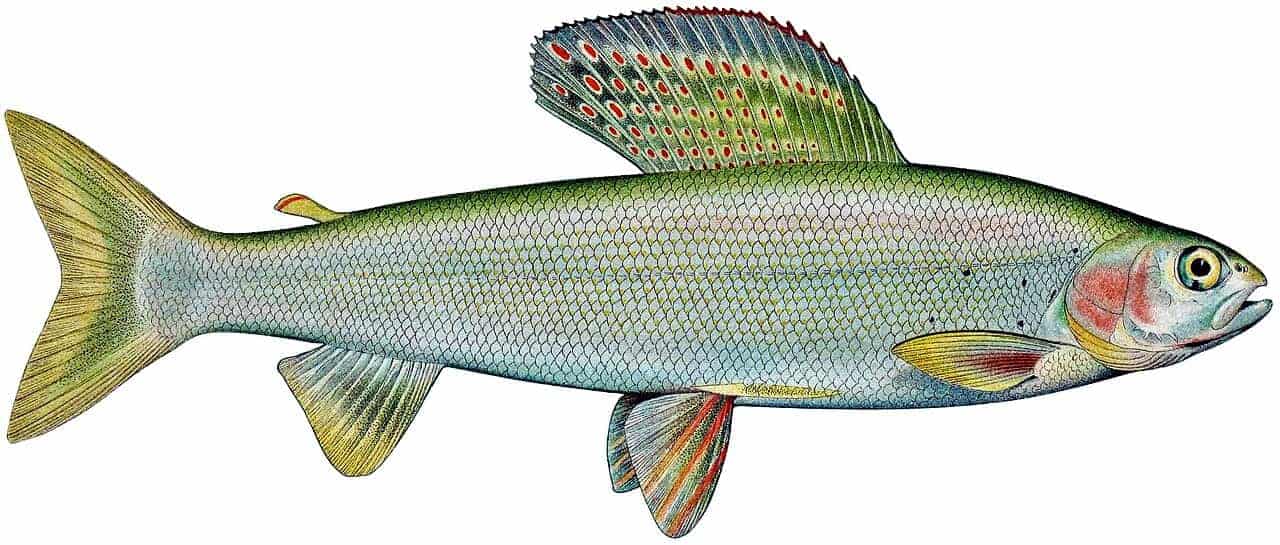
A detailed illustration of a freshwater fish, highlighting its vibrant colors and realistic features for aquatic enthusiasts.
Everybody’s first look at an Arctic grayling goes straight to the fin, and fair enough. It’s a sail with red and aqua painted on it. The part that actually helps you, though, is how much river the fish uses around that fin. Thymallus arcticus can move from spawning tributary to summer feeding water to deep winter refuge over distances that look oversized for a fish this small. In Alaska that mobility sits inside a broad, mostly healthy native range. In Montana, native fluvial grayling hang on in a fraction of their former Upper Missouri distribution. Same species, and not remotely the same management situation.
At a glance · The short version
Scientific name
Thymallus arcticus
North American distinction
The only grayling species native to North America.
Signature identification trait
Very large sail-like dorsal fin, heavily marked with iridescent red, aqua, purple, and other colors.
Primary food
Aquatic insects dominate many river diets; terrestrial insects, fish eggs, small fish, and other opportunistic prey can matter.
Migration
Some populations move between distinct spawning, feeding, and overwintering habitats; Alaska records movements up to about 100 mi, and Montana records roughly 60 mi in the Big Hole system.
Lower-48 native context
Historic native populations occurred in Michigan and Montana; Michigan’s original population is extinct, while Montana’s native fluvial fish persist under intensive conservation.
What fish is this?
Identification
Dorsal fin
The oversized dorsal is not just tall; on adults it can carry dense iridescent red, aqua, purple, and other markings. No other North American salmonid combines that sail with the same slender grayling body shape.
Alaska reports substantial color variation among waters. Backs are generally dark; sides may read silver, black, gold, or blue, with a pale belly and often a gold transition band. A dark slash can appear on each side of the lower jaw.
Grayling have a relatively small mouth and streamlined body compared with many trout and char. The small mouth fits a fish whose river feeding is often built around drifting invertebrates rather than routinely swallowing large prey.
Size
USFWS lists common length around 13.5 in and a maximum reported length around 30 in. Alaska’s state profile gives a largest measured Alaska fish of 24 in and 5 lb 1 oz. Local growth varies substantially with productivity and life history.
Arctic grayling occupy northern North America across Alaska and Canada and extend through Arctic Eurasia. In Alaska the species has an exceptionally broad natural distribution, absent from some southeastern and island areas except where stocked.
USFWS describes clear, cold medium-to-large rivers and lakes. River fish use different habitats seasonally: spawning reaches with current and gravel, productive summer feeding water, and deeper slow-current winter pools that remain usable under ice.
Alaska grayling can overwinter in lakes or deep slower pools of medium and large rivers, including some glacial systems. ADFG notes they can tolerate low dissolved oxygen under ice better than many fish, which complicates a simple grayling equals maximum-oxygen riffle rule.
Grayling have been stocked outside their native Lower-48 distribution, including mountain lakes in western states. A grayling fishery can therefore be native river conservation water, native Alaskan sport water, or a stocked high-country lake. The legal and ecological context needs to be identified before the fishing plan.
With spring breakup, many populations move upstream into spawning habitat. USFWS reports Big Hole grayling movements of about 60 mi between habitats; Alaska reports annual movements ranging from less than a kilometer to roughly 160 km / 100 mi in some populations.
Adults can leave spawning reaches quickly and redistribute into summer feeding areas. That is why a reach full of fish around spawning time may not be the productive summer reach a few weeks later.
Many migratory fish begin moving back toward overwintering habitats in early fall. The direction is often downstream from summer feeding water, but local life histories vary and some populations complete their life in relatively compact systems.
Spawning begins shortly after ice-out in many northern systems. Alaska management literature reports spawning often beginning as water approaches about 4 C / 39 F, although actual habitat and timing vary across the huge range.
Grayling broadcast eggs during spawning rather than constructing and covering a deep salmonid redd. Eggs sink into gravel and other bottom interstices. Alaska reports pea-sized gravel as common preferred substrate while documenting broader spawning substrates as well.
Alaska reports first spawning commonly around age 4–7 and roughly 10–12 in, with about 1,500 to 30,000 eggs depending on female size. Big Hole fish can mature younger because growth and lifespan differ sharply by population.
Black flies, mayflies, stoneflies, caddisflies, and other drifting aquatic insects form a major part of the diet. Montana likewise describes river populations as primarily insectivorous.
Terrestrial insects falling into the river can become important, which is why surface feeding can be visually obvious in summer. Alaska also documents unusually broad opportunism including fish eggs, small fish, and occasional small mammals.
Montana notes zooplankton can be more important in lake populations. A high-country stocked grayling therefore should not inherit a river insect-drift playbook unchanged simply because the species name is the same.
First identify the management context. Alaska’s broad native fisheries, Montana native fluvial conservation water, and stocked lake populations can have very different regulations and conservation priorities.
Drift laneinference
In a river, the first question is where drifting insects are being concentrated without forcing the fish to hold in maximum current: riffle tails, seams, pool heads, softer edges behind boulders, and transitions beside deeper refuge.
Fly methodsconvention
Alaska specifically notes dry flies and nymphs as standard approaches and points to generalized patterns such as Adams-type dries and hare’s-ear-style nymphs. Matching a specific hatch can matter when fish become selective; otherwise a natural drift often matters more than pattern novelty.
Small spinners, spoons, and other compact lures can also catch grayling where legal. Keep hardware proportional to the fish and water so the presentation can work naturally and the fish can be landed efficiently.
Temperature and handling
Cold-water species can become increasingly vulnerable as summer temperature and low flow squeeze habitat. In conservation populations, current closures or special rules outrank anything general you read about the species, this page included.
Montana is not a miniature Alaska
Lower-48 Conservation
Historic loss
The only native Lower-48 populations were in Michigan and Montana. Michigan’s original population is extinct. Montana’s native fluvial grayling once occupied much of the Upper Missouri drainage above Great Falls but now persist in a far smaller distribution.
Montana’s field guide ranks Arctic grayling S1 in the state and lists them as a Species of Concern / Species of Greatest Conservation Need. The Big Hole fluvial population remains the core native river conservation focus, while other Montana grayling include lake and restoration populations with different histories.
Montana’s cooperative conservation work focuses on streamflow, riparian habitat, reducing entrainment, and restoring migration connectivity. In 2026, state reporting continues to treat passage around temporary beaver-dam barriers as part of keeping spawning movement functional in the Big Hole.
Fish conserve energy in deeper pools or lakes under ice.
Where is the stable overwinter refuge rather than the summer feeding lane?
Ice-out / spring
Adults move toward spawning habitat and broadcast eggs over suitable bottom.
Is this a migration corridor or spawning reach with special conservation sensitivity?
Early summer
Adults redistribute toward feeding areas; young fish use slower nursery margins.
Where does current deliver insects beside a low-cost holding position?
Summer
Heavy insect feeding and surface activity can dominate in suitable cold water.
What is actually drifting or falling onto the water, and is temperature still safe?
Early fall
Migratory populations begin moving toward overwinter water.
Has the productive reach shifted downstream or toward deeper refuge?
— · Where sources differ
Open Questions
Montana population counts
Federal and state summaries use different units when discussing fluvial populations, restoration populations, and lake forms. This page therefore avoids turning one agency’s count into a universal statewide inventory and keeps the management context attached to the source.
Age at maturity
Alaska fish can first spawn around age 4–7 and live for decades, while fast-growing Big Hole fish can mature much earlier and rarely reach comparable ages. Population-specific growth is not noise; it is part of the ecology.
— · What we are not filling with guesses
Not Established Here
a single age-at-maturity value for every population
a universal migration distance
a claim that every legal grayling fishery is a conservation population
a fixed summer temperature cutoff independent of local management
a river method automatically transferred to stocked lake fish
— · Sources
FEEDING ECOLOGY · STANDARDIZED
How this fish gets fed.
Primary prey
Aquatic and terrestrial insects dominate, supplemented by crustaceans, fish eggs, and occasional small fishes depending on water and fish size.
Feeding mode / location
A drift and surface-oriented feeder using river pools, runs, riffle margins, seams, and softer current where insects are delivered within reach. Lake fish can also feed through the water column on available invertebrate prey.
Diel / seasonal pattern
The strongest supported pattern is seasonal rather than clock-based: spring spawning tributaries, summer feeding water, and deeper winter refuge. Insect hatches and terrestrial inputs can create short feeding windows, but no universal daily feeding period is established here.
Ontogenetic diet shift
Not established with enough consistency in this profile’s cited source set to state a fixed juvenile-to-adult sequence beyond a broad expansion from small invertebrates to larger prey.
Conservation-temperature guidance is kept separate from feeding ecology.
Compiled 2026-09-11. Limits and advisories are set per water and per state and change between seasons — the managing agency for wherever you are fishing has the current answer.
The fin’s still what you’ll notice first. The movement is what’s worth understanding. A grayling river isn’t one good pool repeated for miles — it’s closer to a chain of spawning water, feeding water and winter refuge, and the chain only works if the fish can reach every link. In Alaska that can be an ordinary seasonal migration through a healthy fishery. In Montana, that same trip is why a beaver-dam barrier or one low-flow reach can end up with a whole management effort pointed at it.
River FishRiver-fish species profiles covering habitat, behavior, seasonal movement, fishing approaches, conservation status, and regional variation across the United States.49 articles
Species & BehaviorFish behavior, habitat, depth, forage relationships, and species-specific field decisions. Start with the Freshwater Fish Species field guide.159 articles
Cookie Consent
We use cookies to improve your experience on our site. By using our site, you consent to cookies.
Contains information related to marketing campaigns of the user. These are shared with Google AdWords / Google Ads when the Google Ads and Google Analytics accounts are linked together.
90 days
__utma
ID used to identify users and sessions
2 years after last activity
__utmt
Used to monitor number of Google Analytics server requests
10 minutes
__utmb
Used to distinguish new sessions and visits. This cookie is set when the GA.js javascript library is loaded and there is no existing __utmb cookie. The cookie is updated every time data is sent to the Google Analytics server.
30 minutes after last activity
__utmc
Used only with old Urchin versions of Google Analytics and not with GA.js. Was used to distinguish between new sessions and visits at the end of a session.
End of session (browser)
__utmz
Contains information about the traffic source or campaign that directed user to the website. The cookie is set when the GA.js javascript is loaded and updated when data is sent to the Google Anaytics server
6 months after last activity
__utmv
Contains custom information set by the web developer via the _setCustomVar method in Google Analytics. This cookie is updated every time new data is sent to the Google Analytics server.
2 years after last activity
__utmx
Used to determine whether a user is included in an A / B or Multivariate test.
18 months
_ga
ID used to identify users
2 years
_gali
Used by Google Analytics to determine which links on a page are being clicked
30 seconds
_ga_
ID used to identify users
2 years
_gid
ID used to identify users for 24 hours after last activity
24 hours
_gat
Used to monitor number of Google Analytics server requests when using Google Tag Manager
1 minute
Jetpack's built-in visitor analytics. It records page views, referring sites, search terms, and outbound link clicks, and also carries the shared visitor-tracking library used by Jetpack Instant Search and WooCommerce Analytics.