Redeye Bass Answer to the Creek Before the Red Eye
Redeye bass (Micropterus coosae) now means the Coosa-system fish only — a small-river current bass living on crayfish and bugs that fall off the bank. Check which drainage you’re in before you trust the red eye.
By HunterUpdated September 13, 2026Read 6 min
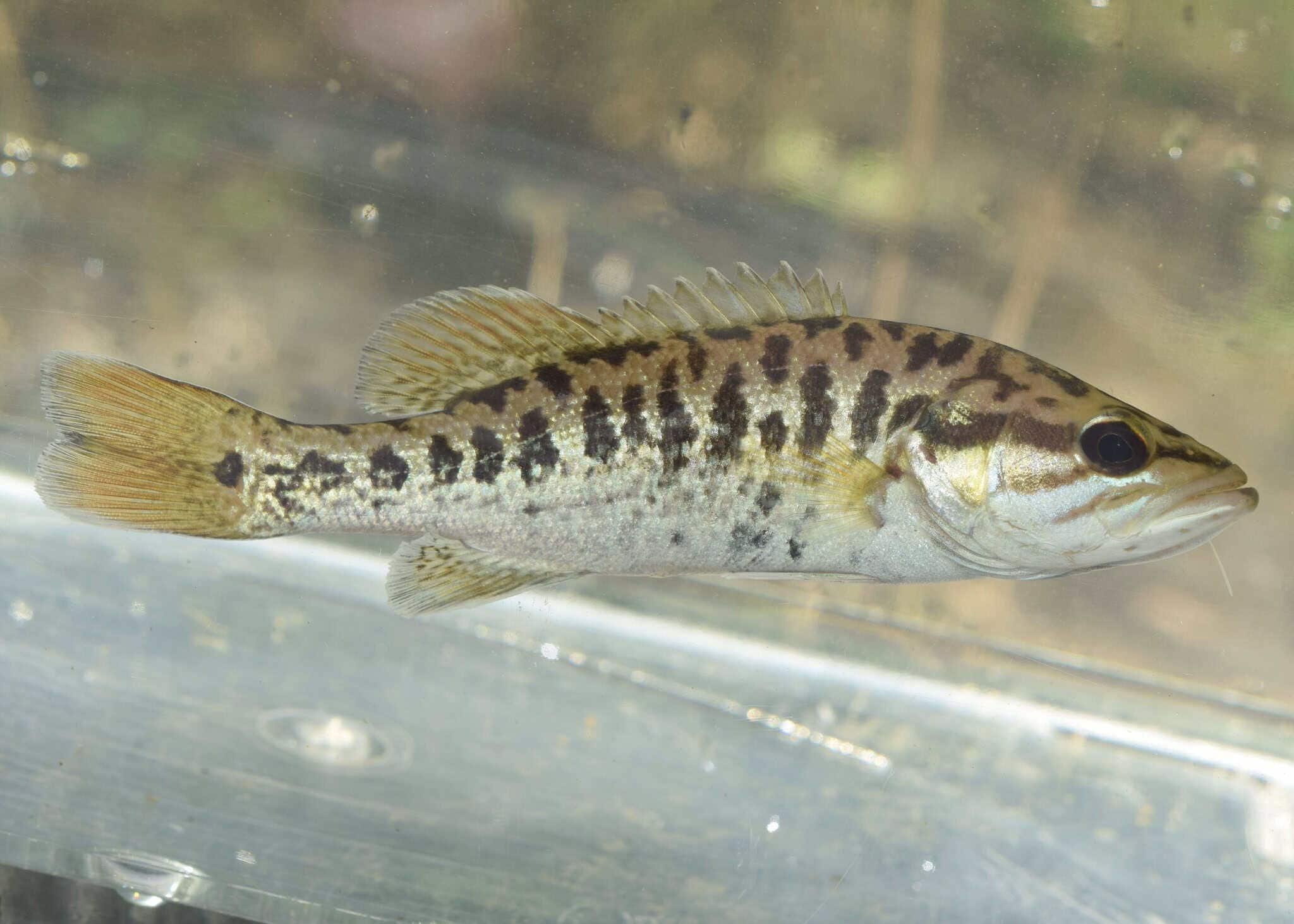
Redeye Bass (Micropterus coosae). Photo: skitterbug / iNaturalist via Wikimedia Commons, CC BY 4.0.
A redeye bass is a creek fish first and a bass second, and the creek decides what you get to call it. Micropterus coosae now means the redeye of the Coosa River system in Alabama and Georgia. Older references stretched the name over a lot more water, but the 2013 revision split the Tallapoosa, Cahaba, Black Warrior and Chattahoochee upland bass off as their own species — so the drainage is part of the ID, not a fun fact you tack on after. I’ve never had one in my hand. Small, clear, rocky water with current in it is a different story; that’s most of the trout water I know, and it’s where the fishing reasoning below comes from. It’s tagged as inference because that’s what it is.
At a glance · The short version
Scientific name
Micropterus coosae
Native range
Coosa River system in Alabama and Georgia under the post-2013 species definition.
Typical adult length
Outdoor Alabama lists adult size as 14-17 in, but that’s the big end. Most redeyes in small creeks run more like 6-10 in, and size varies strongly by stream.
Habitat
Clear upland creeks and small-to-medium rivers, especially rocky runs, pools, current breaks, wood, and undercut banks.
Spawning
Late spring; NatureServe summarizes spawning as water reaches roughly 17-21 C.
Diet
Terrestrial and aquatic insects, crayfish, small fish, and other stream prey.
What fish is this?
Identification Starts With the Drainage
The 2013 split
Baker, Blanton, and Johnston revised the redeye-bass complex using morphology and mitochondrial DNA. M. coosae is now restricted to the Coosa River system. The Tallapoosa bass is M. tallapoosae, Cahaba bass M. cahabae, Warrior bass M. warriorensis, and Chattahoochee bass M. chattahoochae. An old book can therefore be biologically useful while using a species name more broadly than the current taxonomy does.
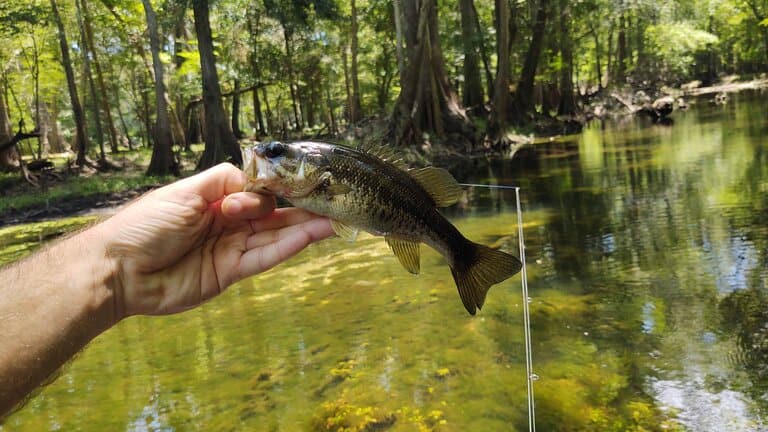
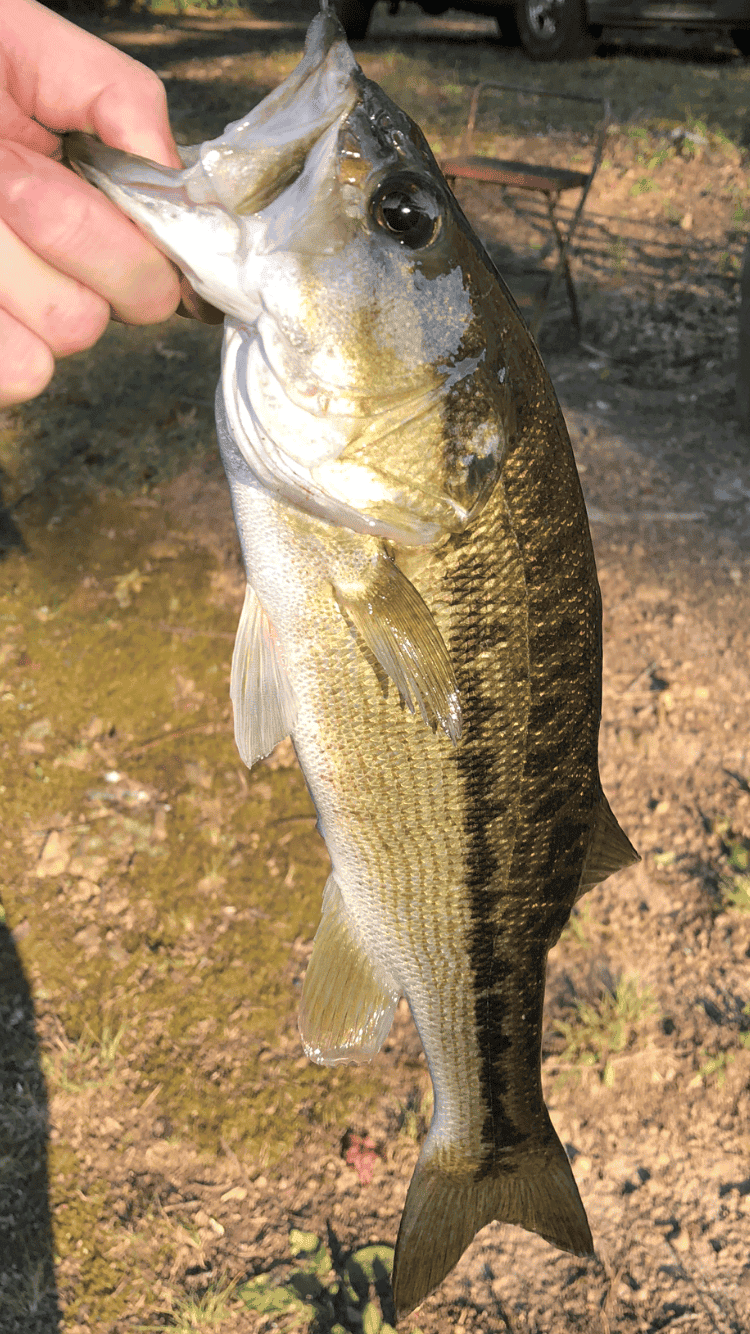
The reddish eye is memorable but not sufficient. Outdoor Alabama also notes blue-green coloration on the lower head and throat of mature males during the spawning period and pale margins on the tail. Those traits belong in a multi-trait identification that also uses drainage and body pattern.
The four newly recognized upland species were separated using combinations of pigmentation, scale counts, tooth-patch development, and genetics. A red eye or turquoise throat cannot carry the whole identification when neighboring drainages hold close relatives.
NatureServe describes clear upland creeks and small-to-medium rivers, especially rocky runs and pools. Outdoor Alabama adds aquatic vegetation, submerged logs, boulders, and undercut banks. The common thread is not one cover type; it is a current-connected position with either shelter or a reduced swimming cost beside food delivery.
NatureServe notes movement into smaller tributaries or toward the heads of pools for spawning. That makes spring a connectivity problem as much as a temperature problem: a barrier between adult holding water and shallow tributary habitat can remove usable spawning water without changing the appearance of the main river.
NatureServe summarizes late-spring spawning as water temperatures rise to about 17-21 C, with maturity estimated in the roughly two-to-four-year range. That is a better species-specific anchor than borrowing a national largemouth calendar.
Outdoor Alabama reports a life span around nine to ten years. Treat that as a regional summary, not a promise that every creek produces ten-year-old fish; stream size, food, drought, floods, and harvest can all compress the age structure.
NatureServe and Alabama references both keep terrestrial insects in the diet alongside aquatic insects, crayfish, and fish. That makes riparian cover part of the food system. A shaded bank is not useful only because it is dark; overhanging vegetation can also be delivering prey directly into the lane.
A 2024 California study found slow growth in an introduced Cosumnes River population and a diet shift from aquatic insects in juveniles toward crayfish and larger prey in adults. That study is valuable evidence of trophic flexibility, but it should not be presented as a native-Coosa growth curve.
A slow-growing, crayfish-heavy population a continent away from the Coosa and a native creek fish holding in a rocky Alabama run are not obviously the same animal to plan a trip around. Until somebody runs the velocity and depth numbers on native water, I’d treat the California study as a warning label, not a stocking chart.
How would I read the stream?
Field Decisions
Evidence level. Habitat, diet, and spawning movement above are sourced. The tactical translation below is field inference, not a claim that one lure has been experimentally proven best for redeye bass.
First water to checkinference
Start where a hard current edge touches refuge: the downstream pocket of a boulder, an undercut bank beside moving water, a log that creates a seam, or the first deeper slot below a riffle. Those positions combine delivery with a cheaper place to hold.
Match the stream scaleinference
The useful feeding lane can be only a few feet wide. Accurate placement and a controlled drift matter more than maximum cast distance. Small crayfish, compact minnow profiles, and insect-like surface or subsurface presentations all fit the documented diet; the day’s actual forage should decide which starts first.
Summer canopyinference
Where terrestrial insects matter, shade lines and overhanging vegetation deserve attention as both thermal cover and food delivery. The right cast is often along the edge of that system rather than deep into the branches.
Conservation is drainage-specific
Native Range, Introductions, and the Redeye Complex
Do not merge the upland bass
This page covers Coosa-system M. coosae only. Tallapoosa, Cahaba, Warrior, and Chattahoochee bass deserve separate profiles rather than being treated as color variants.
Introduced redeye bass
Outside its native range, redeye bass can become a serious ecological problem. The 2024 California work documents replacement of native fishes and major food-web effects in the Cosumnes system. Do not move live fish between drainages.
native-Coosa measurements of current velocity and seasonal depth selection
primary fecundity and nest-depth data under the post-2013 species definition
native-range growth curves separated by sex and stream size
catch-and-release handling evidence for warm upland streams
— · Sources
FEEDING ECOLOGY · STANDARDIZED
How this fish gets fed.
Primary prey
Terrestrial and aquatic insects, crayfish, small fishes and other stream prey are important.
Feeding mode / location
A small-river current predator using rocky runs, pools, boulder pockets, wood, undercut banks and softer seams beside food-delivering flow. Overhanging vegetation can function as both cover and direct terrestrial-prey delivery.
Diel / seasonal pattern
The profile does not establish one universal daily feeding window. Spring spawning movement, summer canopy/terrestrial inputs, current, drought and prey availability provide stronger context than a fixed clock.
Ontogenetic diet shift
A 2024 introduced California population showed juveniles leaning toward aquatic insects and adults shifting toward crayfish and larger prey. That supports trophic flexibility but is not treated as a universal native-Coosa growth sequence.
The California life-stage pattern remains explicitly population-specific rather than being generalized across the native range.
Compiled 2026-09-11. Limits and advisories are set per water and per state and change between seasons — the managing agency for wherever you are fishing has the current answer.
A red-eyed little bass from a rocky creek outside the Coosa system may well be one of the cousins — Tallapoosa, Cahaba, Warrior or Chattahoochee bass — and that’s worth sorting out before you compare it to anything above. Wherever it came from, it goes back in the same water. Carrying one to a new drainage is exactly how the Cosumnes ended up losing native fish to them.
River FishRiver-fish species profiles covering habitat, behavior, seasonal movement, fishing approaches, conservation status, and regional variation across the United States.49 articles
Species & BehaviorFish behavior, habitat, depth, forage relationships, and species-specific field decisions. Start with the Freshwater Fish Species field guide.159 articles
Cookie Consent
We use cookies to improve your experience on our site. By using our site, you consent to cookies.
Contains information related to marketing campaigns of the user. These are shared with Google AdWords / Google Ads when the Google Ads and Google Analytics accounts are linked together.
90 days
__utma
ID used to identify users and sessions
2 years after last activity
__utmt
Used to monitor number of Google Analytics server requests
10 minutes
__utmb
Used to distinguish new sessions and visits. This cookie is set when the GA.js javascript library is loaded and there is no existing __utmb cookie. The cookie is updated every time data is sent to the Google Analytics server.
30 minutes after last activity
__utmc
Used only with old Urchin versions of Google Analytics and not with GA.js. Was used to distinguish between new sessions and visits at the end of a session.
End of session (browser)
__utmz
Contains information about the traffic source or campaign that directed user to the website. The cookie is set when the GA.js javascript is loaded and updated when data is sent to the Google Anaytics server
6 months after last activity
__utmv
Contains custom information set by the web developer via the _setCustomVar method in Google Analytics. This cookie is updated every time new data is sent to the Google Analytics server.
2 years after last activity
__utmx
Used to determine whether a user is included in an A / B or Multivariate test.
18 months
_ga
ID used to identify users
2 years
_gali
Used by Google Analytics to determine which links on a page are being clicked
30 seconds
_ga_
ID used to identify users
2 years
_gid
ID used to identify users for 24 hours after last activity
24 hours
_gat
Used to monitor number of Google Analytics server requests when using Google Tag Manager
1 minute
Jetpack's built-in visitor analytics. It records page views, referring sites, search terms, and outbound link clicks, and also carries the shared visitor-tracking library used by Jetpack Instant Search and WooCommerce Analytics.