BURBOT · SPECIES PROFILE
The fish gets more active when most of the lake feels least inviting.
Burbot are freshwater cod built around cold, darkness and the bottom. Summer pushes them deep and quiet. Then the water cools, they come shallow after dark, and somewhere in midwinter they end up under the ice spawning in a writhing pile over rock and gravel. Most predators slow down right about when the lake turns miserable. This one’s just getting started.
Profile basis: Alaska Department of Fish and Game · New York DEC · U.S. Fish & Wildlife Service
IDENTIFICATION
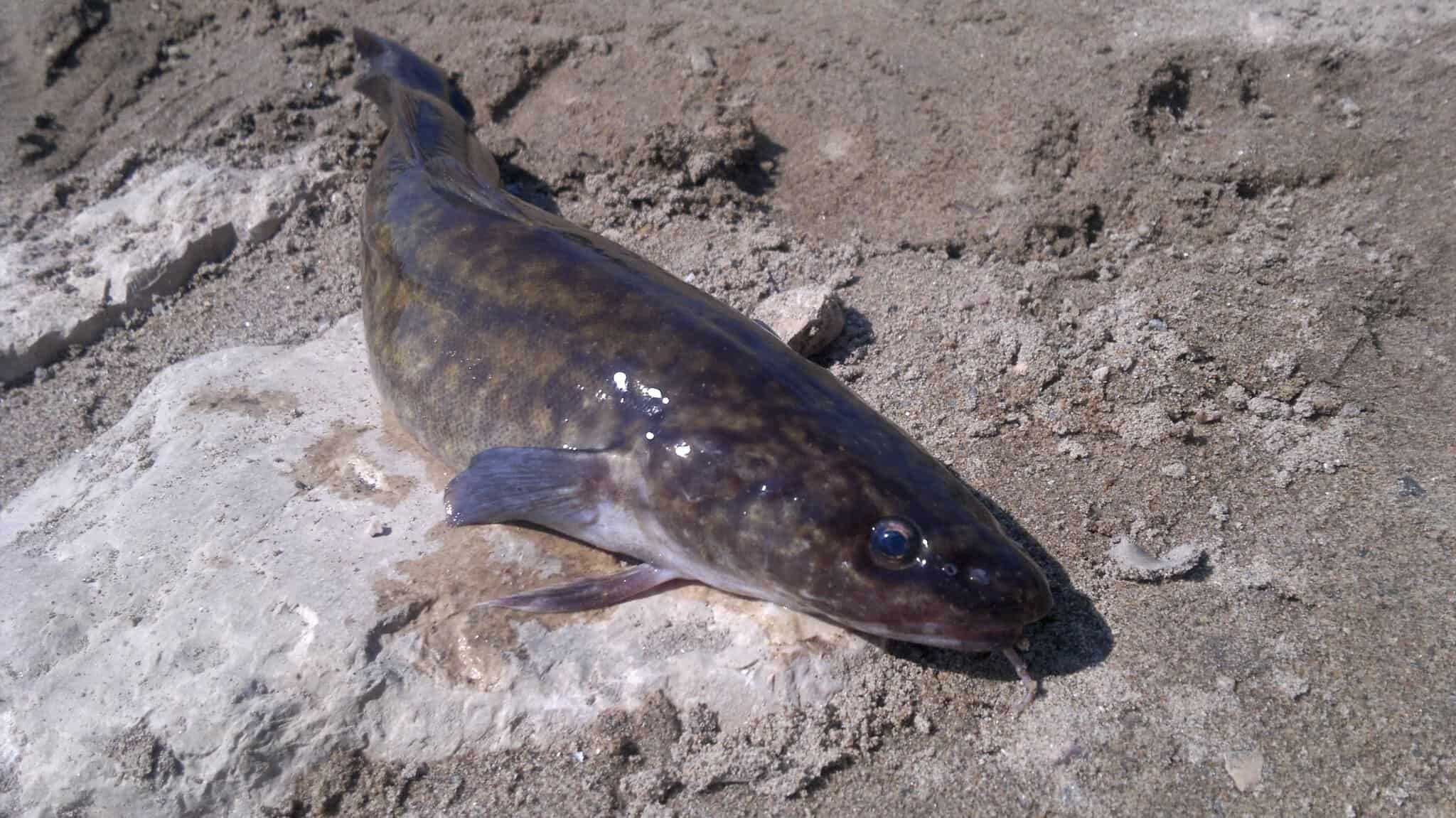
The chin barbel is the shortcut.
Burbot look like somebody crossed a cod with an eel and then made the result slippery. The body is long and mottled brown, olive, gray, yellow or black. The head is broad and flattened. A single obvious barbel hangs under the chin.
That barbel is the easiest separator from the two weird look-alikes that matter most. Bowfin have one long dorsal fin instead of two and no chin barbel. Northern snakehead also have one long dorsal and no chin barbel. Burbot have a short first dorsal followed by a very long second dorsal, plus the long anal fin running toward the tail.
The pelvic fins sit unusually far forward, ahead of the pectoral fins, which is a cod-family trait. The skin looks scaleless but carries tiny embedded scales under a heavy mucus coat.
Regional names don’t help much. Eelpout, lawyer, ling, lingcod, cusk, mudshark, lush, poor man’s lobster and Kootenai leopard can all point at the same fish. The chin barbel is less creative and considerably more useful.
NIGHT IS THE FISHERY
Daylight sends them under things. Darkness gets them moving.
Burbot are about as clearly nocturnal as freshwater fish get. Alaska calls them voracious predators feeding mostly at night. Montana calls them primarily nocturnal. U.S. Fish and Wildlife Service states it plainly: burbot feed at night.
During daylight they use cover and deeper water—boulders, logs, bridge structure, undercut banks and other bottom shelter. After dark they move onto shallower benthic habitat and cruise slopes, flats and shoreline structure.
Idaho’s Kootenai guidance gives a useful local version: shallow flats around 5–15 feet at dusk or night, deeper holes over 40 feet during daylight. That’s one fishery, not a North American depth rule. What travels is the daily movement: deeper or more hidden by day, more willing to come shallow after dark.
Wyoming turns that behavior into practical lure guidance and says bright-glow lures outperform dim ones in its burbot fishery, advising anglers to recharge them every 10–15 minutes. That is unusually specific agency advice and worth keeping as exactly that: a documented Wyoming convention, not a universal commandment.
If you are fishing a burbot lake at noon and wondering why the bottom looks empty, darkness may be the missing variable rather than bait.
BOTTOM FIRST
The chin barbel is down there for a reason.
Adult burbot are benthic predators. They spend much of their time on or near bottom, using rocky slopes, deep holes, gravel bars, tributary mouths, slow river pools and bottom transitions. In lakes, cold deep zones become summer refuge. In rivers, slow water and pools matter more than hard current.
That makes bottom contact the simplest useful presentation check. Idaho advises fishing bait from the bottom and uses the fish’s chin barbel as part of the explanation. Alaska’s set-line systems are weighted specifically to hold bait on the lake or stream bottom.
On a jigging rod, “near bottom” does not mean dragging continuously. Touch, lift, pause, know where the lure is. If the presentation spends the whole drop snagged in rock, you are testing the substrate more thoroughly than the fish.
Tributary confluences deserve special attention in river fisheries because they can combine movement route, spawning substrate and a bottom transition in one place. Idaho specifically calls river junctions prime Kootenai burbot targets during the spawning season.
FRESH BAIT, NOT A SCIENCE PROJECT
The fish eats other fish. Start there.
Adult burbot are strongly piscivorous. Alaska lists whitefish, sculpins, lampreys and other burbot. Minnesota adds perch and walleye. Great Lakes diet work shows prey shifting dramatically when round gobies become abundant.
The Green River invasion gives the predation story an uncomfortable scale: fish appeared in nearly every stomach sampled from larger burbot, and in burbot over 300 mm fish composed most of the stomach contents. Wyoming has documented large burbot eating kokanee up to roughly half their own length.
Agency angling guidance therefore leans heavily on fish-based bait. Alaska lists herring, whitefish, smelt and lamprey in its fisheries; Idaho uses fresh peamouth chub locally and also lists dead shrimp and worms; Wyoming tips glow jigs and spoons with sucker meat or other legal bait.
The word legal belongs in that sentence. Live-bait rules differ sharply among states and waters. Alaska prohibits live bait in the burbot fishery described in its guidance. Other places use different restrictions.
Freshness matters too. Alaska’s advice is direct: use fresh bait and change it often; burbot are predators, not garbage disposals for rotten meat.
Sources: Alaska DFG — burbot ice fishing · Hares, Jonas & Leonard 2015 — Lake Michigan diet
WINTER IS NOT THE OFF-SEASON
This fish gets weird exactly when the lake freezes.
Burbot are winter-active in a way most popular freshwater predators are not. Late autumn cooling brings them out of deep summer refuge and toward shallower bottom habitat. Through winter they become increasingly concentrated around spawning areas.
Alaska describes strong fishing before freeze-up and again from midwinter through break-up. Idaho’s Kootenai fishery builds toward peak spawning from roughly mid-February into March. Wyoming ice anglers target rocky habitat and start at intermediate depths, then adjust.
Do not turn those regional calendars into one national spawn date. Latitude, river versus lake and population matter. The useful seasonal direction is much simpler: cooling increases activity; spawning pulls fish into shallower rocky/gravel water; summer heat sends them away from the bank.
Ice also changes the safety problem. A productive burbot spot does not make ice thickness irrelevant. Use current local ice information, carry the right safety gear and treat moving-water mouths and confluences with extra suspicion because current can weaken ice.
THE SPAWN
A freshwater fish doing this under ice sounds invented.
Burbot spawn in winter, often at water temperatures just above freezing. They move onto shallow sand, gravel or rocky substrate and broadcast eggs rather than building nests.
Multiple agencies describe the spawning aggregation the same way: fish mill together into a large writhing mass. Alaska, U.S. Fish and Wildlife Service, Montana and New York all document group spawning, and no parental care follows.
The sound part is even stranger. U.S. Fish and Wildlife Service notes that burbot vocalize during spawning by rapidly contracting muscles attached to the gas-filled swim bladder. That does not mean an angler can listen through the ice and locate a school. It does mean the spawning event is more socially complicated than a pile of fish accidentally occupying the same gravel bar.
Females carry enormous numbers of tiny eggs, which scatter into the substrate and incubate for weeks in cold water. The species can produce huge numbers of eggs and still have recruitment controlled by habitat, flow and temperature.
SUMMER
The fish does the opposite of the summer shoreline bite.
Warm water is the major seasonal constraint. Review work places useful burbot temperatures broadly around the low-to-mid teens Celsius and reports reduced abundance or feeding as water pushes above roughly 20°C.
Spring warming triggers juvenile movement away from shallow littoral water toward deeper refuge before the hottest part of summer arrives. Adults show the same broad seasonal pattern and can become comparatively quiescent in deep cold water through summer.
This is why the species profile does not need a giant “preferred temperature” card. The fishing relationship is clearer: when surface water warms, burbot retreat to the cold bottom refuge; when autumn cooling reaches down into the water column, they become more mobile and accessible again.
That also means a summer burbot mark on a very deep basin is not automatically a good catch-and-release target. Deep capture can create its own handling and decompression problems in some fisheries, and local agency guidance should decide whether that fish is better left alone.
Sources: Hofmann & Fischer 2002 · Harrison et al. 2016
THE FIGHT IS NOT WHY PEOPLE LOVE THEM
The fish mostly saves its drama for being impossible to hold.
Alaska’s description is refreshingly unromantic: burbot are prized more for delicate white meat than for fighting ability.
That does not mean a large fish cannot pull. It means the species’ reputation is not built around blistering runs or acrobatics. The memorable handling problem is the body itself: heavy mucus, tapering shape and a tail that can wrap around a hand or forearm.
A net and wet hands make the landing easier. Keep hooks controlled because the fish twisting around slippery hands can turn a simple single-hook bait rig into the real hazard.
If the fish is going back, less time wrestling it on the ice or bank is still better even if burbot tolerate cold conditions exceptionally well.
NATIVE HERE, REMOVE-ON-CAPTURE THERE
Kootenai recovery and Green River removal are the same species under opposite management goals.
Burbot are native across northern North America and much of the circumpolar world. In the Kootenai River system of Idaho and British Columbia, dam-related flow changes contributed to a severe decline in a native fluvial population. Recovery has included international cooperation and hatchery support.
The same species was illegally introduced into Wyoming’s Green River drainage, where managers now treat it as an invasive predator. Wyoming documents major impacts on smallmouth bass, crayfish and kokanee and has used liberal harvest, removal derbies and netting to reduce the population.
Reservoir drawdown has even become an incidental control tool in some invaded waters by dewatering spawning habitat.
This is another species where catch-and-release cannot be a generic moral rule. In a recovering native fishery, managers may limit harvest. In an invaded drainage, regulations can require or strongly encourage removal.
Check the water, not the species name alone.
Sources: U.S. Fish & Wildlife Service — Kootenai recovery · Wyoming Game and Fish — Green River invasion
FOOD VALUE
“Poor man’s lobster” has stuck around because the flesh actually is different.
Burbot are repeatedly praised for firm, delicate white meat. U.S. Fish and Wildlife Service compares the flesh with cod; Alaska calls it delicate; Minnesota and Wisconsin sources use the “poor man’s lobster” nickname.
That does not mean one consumption rule travels everywhere. Alaska’s mercury guidance, for example, gives different meal recommendations for burbot meat from different rivers while treating some burbot liver differently again. Long-lived predators can accumulate contaminants according to the food web they live in.
Check the local advisory before keeping fish regularly. The nickname cannot test the water for mercury.
DEEP REFERENCE · THE COLD-WATER NUMBERS
The thermal research is real. It just does not need to sit above the night fishing.
Preferred temperature depends on fish size
Hofmann and Fischer measured final temperature preferences around 11.4°C for smaller burbot and 14.2°C for larger juveniles in their experiment. Other reviews place northern river populations broadly around 10–14°C. Those values help explain seasonal depth movement but are not universal bite temperatures.
How deep can burbot live?
FishBase and North American surveys document an enormous depth range, including records hundreds of meters deep. Summer refuge can therefore be extremely deep in large lakes. Most anglers will meet burbot much shallower during winter movement and spawning, so the extreme-depth number is trivia more than a plan.
When exactly do they spawn?
Agency calendars vary from December into March depending on river, lake and latitude. Temperatures cluster near freezing. The stable relationship is midwinter cold + shallow sand/gravel/rock + aggregation, not a single calendar week.
How old and how big?
FishBase carries a 20-year age record and a 60-inch maximum length. Fished populations described by agencies are usually far smaller. Those extremes are real and help almost nothing with finding or catching one.
What this profile deliberately does not claim
No reliable source in the original research established universal burbot responses to barometric pressure, wind, cloud cover, angling pressure or one exact dissolved-oxygen threshold. Darkness, bottom position, cold water and seasonal migration are supported much more directly.
Most people picture a burbot angler standing over the deepest hole on the lake. Idaho’s own Kootenai numbers argue the opposite — fish sit past 40 feet by day and move up into 5 to 15 feet after dark. Depth isn’t the variable worth chasing. Darkness is.
The night-and-cold-and-shallow-rock combination is the part I would plan the whole trip around, because it inverts almost everything else I know about reading a lake. When a burbot night feels like it is going badly, the honest check is whether I fished the hours the fish is awake for, or only the hours I am.
SOURCES
FEEDING ECOLOGY · STANDARDIZED
How this fish gets fed.
Winter spawning temperature is kept distinct from feeding activity even though the two seasons overlap.
The source shelf.
- Alaska Department of Fish and Game — Burbot
- Alaska DFG — Burbot Ice Fishing
- New York DEC — Burbot Species Status Assessment
- Massachusetts Division of Fisheries and Wildlife — Burbot
- Iowa DNR — Burbot
- Minnesota DNR — Burbot
- U.S. Fish & Wildlife Service — Burbot, the Singsong Gadoid
- Idaho Fish and Game — Kootenai Burbot
- Idaho Fish and Game — Spawning-season Burbot Fishing
- Wyoming Game and Fish — Burbot Fishing
- Wyoming Game and Fish — Burbot Removal
- Hofmann & Fischer 2002 — temperature and seasonal movement
- Harrison et al. 2016 — Burbot and hydropower review
- Hares, Jonas & Leonard 2015 — Lake Michigan diet shift
- McBaine et al. 2018 — Green River diet
Profile reviewed 2026-09-02. Burbot bait, set-line, ice-fishing, harvest and invasive-removal rules vary sharply by jurisdiction. Check the current managing agency for the exact water before the trip.