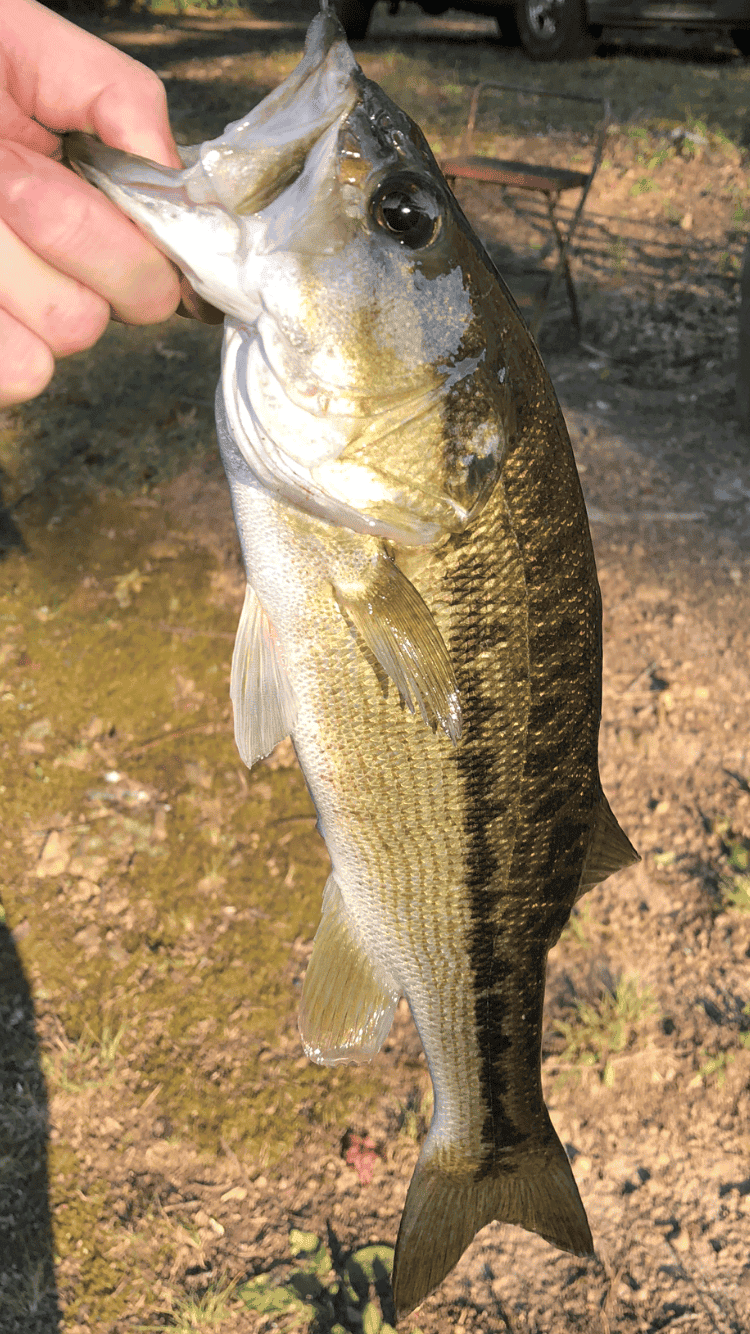
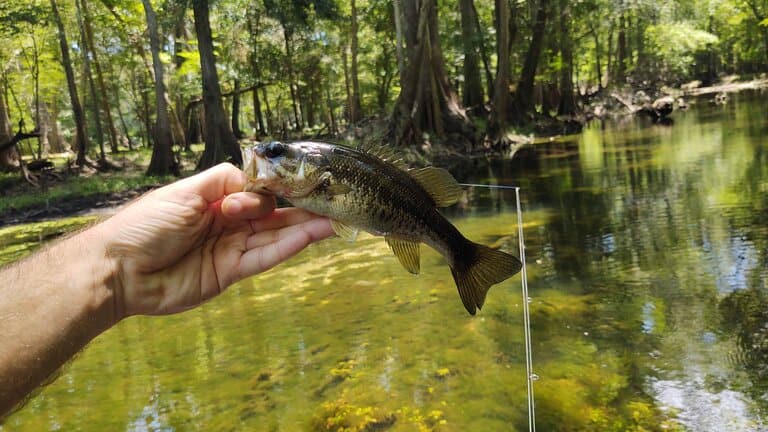
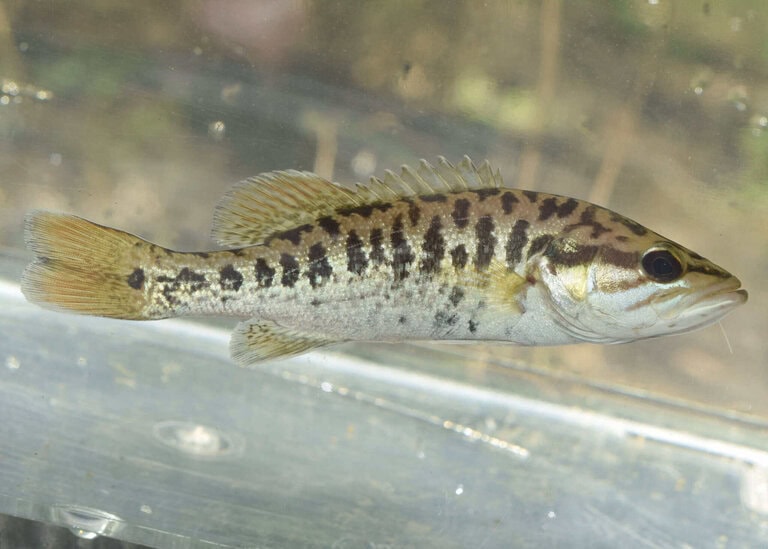
Alabama bass (Micropterus henshalli) are native to the Mobile River basin and a hybridizing problem in the states where people have moved them. They look so much like spotted bass that genetics, not your eyes, often makes the call.
In the Mobile River basin of Alabama, Georgia and Mississippi, an Alabama bass is just a native black bass minding its own business. Carry one into another drainage and it turns into a management headache, because Micropterus henshalli hybridizes with spotted bass and other black bass — it can change a native fishery’s genetics, not just crowd it. That’s most of why people outside Alabama know the name at all, and the useful part of the story lives in agency records more than in anybody’s fishing photos.
At a glance · The short version
Scientific name
Micropterus henshalli
Native range
Mobile River basin in Alabama, Georgia, and Mississippi.
Identification problem
Extremely similar to spotted bass; hybrids can make confident field identification unreliable.
Habitat
Warm rivers, streams, and reservoirs with rock, current, and deeper structure.
Management risk
Outside the native basin, hybridization and displacement of native black bass are major concerns.
Evidence rule
Do not infer genetic identity from one visible trait when Alabama, spotted, and hybrid fish overlap.
What fish is this?
Identification
Taxonomy
Alabama bass is recognized as a distinct species, Micropterus henshalli, rather than a local form of spotted bass. Older fishing material may still use spotted bass loosely for fish that current taxonomy separates.
The fish can resemble spotted bass closely: a dark lateral pattern, rows of spots below the midline, and a jaw that does not project far behind the eye. Georgia’s field guide treats Alabama and spotted bass together for practical identification because the resemblance is so strong.
Where Alabama bass have been introduced and hybridization is occurring, managers increasingly use genetic testing. A fish can look like a spotted bass, an Alabama bass, or something between them and still not be genetically pure. That makes photographs useful evidence but not a final answer in a conservation dispute.
The native range is the Mobile River basin in Alabama, Georgia, and Mississippi. That distinction matters because an Alabama bass inside its native basin and one moved into another drainage are the same species in completely different management contexts.
Agency descriptions of Alabama/spotted-bass habitat repeatedly center on rocky rivers, streams, reservoirs, current breaks, and deeper structure. That puts the first search closer to a river-oriented spotted-bass problem than a vegetation-heavy largemouth problem.
Alabama bass have been moved outside their native drainage, sometimes illegally. Kentucky, Tennessee, North Carolina, and other states have issued management warnings because introduced fish can spread through connected reservoirs and river systems once established.
Why does this fish matter so much outside Alabama?
Hybridization & Invasive Risk
Hybridization
Alabama bass can hybridize with spotted bass and other black bass. The conservation problem is not limited to adding another predator. Introgression can make the native population less genetically distinct over successive generations.
In May 2026 Kentucky announced that two fish collected at Lake Linville in fall 2024, first called spotted bass, came back from genetic testing as Alabama Bass × Spotted Bass hybrids, and it expanded testing on the lake’s bass. That is a current example of why a fish that looks like a routine spotted bass can become a management issue only after genetics reveal what is happening.
Moving live black bass between waters is not a harmless stocking shortcut. Where Alabama bass are nonnative, one illegal transfer can create a self-reproducing population with consequences that extend beyond the original lake.
How would I read the water?
Field Decisions
Evidence level. The habitat and management fields above are sourced. The positioning and presentation notes below translate that ecology into a starting fishing plan and should stay marked as field inference until a fuller species-specific angling-source pass is complete.
First water to checkinference
Rock beside moving water, deeper current breaks, channel swings, bridge riprap, and hard-bottom transitions are more defensible starting points than featureless slack water. In reservoirs, follow the same logic toward rocky points, channel-related structure, and depth.
Presentationinference
Start with a crayfish or baitfish profile that can maintain bottom or mid-depth contact around rock. Change depth and current position before assuming the species requires a completely different lure family from spotted bass.
Identification at the boat
Take clear side photographs if identification matters, note the exact waterbody, and check the local agency’s Alabama-bass guidance. Do not use a rough tongue patch or one stripe pattern as proof of genetic identity.
What the measurements add
Spawning, Diet & Identification Evidence
Spawning window and temperature
The American Fisheries Society species account reports successful Alabama Bass spawning beginning in April in Mobile-basin reservoirs. Back-calculated swim-up dates show the earliest recruitment when water temperatures were about 13-16 C, with hatching peaking around 20-23 C. The same synthesis reports a viable spawning period of roughly 22-45 days and fecundity estimates of about 1,500-7,200 eggs.
Alabama Bass are piscivorous in some waters, with shad important prey, but Lewis Smith Lake data show how strongly the answer can shift with habitat and prey supply: crayfish made up about 75% of diet by weight, shad about 14%, and sunfish/crappie about 9%. That is a useful warning against turning one reservoir’s forage base into a species-wide lure prescription.
The AFS synthesis and the original species diagnosis both emphasize combinations of characters rather than one shortcut. Alabama Bass generally have higher scale and gill-raker counts than Spotted Bass, a narrower head, and a smaller tooth patch. For photographs, the dorsolateral blotches and the way the lateral stripe breaks into blotches toward the caudal peduncle are more useful than a tongue patch alone. Hybrids still defeat a confident visual call.
Current Tennessee and North Carolina guidance treats introduced Alabama Bass as a serious threat to native black-bass fisheries because of competition, rapid population expansion, and hybridization. North Carolina’s distribution map expanded again in 2025, and Tennessee documents hybridization with Smallmouth Bass in multiple reservoirs. The management instruction is simple even where harvest rules differ: never move live Alabama Bass or lookalike black bass between waters.
age, growth, and longevity from primary fisheries literature
measured diet proportions by life stage
temperature, dissolved-oxygen, and turbidity tolerances
catch-and-release handling evidence
— · Sources
FEEDING ECOLOGY · STANDARDIZED
How this fish gets fed.
Primary prey
Fishes and crayfish are major prey, with aquatic invertebrates also important. The profile’s Lewis Smith Lake example found a strongly crayfish-heavy diet, while other waters can be much more shad-oriented.
Feeding mode / location
A black-bass predator using rocky rivers, reservoirs, current breaks, channel structure and deeper hard-bottom habitat. Productive feeding positions combine prey with structure or reduced-current holding water.
Diel / seasonal pattern
Not established as one universal species-wide feeding clock in this profile. Seasonal spawning movement, current, temperature, prey and reservoir/river structure provide stronger context.
Ontogenetic diet shift
Not established with enough Alabama-Bass-specific life-stage diet evidence in this profile’s cited source set to state a fixed sequence.
One reservoir’s 75% crayfish-by-weight result is kept as local evidence, not converted into a species-wide prey percentage.
Compiled 2026-09-11. Limits and advisories are set per water and per state and change between seasons — the managing agency for wherever you are fishing has the current answer.
Alabama bass aren’t spotted bass with a different state name, and the fish won’t settle that argument for you at the boat. Take the side photo, write down which water it came from, and let the agency’s genetics handle the part your eyes can’t. The physiology and handling questions above stay blank instead of borrowing numbers from some other black bass.
Calling a hybrid wrong at the boat isn’t a skill problem; people counting gill rakers and tooth patches still send fish to a lab. The part anybody can get exactly right is simpler: a bass you caught never rides in a bucket to some other lake.
River FishRiver-fish species profiles covering habitat, behavior, seasonal movement, fishing approaches, conservation status, and regional variation across the United States.49 articles
Species & BehaviorFish behavior, habitat, depth, forage relationships, and species-specific field decisions. Start with the Freshwater Fish Species field guide.159 articles
Cookie Consent
We use cookies to improve your experience on our site. By using our site, you consent to cookies.
Contains information related to marketing campaigns of the user. These are shared with Google AdWords / Google Ads when the Google Ads and Google Analytics accounts are linked together.
90 days
__utma
ID used to identify users and sessions
2 years after last activity
__utmt
Used to monitor number of Google Analytics server requests
10 minutes
__utmb
Used to distinguish new sessions and visits. This cookie is set when the GA.js javascript library is loaded and there is no existing __utmb cookie. The cookie is updated every time data is sent to the Google Analytics server.
30 minutes after last activity
__utmc
Used only with old Urchin versions of Google Analytics and not with GA.js. Was used to distinguish between new sessions and visits at the end of a session.
End of session (browser)
__utmz
Contains information about the traffic source or campaign that directed user to the website. The cookie is set when the GA.js javascript is loaded and updated when data is sent to the Google Anaytics server
6 months after last activity
__utmv
Contains custom information set by the web developer via the _setCustomVar method in Google Analytics. This cookie is updated every time new data is sent to the Google Analytics server.
2 years after last activity
__utmx
Used to determine whether a user is included in an A / B or Multivariate test.
18 months
_ga
ID used to identify users
2 years
_gali
Used by Google Analytics to determine which links on a page are being clicked
30 seconds
_ga_
ID used to identify users
2 years
_gid
ID used to identify users for 24 hours after last activity
24 hours
_gat
Used to monitor number of Google Analytics server requests when using Google Tag Manager
1 minute
Jetpack's built-in visitor analytics. It records page views, referring sites, search terms, and outbound link clicks, and also carries the shared visitor-tracking library used by Jetpack Instant Search and WooCommerce Analytics.