Bowfin Turned Out to Be Two Fish, and Neither Is a Snakehead
Bowfin roll up to gulp air in warm, weedy water most predators can’t use. They’re also now two native species, ruddy and emerald, so where a fish or a study came from decides which one you’re talking about.
By HunterUpdated September 19, 2026Read 10 min
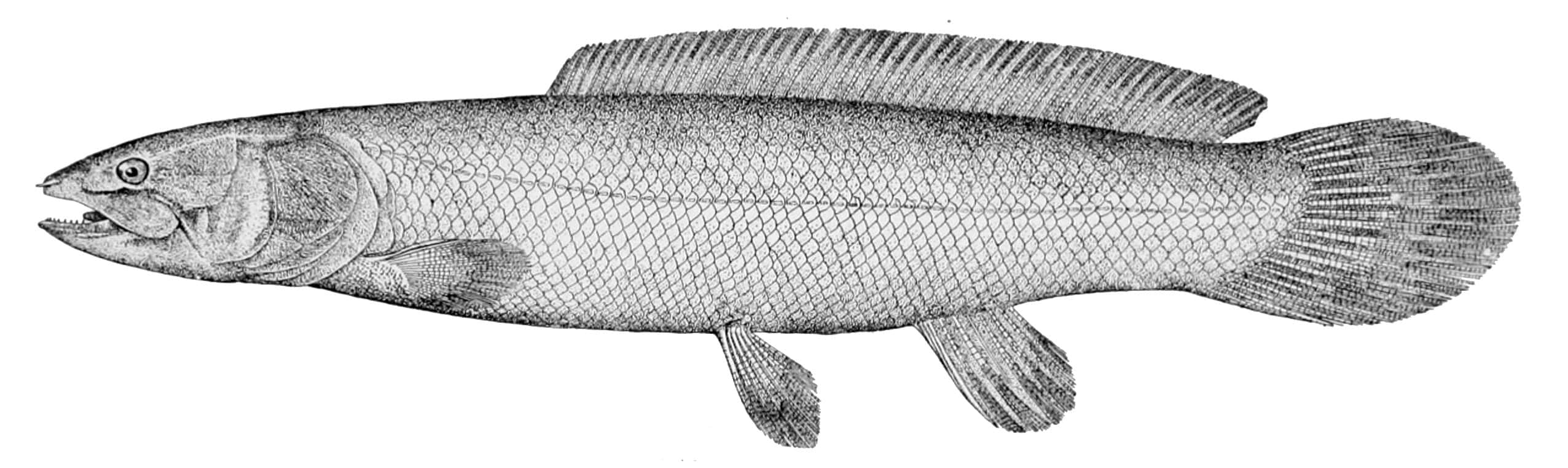
Bowfin (Amia calva) drawn in strict lateral view, the undulating dorsal fin running almost the whole length of the back into a rounded tail. Illustration: Edgar Ravenswood Waite / Records of the Australian Museum, public domain.
A glassy slough that looks empty usually isn’t. Give it a few minutes and a bowfin may roll at the surface to refill the air in its gas bladder, then sink back into weeds that would look close to unfishable if you were judging the water by bass standards. The bigger surprise is on paper: the fish North American anglers called one species for more than a century is now recognized as at least two. The old catch-all name Amia calva no longer covers every bowfin from the Great Lakes to the Gulf, which changes identification, range, conservation, and whether the fish in an older paper is even the same species as the one in front of you.
Atlantic-slope and southeastern Gulf populations centered from Virginia through Florida and parts of Georgia, Alabama, Mississippi, and eastern Louisiana.
Emerald Bowfin range
Great Lakes, St. Lawrence, Mississippi and Ohio basins, with range extending southwest toward Gulf-draining rivers in eastern Texas.
Habitat
Warm, slow, vegetated backwaters, swamps, oxbows, ditches, floodplain lakes, and sluggish stream pools; swift current is generally avoided.
Signature adaptation
A vascularized gas bladder functions in air breathing, letting bowfins exploit warm, low-oxygen water unavailable to many predators.
Spawning
Spring; males build shallow vegetated nests, guard eggs, and then lead and defend schools of fry.
The taxonomy changed
Two Bowfins, Not One
What happened in 2022
Genomic studies independently recovered deep structure inside the old one-species bowfin concept. Current North American fish nomenclature recognizes Amia ocellicauda as a valid species alongside A. calva. ITIS and the 2023 American Fisheries Society names list now reflect two living bowfin species.
Amia calva is now the ruddy bowfin in many modern references, associated with Atlantic Coast drainages from Virginia south through Florida and portions of the southeastern Gulf region. NatureServe uses the 2023 AFS treatment and explicitly notes that A. ocellicauda was formerly synonymized with it.
Amia ocellicauda covers the Great Lakes and much of the Mississippi/Ohio drainage complex west of the Appalachians. Missouri now calls its native fish Emerald Bowfin and has updated agency identification and regulation pages accordingly.
A paper published under the name A. calva before the split may actually describe emerald bowfin, ruddy bowfin, or a mixture of populations. Geographic provenance now matters as much as the scientific name printed on the paper.
Where the biology is shared, the two get treated together below. Where a source is specific to one species, it’s labeled that way.
Not a snakehead
Identification
Long dorsal fin
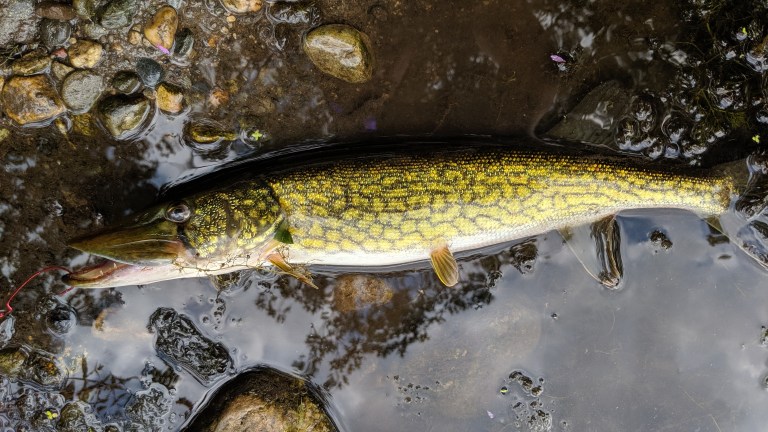
Bowfins have an extremely long dorsal fin running over more than half the back, a rounded tail, no fin spines, a scaleless head, and a small barbel-like flap at each nostril.
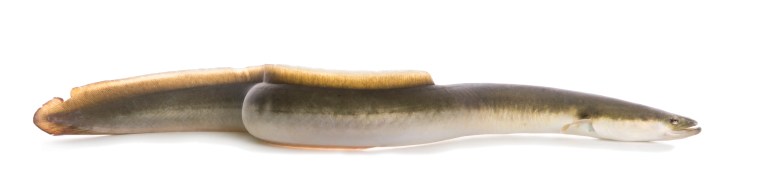
Invasive snakeheads can look similar and also tolerate low oxygen, but snakeheads carry a long extended anal fin and pelvic fins positioned much farther forward near the pectoral fins and gills. Bowfins have a much shorter anal fin. Do not kill a native bowfin because the body looked snake-like from three feet away.
Missouri describes emerald bowfin as greener, especially breeding males, with a stronger caudal eyespot, while ruddy bowfin are more reddish-brown and generally show a weaker eyespot. Research also finds differences in dentary-tooth count and the interopercle bone, but those are not simple boat-side traits.
Drainage is part of identification because the two species are largely allopatric. Where range boundaries or introductions complicate the picture, photographs and color are not equivalent to a genetic or meristic identification.
Why the surface roll matters
Air Breathing & Habitat
Gas bladder as a lung
Bowfins can use the gas bladder for aerial respiration. Florida Museum notes air breathing is minimal in cold water and increases as water warms, becoming especially active through roughly 18–30 C. The behavioral point is stronger than any one threshold: a summer backwater can remain usable after dissolved oxygen has pushed many other predators out.
Backwaters, oxbows, swamps, marshes, ditches, flooded vegetation, and sluggish stream pools are characteristic habitat. Missouri notes emerald bowfin usually avoid swift current and excessively turbid water and occur more often in Mississippi River backwaters and oxbows than in the main channel.
Missouri describes fish hiding in deeper water by day and moving shallower to feed at night. That is a useful working pattern in a weedy backwater because visible shoreline cover may become much more important after light drops.
A bowfin surfacing for air gives away a neighborhood, not an address. Note the cover around the roll and let the water settle instead of pounding the surface ring. The fish may already have dropped back into the lane it was using.
What does it eat?
Predation
Adults
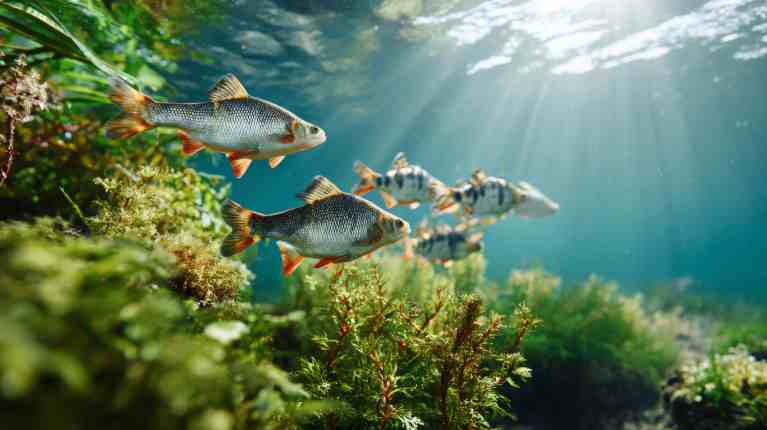
Fish and crayfish dominate many bowfin diets, with insects, worms, frogs, and other amphibious prey also taken. Missouri lists gizzard shad, golden shiners, bullheads, and sunfish among common emerald-bowfin prey.
Bowfins have long been persecuted as competitors or destroyers of preferred sport fish. Missouri states that research has not supported the old idea that bowfins inherently damage sport-fish populations; they are native predators functioning inside native food webs.
Missouri reports spawning from April into early June for emerald bowfin. Florida Museum gives April–June for southeastern bowfin and reports nesting around 16–19 C in its older species account. Because that Florida account predates the split, those precise values should stay attached to southeastern A. calva rather than being generalized automatically to emerald bowfin.
After hatch, fry form a tight school with the male. He continues guarding them until the young reach roughly four inches and the school breaks apart. That prolonged parental care is one of the most distinctive pieces of bowfin life history.
The adaptation changes the map. Low oxygen does not automatically empty a backwater of predators. If bowfin are present, surface rolls, vegetation openings, wood, and the edge between deep refuge and shallow feeding cover become much more useful than a generic oxygen rule.
First water to checkinference
Look for a lane through thick vegetation, a stump beside slightly deeper water, a ditch entering a flooded flat, the edge of an oxbow drop, or the immediate cover around repeated surface rolls. The fish needs ambush cover but still needs room to turn and intercept prey.
Lure categoriesconvention
Live minnows and cut bait work where legal, while jigs, spinnerbaits, vibrating jigs, weedless plastics, crankbaits, and topwater can all fit active predators in cover. A slow weedless presentation or vibrating jig through the lane can stay available to a fish longer than a bait rushed over the cover.
Tackle tradeoffconvention
Heavy braid and a stout rod can help control a fish around weeds and wood, but that same setup can make a soft following bite harder to read. Let the fish load the rod before reacting to a tentative bump.
Fightconvention
Bowfin are powerful, flexible fish and can roll or surge near the boat or bank. Keep fingers clear of the mouth and have pliers ready.
Conservation is changing with the taxonomy
Native Fish, New Management Questions
Do not kill it as a snakehead
Bowfins are native North American fishes. In waters invaded by snakeheads, misidentification can turn public concern about an invasive species into unnecessary killing of a native predator. Confirm the anal fin, pelvic-fin position, and local identification guide.
Bowfin roe has become more commercially valuable as alternative caviar. Missouri warns that targeting gravid females just before spawning can remove a disproportionate amount of annual reproductive capacity and that states may need more protective management.
The 2022 genomic work found at least two independently evolving species and suggested additional lineages may deserve recognition with more sampling. Conservation status based on the old continent-wide single-species concept can therefore hide local vulnerability.
Cooling reduces the low-oxygen advantage but fish continue feeding.
Persistent cover, prey concentration, and the transition from shallow nighttime feeding to deeper holding water.
— · Where sources disagree or lag
Still unsettled
Which species is an old study actually about?
Older literature usually calls every bowfin A. calva. We now need the collection location before importing a temperature, growth, diet, or behavior value into either ruddy or emerald bowfin.
Are there more than two?
The first genomic analyses supported at least two species and recovered additional geographic structure. Current names recognize two, but future taxonomic work may split more lineages.
— · What we are not filling with guesses
Nobody has settled this one
a single temperature-preference range shared by both species
a universal dissolved-oxygen minimum
one nationwide spawning temperature
a universal depth by season
a field-perfect visual rule for separating every ruddy and emerald bowfin
— · Sources
FEEDING · AMBUSH IN THE SLOUGH
It waits in weedy backwater for fish and crayfish. It breathes air and survives water nothing else wants, which is not the same as that water being worth fishing.
What it eats
Fishes, crayfish, aquatic insects, and other available animal prey. Older bowfin literature often pooled populations now recognized as more than one living Amia species, so locality matters when importing detailed diet values.
How and where it hunts
An ambush predator of vegetated sloughs, backwaters, floodplain lakes, and slow margins. Bowfin can use extremely low-oxygen water because they breathe air, but that tolerance does not mean every stagnant pocket is equally productive feeding habitat.
When it feeds
Low-light and nocturnal activity are commonly reported in bowfin literature, but the profile keeps the newer taxonomic split visible rather than treating every historical behavior study as automatically applicable to every Amia population. Spring nesting activity is reproductive behavior.
What changes as it grows
Older bowfin literature describes young fish beginning on zooplankton and small invertebrates, then shifting toward crayfish and fishes. Exact species assignment should be checked against collection locality under the current taxonomy.
The taxonomy caveat stays attached to older feeding studies rather than being hidden by a single species-wide number.
Missouri Department of Conservation — current emerald-bowfin taxonomy, range, identification, habitat, diet, life cycle, and conservation context.
NatureServe Explorer — current ruddy-bowfin treatment referencing the 2023 AFS names list.
Florida Museum of Natural History — southeastern bowfin physiology, reproduction, and historical life-history reference; interpreted cautiously because the page retains the older broad species framework.
Compiled 2026-09-11. Limits and advisories are set per water and per state and change between seasons — the managing agency for wherever you are fishing has the current answer.
One roll turns a dead-looking slough into occupied water. What it doesn’t tell you is which bowfin you’re looking at, and that part takes the drainage plus a quick check of whether the study you’re leaning on was written before or after the split.
The mistake that actually costs a bowfin its life is the snakehead call, and it’s an easy one to make when a long, snaky fish comes thrashing out of the weeds at you. Nobody’s born knowing fin positions. Look at the anal fin before anybody reaches for a knife. Most of the fish in River Fish of the United States need moving, oxygenated water to make a living; this one gulps air in a warm backwater and does fine.
FIELD OBJECT
This one should leave the page.
The article is the long version. These are the pieces worth carrying into the next trip.
The 30-second version
Bowfin roll up to gulp air in warm, weedy water most predators can’t use. They’re also now two native species, ruddy and emerald, so where a fish or a study came from decides which one you’re talking about.
What to watch
Two Bowfins, Not One
Identification
Air Breathing & Habitat
Predation
Field card
a single temperature-preference range shared by both species
a universal dissolved-oxygen minimum
one nationwide spawning temperature
a universal depth by season
a field-perfect visual rule for separating every ruddy and emerald bowfin
RIGHT TOOL, NEXT
Species & Presentation
Carry the species behavior and presentation question into a narrower water-to-fish-to-presentation handoff.
We use necessary cookies to operate the site. With your choice, we may also use analytics and advertising cookies. Choose Accept All, Reject, or Preferences.
Contains information related to marketing campaigns of the user. These are shared with Google AdWords / Google Ads when the Google Ads and Google Analytics accounts are linked together.
90 days
__utma
ID used to identify users and sessions
2 years after last activity
__utmt
Used to monitor number of Google Analytics server requests
10 minutes
__utmb
Used to distinguish new sessions and visits. This cookie is set when the GA.js javascript library is loaded and there is no existing __utmb cookie. The cookie is updated every time data is sent to the Google Analytics server.
30 minutes after last activity
__utmc
Used only with old Urchin versions of Google Analytics and not with GA.js. Was used to distinguish between new sessions and visits at the end of a session.
End of session (browser)
__utmz
Contains information about the traffic source or campaign that directed user to the website. The cookie is set when the GA.js javascript is loaded and updated when data is sent to the Google Anaytics server
6 months after last activity
__utmv
Contains custom information set by the web developer via the _setCustomVar method in Google Analytics. This cookie is updated every time new data is sent to the Google Analytics server.
2 years after last activity
__utmx
Used to determine whether a user is included in an A / B or Multivariate test.
18 months
_ga
ID used to identify users
2 years
_gali
Used by Google Analytics to determine which links on a page are being clicked
30 seconds
_ga_
ID used to identify users
2 years
_gid
ID used to identify users for 24 hours after last activity
24 hours
_gat
Used to monitor number of Google Analytics server requests when using Google Tag Manager
1 minute
Jetpack's built-in visitor analytics. It records page views, referring sites, search terms, and outbound link clicks, and also carries the shared visitor-tracking library used by Jetpack Instant Search and WooCommerce Analytics.