Black drum search the bottom with chin barbels and crush shellfish with teeth in the throat, and some live about 60 years. Put the bait where that chin is working, not a few feet above it.
By HunterUpdated September 19, 2026Read 7 min
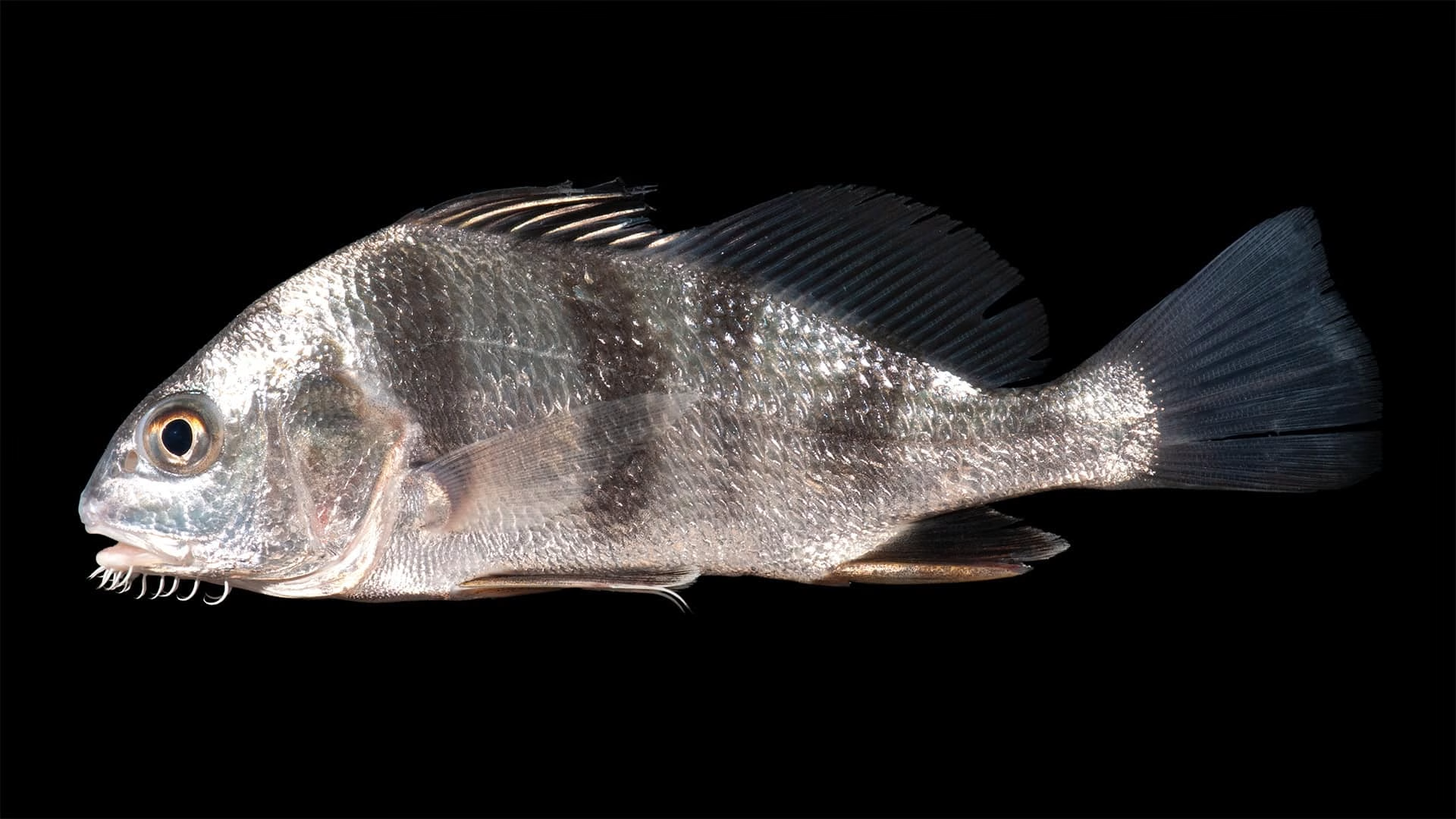
Black Drum (Pogonias cromis), Rhode River, Maryland. Smithsonian Environmental Research Center / Robert Aguilar, CC BY 2.0.
A black drum isn’t a red drum with the spots rubbed off, and the chin is where that shows first.Pogonias cromis has a different mouth, a different way of feeding and a much longer life. Short barbels under the chin search the bottom, crushing teeth farther back break shellfish, and some Atlantic fish live about 60 years and top 100 pounds. Most of the useful fishing questions — where to look, how close to the bottom a bait needs to sit — come back to that chin.
At a glance · The short version
Scientific name
Pogonias cromis
Best ID clues
Blunt low mouth, multiple chin barbels, high arched back; juveniles often show 4–6 dark vertical bars.
Feeding hardware
Barbels locate prey; pharyngeal crushing teeth process oysters, mussels, crabs and other hard-bottom food.
Life history
Can exceed 46 in and 120 lb, live about 60 years, and grow rapidly until roughly age 15 before growth slows.
Spawning
Winter/early spring in the south, later farther north; approximately Nov–Apr south and Apr–Jun north in ASMFC’s Atlantic synthesis.
The chin settles the Red Drum question
Identification
Barbels
Black Drum carry multiple short barbels under the chin. Those sensory structures are absent on Red Drum and are one of the fastest reliable field characters when the fish is muddy, dark or too large for juvenile striping to help.
Young Black Drum commonly show four to six dark vertical bars. That can create confusion with Sheepshead, but the mouth solves it: Black Drum have chin barbels and a low downturned mouth; Sheepshead have prominent incisor-like front teeth and no chin barbels.
Adults become deep-bodied with a high arched back and thick shoulders. The body can range from silvery-gray to very dark bronze/black. Color is less reliable than barbels, body shape and mouth position.
Size changes the entire fishery
ASMFC reports fish over 46 inches and 120 pounds. A two-pound drum in a creek and a 70-pound winter spawner are the same species but not the same tackle, handling or harvest decision.
Black Drum produce low-frequency drumming by contracting specialized sonic muscles associated with the swim bladder. The sound is especially associated with reproductive behavior and spawning aggregations. It does not come from the mouth.
Useful evidence, not feeding proof
If underwater sound or vibration suggests drumming, it can indicate drum are present and socially active. It does not prove they are feeding at that moment. Treat sound as a presence/spawning clue, then let bottom marks, bait response and current determine the fishing decision.
Estuary fish first, giant coastal fish later
Range & Habitat
Atlantic range
ASMFC describes Black Drum in nearshore Atlantic waters from the Gulf of Maine to Florida, with the species continuing south to Argentina.
Young Black Drum use estuaries, bays, marsh edges, river mouths and shallow soft-bottom habitat where small invertebrates are abundant. The nursery map is more protected and inshore than the large-adult/spawning map.
Adults broaden the habitat
Larger fish use deeper channels, shell bottom, bridges, jetties, nearshore structure and offshore spawning areas. The common denominator is often bottom prey and travel access rather than one fixed type of structure.
Atlantic migration
ASMFC describes Atlantic coast Black Drum moving north and inshore in spring and south in fall. That pattern helps explain why very large fish can appear predictably in specific bays and coastal corridors during limited seasonal windows.
ASMFC lists copepods, annelids, amphipods, other invertebrates and small fish in young Black Drum diets. Juveniles do not begin life crushing the same prey as a giant adult.
Large Black Drum are heavily benthic feeders. Oysters, mussels, crabs, shrimp and other bottom organisms fit the barbels-plus-pharyngeal-teeth design: locate prey at the substrate, pick it up with the mouth, crush the hard parts farther back.
Bottom contact matters
A natural bait held several feet above a shell bed may be technically in the same water but outside the fish’s normal search lane. The more useful presentation question is whether the bait is moving with the current close enough to bottom for a drum searching by smell, touch and pressure to encounter it.
Spawning is late enough in life to make giant fish valuable
Age, Growth & Reproduction
Longevity
ASMFC reports Black Drum to about 60 years. Growth is relatively rapid until around age 15, then slows. A very large adult therefore represents a long accumulation of survival, not merely one unusually productive summer.
ASMFC’s Atlantic synthesis places spawning in winter and early spring, occurring earlier in southern waters—roughly November through April—and later farther north, roughly April through June. That range should replace one coastwide spawning date.
ASMFC gives a striking example: an average-sized 13.4-pound female may produce about 32 million eggs in a year. That is not a universal egg count for every female; it is a useful scale reference for how reproductive output can rise with size.
Large successful year classes appear sporadically rather than evenly every year. A fishery can therefore contain many adults from a few strong recruitment events and then go years without equivalent replacement. That is another reason current abundance should not be read from one hot season.
Honest label. Black drum aren’t a fish I’ve targeted, so treat these four rows as reasoning from the habitat, diet and seasonal movement above. Worth testing, not proven.
Search shell and channel edgesinference
Oyster/mussel beds, bridge channels, channel bends, cuts beside flats, jetties and deeper holes are defensible starting points because they combine bottom food with movement corridors.
Weight is current-specificinference
Use enough weight to keep the bait in the bottom lane without pinning it so rigidly that current cannot carry scent or movement naturally. The right sinker is a function of depth, current and line diameter, not a Black Drum number.
Let the fish load the rodinference
A large drum can mouth or crush bottom prey before moving off. A circle-hook system works best when the fish is allowed to load steady pressure rather than receiving a violent hookset designed for a moving lure. Follow the hook manufacturer’s and jurisdiction’s current rules.
Scale tackle to the actual size classinference
The same species ranges from small estuary fish to hundred-pound adults. Gear that is perfectly balanced for school-sized drum is not automatically responsible for a large spawning aggregation if fight time becomes excessive.
A giant drum is mostly a release decision
Handling & Food Value
Support the body
Very large Black Drum are heavy enough that one-handed jaw suspension is a poor handling plan. If a legal fish is released, keep it supported horizontally, minimize air exposure and prepare the camera before the fish is lifted.
Consumption
Food quality is subjective and varies with fish size and handling. Large old drum can be coarse and can accumulate contaminants depending on location. Check current state consumption advisories before keeping fish from industrial estuaries or waters with specific advisories.
Not established here
Where this stops short
that drumming means active feeding
one best bait independent of local shellfish and current
that a 120-pound fish is typical rather than an extreme
that every large legal drum should be harvested
— · Sources
FEEDING · CHIN BARBELS, THEN TEETH
The barbels find the crab and the throat teeth deal with the shell. Older drum get a lot better at the second half of that.
What it eats
Crabs, shrimp, worms, oysters, clams, and other benthic invertebrates dominate, with some fishes taken by larger Black Drum.
How and where it hunts
A bottom-oriented tactile and chemical forager that uses chin barbels to locate prey over mud, sand, shell, oyster, channels, and structure. Strong pharyngeal teeth let larger drum crush hard-shelled prey.
When it feeds
Tide, current, and prey access are stronger than a universal clock. Seasonal movement shifts fish among estuaries, passes, bays, surf, and spawning areas; the profile does not establish one species-wide diel feeding window.
What changes as it grows
Young Black Drum emphasize small crustaceans and soft-bodied benthic prey. As jaws and pharyngeal teeth develop, larger fish exploit more crabs, oysters, clams, and other hard-shelled prey.
Bottom type and prey access carry more feeding evidence than body color or a generic tide label.
Compiled 2026-09-11. Limits and advisories are set per water and per state and change between seasons — the managing agency for wherever you are fishing has the current answer.
The drumming gets this fish its name, and it can tell you drum are around. Where to put the bait is a question for the chin.
FIELD OBJECT
This one should leave the page.
The article is the long version. These are the pieces worth carrying into the next trip.
The 30-second version
Black drum search the bottom with chin barbels and crush shellfish with teeth in the throat, and some live about 60 years. Put the bait where that chin is working, not a few feet above it.
What to watch
Identification
Drumming
Range & Habitat
Diet & Bottom Feeding
Field card
that drumming means active feeding
one best bait independent of local shellfish and current
that a 120-pound fish is typical rather than an extreme
that every large legal drum should be harvested
Atlantic States Marine Fisheries Commission — Black Drum — range, migration, life history, fecundity, recruitment, fishery scale, accepted stock status and management.
RIGHT TOOL, NEXT
Species & Presentation
Carry the species behavior and presentation question into a narrower water-to-fish-to-presentation handoff.
We use necessary cookies to operate the site. With your choice, we may also use analytics and advertising cookies. Choose Accept All, Reject, or Preferences.
Contains information related to marketing campaigns of the user. These are shared with Google AdWords / Google Ads when the Google Ads and Google Analytics accounts are linked together.
90 days
__utma
ID used to identify users and sessions
2 years after last activity
__utmt
Used to monitor number of Google Analytics server requests
10 minutes
__utmb
Used to distinguish new sessions and visits. This cookie is set when the GA.js javascript library is loaded and there is no existing __utmb cookie. The cookie is updated every time data is sent to the Google Analytics server.
30 minutes after last activity
__utmc
Used only with old Urchin versions of Google Analytics and not with GA.js. Was used to distinguish between new sessions and visits at the end of a session.
End of session (browser)
__utmz
Contains information about the traffic source or campaign that directed user to the website. The cookie is set when the GA.js javascript is loaded and updated when data is sent to the Google Anaytics server
6 months after last activity
__utmv
Contains custom information set by the web developer via the _setCustomVar method in Google Analytics. This cookie is updated every time new data is sent to the Google Analytics server.
2 years after last activity
__utmx
Used to determine whether a user is included in an A / B or Multivariate test.
18 months
_ga
ID used to identify users
2 years
_gali
Used by Google Analytics to determine which links on a page are being clicked
30 seconds
_ga_
ID used to identify users
2 years
_gid
ID used to identify users for 24 hours after last activity
24 hours
_gat
Used to monitor number of Google Analytics server requests when using Google Tag Manager
1 minute
Jetpack's built-in visitor analytics. It records page views, referring sites, search terms, and outbound link clicks, and also carries the shared visitor-tracking library used by Jetpack Instant Search and WooCommerce Analytics.