The eye explains what this fish can do, not the only hour it can do it. A bigeye emperor can use dim reef edges efficiently, but the bite still needs current, prey, and a route from cover. “Night fish” is too simple; the better question is which edge becomes useful when the light falls.
Bigeye emperor fishing is a timing-and-position problem built around reef transitions. In Hawaiʻi, mū may work a sand channel, rubble apron, reef shoulder, or deeper hard-bottom edge. The bait has to enter that lane without living in the coral, and the first pull after the bite has to lead toward open water.
Species: Bigeye emperor or humpnose big-eye bream, Monotaxis grandoculis. Mū is the usual Hawaiian name. The 2021 Hawaiʻi life-history study calls it the islands’ only lethrinid and gives this profile unusually useful local age and spawning data.
AT A GLANCE · MŪ
Source: NOAA-hosted peer-reviewed study
01 · IDENTIFICATION
Read the whole fish, not just the eye
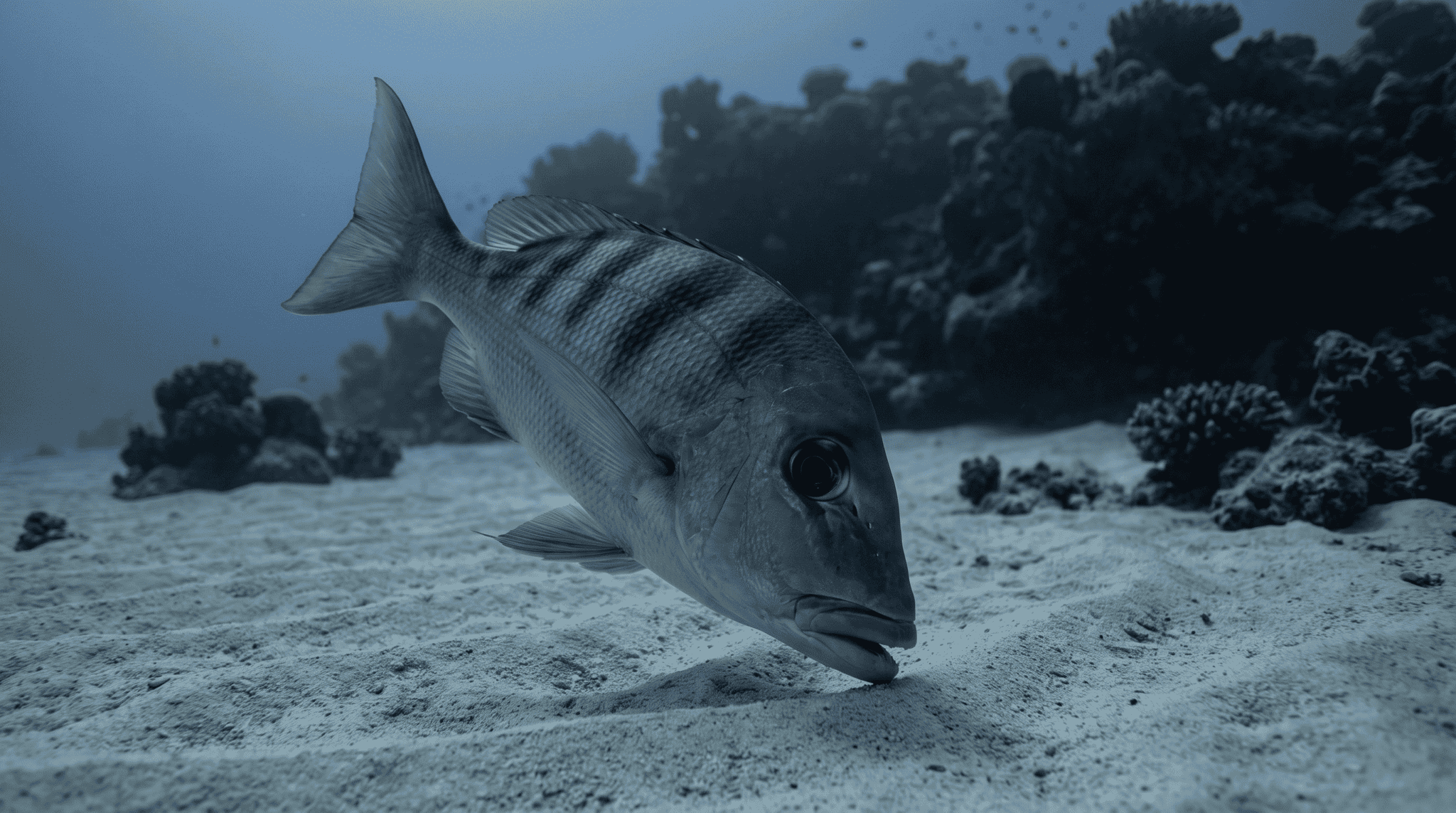
Mū have a deep, compressed silver-gray body; a conspicuously large eye; thick lips; a forked tail; and dark-edged scales that can produce a crosshatched look. Larger adults develop a more pronounced forehead profile. Reddish or dusky fin tones vary with light, depth, stress, and the image’s white balance.
“Large eye” is not a diagnosis. Several nocturnal reef fishes share that feature, and common names for emperors and bream overlap across the Pacific. Photograph the complete side, head, lips, dorsal outline, tail, and scale pattern before the fish is cleaned. A market-darkened fish may lose the cues a quick color match depends on.
The featured image on this page is a stylized illustration, not a measurement plate. Use the form cues above and a current regional identification guide when retention or reporting depends on the species.
02 · LIFE HISTORY
A 23-year fish changes the harvest question
The Hawaiʻi study sampled 157 mū and found both sexes older than 20 years, with a maximum observed age of 23. About 70 percent of modeled growth occurred in the first five years. The estimated combined 50-percent maturity point was 303 mm fork length at about 3.6 years, while males reached a larger modeled asymptotic size than females.
The same work found a distinct May-through-August spawning season in its Hawaiʻi samples. It did not find evidence of the female-to-male sex change seen in some other lethrinids. That matters because borrowing a reproductive story from a related emperor would be biologically wrong.
These are population estimates, not a ruler that determines whether one individual has spawned. They are still useful context: a large mū is the product of many reef seasons, and avoiding unnecessary harvest of immature or visibly spawning fish is more defensible than treating every legal opportunity as identical.
Source: Life history of the humpnose big-eye bream
03 · SEARCH
Build a lane between shelter and feeding bottom
Start with transitions a fish can use without crossing a featureless flat: coral giving way to rubble, rubble feathering into sand, the mouth of a channel, a reef shoulder beside deeper water, or broken hard bottom with narrow clean lanes. The useful target is often beside the highest relief, not on top of it.
On sonar, save the start and end of the transition. On a drift, the boat waypoint and the bait position separate as current builds. Mark where the line was pointing when the bite occurred, then reconstruct the lane on the next pass. From shore, the same idea applies at reef openings and channel lips, but wave sets and footing decide whether access is responsible.
A blank edge after one pass proves little. A blank edge after three controlled passes at different heights says more. Search should reduce uncertainty instead of producing a pile of identical drops.
04 · LIGHT AND FLOW
Low light opens an opportunity; flow delivers it
The large eye supports the low-light hypothesis, but the Hawaiʻi demographic study did not establish a universal nightly feeding schedule. Treat dawn, dusk, night, overcast conditions, and deeper shaded water as tests. Then watch whether current carries scent or small prey through the lane.
Slack water can make a promising edge lifeless. Excess flow can scope line into coral and hold a bait above the target. The middle condition—enough movement to create a direction while the rig remains controllable—is usually more informative than a tide-table label alone.
Record civil twilight, cloud cover, current direction, and whether the bite began before or after the flow changed. Moon phase without current or visibility context is mostly decoration in a notebook.
05 · NATURAL BAIT
Make the bait survive the cast or drop
Shrimp, crab, squid, and legal local fish bait are practical experiments for a reef-edge forager. Freshness matters, but durability and shape matter just as much. A bait that helicopter-spins, masks the point, or disappears during descent cannot test the spot.
Trim strips so they track rather than corkscrew. Pin crustacean baits firmly without burying the hook gap. If pickers erase a soft bait immediately, change toughness, size, or presentation height before increasing hook size. A huge hook wrapped in shredded bait usually solves the wrong problem.
Let scent travel out of the reef, not deeper into it. On a stationary boat, position so the trail crosses the edge before it reaches open sand. On a drift, keep the rig near the clean side and use short corrections instead of continuously plowing the sinker.
06 · LURES AND RIG GEOMETRY
Control beats color
Compact jigs, soft plastics, and crustacean-shaped lures can cover the same lane when they stay in the working band. Count the fall, stop above the contour, and keep contact as the lure returns. A free-spooled jig that wedges into coral is not reaching fish more effectively; it is only reaching rock faster.
For bait, a short dropper, sliding sinker, or locally proven bottom rig can work. Choose the layout by current and snag risk. Short branches tangle less, but branches so short they pin the bait against the main line lose movement. Use the lightest sinker that preserves a reliable position.
Color may affect visibility, but depth, silhouette, motion, and time in the lane are the primary controls. Change one variable per pass or the next bite teaches almost nothing.
07 · BITE TO FIRST TURN
The hook style decides the response
A cautious bite may begin as taps, a soft load, or a brief stop in the lure’s fall. With a circle hook, maintain contact and wind until the rod loads; a hard, early strike can pull the hook out before it turns into the jaw corner. With a J-hook or lure, remove slack and set only after weight is clear and where that hook style is lawful.
Once connected, the first objective is separation from coral. Gain line under firm, smooth pressure and use a low rod angle when side pressure can steer the fish toward the clean lane. High-sticking creates a weak lever and does not move the fish farther from cover.
If three good bites cut the leader at the same moment, the fix is probably boat angle, drag transition, or rig height—not merely heavier line.
08 · TACKLE
Rig for the reef, not the average mū
Rod power, reel capacity, and leader should be chosen from current, sinker weight, casting distance or drop depth, and proximity to coral. Braided main line offers contact, while an abrasion-resistant leader absorbs the close work. The weakest knot still sets the real system strength.
Inspect the first several feet after every fish and snag. Roughness felt between wet fingers is enough reason to retie. Check hook points against a fingernail, replace bent hardware, and keep spare sinkers secured so a rolling deck does not turn them into projectiles.
At night, simplify. Pre-tie leaders, protect headlamp night vision, illuminate knots without flooding the water, and keep hooks out of loose line. The best reef plan is useless if the crew cannot move safely.
09 · FAILURE DIAGNOSIS
Let the returned rig tell you what happened
- Bait gone, no bite: use a tougher bait, expose the point, or lift above the picker layer.
- Rig polished or frayed: it is touching rock too often; shorten the drop or move to the clean shoulder.
- Every cast snags on the swing: change the line of pull so the terminal gear exits across sand.
- Bites vanish with brighter light: move deeper or return at another low-light window instead of inventing a new lure color.
- Only small reef fish appear: shift along the transition, change bait size, or fish a different height.
- One heavy fish cuts off: rebuild the first-turn plan before repeating the exact approach.
The discipline is simple: identify which part of the sequence failed—arrival, survival, detection, hookup, or extraction—then make one repair.
10 · HANDLING
Separate a shallow reef release from a deep one
For a fish caught shallow enough to remain stable, keep it wet, support the body, remove the hook quickly, and return it without a long photo session. A fish from substantial depth may show pressure injury; floating at the surface is not recovery.
Have a descending option when the trip can produce deep catch, and learn the device before a fish is on deck. The barotrauma and descending-device guide explains the operational difference between venting, surface release, and returning a fish under controlled weight.
For legal retention, dispatch and chill promptly. Keep the fish clean and out of meltwater. Good food care begins when the fish crosses the rail, not back at the harbor.
11 · RULES AND REEF ETHICS
Check the place as carefully as the species
Mū are not part of Hawaiʻi’s Deep 7 bottomfish group. Do not copy the five-fish combined Deep 7 rule onto this species. Instead, check the current statewide rules plus the exact Marine Life Conservation District, Fisheries Management Area, gear restriction, access rule, and island-specific provision that covers the water you will fish.
The linked Hawaiʻi regulation booklet was the current document available during this September 2026 review, but agency pages can change sooner than an article. Open the live DAR material before each trip. A general statewide allowance never cancels a protected-area boundary.
Avoid anchoring on coral, retrieve lost line when safe, and do not turn a productive edge into a terminal-tackle dump. Selectivity is part of reef fishing skill.
Source: Hawaiʻi fishing regulations booklet
12 · FIELD SEQUENCE
Run the same questions in the same order
- Identify a clean travel lane beside reef relief.
- Observe wind, current, light, and safe access before rigging.
- Choose bait or lure geometry that can survive the route.
- Make one controlled pass and record line angle and bottom contact.
- On a bite, match the response to the hook and turn toward open water.
- Use the returned rig and leader to diagnose the miss.
- Confirm identification and current rules before retention.
- Record the decision that changed the result, not only the catch.
This sequence keeps “low light” from becoming a superstition. Timing matters because it interacts with a specific lane, flow, and presentation.
13 · RELATED PROFILES
Follow the depth gradient
Use the Hawaiian Grouper profile when the target shifts from reef edge to deep structure and the first lift becomes the central problem. The Onaga profile handles a different slope presentation: fish may suspend above relief, so actual lure depth matters more than touching bottom.
Those links are not species substitutions. They show how the same boat position can create three different fishing problems as habitat deepens.
14 · PRIMARY SOURCES
What supports this profile
- Life history of the humpnose big-eye bream Monotaxis grandoculis — Hawaiʻi age, growth, maturity, reproductive season, and sex-structure evidence.
- Hawaiʻi Division of Aquatic Resources fishing regulations — current statewide and place-based rule gateway used for this review.
Evidence review updated 2026-09-15. Fishing tactics are presented as testable field decisions built on the cited biology and habitat, not as guaranteed behavior.
<
p class=”sp-note”>The cleanest mū clue is often not the fish on the screen. It is the moment one rubble edge gains enough flow and loses enough light to become a travel lane. Put the bait in that lane, keep it out of the coral, and let the result change the next pass.