BRAID / SUPERLINE · TERMINAL
Tie braid on the way you’d tie mono and the whole connection can creep loose before you’ve made many casts. When that happens, cut it off, start again with a fresh length, and double the braid this time. Slick PE line doesn’t grip itself the way nylon does, so this knot cheats. The braid gets doubled before it wraps, and eight turns of compression build enough surface contact to keep the package from creeping.
Four strands, eight wraps, then one pass behind the eye
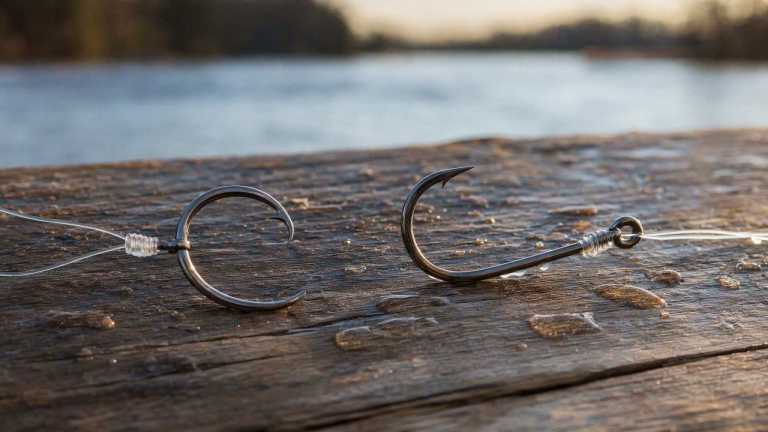
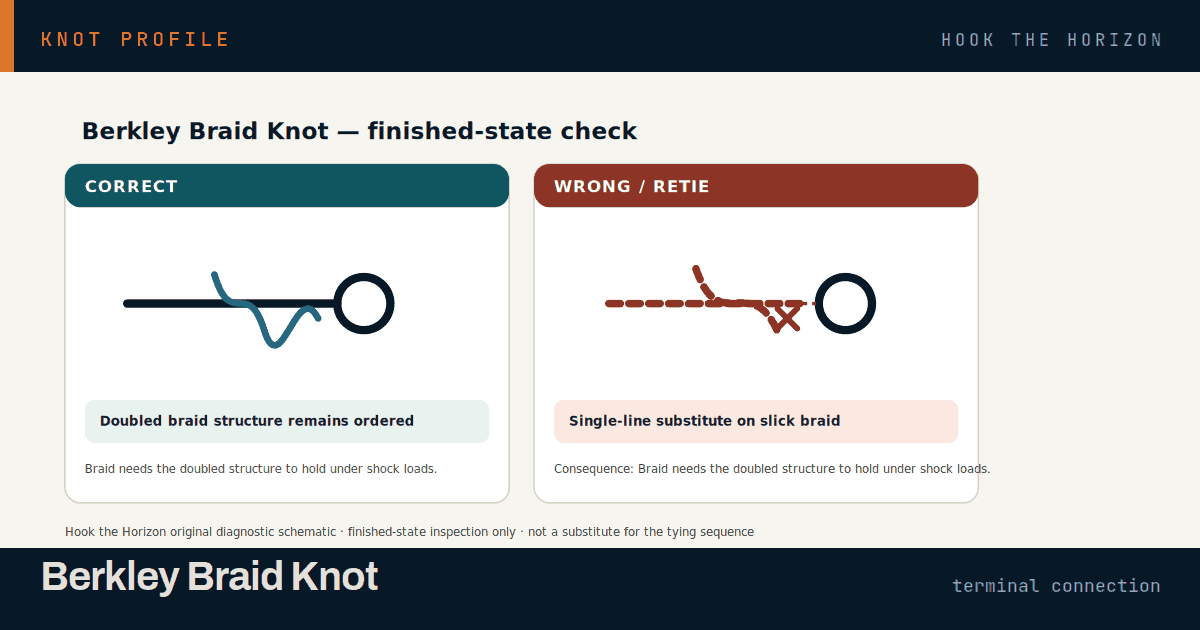
Original Hook schematic; teal is standing braid and dashed coral is the doubled working loop/tag path.
Verified materialBraid and superlines such as FireLine, PowerPro and SpiderWire.
What it’s actually for
Braided main line directly to hook, lure, swivel or snap — the connection I don’t trust to a mono knot anymore.
Eye requirement
The terminal eye must accept a doubled braid section.
Not a generic knot
I treat this as braid-first. It isn’t a reason to abandon cleaner mono and fluoro knots when that’s what’s actually on the spool.
The doubled line is doing the anti-slip work.
It’s close in spirit to the San Diego Jam, except the working section is doubled. The loop enters the eye, folds back alongside the standing and tag strands, then wraps around all four lines at once. That’s a lot of contact for one terminal knot, and braid needs every bit of it. A short mono-style knot can just pull through under load, and on braid it doesn’t take much load to do it.
Build the wrap package before you pull
- Double the braid and pass the loop through the terminal eye.
- Fold the loop back parallel to the standing and tag sections so four strands lie together.
- Hold those four strands and wrap the doubled loop around them about eight times toward the eye.
- Pass the working loop through the opening immediately behind the eye.
- Pull with steady, even pressure until the wraps compact.
- Only after a hard pull test, cut the working loop and trim the tag.
What a bad wrap package looks like
Too few wraps: slick braid creeps. Crossed wraps: the barrel loads unevenly. Twisted doubled section: one eye strand gets pinched. Premature trimming: cut early and you won’t see the tag move during the pull test.
Use it
Direct braid-to-terminal connections where doubled line fits the hardware and you want a braid-specific wrap knot.
Skip it
Mono/fluoro, tiny eyes, or situations where a clean Palomar solves the same problem with less line handling.
Other ways to terminate slick braid
Palomar: simpler doubled-line braid knot. San Diego Jam: works across braid, mono and fluoro without a giant pass-through loop. Fish N Fool: doubled-eye Uni-family braid option.
HOW I CHECK MYSELF
I count the wraps on video, then I count them again on my own knot.
Braid hides a sloppy wrap better than mono does, since it doesn’t kink or scorch the way stiffer line will. That makes eyeballing it less reliable, so I actually count. Eight wraps on the video, eight wraps in my hand, every time.
NetKnots — Berkley Braid Knot animation · Berkley Fishing — official Berkley Braid Knot · Fishing Explained — Berkley Braid for braid · NetKnots — braid-specific background
These external sources are reference and teaching links. Hook diagrams and copy are independently produced. Prefer the official Berkley demo for wrap count and doubled-loop structure on superline.
Open the deeper knot workflowJob, material, route, dressing, seating, pull-test checks and the standardized comparison record.
THE SIX-MOVE CHECK
Job → Material → Route → Dress → Seat → Test
- Job. Name what the connection has to do before choosing the knot.
- Material. Confirm the line, leader, rope, wire, and hardware actually suit this structure.
- Route. Trace every pass before tightening anything.
- Dress. Put strands, wraps, and loops in their intended order with no accidental crossings.
- Seat. Tighten in the order this knot needs. More force does not repair bad geometry.
- Test. Inspect the finished shape, load it by hand when appropriate, and retie if anything moves or fails the article-specific checks.
Practice / pass test. Tie this knot three clean times without rushing. A tie passes only when it matches this article’s What to check before you trust it geometry, shows none of the listed failure clues, and survives the stated load/inspection test. If you cannot tell why one attempt is better than another, keep practicing—the lesson is recognition, not memorization.
KNOT SPEC
Berkley Braid Knot — the short answers
- ALSO CALLED
- Berkley Braid Knot, sometimes just called the braid knot. Named for the line company that promoted it rather than for a person or a place. No meaningful regional aliases.
- KNOT TYPE
- Terminal knot for braid, doubled line wrapped around four strands
- WHAT IT CONNECTS
- Braided main line direct to hook, lure, swivel or snap. It is not a line-to-line knot, not a leader knot, and not a spool knot.
- LINE TYPES
- Braid and superlines — the thin-diameter PE lines this knot was designed around. It works on mono and fluoro but is unnecessarily bulky there, and cleaner mono knots exist.
- STRENGTH BAND
- High on braid, near the top of the direct braid-to-hardware group, because the doubled section and eight wraps build enough contact to stop creep. It is also the knot most punished by a short or sloppy wrap count.
- DIFFICULTY
- Intermediate. The moves are simple but managing a doubled loop and eight wraps of slick braid takes practice. Not the first knot to teach a child, and not one to learn on the water.
- STEPS AND WRAPS
- Six moves. Around eight wraps of the doubled loop around all four strands — that count is the knot, not a suggestion. Thinner and slicker braid wants the full count; there is no mono version worth tying.
- TIE TIME
- Slow for a terminal knot — closer to a home knot. A minute or more, and longer in the dark. Tie a dozen in good light before you trust one at midnight.
- POOR CONDITIONS
- Difficult in cold hands and low light. Holding four strands together while laying eight wraps on slick braid is exactly the job that falls apart when you are rushed and wet.
- THROUGH THE GUIDES
- Bulkier than a Palomar because of the doubled section and the long wrap barrel, but still compact enough to clear guides. It sits at the hardware, so guide passage rarely matters.
- LUBRICATION
- Wet it before the final compaction. Braid does not scorch the way mono does, so the visible warning is absent — which is exactly why people skip it. The wet pull lets the eight wraps compact evenly instead of jamming half-formed.
- TAG END
- Leave more tag than you would on mono — a quarter inch or so — because braid creeps under load. Cut the working loop and the tag only after the pull test, never before.
- TOOLS
- None. Braid scissors or a dedicated braid cutter, because ordinary clippers crush rather than cut braid and leave a frayed stub.
- BEST SUITED TO
- Braid-first fisheries — bass in heavy cover, inshore saltwater, jigging, and anywhere a direct braid connection to hardware is the plan. Chosen by line type rather than by species.
The strength bands are rough on purpose. Published knot tests don’t agree with each other — the same braid-to-leader knot has tested near ninety percent of line strength on one machine and under half on another, because the line brand, its diameter, how fast it got cinched, whether it was wet and whose hands tied it all move the number more than the knot does. Use the band to compare this knot with the others, not as a number to quote.
EIGHT WRAPS TAKE TIME
Braid creeps under most wrapped knots and this one gives it enough contact to stop. Doubled line through the eye and eight wraps is slow work when the fish are showing.
Advantages
- It is built specifically for slick braid, and the doubled section plus eight wraps gives the contact area that stops braid creeping.
- It ties direct to hardware without passing the whole lure through a loop, so big or trebled baits are no obstacle.
- The wrap count is explicit, so it is a knot you can verify by counting rather than by feel.
- It holds up well on the fine, slick, high-strength lines where ordinary wrapped knots give up.
Disadvantages
- It needs an eye that accepts a doubled braid section, which rules out small eyes and crowded hardware.
- It uses a lot of line and takes a lot of handling — slow when the fish are showing.
- Braid hides a sloppy wrap. There is no kink or scorch mark to warn you, so a bad one looks like a good one.
- It is bulky and over-engineered on mono and fluoro, where simpler knots do better.
- Eight wraps is easy to lose count of, and short-counting it is the main way it fails.
Use a different knot when
- Palomar — when the lure passes easily through a loop — it is simpler, faster and solves the same braid problem with less line handling
- San Diego Jam — when you want one knot that works across braid, mono and fluoro without a large pass-through loop
- Uni / Grinner with extra wraps — when the eye will not take a doubled braid section
- A leader and a line-to-line knot — when the fishery calls for a shock or abrasion leader rather than braid straight to the hook
WHAT TO CHECK BEFORE YOU TRUST IT
This knot earns its place when braid is going direct to hardware that will not take a Palomar loop — a big trebled plug, a crowded split ring, a heavy jig. Those eight wraps are the whole knot, and it pays to say the numbers out loud, because braid gives no visual warning of a bad wrap the way mono does with a kink or a scorch mark. Then pull-test before trimming, while the working loop is still there to grab. The real tradeoff is time: this is a deliberate, two-handed knot, and on a short bite window a Palomar tied in a third of the time is often the better answer.
What actually makes it fail
- Too few wraps, so the slick braid creeps through the barrel under sustained load.
- Crossed wraps, which load the barrel unevenly and let it collapse to one side.
- The doubled section twisting at the eye so one strand pinches the other instead of lying parallel.
- Trimming the working loop before the pull test, which removes the only chance to see the tag move.
- Compacting the wraps dry and fast, so they jam half-formed with slack braid trapped inside.
How to test it, and how it ages
Count the wraps before you pull — eight, stacked tight, none crossed — and check the doubled section at the eye is still parallel rather than twisted. Wet it and compact with steady even pressure, not a snatch. Then, with the working loop still uncut, pull hard against the reel or a gloved hand and watch the tag: any movement means the barrel has not locked. Cut the loop and trim only after that test passes. Braid gives no visual damage cues, so the pull is the inspection.
Over a session: Good over a session once seated, and better than most wrapped knots at resisting the creep braid is prone to. Braid still polishes and flattens where it turns through a hook eye, so check the line just above the knot after every fish and retie when it feels flat or fuzzy.
Troubleshooting
Why does it still creep on braid?
Almost always too few wraps, or wraps compacted dry so they never closed. Count to eight and draw them down wet and slow.
Why can I not get the doubled line through the eye?
The eye is too small for this knot on that line. Use a Uni with extra wraps, or move to hardware that takes a doubled pass.
Why does a bad one look identical to a good one?
Because braid does not kink or scorch. You cannot eyeball this knot. Count the wraps and pull-test it before trimming.
When do I cut the working loop?
After the pull test, never before. The loop is what you hold to load the knot properly.
Should I use it on mono?
There is no reason to. It is bulky on mono and a clinch, Trilene or Uni does the job with less line and less time.
FIELD OBJECT
This one should leave the page.
The article is the long version. These are the pieces worth carrying into the next trip.
The 30-second version
Braid slides where mono grips, so the Berkley Braid Knot doubles the line and wraps it eight times. Count those wraps, and pull-test before you cut the loop. If the lure fits through a Palomar loop, that’s faster.
What to watch
- Four strands, eight wraps, then one pass behind the eye
- The doubled line is doing the anti-slip work.
- Build the wrap package before you pull
- What eight good wraps look like
Field card
- Double the braid and pass the loop through the terminal eye.
- Fold the loop back parallel to the standing and tag sections so four strands lie together.
- Hold those four strands and wrap the doubled loop around them about eight times toward the eye.
- Pass the working loop through the opening immediately behind the eye.
- Pull with steady, even pressure until the wraps compact.
RIGHT TOOL, NEXT
Knot Analyst
Carry the connection problem into a knot choice built around line, hardware, conditions, and failure mode.