MONO / FLUORO · TERMINAL
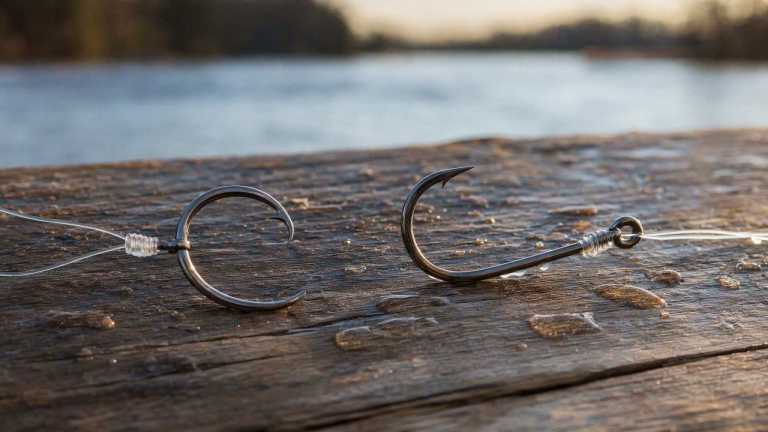
More wraps feels like it ought to mean more strength. Then you put a double or triple-pass knot on a small hook and watch it crowd the eye and sit crooked. The World Fair Knot goes the other way: one pass through the eye, a looped tag path folded into a short terminal lock. It was designed as a strong monofilament knot that also works in fluorocarbon. I’m not stretching that onto braid without a braid-specific source, and I wouldn’t let anybody talk you into it either.
The two returns go through different openings
What it actually does
Verified for monofilament and fluorocarbon.
Its job
A snug line-to-hook, lure, or swivel connection.
Eye limit
One pass through the eye is all it needs, so it crowds a small eye less than the double and triple-pass knots do — that’s the whole reason I reach for it.
What it’s best suited for
Small hooks and light mono or fluoro where a bulkier knot would crowd the eye or throw off the presentation — not the knot I’d reach for on heavier terminal tackle where a fuller wrap package makes more sense.
Short enough that the path has to be exact
A working loop forms beside the standing line, and the tag routes through the openings in order before anything is tightened. Those crossings are where the friction comes from. Short knots don’t forgive much. There’s no long coil sitting there to make up for a missed opening, which is the trade you accept for a lock this small. I like it for that reason and I’m careful with it for the same reason.
Close it slowly and let the crossings stack
- Pass mono or fluoro through the eye.
- Form the working loop beside the standing line.
- Cross and route the tag through the first opening of the loop structure.
- Return it through the second opening exactly as shown in the verified reference path.
- Moisten and close gradually so the crossings stack instead of roll.
- Pull-test and trim only after the compact lock is fully seated.
Failure clue
The tag misses a return opening. A crossing rolls over rather than stacking, and the result is a lock that looks tidy while holding less than it should — that’s the sneaky one, because it doesn’t look wrong. A dry cinch damages the line as it closes, so wet it, every time. And moving the knot onto braid on the strength of a mono claim is guesswork until a braid-specific source says otherwise. I don’t do it.
Mono and fluoro, which is where the evidence stops
Use it: compact mono or fluoro terminal connection, especially on smaller hooks. Skip it: braid or oversized stiff leader, where the case for it just isn’t there. Compare: Orvis or Pitzen for other compact locks, Trilene for doubled eye contact.
Watch + verify
Because this one gives you so little room for error, I always pull-test it before I trust it on a small hook, not after I’ve already made a cast. NetKnots has a good reference for the World Fair Knot if you want to see the exact path through those two openings before you try it under pressure.
Open the deeper knot workflowJob, material, route, dressing, seating, pull-test checks and the standardized comparison record.
THE SIX-MOVE CHECK
Job → Material → Route → Dress → Seat → Test
- Job. Name what the connection has to do before choosing the knot.
- Material. Confirm the line, leader, rope, wire, and hardware actually suit this structure.
- Route. Trace every pass before tightening anything.
- Dress. Put strands, wraps, and loops in their intended order with no accidental crossings.
- Seat. Tighten in the order this knot needs. More force does not repair bad geometry.
- Test. Inspect the finished shape, load it by hand when appropriate, and retie if anything moves or fails the article-specific checks.
Practice / pass test. Tie this knot three clean times without rushing. A tie passes only when it matches this article’s What to check before you trust it geometry, shows none of the listed failure clues, and survives the stated load/inspection test. If you cannot tell why one attempt is better than another, keep practicing—the lesson is recognition, not memorization.
KNOT SPEC
World Fair Knot — the short answers
- ALSO CALLED
- World Fair Knot, also written World’s Fair Knot. The name comes from a knot-tying contest connected with the 1982 World’s Fair. That contest is its whole claim to fame; it never became a common knot on the water.
- KNOT TYPE
- Terminal knot — a short folded lock with one pass through the eye
- WHAT IT CONNECTS
- Line to hook, lure or swivel. It is not a line-to-line knot and not a loop knot. A snug terminal connection and nothing else.
- LINE TYPES
- Monofilament and fluorocarbon, which is where the published guidance stops. Do not carry it onto braid on the strength of a mono claim. Stiff heavy leader is a poor fit, because the short lock will not stack cleanly.
- STRENGTH BAND
- Variable — technique dominates. There is no long coil to cover a mistake, so a correctly routed one is respectable on mono while a misrouted one holds far less and looks identical. It is not a proven front-runner.
- DIFFICULTY
- Intermediate. Few moves, but the tag has to pass through two specific openings in the right order and there is no wrap count to fall back on. Learnable by a child at a table, unforgiving in the dark.
- STEPS AND WRAPS
- Six moves and no wraps at all. That is the point of it — the grip comes from crossings stacking rather than turns accumulating. Nothing changes for braid, because it is not a braid knot.
- TIE TIME
- Quick once the path is memorized — twenty to thirty seconds. The catch is that a half-remembered path takes far longer than a knot whose turns you can simply count off.
- POOR CONDITIONS
- Mixed. It is short and uses little line, which helps in wind. But a precise path with no count is exactly what cold hands and low light spoil, and a misroute here still looks like a finished knot.
- THROUGH THE GUIDES
- Very compact, among the smaller terminal knots, so it clears guides and rod tips easily. It sits at the hook, so guide passage rarely comes up at all.
- LUBRICATION
- Yes, always, and on this knot particularly. It closes short and fast, so friction concentrates in a small space. Fluorocarbon cinched dry here shows cloudy or scorched-looking spots at the crossings.
- TAG END
- Trim close, roughly an eighth of an inch, once the lock is seated and symmetrical. There is no braid case to consider. A tag that will not lie flat usually means a crossing rolled instead of stacking.
- TOOLS
- None. Nippers to trim, and good light while you are still learning the path. Nothing else helps this knot.
- BEST SUITED TO
- Not species-specific — chosen by hardware. It suits small hooks and light mono or fluorocarbon in freshwater and light inshore work, where a bulkier knot would crowd the eye or spoil a presentation.
The strength bands are rough on purpose. Published knot tests don’t agree with each other — the same braid-to-leader knot has tested near ninety percent of line strength on one machine and under half on another, because the line brand, its diameter, how fast it got cinched, whether it was wet and whose hands tied it all move the number more than the knot does. Read the band as a rough place among the other terminal knots on this site, not as a figure to quote.
SHORT FORGIVES NOTHING
One pass through the eye and very little line spent, which is what a fine wire hook and a small eye want. There is so little of it that a single missed opening is most of the knot, and it still looks tidy.
Advantages
- Very compact, so it crowds a small eye far less than the double and triple-pass terminal knots do.
- One pass through the eye, which matters on fine-wire hooks and small hardware.
- No wrap count to remember, miscount or carry over wrongly from another line type.
- Uses very little line, which is worth something when you are retying a light rig again and again.
Disadvantages
- A short knot forgives nothing. One missed opening is a large share of the entire structure.
- A misrouted one looks tidy and holds much less, so the fault is invisible unless you know the path well.
- Mono and fluorocarbon only. There is no braid guidance behind it, and taking it there is guesswork.
- Its reputation rests on a contest win rather than on wide use or decades of accumulated field experience.
- The path is easy to half-remember, and a half-remembered path is slower than counting wraps.
Use a different knot when
- Palomar Knot — when the hardware will pass through a doubled loop and you want the proven default
- Improved Clinch or Trilene — when you would rather have a wrapped knot whose turns you can count and check
- Orvis or Pitzen Knot — when you want another compact lock for small hooks
- Non-Slip Loop Knot — when the lure needs to swing freely instead of being locked against the eye
WHAT TO CHECK BEFORE YOU TRUST IT
The World Fair Knot earns its place on small hooks and light mono or fluorocarbon, where a double or triple-pass knot crowds the eye and never sits right. The thing to grade above all is the path. Close it slowly so the crossings stack rather than roll, then check that the finished lock is short and symmetrical with no open side loop showing. The tradeoff is being honest about its standing. It won a contest in the early nineteen-eighties and remained a minor knot. It is a decent compact terminal option on mono, not one most anglers need to learn.
What actually makes it fail
- The tag missing a return opening, so the lock never fully forms.
- A crossing rolling over instead of stacking, which leaves a tidy-looking knot holding less than it should.
- A dry cinch, which on a knot this short concentrates friction heat into a very small space.
- Carrying it onto braid, where there is no evidence behind it either way.
- Closing it fast rather than gradually, so the structure sets before the crossings have found their places.
How to test it, and how it ages
Close it slowly and wet, watching the crossings settle rather than roll over each other. Then look at the finished knot: short, symmetrical, no open side loop standing out, nothing pointing sideways. On fluorocarbon, check the crossings for a cloudy or scorched-looking patch, which means it went down too dry or too fast. Then pull-test firmly against the hook before you cast rather than after. On a knot this compact, one bad crossing is a much bigger share of the whole structure than it would be on something with a long coil, so the pull test matters more here than usual.
Over a session: Steady through a session once seated properly, and its small size gives less for structure to catch or abrade. It is short enough, though, that any damage is damage to a large fraction of the knot — retie after a fish or a snag instead of inspecting and hoping.
Troubleshooting
Why does it look right and still pull out?
A crossing rolled instead of stacking, or the tag missed a return opening. Both leave a tidy-looking knot. Close it slowly, and if you cannot see the path clearly, retie it against a reference.
Can I use this on braid?
There is no braid guidance behind it, so it is guesswork. Use a knot with a real braid case behind it and keep this one for mono and fluorocarbon.
Why does my fluorocarbon look cloudy at the knot?
It was closed dry, too fast, or both. The lock is short, so the friction concentrates. Wet it and close it gradually.
Is it actually one of the strongest knots?
It came out of a knot contest connected with the 1982 World’s Fair, and that is the source of the reputation. Tied correctly on mono it is respectable. Treat it as a good compact option, not a front-runner.
Why do I keep forgetting the path?
Because there is no wrap count to anchor it in your hands. Tie a dozen at a table against a reference until the two openings become obvious, and do not learn it for the first time on the water.
FIELD OBJECT
This one should leave the page.
The article is the long version. These are the pieces worth carrying into the next trip.
The 30-second version
On a small hook, the World Fair Knot takes one pass through the eye and folds into a short lock. That's why it suits light mono and fluoro, and why a misrouted one is so hard to spot.
What to watch
- The two returns go through different openings
- Short enough that the path has to be exact
- Close it slowly and let the crossings stack
- Seat check
Field card
- Pass mono or fluoro through the eye.
- Form the working loop beside the standing line.
- Cross and route the tag through the first opening of the loop structure.
- Return it through the second opening exactly as shown in the verified reference path.
- Moisten and close gradually so the crossings stack instead of roll.
RIGHT TOOL, NEXT
Knot Analyst
Carry the connection problem into a knot choice built around line, hardware, conditions, and failure mode.