Species Intelligence · Western Atlantic small coastal sharks
Atlantic sharpnose sharks find the same bottom rigs intended for whiting, croaker, redfish, and other inshore fish. Their size makes the encounter manageable. It does not turn teeth, identification, or hook removal into an afterthought.
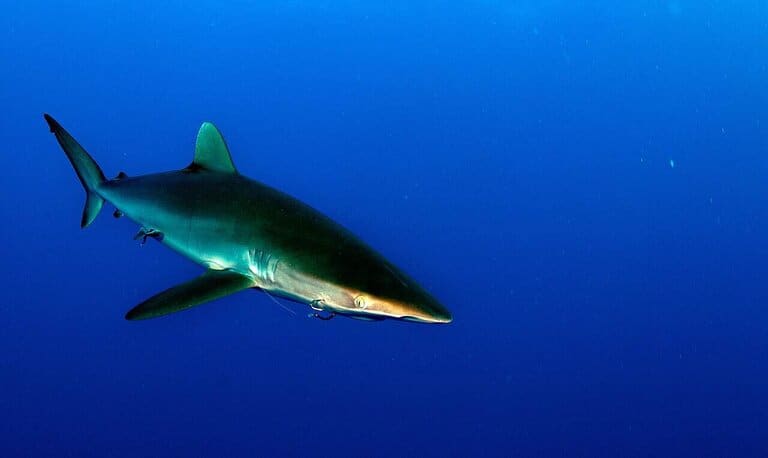
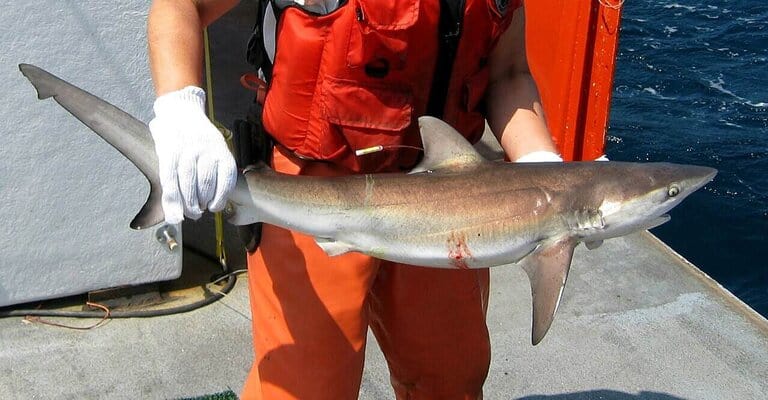
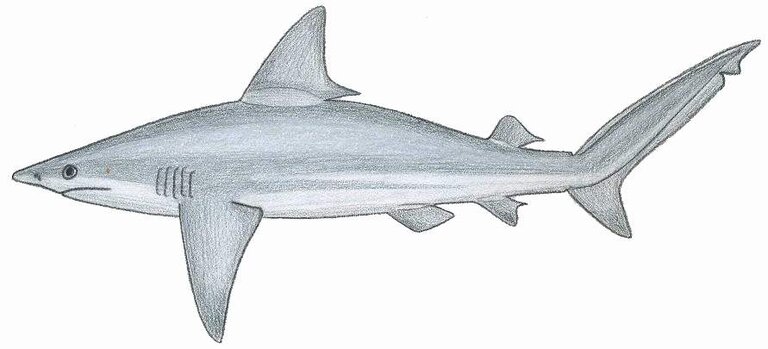
Start with proportions: a slender small shark, a long sharply rounded snout, an unusually long groove along the upper lip, a first dorsal set well behind the pectoral, and—often on adults—small white side spots.
1. The fast read
Rhizoprionodon terraenovae is one of the western Atlantic’s common small coastal sharks. Adults mature at roughly two to three feet and rarely exceed about three and a half feet. They use surf zones, bays, estuaries, and offshore water, which puts them in the path of ordinary bait fishing.
- Useful marks: long rounded-pointed snout, very long upper labial furrow, first dorsal far behind the pectoral, and small white spots on many adults.
- Common confusion: blacknose shark; the blacknose carries a dark mark on the snout.
- Current federal size rule: no minimum fork length.
- Current federal bag: one Atlantic sharpnose per person per trip, separate from the one-shark-per-vessel aggregate.
“Small” describes the body, not the importance of the call. Atlantic shark fishing brings permit, endorsement, hook, handling, and state-rule questions before harvest is considered.
2. Identification lives around the snout and dorsals
The back is brown to olive-gray and fades into a pale belly. Juveniles often show darker edges on the dorsal and caudal fins; adults may show a loose scatter of small white spots along the sides. Color shifts with light and water, so geometry is more dependable.
Look at the upper labial furrow—the groove running along the upper lip. It is notably long on Atlantic sharpnose. The first dorsal begins well behind the pectoral fin, and the second dorsal begins over or behind the middle of the anal fin. There is no ridge between the two dorsals.
A dark-tipped snout argues for blacknose rather than sharpnose. Do not identify from maximum size: a juvenile of a larger, possibly prohibited species can occupy the same length class.
3. Small coastal does not mean one habitat
Sharpnose use the surf line, bays, sounds, estuaries, and coastal shelf. Adults also occur offshore. The label “small coastal shark” is a management and life-history grouping, not a claim that every fish stays behind the first bar.
Inshore fish often track depth, salinity, temperature, and prey through a tide. A falling tide may draw shrimp and small fish from grass or marsh edges toward a channel. An inlet may gather that flow against a beach trough. Offshore, the same species can work bottom contours and prey layers invisible from land.
Think of habitat as connected lanes. The shark does not know that an angler calls one side “the bay” and the other “the beach.”
4. Seasonal movement connects mating and nursery water
FWC reports mating in late spring and early summer, followed by pregnant females moving offshore. After a gestation of roughly ten to eleven months, females return toward nearshore water to give birth to live young. Litters commonly contain four to seven pups.
That cycle can change which sizes and sexes appear in a place. A run of small fish may reflect nursery use; a later run of adults may be movement rather than a permanent resident population.
When repeated small sharks are swallowing hooks or exhausting on undersized tackle, relocation is a legitimate conservation decision. The abundance of bites does not erase the accumulated handling cost.
5. The mouth is scaled to ordinary forage
Atlantic sharpnose feed on small fishes such as silversides, jacks, and other baitfish, plus crabs, shrimp, and mollusks. That menu overlaps with what many coastal anglers put on a bottom rig.
A shrimp, strip of fresh fish, squid piece, or small cut bait can all be intercepted. A large bait is not necessary to prove a shark is present. Smaller, tidy baits also cast cleanly and let a circle hook remain exposed.
Location still beats scent volume. Put the bait where tide delivers prey: the edge of a channel, a trough exit, the down-current side of a bar, or the line where a flat drains. If the rig rolls constantly, fix sinker shape or position before adding more weight and hoping.
6. Why “easy to catch” is the wrong lesson
A common animal that eats common baits can make the first catch happen quickly. The hard part begins afterward: recognizing the shark, controlling it without pinning it under a knee, and removing or cutting the hook without reaching across the mouth.
Frequent encounters are useful practice only when the release system is already prepared. They are not permission for prolonged photos, tail dragging, or testing how light a line can land a shark.
The better benchmark is repeatability with low damage: secure hookup, short fight, clear working area, correct identification, minimal air exposure, and a fish that leaves upright.
7. Fish the route, not the random cast
On a beach, start with the first trough and its cuts before reaching for the horizon. Small prey often travels inside the bar, especially around dawn, dusk, or moving water. In a bay, channel margins and current-swept points can do the same work.
Pay attention to what else is biting. Croaker, spot, small jacks, pinfish, or whiting can identify an active prey layer. A sudden series of cut leaders or fast directional runs suggests the rig needs to change before another bait is sent.
From a boat, bottom marks and bycatch tell the story. If sharpnose arrive on every drop, moving depth or distance can be more effective than trying to fish through them for another target.
8. Right-sized tackle is not ultralight tackle
Sharpnose do not require surf tackle built for a six-foot blacktip, but they do require enough line strength and drag to prevent a long fight. Use a rod that can control the fish in current and lift the sinker without overloading its rating.
Abrasion resistance matters around shell, sand, pilings, and the shark’s skin. Add a bite-resistant terminal section appropriate to the expected fish and inspect it after every contact. The smallest wire that survives one bite may fail after being kinked.
Keep the system simple enough to diagnose. If the sinker, swivel, leader, and hook form a tangle on every cast, more components will not fix it.
9. The circle hook needs room to work
When a line targets Atlantic sharks with natural bait, federal HMS rules require a non-offset, non-stainless-steel circle hook. Do not bury the point inside a thick bait. Secure the bait so the gap stays open.
On the run, engage and wind into pressure. Let the hook rotate toward the jaw corner. A hard overhead strike is borrowed from the wrong kind of fishing.
Carry a long dehooker, leader cutters, and cutters capable of cutting the hook. Test the cutters on the same hook pattern at home. Tool packaging does not release a shark.
10. Landing control begins before touching the leader
Choose where the fish will come in. In surf, avoid rocks, steep drop-offs, and crowds. Use the wash to keep the shark supported rather than pulling it high onto dry sand. On a boat, clear a working corner and keep the shark away from a spinning propeller.
One person should control the line while another handles the tool. Too many hands produce slack, crossed instructions, and fingers in the wrong place. A sharpnose can bend far enough to bite near its own tail.
Do not lift it by the tail alone or hold it vertically for a portrait. Support the body if legal handling requires movement, and keep that movement short.
11. Decide remove versus cut quickly
A clean jaw-corner hook that backs out with a long tool is the easy case. A deep hook, a hook near the eye or gills, or a fish that is losing condition changes the answer. Cut the leader or hook close instead of turning one wound into several.
Keep water moving forward over the gills. Never drag the shark backward for “revival.” Release it facing clean flow and wait for it to hold itself level and kick away.
If identification is uncertain or the fish resembles a prohibited species, keep it in the water and release. A photograph can be reviewed later; a mistaken landing cannot be reversed.
12. The federal bag is per person, not per vessel
NOAA’s current Atlantic recreational shark status page lists Atlantic sharpnose as open with no minimum fork length and a limit of one per person per trip. NOAA explicitly treats that allowance separately from the one-shark-per-vessel aggregate used for blacktip, spinner, and other listed sharks.
The permit and gear framework still applies. A vessel fishing for Atlantic sharks needs the appropriate HMS Angling or Charter/Headboat permit plus shark endorsement. Natural-bait targeting requires the specified circle hook. State waters may add or tighten rules.
Check NOAA’s live status table and the current state regulations before fishing. “No federal minimum” is not the same as “no rules.”
The ordinary-bottom-rig response plan
| What happens | What it means | Next move |
|---|---|---|
| Clean bite-off before pressure | A tooth-bearing fish reached monofilament or fluorocarbon | Do not blindly increase hook size. Add an appropriate bite section and keep the target species in mind. |
| Small shark comes in green | The tackle has control, but the fish can still turn quickly | Keep it supported in water and use the long tool from the side. |
| Hook sits in the jaw corner | The circle hook worked as intended | Back it out only if the tool can do so promptly; otherwise cut close. |
| White spots are visible but snout view is poor | One supporting mark is present | Check lip furrow and dorsal positions. Spots alone do not finish identification. |
| Repeated sharpnose interrupt another fishery | The rig is sitting in an active small-shark lane | Change depth, distance, tide window, bait profile, or location instead of stacking releases. |
A small shark can reveal a large rig problem
If a sharpnose consistently swallows the bait, shorten the wait between pickup and steady engagement, reduce bait bulk, and make sure the hook point and gap are exposed. If the fish arrives tail-wrapped, examine leader length, swivel placement, and the amount of slack allowed during the fight.
If cutters cannot reach the hook without hands crossing the mouth, use a longer tool. If the tool bends, rusts, or cannot cut the hook pattern, replace it before another trip. The release kit is part of the terminal tackle, even though it never enters the water until the end.
Log the bycatch, not just the target
Write down where sharpnose entered the catch: distance from the beach, depth, bottom, tide, salinity after rain, water temperature, bait, and time. Note size class and whether the animal carried white spots or juvenile fin edging. Those details can expose a nursery or seasonal movement that a simple tally hides.
When the goal is another species, the log can help avoid sharks. A different tide stage, bait size, or position may reduce encounters. Avoidance is often the cleanest release method because it prevents the hookup.
Reasons to end or move
- Multiple deep hookups show the bait-and-timing system is failing.
- Juveniles dominate a shallow area and release quality is declining.
- A crowded shoreline makes safe tool use impossible.
- The species cannot be distinguished from a prohibited similar shark.
Abundance can hide cumulative impact. Ten quick fights still produce ten handling events.
13. Use the group to calibrate scale and shape
Compare the sharpnose with Blacktip and Spinner, both larger coastal sharks with a 54-inch federal minimum in the vessel aggregate. Then move to Bonnethead, another small coastal shark under the current one-per-person rule but a member of the hammerhead family with unmistakably different head geometry.
Four profiles create a working identification set: snout and lip furrow, anal-fin color, dorsal placement, head shape, size class, and bag category. No single clue should carry the whole call.
14. Primary references and verification trail
- Florida Fish and Wildlife Conservation Commission: Atlantic Sharpnose Shark — field marks, size, habitat, feeding, and reproduction.
- NOAA Fisheries: current Atlantic recreational shark status, sizes, and bags.
- NOAA Fisheries: 2026 HMS Recreational Compliance Guide.
- NOAA Fisheries: 2024–2025 Atlantic HMS SAFE Report.
- FWC: current recreational shark regulations.
Biology and regulations were checked September 15, 2026. Recheck agency pages on the day of the trip.
Bottom line: the sharpnose is the shark most likely to arrive on an ordinary bottom rig. That makes a cutter, a long dehooker, and a practiced identification sequence ordinary tackle too.