Hybrid Striped Bass (Wipers) Follow the Shad, Not the Shoreline
Wipers are stocked to eat shad, and they go where the shad go, which is usually not the bank you like. How to tell one from a striper by the tongue, and where the bait sits each season.
By HunterUpdated September 13, 2026Read 6 min
Fresh wiper fish fillet displayed with color calibration chart for accurate color reproduction.
Somebody put this fish in the reservoir to eat shad, and it takes the job seriously. A wiper is a striped bass × white bass cross, stocked as an open-water predator, so the bank-beating habits that work fine on largemouth can keep you busy all day in water it has no reason to visit. I haven’t fished for them. You don’t need me to have, though, because the whole idea falls out of what they eat and where that food lives, and a sonar screen will tell you whether the shad agree.
At a glance · A stocked open-water predator that inherits the reservoir problem from both parents
Deep body, distinct horizontal stripes that are usually broken above the lateral line, and two tongue-tooth patches joined or nearly joined.
Why managers stock it
Warm-water tolerance greater than striped bass, rapid growth, hard fight, and strong predation on schooling baitfish such as gizzard shad.
Reproduction
Reduced fertility means inland fisheries are generally maintained through stocking; Indiana notes spawning attempts are usually unsuccessful.
Spring cue
Indiana reports movement toward inflows around 55 F even when successful reproduction does not follow.
Summer cue
Follow cooler oxygenated depth and bait schools; surface “busting” can create short feeding windows.
Broken stripes help, but the tongue and body make the identification harder to fake
Identification
Hybrid striped bass
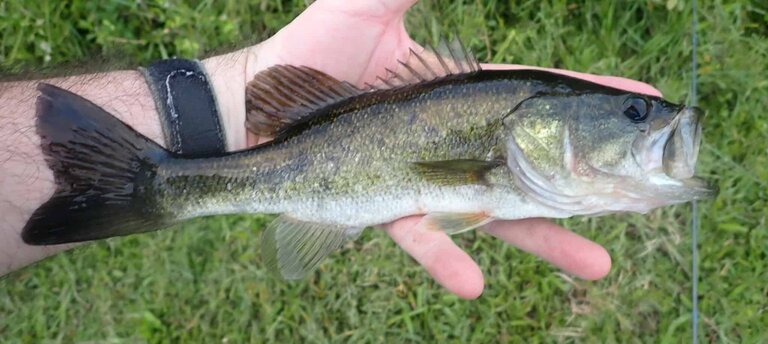
Indiana describes a deep-bodied fish with distinct dark horizontal stripes. Stripes above the lateral line are usually broken. Two tooth patches on the back of the tongue are joined or nearly joined. Colorado likewise uses the broken-stripe pattern and deep body as useful field marks.
Pure striped bass are more slender, their stripes above the lateral line are generally unbroken, and their two tongue-tooth patches are separate and parallel. A broken stripe alone is not foolproof; use body depth and tongue structure.
White bass have a single tooth patch on the tongue and the first stripe below the lateral line does not run completely to the tail in Indiana’s identification key. Hybrid fish combine a white-bass-like deep body with a stronger striped pattern and different tongue dentition.
If a regulation turns on the species, I’d check the tongue before I’d trust the stripe — a broken bar is the mark everyone reaches for first, and it’s also the one a stressed, half-silvered fish can blur.
The fishery is deliberately manufactured around a forage problem
Stocking & Management Purpose
Why wipers exist in reservoirs
Indiana stocks hybrid striped bass to diversify sport fishing and increase predation where baitfish such as gizzard shad are abundant. The white-bass component provides greater tolerance for warm inland water than pure striped bass, while the striped-bass component contributes size and open-water predation.
Colorado reports that forage-rich waters can produce wipers around seven pounds by age three and more than 20 pounds by age ten. Those are conditional growth examples, not an age-length key for every reservoir.
It’s easy to read stocking dependence as proof the fish is sterile. Indiana uses the more accurate language: reduced fertility limits reproduction, and spawning is generally unsuccessful in its inland fisheries. That is enough to require stocking without claiming every hybrid in every cross is incapable of reproduction.
Temperature changes where the bait and the fish can overlap
Seasonal Habitat
Thermal tolerance
Indiana notes that white-bass genes let hybrid striped bass tolerate warmer water—up to about 90 F in its agency guidance—than pure striped bass, which generally perform best in well-oxygenated water below roughly 75 F. That upper number is not a preferred fishing temperature; it describes tolerance that expands which inland lakes can support the hybrid.
As water approaches roughly 55 F, Indiana reports hybrids attempting spawning movements into inflowing streams. Even where reproduction fails, the movement is useful to anglers because it concentrates fish near current, tributary mouths, tailwaters, and adjacent deeper staging water.
In warm months, Indiana recommends trolling baitfish imitations or drifting live or cut bait at cooler depths. The useful layer is where temperature, oxygen, and shad overlap. A reservoir can be thermally survivable but still compress feeding into a narrow vertical band.
Cooling water expands usable shallow habitat again. Indiana highlights surface feeding in early morning and evening; Colorado likewise describes summer and seasonal schools “busting” prey at the surface. The visible boil is the event, not the home address.
Ninety degrees of listed tolerance isn’t ninety degrees of good fishing. In a hot reservoir the fish can survive in a lot of the lake and still feed in only a thin slice of it, so the band where oxygen and shad overlap is still the thing to find.
Follow the forage, then ask what structure intersects the school
Diet & Behavior
Schooling predator
Hybrid striped bass are open-water predators specialized around schooling baitfish. Indiana specifically describes their management value as predators of gizzard shad, while Colorado emphasizes visible schooling attacks at the surface. The practical map begins with prey concentration rather than a favorite shoreline object.
Indiana recommends windblown shorelines, drop-offs, humps, and points where those features intersect cooler depth. That is the important distinction: a point is valuable because it compresses prey and usable water, not because wipers are structurally resident like largemouth bass.
Keep a shad-sized topwater, spoon, swimbait, or fly ready when fish are visibly feeding. Cast past the edge of the school and retrieve through it instead of driving the boat into the center. The school can sound or relocate quickly after boat pressure.
No surface activity
Use sonar to find bait and predators at depth. Trolling baitfish imitations or drifting legal live/cut bait can hold the offering in the productive layer. If a school is marked at 24 feet, solving 24 feet is more important than changing from one shad-colored lure to another.
Tailwaters, inflows, and river sections can concentrate fish against current seams. Present across or down the seam so the bait intersects the holding lane rather than pulling continuously against the strongest flow.
Tackle
Use enough drag capacity and line to handle long open-water runs without overplaying the fish. Wipers are known for strong sustained fights. The exact rod and line depend on lure size, fish size, current, and cover—not on a universal “wiper setup.”
Release in warm water
A fish with greater heat tolerance can still be stressed by warm water, low oxygen, exhaustive exercise, and long air exposure. During summer, land the fish efficiently, keep tools ready, and release promptly if it is not being kept.
Here’s the check worth running on yourself: when the boat keeps drifting back toward the bank, look at the sonar before the next cast. No shad out there, no reason for a wiper to be there either. A good-looking point with nothing around it is just a good-looking point.
FEEDING ECOLOGY · STANDARDIZED
How this fish gets fed.
Primary prey
Schooling baitfish dominate the feeding problem, especially gizzard shad in the inland reservoirs highlighted by Indiana and Colorado.
Feeding mode / location
An open-water schooling predator that tracks bait schools rather than living on one shoreline object. Points, humps, drop-offs, windblown banks, inflows, and tailwaters matter when they compress prey or intersect a usable temperature-and-oxygen layer.
Diel / seasonal pattern
Spring movement can concentrate fish near inflows. Summer often pushes schools toward cooler oxygenated depth, with brief surface busting when bait rises. Indiana and Colorado support early-morning/evening surface feeding windows, but visible prey concentration is more reliable than a clock.
Ontogenetic diet shift
The sources behind this page don’t cover it.
Thermal tolerance is not relabeled as an optimal feeding-temperature band.
Lake FishPredominantly lake- and reservoir-centered U.S. fish profiles covering habitat, behavior, seasonal movement, fishing approaches, regional variation, and memorable biology without duplicating the River Fish cluster unless the lake fish is a distinct species, hybrid, or landlocked form. Start with Lake Fish of the United States: Species Profiles.27 articles
Species & BehaviorFish behavior, habitat, depth, forage relationships, and species-specific field decisions. Start with the Freshwater Fish Species field guide.159 articles
Cookie Consent
We use cookies to improve your experience on our site. By using our site, you consent to cookies.
Contains information related to marketing campaigns of the user. These are shared with Google AdWords / Google Ads when the Google Ads and Google Analytics accounts are linked together.
90 days
__utma
ID used to identify users and sessions
2 years after last activity
__utmt
Used to monitor number of Google Analytics server requests
10 minutes
__utmb
Used to distinguish new sessions and visits. This cookie is set when the GA.js javascript library is loaded and there is no existing __utmb cookie. The cookie is updated every time data is sent to the Google Analytics server.
30 minutes after last activity
__utmc
Used only with old Urchin versions of Google Analytics and not with GA.js. Was used to distinguish between new sessions and visits at the end of a session.
End of session (browser)
__utmz
Contains information about the traffic source or campaign that directed user to the website. The cookie is set when the GA.js javascript is loaded and updated when data is sent to the Google Anaytics server
6 months after last activity
__utmv
Contains custom information set by the web developer via the _setCustomVar method in Google Analytics. This cookie is updated every time new data is sent to the Google Analytics server.
2 years after last activity
__utmx
Used to determine whether a user is included in an A / B or Multivariate test.
18 months
_ga
ID used to identify users
2 years
_gali
Used by Google Analytics to determine which links on a page are being clicked
30 seconds
_ga_
ID used to identify users
2 years
_gid
ID used to identify users for 24 hours after last activity
24 hours
_gat
Used to monitor number of Google Analytics server requests when using Google Tag Manager
1 minute
Jetpack's built-in visitor analytics. It records page views, referring sites, search terms, and outbound link clicks, and also carries the shared visitor-tracking library used by Jetpack Instant Search and WooCommerce Analytics.