White catfish get filed as a bullhead with a forked tail, and that filing costs you the actual fishery. In a tidal river the clock matters about as much as the spot: the stage of the tide decides which edge has current and which one is dead water, and that flips several times a day. I haven’t fished for white catfish, so what follows about stage and direction is reasoned from how moving water carries scent and bait, not pulled from a logbook.
Think channel edges and tide timing, not pond bottoms. They use larger rivers, estuaries, reservoirs, and impoundments, often around sluggish channels, vegetated borders, shoals, and off-channel water. In tidal systems, current direction and stage determine where scent travels and whether a bait holds in the feeding lane.
Species: White catfish, Ameiurus catus. Native to Atlantic and Gulf-slope systems and introduced elsewhere. Some native populations are declining even where introduced populations remain common.
The tidal-river plan
- Choose a stage: fish enough moving water to carry scent, but not so much that the rig tumbles.
- Find the border: channel edge, backwater mouth, shoal, bridge corner, vegetation line, or creek confluence.
- Set down-current: place bait where the scent line crosses the travel route.
- Hold without anchoring blindly: use sinker shape and weight matched to current and bottom.
- Reset with the tide: when direction or speed changes, the productive side of structure changes too.
Identification: the tail is only the first clue
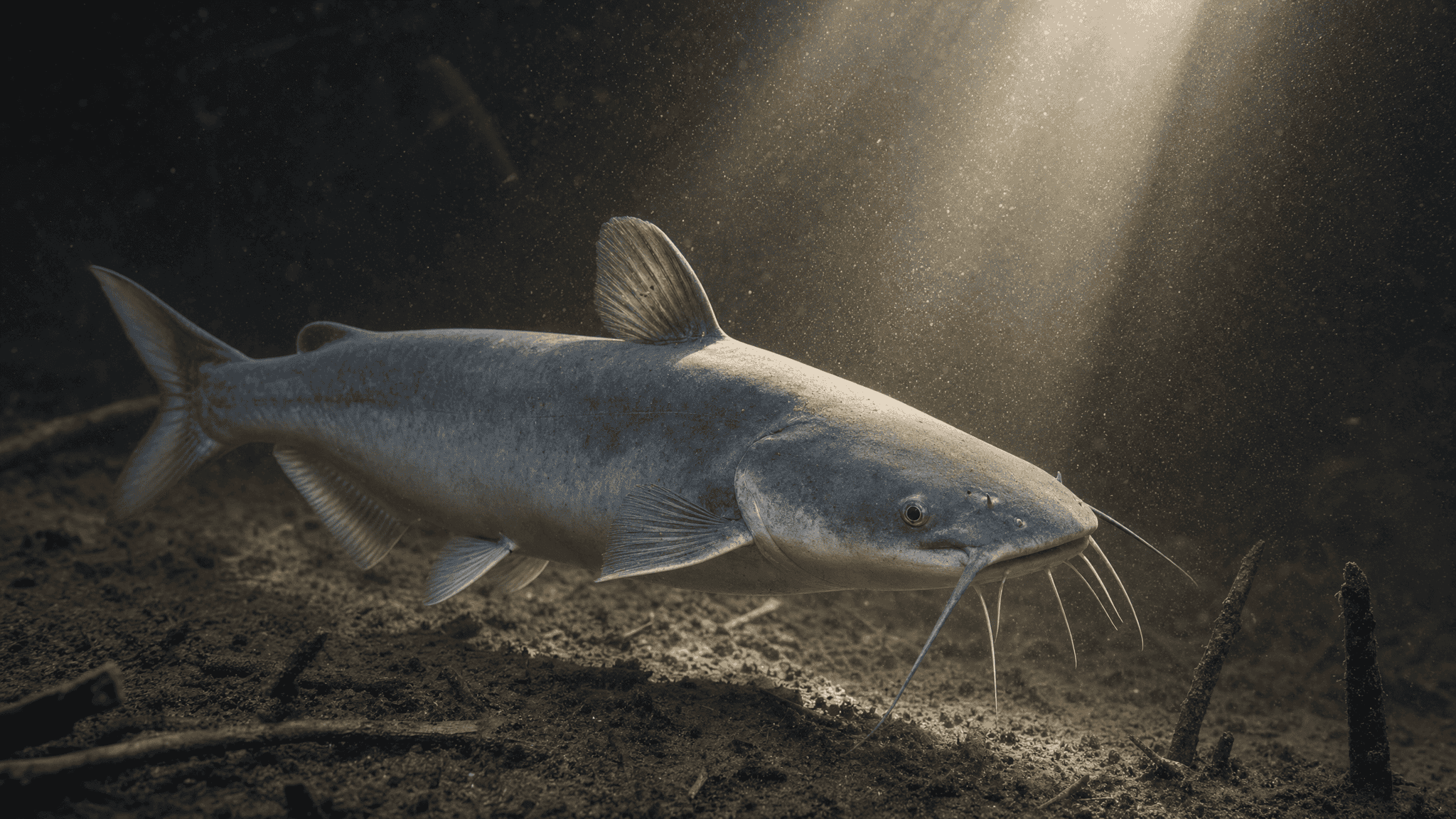
White catfish have a moderately forked tail—more forked than a bullhead, less deeply forked than a channel catfish. The head is broad, the body blue-gray to slate above and pale below, and chin barbels are usually pale. Adult white catfish often look stockier than channel catfish.
Do not identify by body color alone. Use tail fork, head width, anal-fin shape and ray count, chin barbels, spots, and range. Blue and channel catfish can overlap in introduced systems. Photograph the side and tail of an uncertain catch before retention.
Where white catfish differ from pond bullheads
White catfish occupy rivers, tidal freshwater, brackish reaches, reservoirs, ponds, and lakes. In large systems they use sluggish channel borders, vegetated backwaters, tributary mouths, flats, and firm shoals. Their salinity tolerance helps them occupy estuarine transitions avoided by many freshwater catfish.
On sonar, look for the break from channel to flat, depressions at the mouth of a creek, and fish marks close to—but not always on—bottom. From shore, target accessible current seams, bridge edges where legal, riprap ends, and the downstream edge of points.
A flat becomes more useful when it connects two pieces of habitat. An isolated muddy bank with no current, depth, cover, or food is merely easy to cast toward.
Tide, river stage, and current direction
Incoming tide can push fish onto flooded margins and backwater entrances; outgoing tide can drain food toward creek mouths and channel edges. Slack water may reduce scent travel and feeding activity, though local fish can still use it. Learn the delay between published tide time and actual current at the fishing location.
I’d clock that delay with a scrap of bait and a cheap bobber before trusting an app. The published prediction may belong to a station a long way from the bend you’re fishing, and a bobber drifting the wrong direction is about the cheapest correction you’ll ever get.
In non-tidal rivers, rising water can open bank cover and tributary mouths, while falling water pulls fish toward channels and holes. Flood current, floating debris, and unstable banks are safety limits. No bite is worth fishing a dangerous bridge abutment or steep muddy bank.
Rigging for moving water
A sliding sinker rig with a short leader and circle hook is a strong starting point. Use a no-roll, coin, or other bottom-gripping sinker where legal and suited to substrate. The lightest weight that holds allows better bite detection; a rig rolling naturally can work only when it stays out of snags and the angler understands its path.
Cast across or slightly upstream of the target so the bait settles in the seam. Keep the rod tip high enough to reduce line in the current, then lower it once the rig holds. If debris collects constantly, change angle, move to a protected seam, or wait for safer conditions.
Baits matched to the forage
White catfish eat fishes, crustaceans, insects, mollusks, and other bottom prey. Fresh cut bait, shrimp, worms, crayfish, clams where legal, and locally appropriate prepared baits can work. In tidal water, match common forage and check bait frequently for crabs or small fish.
Cut bait should release scent but remain on the hook. Hook through tough skin with the point exposed. Scale bait size to the fish and current; a huge flap spins and tangles. Freshness and placement beat a secret marinade.
Active presentations
A jig tipped with bait, compact soft plastic, or small blade bait can search channel edges and bridge shadows when fish are active. Maintain bottom contact intermittently rather than dragging through every snag. Lift over rock and pause in the pocket.
Drifting from a boat can cover a channel border, but speed must keep the bait near bottom. Use the motor or drift sock where safe to control presentation. Never drift into navigation traffic, anchored lines, or restricted infrastructure.
Tackle and landing
Medium spinning or conventional tackle with abrasion-resistant line handles current, sinker weight, and larger fish. Choose leader for rocks, shells, pilings, and possible bycatch. Set drag and secure rod holders; tidal current can make a modest fish feel much heavier.
When the line tightens on a circle hook, reel steadily until the rod loads. Keep the fish away from pilings and anchor line. At landing, use a net and control the pectoral and dorsal spines. Do not lift a larger catfish by the leader.
Next-tide decisions
- Rig will not hold: change sinker shape, weight, or move into a softer seam.
- Crabs strip bait: use tougher bait, elevate it slightly, or move along the channel edge.
- Bites begin at one tide stage: record actual current, not just the tide-table label.
- Only channel catfish appear: recheck identification and move toward habitat documented for white catfish.
- Debris loads the line: stop or relocate; more sinker does not solve unsafe flow.
- One fish from a backwater mouth: test the next comparable mouth at the same stage.
Conservation status and local differences
White catfish can be native, introduced, declining, or locally common. New York’s 2024 assessment documents decline in the Hudson River estuary and possible competition with introduced channel catfish, while other states manage established nonnative fisheries. That means harvest advice cannot be national.
Same species, opposite management problem: New York is trying to explain a disappearance, and other states are trying to manage an established newcomer. A conservative bag limit that fits the Hudson would be an odd rule to import onto a reservoir where the species was never native to start with.
Never move live catfish between waters. Release uncertain or conservation-sensitive fish quickly and document identification.
Handling and food care
Use pliers, a net, and a grip behind the spines. For release, wet hands and minimize air exposure. For retention, dispatch and ice promptly. In estuaries and urban rivers, consult contaminant advisories for the exact reach and species.
FEEDING ECOLOGY · STANDARDIZED
How this fish gets fed.
Tidal stage is treated as a physical feeding condition, not as a substitute for an unsupported diel rule.
Field notes and sources
Record tide prediction, actual current start and direction, river stage, salinity if known, channel position, depth, sinker, bait, crab activity, strike time, and species ID. “Caught on outgoing tide” becomes useful only when connected to the creek mouth, current speed, and minutes after flow began.
Of everything in that list, the tide prediction is the only thing you can get from the kitchen table. The creek mouth, the current speed and the minutes after flow began all have to be found out on the water, but at least you show up knowing which stage you’re walking into.
Species and distribution: USGS White Catfish profile. Conservation and estuary habitat: New York DEC White Catfish status assessment. Regional reference: North Carolina Wildlife Resources Commission.
Compiled 2026-09-11. Limits and advisories are set per water and per state and change between seasons — the managing agency for wherever you are fishing has the current answer.