The name is a warning about the mouth rather than the fight — the membrane tears if you lean on it. Underneath the migration and the estuary nurseries sits one number nobody has explained: natural mortality that climbed from 0.16 to 0.92.
Weakfish got their name from a mouth that tears, not from a fight that quits.Cynoscion regalis is an Atlantic croaker relative that migrates inshore with warming water, spawns in batches through spring and early summer, uses estuaries as nursery habitat, and feeds heavily on shrimp, crustaceans and small fish. Keep that soft mouth in the back of your head through all of it. It’s the part that decides how the fish ends up in the net instead of back in the water with a torn lip.
At a glance · The short version
Scientific name
Cynoscion regalis
Best ID clues
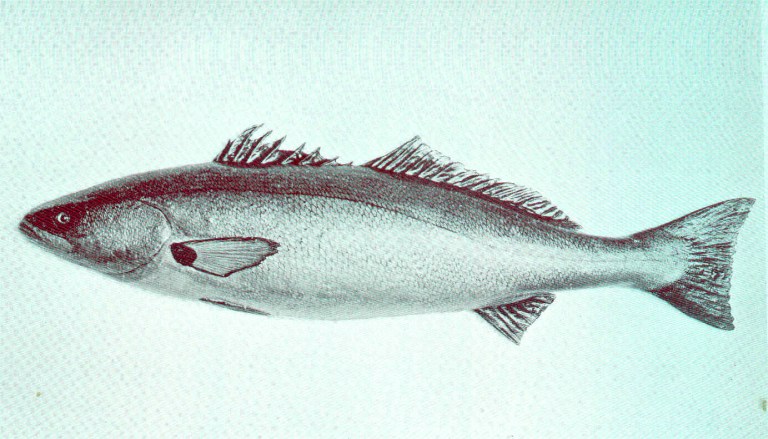
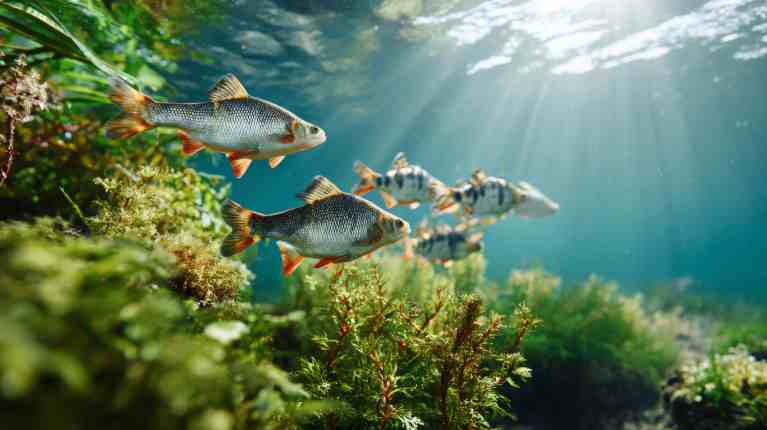
Greenish/purple back, silver sides, fine dark wavy spots/lines, yellowish pelvic and anal fins, projecting lower jaw, canine-like teeth, no chin barbels.
Core abundance
Nova Scotia to Florida, with strongest abundance generally from New York through North Carolina.
Spawning
Spring through early summer; peak commonly April–June with regional variation; females release eggs in repeated batches.
A trout-shaped fish with a different pattern
Identification
Body color and markings
Weakfish commonly show a greenish-gray to purple-green back over silver sides, with small dark spots arranged in wavy or diagonal lines. Yellowish pelvic and anal fins are useful supporting traits, but color changes quickly with light and stress.
The mouth is large and oblique, the lower jaw projects, and prominent canine-like teeth occur in the upper jaw. There are no chin barbels. Those structural characters matter more than trying to call the fish from a purple cast on the flank.
Spotted Seatrout carry stronger round spots onto the dorsal and tail fins. Weakfish markings tend to read as finer, wavy rows concentrated across the upper body. Use pattern, fins, geography and jaw together rather than asking one dark spot to settle the identification.
ASMFC places Weakfish from Nova Scotia to southeastern Florida, with the largest concentrations generally from New York through North Carolina. That broad range makes one fixed “weakfish season” misleading before latitude is even considered.
Warming coastal water brings adults inshore and north from offshore wintering grounds between roughly Chesapeake Bay and Cape Lookout toward sounds, bays and estuaries. The migration is a temperature-and-geography event, not a date printed permanently on a calendar.
Cooling water drives an offshore and southerly migration in fall. An estuary that held adult Weakfish in summer can therefore empty because the fish moved through the seasonal route, not because a particular lure stopped working.
Larvae move from spawning areas toward nursery habitat in deeper portions of coastal rivers, bays, sounds and estuaries. They remain there into late fall of the first year before juveniles move toward the coast.
ASMFC notes especially rapid first-year growth, with most age-one fish around 10–11 inches. Weakfish mature young, but early maturity has not been enough to overcome the stock’s high total mortality.
Adults are often found near eelgrass peripheries where shrimp, crustaceans and small fish concentrate. The useful unit is grass together with the depth beside it, the current running past it, and what that current delivers. Grass on its own explains very little.
Spawning begins soon after the spring inshore migration and typically peaks from April through June, with latitude and local conditions shifting the window. The broader spawning season can extend beyond those peak months.
Females continuously develop and release eggs over the spawning season instead of investing everything in one event. That makes a productive spring aggregation part of a repeated reproductive process rather than a single-night pulse.
Shrimp and small fish define the search better than a favorite lure
Diet & Field Decisions
Adult diet
ASMFC describes adults feeding primarily on shrimp, other crustaceans and small fish. That prey mix can be concentrated along eelgrass, channel edges, inlet seams and open-estuary bait schools, so a permanent object is not automatically the best address.
Where these come from. I haven’t fished for weakfish, so the three rows below aren’t things I’ve watched happen. They’re my best read of the documented migration, habitat and forage.
Search a connected routeinference
Start with bay or sound water, then channel edges, grass peripheries, inlet seams and forage signals. Birds, nervous bait, shrimp activity and repeated marks at one depth are more useful than a spot name by itself.
Repeat depth before changing colorinference
When one fish is found, repeat the depth and retrieve angle first. A schooling predator can make depth and position more repeatable than lure cosmetics.
Current controls weightinference
Use enough weight to reach and hold the feeding layer without turning the presentation into dead hardware. If current lifts the offering above the fish, add weight before concluding the school stopped feeding.
The name becomes a landing problem
Soft-Mouth Handling
Tender mouth tissue
The common name reflects the relatively fragile mouth tissue. Use a sharp hook, a drag that can give under a surge, and steady pressure instead of abrupt high-stick lifting at the boat.
Use a net
A landing net reduces the temptation to swing a fish by the hook connection. If the fish is being released, support it, shorten air exposure and avoid widening an existing tear while removing the hook.
Not established here
Nobody’s proven these yet
one coastwide optimum temperature or tide
one universal lure color, hook size or eelgrass depth
that a local concentration proves coastwide recovery
that high natural mortality has one proven cause
that the rest of the school sticks around after the first fish is landed
In ASMFC’s assessment, natural mortality on this fish averaged about 0.16 over the first ten years of the time series and 0.92 over the most recent ten, and the assessment doesn’t pin down why. A bag limit can’t fix a cause nobody has pinned down. Anybody who sounds sure about that one — a fisherman, a forum, me — is ahead of the evidence.
— · Sources
FEEDING · THE MOUTH IS THE PROBLEM
It hunts shrimp and small fish along seams like any other estuary predator. The soft mouth changes how you land one, not how it eats.
What it eats
Fishes and shrimp are major adult prey, with squid and other crustaceans also taken. Juveniles rely more heavily on small crustaceans and other estuarine invertebrates.
How and where it hunts
A mobile estuarine predator using grass, channels, shoals, inlets, beaches, and current seams where small fish and shrimp concentrate. The soft mouth changes handling, not the basic feeding strategy.
When it feeds
Low-light and tidal periods can concentrate feeding, but the profile does not support one coastwide clock. Seasonal migration between estuaries and coastal water is strongly documented and often matters more than time of day.
What changes as it grows
Young weakfish emphasize small crustaceans and other invertebrates; larger fish become increasingly piscivorous while retaining shrimp and squid as important prey.
Seasonal migration and spawning are kept separate from an unsupported feeding-temperature optimum.
Compiled 2026-09-11. Limits and advisories are set per water and per state and change between seasons — the managing agency for wherever you are fishing has the current answer.
FIELD OBJECT
This one should leave the page.
The article is the long version. These are the pieces worth carrying into the next trip.
The 30-second version
The name is a warning about the mouth rather than the fight — the membrane tears if you lean on it. Underneath the migration and the estuary nurseries sits one number nobody has explained: natural mortality that climbed from 0.16 to 0.92.
What to watch
Identification
Range & Seasonal Movement
Early Life & Habitat
Reproduction
Field card
one coastwide optimum temperature or tide
one universal lure color, hook size or eelgrass depth
that a local concentration proves coastwide recovery
that high natural mortality has one proven cause
that the rest of the school sticks around after the first fish is landed
RIGHT TOOL, NEXT
Species & Presentation
Carry the species behavior and presentation question into a narrower water-to-fish-to-presentation handoff.
We use necessary cookies to operate the site. With your choice, we may also use analytics and advertising cookies. Choose Accept All, Reject, or Preferences.
Contains information related to marketing campaigns of the user. These are shared with Google AdWords / Google Ads when the Google Ads and Google Analytics accounts are linked together.
90 days
__utma
ID used to identify users and sessions
2 years after last activity
__utmt
Used to monitor number of Google Analytics server requests
10 minutes
__utmb
Used to distinguish new sessions and visits. This cookie is set when the GA.js javascript library is loaded and there is no existing __utmb cookie. The cookie is updated every time data is sent to the Google Analytics server.
30 minutes after last activity
__utmc
Used only with old Urchin versions of Google Analytics and not with GA.js. Was used to distinguish between new sessions and visits at the end of a session.
End of session (browser)
__utmz
Contains information about the traffic source or campaign that directed user to the website. The cookie is set when the GA.js javascript is loaded and updated when data is sent to the Google Anaytics server
6 months after last activity
__utmv
Contains custom information set by the web developer via the _setCustomVar method in Google Analytics. This cookie is updated every time new data is sent to the Google Analytics server.
2 years after last activity
__utmx
Used to determine whether a user is included in an A / B or Multivariate test.
18 months
_ga
ID used to identify users
2 years
_gali
Used by Google Analytics to determine which links on a page are being clicked
30 seconds
_ga_
ID used to identify users
2 years
_gid
ID used to identify users for 24 hours after last activity
24 hours
_gat
Used to monitor number of Google Analytics server requests when using Google Tag Manager
1 minute
Jetpack's built-in visitor analytics. It records page views, referring sites, search terms, and outbound link clicks, and also carries the shared visitor-tracking library used by Jetpack Instant Search and WooCommerce Analytics.