Twenty minutes behind somebody fishing streamers will show you one retrieve, repeated.
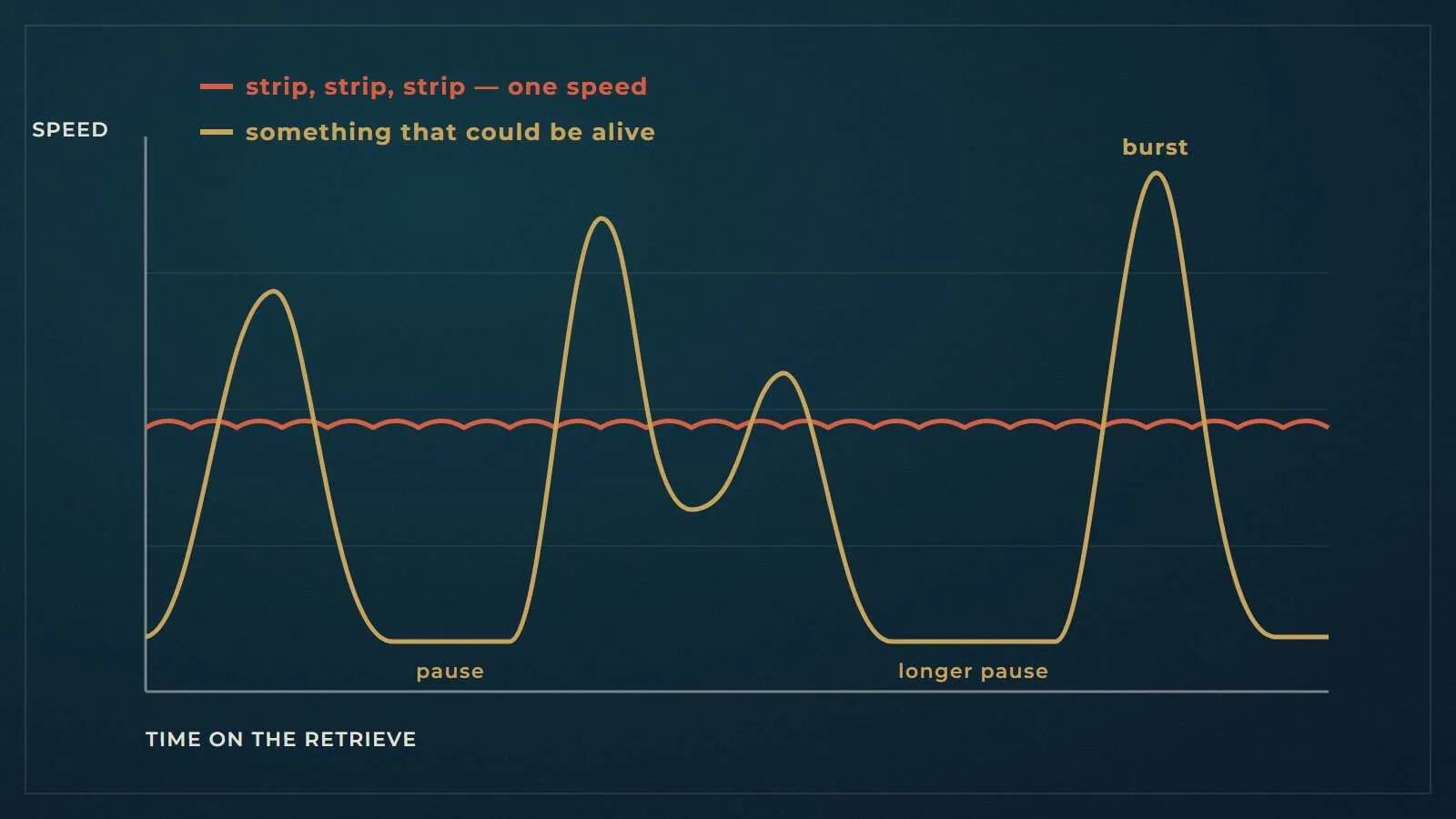
Cast across, two false casts, then strip-strip-strip-strip all the way back at a steady tempo, pick up, do it again. It’s rhythmic and oddly satisfying, and it’s the fishing equivalent of walking through a forest at a constant speed hoping something jumps out.
The fly is moving like a machine. Nothing it’s imitating moves like a machine.
What you’re actually imitating
Worth being specific, because “baitfish” covers a lot of different behaviors.
A healthy minnow doesn’t travel in a straight line at constant speed across open water in front of a trout. It holds near cover, moves in short bursts, stops, turns, and gets back to safety.
A sculpin is different again. Sculpin don’t swim like minnows; they dart along the bottom and settle.
An injured fish moves erratically, often with a lot of falling and struggling and very little forward progress.
Every one of those is irregular. The constant-speed strip isn’t imitating any of them; it’s imitating a lure, and it works often enough that people never question it.
Vary two things: speed and direction
The most useful change is simply making the retrieve uneven.
Two fast strips, a pause, one long slow pull, a pause, three short ones. Not a pattern you repeat — genuinely irregular, the way something that’s making decisions moves.
Then add direction. A twitch of the rod tip mid-strip kicks the fly sideways, and a lift changes its depth. Drop the rod tip and it falls.
That fall is where a disproportionate number of takes happen, for the same reason they happen on the pause with a jerkbait. Something that stops being able to swim is the easiest meal in the river, and a weighted streamer that drops on a semi-slack line does that convincingly.
Which means you have to be prepared for a take when the fly isn’t moving. Most people have slack out during the fall and miss it entirely.
The swing isn’t a failure of the retrieve
At the end of a cross-stream cast, the current picks up the line and the fly swings around below you, rising as it goes.
A lot of anglers treat that as the dead part of the drift and start stripping fast to get the cast over with. It is frequently the best part.
A fly swinging broadside across the current and lifting toward the surface is doing something a fleeing baitfish does, and the take on a swing is unmistakable because the fish hooks itself against the tension. On a lot of water — particularly bigger rivers and for bigger fish — the swing accounts for more of the eats than the strip does.
Slow it down and lead it with the rod tip, maybe with a small twitch as it swings. Then let it hang below you for several seconds at the end before you pick up, because fish follow a swinging fly and eat it when it stops.
Fish the structure, not the water between it
A big trout eating big food isn’t cruising midstream. It’s sitting somewhere that costs it nothing and gives it ambush access: an undercut bank, a log jam, the downstream side of a boulder, the seam where a fast tongue meets slow water.
Which means the cast is at that structure, tight, and the first two feet of the retrieve is the most important part — because that’s when the fly is where the fish is. A cast that lands four feet off the bank and gets stripped out into open water has already missed.
This costs flies. Fishing tight to wood means losing flies to wood, and if you’re not losing any, you’re fishing too far off.
Reading what happens
Streamer fishing produces visible information and it’s worth using.
A follow that turns off usually means the fly kept doing the same thing for too long. Change speed mid-follow — speed it up, or stop it dead. Stopping it is the one that works more often, and it’s the one nobody does because the instinct when a fish appears is to strip faster.
A swirl behind the fly with no contact is a fish that committed and missed, or a fish that swiped at it without meaning to eat. Come back to that spot in ten minutes with something smaller.
Multiple follows, no eats means you’re in the right place with the wrong presentation. Downsize before you change color — size and silhouette first.
Nothing means try somewhere else. Streamers are a searching method and the whole point is covering water.
Depth is a separate problem
None of the retrieve work matters if the fly is three feet above the fish.
In a slow pool a floating line and a weighted fly will get down. In anything with real current it usually won’t, and a sink tip becomes the difference between fishing and casting. The fly needs time to drop before the retrieve starts, and that often means casting further upstream than feels right and letting it sink on a mended, slack line before doing anything. The mending is buying sink time, not drift quality.
Why it’s worth being bad at this for a while
Streamer fishing has a worse catch rate than nymphing on most days and everybody knows it. You cast a lot, you move a lot, you get fewer fish, and your arm hurts.
What you get in exchange is a look at a different population of fish and a better idea of what’s actually in a river, plus every so often a take that’s genuinely startling — a big fish appearing from under a bank in water you’d written off.
That’s not a rational trade on a fish-count basis. It’s a fine trade anyway, and it’s one of the few parts of the sport where being deliberately unpredictable is the technique.
FIELD OBJECT
This one should leave the page.
The article is the long version. These are the pieces worth carrying into the next trip.
The 30-second version
Strip, strip, strip, all the way back at one speed. Nothing in a river moves like that, and a big fish has spent years watching things that don't.
What to watch
- What you're actually imitating
- Vary two things: speed and direction
- The swing isn't a failure of the retrieve
- Fish the structure, not the water between it
Field card
- What you're actually imitating
- Vary two things: speed and direction
- The swing isn't a failure of the retrieve
- Fish the structure, not the water between it
- Reading what happens
RIGHT TOOL, NEXT
Species & Presentation
Carry the species behavior and presentation question into a narrower water-to-fish-to-presentation handoff.