Watch a beginner who has just been taught to mend and you’ll see something specific: they mend immediately after every cast, hard, regardless of what the water is doing.
It’s not their fault. Somebody showed them the motion and the motion is the memorable part. What didn’t come across is that the motion is an answer to a question, and if the question isn’t being asked, the answer is just you yanking your fly sideways across the exact water you were trying to fish.
The problem mending solves
Current isn’t one speed. A river is a set of adjacent lanes moving at different rates, and your line is usually lying across several of them.
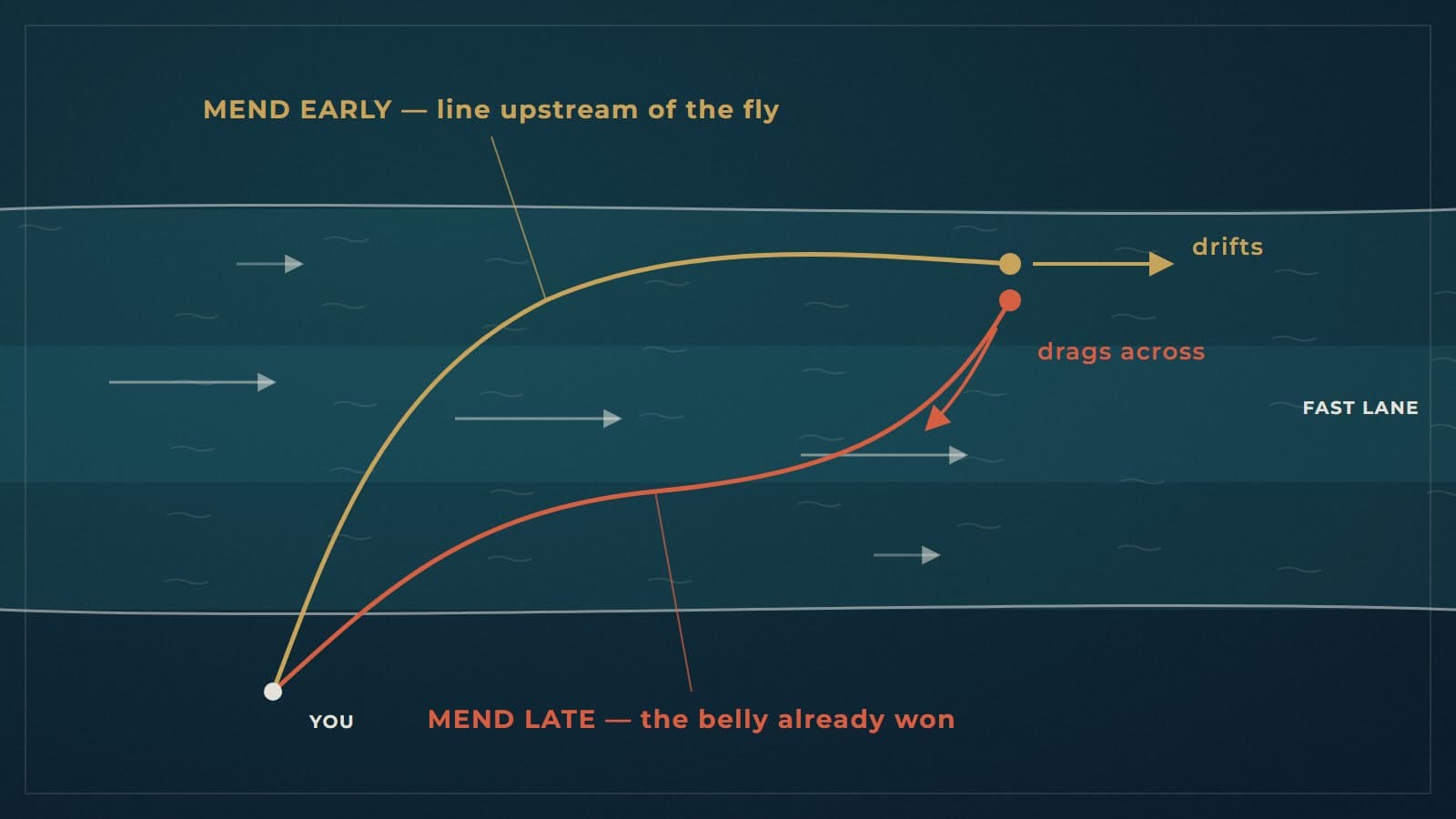
Faster water catches the middle of your line, bellies it downstream, and that belly starts pulling on the fly. Now the fly is traveling faster than the water it’s sitting in, or being towed across it, and a fish looking at that sees something no real insect does.
Everything about mending is aimed at that one problem: line in a faster lane than fly.
Which means the first thing to do is read the lanes. If your line and your fly are in the same speed of water, there’s nothing to fix. Reading moving water before the first cast comes before any of this, because mending without reading is a motion, not a technique.
Upstream or downstream depends on which side is fast
The default everyone learns is the upstream mend, because the most common situation is casting across a fast middle into a slower seam. The fast water is between you and the fly, so you flip the belly upstream to give the fly slack and delay the pull.
But the opposite situation is real and it’s where people freeze. If you’re standing in the fast water and your fly is across in even faster water, an upstream mend just makes things worse. You want a downstream mend — putting the line below the fly so that it isn’t held back.
The question to ask isn’t “which way do I mend.” It’s “is my line in faster or slower water than my fly.” The answer picks the direction for you.
Mend before drag starts, not after
This is the one that actually changes results.
Once the belly has formed and the fly has begun to skate, the mend is a rescue operation. Picking that line up and throwing it upstream moves the fly. You’ve corrected the line and destroyed the drift in the same motion.
The good version happens early, while the belly is small and the fly hasn’t started moving. A small mend at the right time does more than a big one at the wrong time, and it doesn’t disturb the fly at all.
Which means watching the line, not the fly. That takes a while to get comfortable with. Most people watch the indicator or the dry because that’s where the excitement is, and by the time the fly tells you about drag, you’re late.
Fix it in the air first
The best mend is the one you don’t have to make.
Reach cast. As the line is unrolling, move the rod tip upstream or downstream. The line lands already curved in the direction you need, and you get a drag-free drift from the moment it touches down rather than after a correction. This single cast eliminates more mending than any amount of on-water technique.
Stack mends. Feeding slack in a series of small waves as the drift develops, extending it without ever picking the line up.
Just get closer. Less line on the water is less line in the wrong lanes. A lot of mending exists to compensate for a cast that didn’t need to be that long. A short cast with a clean drift beats a long one with three corrections, every time — which is part of why an ugly cast can fish better than a perfect one.
The subsurface version is different
Mending a nymph rig isn’t only about avoiding drag. It’s also about depth.
An upstream mend on a weighted rig releases tension, which lets the flies sink. Mending early and often at the top of a drift is how you get flies down fast in the short distance available before the run ends. That’s a different purpose from the dry-fly mend, and it’s why nymph anglers mend more aggressively and don’t worry as much about moving the fly a little.
At some point the mending stops being worth it and you’re better off eliminating the line on the water entirely. That’s what tight-line nymphing does — it solves the drag problem by refusing to have a belly in the first place.
When not to mend
Worth saying directly, because the reflex is strong.
Don’t mend when your line and fly are in the same current speed, or when you’re fishing a swing on purpose and the tension is the point. Skip it in the last third of a drift when the fly is about to swing anyway and the mend will only cause a jump. And don’t mend a dry fly that’s floating perfectly, which happens more than you’d think and gets ruined by habit.
A drift that’s working does not need your help.
How to practice it
Pick one seam and fish it for twenty minutes without changing flies.
Cast, watch the line rather than the fly, and try to identify the moment the belly starts forming. Don’t mend at all for the first several drifts — just find the moment. Then start mending at that moment and see how much longer the drift lasts.
That’s a genuinely boring twenty minutes and it’s the fastest way I know to make mending stop being a ritual. Once you can see the belly forming, the timing takes care of itself, and you’ll notice you’re mending less often and getting better drifts, which is the opposite of what most people expect.
FIELD OBJECT
This one should leave the page.
The article is the long version. These are the pieces worth carrying into the next trip.
The 30-second version
Mending isn't something you do after every cast just because somebody showed you the motion. It fixes one problem, and doing it at the wrong moment drags your fly across the lane.
What to watch
- The problem mending solves
- Upstream or downstream depends on which side is fast
- Mend before drag starts, not after
- Fix it in the air first
Field card
- The problem mending solves
- Upstream or downstream depends on which side is fast
- Mend before drag starts, not after
- Fix it in the air first
- The subsurface version is different
RIGHT TOOL, NEXT
Tackle Link Analyst
Follow the load path and find the part of the setup that actually limits the rest.