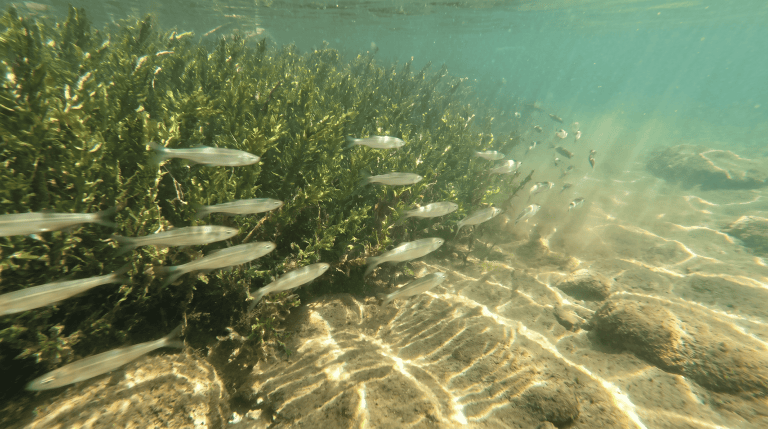
From the bank, a river looks like one thing going one direction at one speed. It isn’t. Current speeds up, slows, splits around rocks and drops over ledges, and it leaves soft pockets behind where a fish can sit next to the food line without paying for it.
FIELD PLATE · CURRENT
Spend the first few minutes finding this picture in the actual river.
So the first few minutes on a run shouldn’t be casting minutes. They’re for finding the lanes, the soft edges beside them, somewhere you can stand, and somewhere you could actually land a fish. Then pick an angle that lets the current work for you instead of stealing the rig.
Read the flow before you choose tackle
A few minutes on shore, before you get in, shows you more than the first ten casts will — fast tongues, eddies, the spots where flow bends. Foam, bubbles and drifting leaves draw the flow paths for free. Standing there looking still isn’t the same as knowing, and the line between the two is worth being strict about.
The fastest water you can see isn’t automatically where the fish are. The useful relationship is usually fast water delivering food beside slower water where a fish can wait without spending everything it eats.
Seams
A seam is where water moving at different speeds or in different directions meets. That boundary can concentrate drifting food and let a fish use the current without living in the worst of it.
Fish both sides and the line itself. Which side pays can change with depth, light and flow, so two drifts don’t settle it.
What’s behind the rock is only half of it
Boulders, logs, bridge piers, islands and bottom changes all make softer pockets downstream or alongside. The obvious calm right behind the rock is the part everybody casts at. The faster water wrapping around its edges may be the actual feeding lane.
So drift the edge where fast meets soft, not just the rock.
A pool is several pieces of water
Water entering a pool usually carries food down a defined lane before it spreads and slows. The tail squeezes the flow again as the bottom comes up. Fish move between those parts depending on temperature, light, food and flow.
Treat the head, body and tail as different targets. Treat the whole thing as one big oval and you can fish a good pool badly for an hour.
Smooth water can hide depth
The surface doesn’t reliably tell you what’s under it. Darker color, slower surface flow and standing waves all help, and every one of them can lie to you.
Wade like you don’t know the bottom, because you don’t. Check current local information, carry the safety gear that water calls for, and don’t step into anything you can’t assess. No read of a run is worth that.
Pick the lane before the lure
Decide where the presentation needs to travel — the soft side of a seam, say, or along a boulder edge. That lane decides your weight, depth, angle and line management.
Pick the lure first and force it through the wrong current, and the drift turns into a fight with your tackle instead of a test of the water.
The angle sets the speed
Casting upstream gives a sinking presentation time to get down, and you’ll be managing slack the whole way. Across covers water efficiently but builds a belly in the line. Downstream loads tension, which changes the speed and puts a swing in it.
There’s no single correct angle. There’s the one that gives this piece of water the path and depth it needs.
Line management is part of the presentation
Current pulling on the line can drag a lure or bait faster than the water around it, lift it off depth, or pull it right out of the lane. Mend, move the rod, shorten the cast, or change the angle — whatever the technique calls for.
You want enough connection to feel and steer without so much tension that drag ruins the drift. Those two pull against each other the entire time, and balancing them is most of the skill.
Weight isn’t always the first fix
More weight gets a rig down. It also snags more, kills movement, and can make the drift harder to manage. Before you add any, check the angle, the cast distance, line diameter, and where you’re standing.
Use the lightest setup that reliably does the job. Adding a split shot takes ten seconds. Retying after the river keeps your whole rig takes a lot longer.
Shorten the cast when the current owns the line
Long casts hand the current and wind more line to play with. If the belly is wrecking your depth or hiding bites, move where it’s legal and safe, change the angle, or just throw less.
A long cast only counts if you can still fish the water it reached.
Let the line and depth verify the read
The line is telling you things
A hesitation, a sideways twitch, tension that suddenly disappears — that could be bottom, weeds, a current change, a snag, or a fish. Learn what the rig does on a normal drift before you set on everything.
Line behavior is part of reading moving water, because it shows you forces the surface is keeping to itself.
Check the seam at more than one depth
The seam you see on top doesn’t necessarily line up with the useful boundary near the bottom. Flow bends around contours and rocks on the way down.
If the upper layer gives you nothing, change depth before you give up on the seam. That matters most when fish are holding tight to bottom while food moves higher up.
Position for control and for the landing
Two steps upstream can change the whole cast
The closest place to cast from isn’t automatically the best one. A few steps up, down, or back from the edge can fix the angle and take drag out of the line. Boat position works the same way.
Pick your spot for presentation and footing at the same time, and don’t wade deeper just to gain distance. That trade always looks better from dry ground than it is.
Plan the landing before the hookset
Current that’s easy to stand in while casting gets complicated with a fish attached. Find the slower water, stable bank, or netting spot where you can control a fish without dragging it across rocks or holding it in heavy flow.
If the landing route isn’t safe for you or the fish, move before you cast.
Read it again when the flow changes
Dam releases, tides, rain, irrigation and snowmelt all move seams, bury rocks and open new channels. The map you built this morning can be wrong by two o’clock.
When the flow changes, stop and read the water again instead of repeating the same casts at a river that’s moved on.
If all of this sounds like something other people were born able to see, it isn’t. It’s the same few shapes — a seam here, a soft pocket there — and after enough runs they start jumping out at you before you’ve even strung up the rod.
FIELD OBJECT
This one should leave the page.
The article is the long version. These are the pieces worth carrying into the next trip.
The 30-second version
A river only looks like one thing going one direction. Find the lane, the soft water beside it, and a place you could land a fish before the first cast goes anywhere.
What to watch
- Read the flow before you choose tackle
- Seams
- What's behind the rock is only half of it
- A pool is several pieces of water
Field card
- Read the flow before you choose tackle
- Seams
- What's behind the rock is only half of it
- A pool is several pieces of water
- Smooth water can hide depth
RIGHT TOOL, NEXT
Field Sense Navigator
Take the article’s water or access question into a place-specific conditions and route check.