Spotted Bass Live in the Gap Between Largemouth Water and Smallmouth Water
Spotted bass hold more current than a largemouth wants and warmer, murkier water than a smallmouth likes. Where to start in that gap, and the jaw and tongue checks that keep you from calling it a largemouth.
By HunterUpdated September 12, 2026Read 9 min
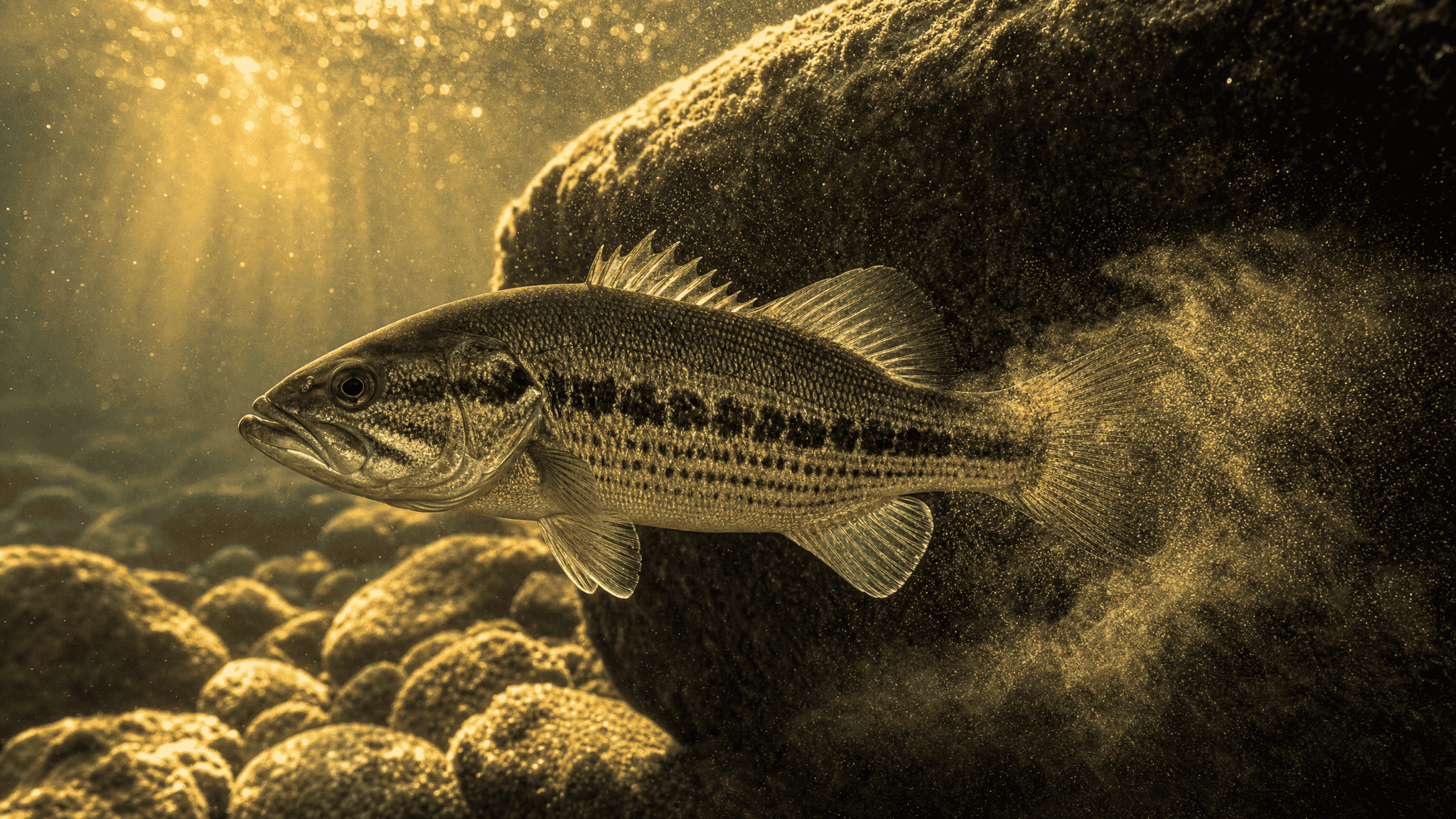
Image: behind a boulder, golden current
Spotted bass take the water their two famous relatives leave on the table: more current than a largemouth usually bothers with, but warmer, murkier or slower than a smallmouth likes. Micropterus punctulatus is a black bass of the Mississippi basin and Gulf-slope drainages, and that current gap is the best starting point for finding one. A spotted bass has never been on the end of my line, so what’s below about identifying and fishing one comes from agency accounts.
At a glance · The short version
Scientific name
Micropterus punctulatus
Identification shortcut
Jaw ends at or only slightly behind the eye, a rough tooth patch sits on the tongue, and rows of dark spots run below the lateral stripe.
Reported maximum length
61 cm (24 in) in the USGS Nonindigenous Aquatic Species profile.
Spawning water
Rock and gravel; Texas Parks & Wildlife reports spawning at roughly 57–74 F.
River address
Rocky current breaks, pools, and runs with real flow but not necessarily the cold, hard current a smallmouth can dominate.
Conservation wrinkle
Outside its native range, stocked spotted bass can hybridize with native black bass and change a fishery genetically, not just numerically.
What fish is this?
Identification
Jaw and mouth
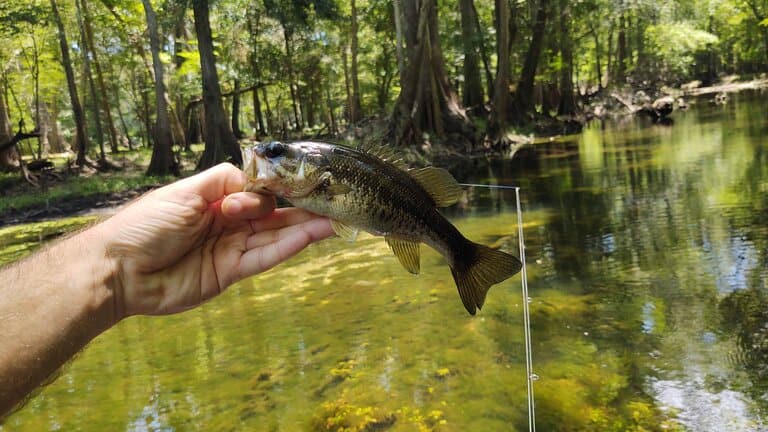
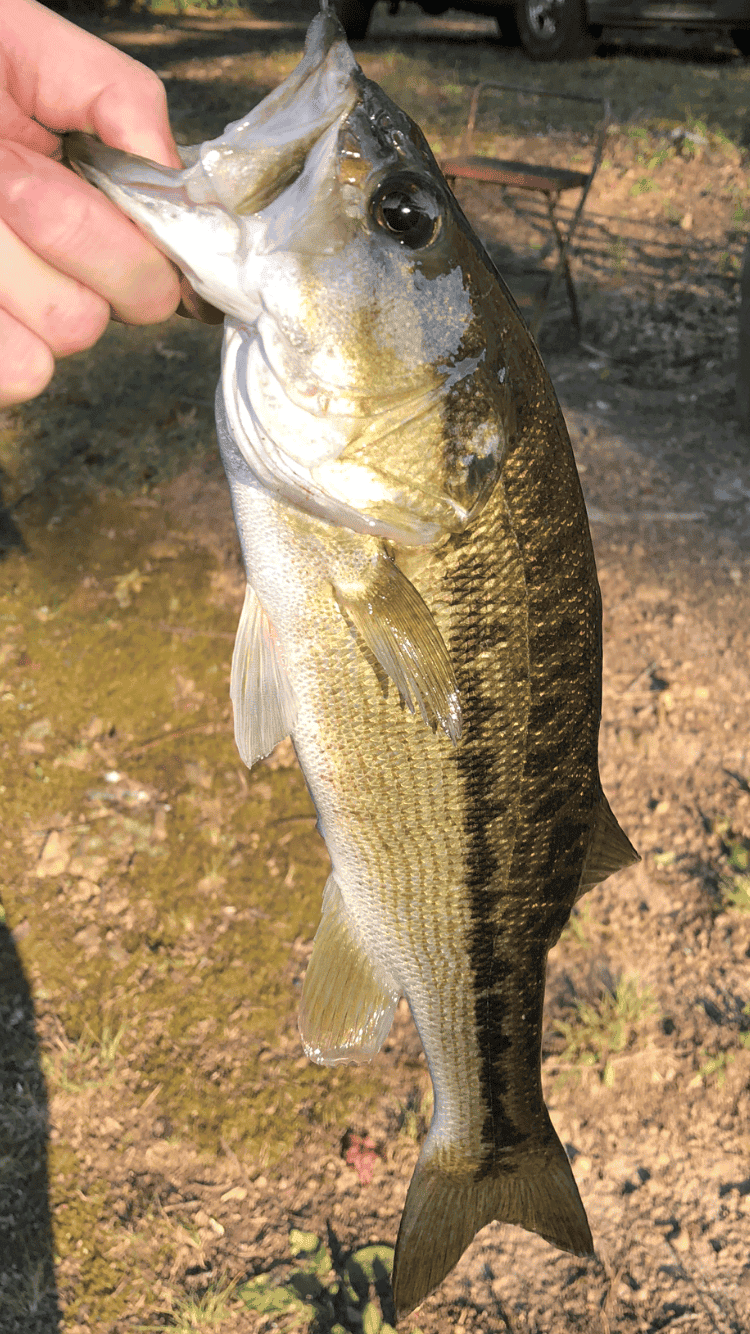
The upper jaw reaches to, or only very slightly beyond, the rear margin of the eye in an adult. That immediately separates it from a largemouth, whose jaw projects well behind the eye.
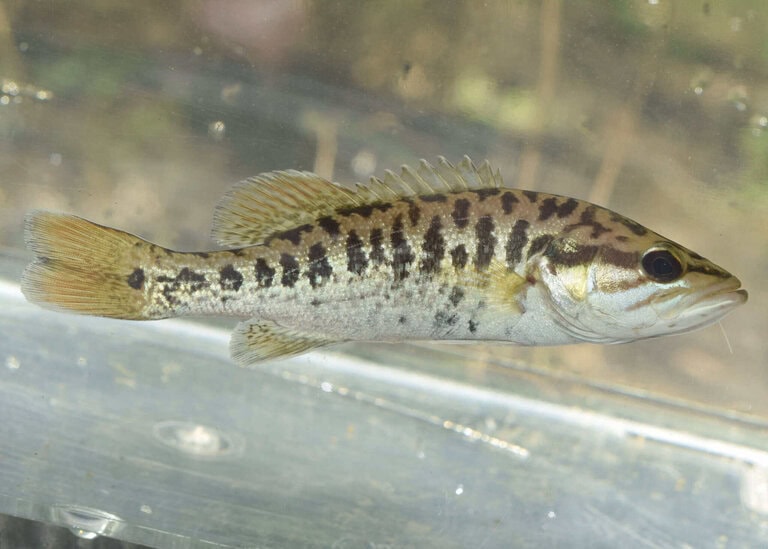
A dark horizontal band can look largemouth-like at first glance, but spotted bass add rows of dark spots or streaks on the lower sides. Texas notes that the species name punctulatus refers to those dotted lower-side rows.
A small rough patch of teeth on the tongue is a useful structural trait when color and pattern are ambiguous. Georgia DNR also uses that tongue patch in its field identification guidance.
The safest field call uses several traits together: jaw reach, lower-side spotting, tongue patch, dorsal-fin connection, and the drainage you’re standing in. Alabama bass and hybrids make a one-feature identification especially risky in parts of the Southeast.
Where do I find them?
Habitat & Range
Native range
USGS places the native range through the Mississippi River basin from southern Ohio and West Virginia west toward southeastern Kansas and south to the Gulf, plus Gulf-slope drainages from the Chattahoochee system west to the Guadalupe River in Texas. Stocking has carried the fish beyond that core range.
Texas describes a useful habitat separation from its two famous relatives: spotted bass generally use more current than largemouth, while also occupying water that can be too warm, turbid, or sluggish for smallmouth. That doesn’t mean every spotted bass sits in a mathematically perfect middle seam. It means the species tolerates a broader warm-river middle ground than the shortcut phrase fish it like a smallmouth suggests.
“Middle ground” sounds like a spot you could drop a pin on. It works better as a test — start in the slower, largemouth-looking water and work toward the current, paying attention to where fish show up and where they quit. That line moves from river to river, and nobody at the ramp can hand it to you.
Structure
Rock and gravel matter repeatedly in agency descriptions, in both rivers and reservoirs. In current, that makes bridge riprap, boulder edges, gravel transitions, channel swings, submerged rock, and the softer water immediately behind hard structure more useful starting points than featureless slack banks.
Spotted bass have been stocked outside their native drainages for sport fishing and are established in many of those locations. USGS documents introductions and warns that the ecological result can include predation, competition, and hybridization with native black bass.
Texas reports rock and gravel as typical nesting substrate and a broad spawning temperature range of 57–74 F. Nest depth varies. Many fish mature early, although adults found on spawning areas are commonly older. Females may produce roughly 1,150 to 47,000 eggs, and males guard the eggs and can remain with young for up to four weeks after hatch.
Young spotted bass begin on zooplankton, shift toward insects as they grow, and later take fish and crayfish. That ontogenetic change matters to presentation: a six-inch fish and a mature river bass are not solving the same food problem.
USGS summarizes research showing diet overlap between juvenile and subadult spotted bass and both largemouth and shoal bass. In an introduced population, the concern is therefore not just that a spotted bass eats native prey. It can also compete directly with native black bass while hybridizing with them.
Evidence level. The biological fields above come from agency species accounts and USGS records. The tackle section below is agency angler guidance and field logic, so treat it as convention rather than experimental proof.
First water to checkconvention
Start where current meets rock but gives the fish a cheaper holding position: the downstream side of a boulder, an inside seam, the lip of a deeper pool, riprap beside moving water, or a gravel-to-rock transition. If the water looks perfect for largemouth because the current has basically disappeared, move closer to flow. If it looks like the hardest smallmouth water in the river, check the softer edge first.
Lure categoriesconvention
Georgia DNR lists natural or artificial crayfish, worms, shad-pattern crankbaits, spinnerbaits, and bottom-fished worms. That list makes biological sense because adult diet centers heavily on fish and crayfish and the habitat is usually structured enough to reward a lure that can stay near the bottom without being pinned there.
Let the current help. A bottom bait that tracks naturally down a seam or a crankbait that ticks rock and then clears into the soft pocket is closer to the fish’s actual feeding lane than dragging every cast straight across the current at the same speed.
What to change firstinference
If the water is right and nothing happens, change depth before abandoning the structure. Spotted bass use rivers and reservoirs, and a fish comfortable with current can still slide vertically when light, temperature, discharge, or forage position changes.
What changes with the season?
Seasonal Working Map
Period
What changes
What I would watch
Pre-spawn
Fish move toward suitable rock and gravel spawning areas as water warms.
Protected gravel near current, staging depth close to spawning habitat, and the first stable warm-water windows.
Spawn
Nesting occurs across a broad agency-reported band of roughly 57–74 F; males guard eggs and young.
Do not turn a temperature number into permission to hammer visible nesting fish. Regulations and conservation priorities differ by water.
Summer
Current remains an oxygen and feeding advantage, but depth and shade can matter more as water heats.
Deeper current breaks, bridge shade, rock adjacent to channel depth, and forage position rather than shoreline appearance.
Autumn
Cooling water and moving forage can pull fish back into aggressive feeding lanes.
Shad or other baitfish using current edges, creek mouths, and rocky transitions.
Winter
Metabolism slows and fish often use deeper, more stable water.
Pool depth, channel bends, and slower presentations that stay in the strike zone longer.
The seasonal rows above are a working map, not a nationwide calendar. Latitude, reservoir influence, flow regime, and local forage can shift timing substantially.
What can go wrong?
Conservation, Identification & Regulation
Hybridization
USGS documents spotted bass hybridizing with smallmouth where the species has been introduced, including evidence that hybridization contributed to smallmouth decline in a Missouri drainage. Texas is also actively studying Guadalupe Bass × Spotted Bass hybridization in its rivers. Moving a live black bass between waters is therefore not a harmless way to improve fishing; it can permanently change the genetics of a native population.
Older field guides and some state pages historically grouped Alabama bass with spotted bass. Modern taxonomy treats Micropterus henshalli as a separate species. In waters where both may occur, a generic spotted-bass label can hide a real identification and management problem.
Some agency identification pages still discuss them together because the field problem is real. Current taxonomy separates them. Alabama bass have their own genetics, range and invasive-management story, and it needs more room than a card on somebody else’s page.
The current middle ground
The common shorthand that spotted bass sit between largemouth and smallmouth in current tolerance is useful but not a hydraulic specification. Discharge, temperature, turbidity, cover, depth, and local competition all change which species owns a particular seam.
— · Still unsettled
Not Established Here
a single nationwide preferred temperature band
a universal depth by season
barometric-pressure response
cold-front response
a universal wind rule
a single tackle setup that applies across rivers and reservoirs
— · Sources
FEEDING ECOLOGY · STANDARDIZED
How this fish gets fed.
Primary prey
Adults take fishes and crayfish as major prey, with aquatic insects also important, especially in smaller fish.
Feeding mode / location
A current-tolerant black bass that feeds around rock, gravel, channel structure, current breaks, and reservoir points or offshore structure. Productive positions put prey delivery beside a lower-cost holding lane.
Diel / seasonal pattern
No universal diel feeding window is established in this profile. Spring spawning moves adults shallow; outside the spawn, current, prey availability, depth, and seasonal temperature shape position more reliably than a fixed clock.
Ontogenetic diet shift
Young spotted bass begin with zooplankton, then shift toward insects; larger fish increasingly take fishes and crayfish.
The documented spawning-temperature range remains a spawning value, not a feeding-temperature band.
Compiled 2026-09-11. Limits and advisories are set per water and per state and change between seasons — the managing agency for wherever you are fishing has the current answer.
“Halfway between a largemouth and a smallmouth” is a pretty boring way to describe a fish. It earns its keep anyway, because it tells you what to test. When a river has more push than largemouth water but runs warmer or murkier than good smallmouth water, slow down and check the jaw and the tongue patch on the one you just landed. Calling every green bass a largemouth is exactly how an introduced spotted bass, or a hybrid, goes unnoticed.
River FishRiver-fish species profiles covering habitat, behavior, seasonal movement, fishing approaches, conservation status, and regional variation across the United States.49 articles
Species & BehaviorFish behavior, habitat, depth, forage relationships, and species-specific field decisions. Start with the Freshwater Fish Species field guide.159 articles
Cookie Consent
We use cookies to improve your experience on our site. By using our site, you consent to cookies.
Used to determine whether a user is included in an A / B or Multivariate test.
18 months
_ga
ID used to identify users
2 years
_gali
Used by Google Analytics to determine which links on a page are being clicked
30 seconds
_ga_
ID used to identify users
2 years
_gid
ID used to identify users for 24 hours after last activity
24 hours
_gat
Used to monitor number of Google Analytics server requests when using Google Tag Manager
1 minute
_gac_
Contains information related to marketing campaigns of the user. These are shared with Google AdWords / Google Ads when the Google Ads and Google Analytics accounts are linked together.
90 days
__utma
ID used to identify users and sessions
2 years after last activity
__utmt
Used to monitor number of Google Analytics server requests
10 minutes
__utmb
Used to distinguish new sessions and visits. This cookie is set when the GA.js javascript library is loaded and there is no existing __utmb cookie. The cookie is updated every time data is sent to the Google Analytics server.
30 minutes after last activity
__utmc
Used only with old Urchin versions of Google Analytics and not with GA.js. Was used to distinguish between new sessions and visits at the end of a session.
End of session (browser)
__utmz
Contains information about the traffic source or campaign that directed user to the website. The cookie is set when the GA.js javascript is loaded and updated when data is sent to the Google Anaytics server
6 months after last activity
__utmv
Contains custom information set by the web developer via the _setCustomVar method in Google Analytics. This cookie is updated every time new data is sent to the Google Analytics server.
2 years after last activity
Jetpack's built-in visitor analytics. It records page views, referring sites, search terms, and outbound link clicks, and also carries the shared visitor-tracking library used by Jetpack Instant Search and WooCommerce Analytics.