SMALLMOUTH BUFFALO · SPECIES PROFILE
A native fish that gets killed for looking like something it isn’t.
Most people meet a smallmouth buffalo as a silhouette and file it under carp. It’s a native sucker, and it isn’t really a hook-and-line fish either — Nebraska says so directly — so you’re a lot more likely to need to identify one than to catch one on purpose. I haven’t caught one, and I’m not sure I’ve even seen one. What I can do is take the ID seriously, because getting it wrong costs a native fish its life for looking like something else.
Profile basis: Lackmann et al. 2023, Scientific Reports · Missouri Department of Conservation · Nebraska Game and Parks
A HUNDRED AND ONE
Somebody finally cut one open and counted properly.
In 2023 a team published otolith thin-section ages for smallmouth buffalo out of Apache Lake in Arizona. An otolith is the ear stone, and it lays down annual rings the way a tree does; you slice it and count. The oldest fish came back at a hundred and one years.
Everything published before that put the maximum at fifteen to eighteen. So this wasn’t a correction of a few years at the top end. It was off by roughly a factor of five, and it means a species that’s been managed as disposable has been quietly running on a century-long clock the whole time.
Why Apache Lake specifically: the population there was founded in 1918, it’s lightly fished, and almost nobody has been removing the old ones. Everywhere that gets hammered, the old fish are simply gone, so nobody finds them, so nobody writes them down. The earlier low numbers were mostly scale-based aging of exploited populations, and scales stop being readable long before the fish stops living.
Two things I want to be careful about, because this fact gets repeated badly. First, the hundred-and-one figure is not bomb-radiocarbon validated and it rests on three fish. It is a striking result, not a settled one. Second — and this is the one that goes wrong constantly — there is a radiocarbon-validated hundred-and-twelve-year record, and it belongs to bigmouth buffalo, a different species. Any article giving smallmouth buffalo a validated hundred and twelve years has borrowed a number from the fish next door.
A 2024 study on Lake Erie’s commercial harvest put the oldest buffalo it saw at forty-eight. That is a fished population being honest about what is left in it.
Sources: Lackmann et al. 2023 · Lake Erie buffalo harvest study, 2024 · FishBase
BARBELS
Two pairs or none. That is the whole thing.
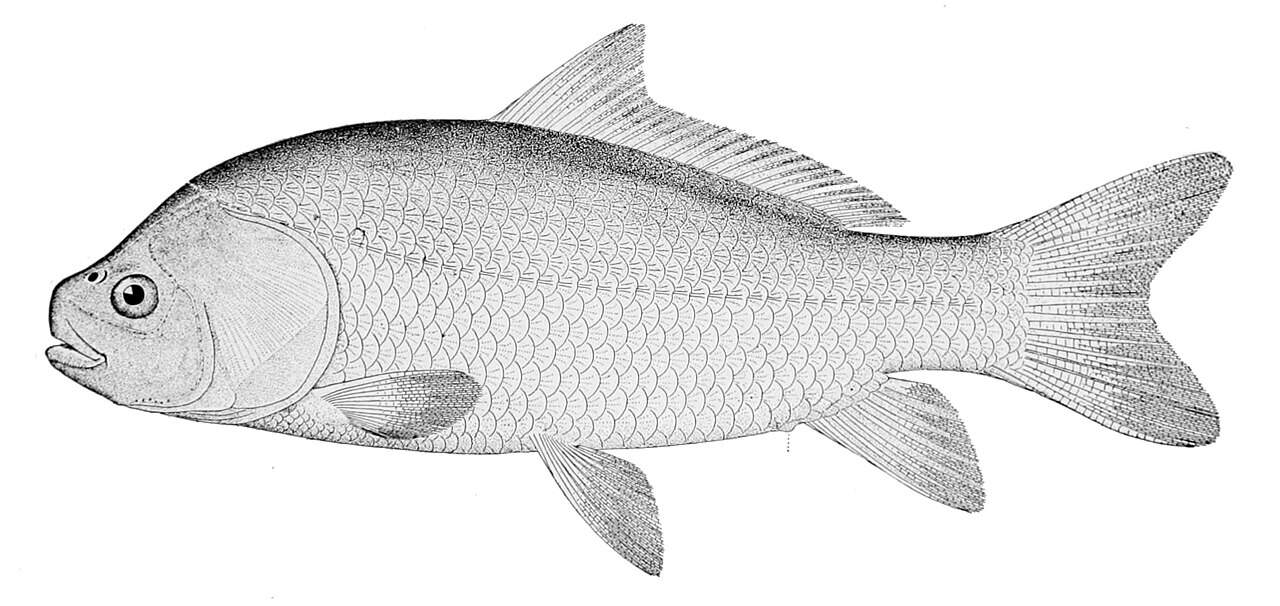
This is the check that matters most on this page. Smallmouth buffalo get shot, netted and left on the bank because somebody read them as carp at ten yards. Look at the mouth: a buffalo has a sucker mouth and no barbels at all, and a common carp has two pairs of them. That settles it, and it settles it before anything else gets decided.
The Fish and Wildlife Service publishes a side-by-side graphic for exactly this comparison, which tells you how routine the mistake is. Oklahoma puts it plainly too: buffalofish are often lumped in with carp or just called carp, by people who have never been given a reason to look closer.
If you want a second check, the dorsal fin does it. A carp’s dorsal is preceded by a stout serrated spine. A buffalo’s is long and falcate with twenty-six to thirty-one rays and no spine at all. The eye sits small and forward, closer to the snout than to the back of the gill cover.
Color is no use. Size is no use. At distance, in poor light, from a boat, a big buffalo and a big carp throw the same silhouette, and that’s the entire problem in one sentence.
Sources: US Fish and Wildlife Service · Oklahoma Department of Wildlife Conservation · USGS
AND THEN THERE ARE THE OTHER TWO
Telling three buffalo apart is harder than telling one from a carp.
Bigmouth buffalo is the easy one, because the name is doing real work. Its mouth is large, terminal and oblique — it opens nearly straight forward, the way a fish that eats plankton in open water needs to. A smallmouth’s mouth is small, nearly horizontal and subterminal, pointing down at the bottom where its food is. The tidiest version of the check is the eye: on a smallmouth the upper lip sits well below the lower edge of the eye, and on a bigmouth it’s roughly level with it. The upper jaw is also shorter than the eye is wide, which it isn’t on a bigmouth.
Black buffalo is the hard one, and this is where the shortcut fails: both are subterminal, so the mouth tells you nothing. You have to go to proportions. A black buffalo isn’t as deep in the body but is thicker through it, at about 2.6 to 3.2 times its standard length, and its back curves gently. A smallmouth is deeper and flatter, and the back in front of the dorsal is strongly keeled — sharp enough to feel.
What won’t work, in any combination, is length. Smallmouth run fifteen to thirty inches, black buffalo twenty to thirty, bigmouth fifteen to twenty-seven. The overlap is total. Size never identifies a buffalo.
Sources: Nebraska Game and Parks · Missouri Department of Conservation, black buffalo · Missouri Department of Conservation, bigmouth buffalo
A GRINDER, NOT A HUNTER
Which is precisely why it won’t take your bait.
Behind the throat a smallmouth buffalo carries something like a hundred and eighty to a hundred and ninety pharyngeal teeth on each arch, and they’re for grinding shelled things. The fish works the bottom, sorting substrate and taking crustaceans, insect larvae, attached algae, mollusks, detritus and whatever zooplankton comes past, roughly in proportion to how much of each is there. It is opportunistic without being predatory. Juveniles start on copepods and cladocerans and then move onto the rest.
One trait not to import from the family: only bigmouth buffalo is a genuine plankton feeder. That one is a filterer in open water. This one is a bottom grinder, and they are doing different jobs.
And that is the actual reason the method section on this page is short. It is not that nobody has studied how to catch them. It is that a substrate-sorting benthic grazer has very little reason to strike a lure or engulf a baited hook in the first place. The blanks in the fishing record are blank by nature rather than by neglect, which is a more satisfying answer than I expected to find.
Sources: USGS Nonindigenous Aquatic Species · Missouri Department of Conservation
IF YOU ACTUALLY WANT ONE
Iowa’s honest answer is a bow.
Agencies don’t describe this as a hook-and-line fishery, so a lot of what follows is really about recognizing what happened when one grabs a bait meant for something else. The guidance is thin and it’s convention. If a smallmouth buffalo is honestly the fish you want, it’s a bottom-feeding, small-bait, patience problem, and I’d trust somebody local over anything printed here.
Iowa lists snagging and bowfishing as the most likely ways to get this fish, which isn’t advice so much as a description of how it usually happens. Nebraska says seldom caught by anglers. Missouri’s state record black buffalo was hooked by accident by somebody who was crappie fishing, which is about the most representative capture story in the genus.
Texas supplies the only bait any agency names: doughballs made with cottonseed meal. One bait, in the entire record. Passive set lines do work — trotline, throwline, limb line, bank line, jug line — and it was a trotline that produced the ninety-seven-pounder.
Where to look, if you’re looking: Iowa records large schools gathering near structure like wing dams, in moderate current over sand and gravel, and in deep pools. They prefer finer substrate and deeper water than their relatives, clearer water than a bigmouth, and less current than a black buffalo — within the genus this is the middle fish on every axis.
And for what it’s worth, Texas calls a hooked one substantial sport and Missouri groups buffalo with the hard-fighting, good-eating fish of the Missouri River. The people who catch them on purpose aren’t apologetic about it.
Sources: Iowa DNR · Texas Parks and Wildlife · Nebraska Game and Parks
SIXTY TO SIXTY-FIVE
Spring is when they’re easiest to find and easiest to kill, and those are the same weeks.
Spawning runs at sixty to sixty-five degrees Fahrenheit, April into early June, and USGS and Texas arrived at that band independently. No nest, no guarding, nothing: eighteen thousand to half a million adhesive eggs scattered and abandoned, hatching in one to two weeks. Missouri puts the spawning depth at four to twenty feet. Montana’s Missouri River fish run later, late May into July with a mid-June peak.
The standard account has them spawning in deep pools and backwaters over weeds and mud. A study on the Lower Wisconsin River found thousands of them instead on main-channel gravel shoals in shallow water near shore, and the authors were careful to flag it as possibly a novel spawning habitat rather than quietly folding it into the textbook. Either the species is more flexible than anybody thought or it’s doing something new, and I don’t think anyone knows which.
Spring water-level fluctuation significantly affects how many young survive. It’s the only recruitment driver anybody has documented for this fish, which is a thin evidence base for a species this widespread.
The uncomfortable part is that the aggregation and the exposure are the same event. Dense schools in shallow water in spring is the period of maximum vulnerability, and it lines up almost exactly with the season when a lot of places allow snagging and bowfishing. Nobody appears to have written down whether that matters, one way or the other.
Sources: USGS · Texas Parks and Wildlife · Lower Wisconsin River spawning study · Montana Field Guide
THE PAPERWORK HAS NOT CAUGHT UP
Least Concern, assessed on a lifespan that turned out to be wrong by a factor of five.
The IUCN listed smallmouth buffalo as Least Concern in 2018, when the species was believed to live fifteen to eighteen years. That isn’t a bad assessment. It’s one that has been overtaken, and nobody has redone it.
The numbers sitting next to that listing already disagree with it. FishBase rates the species’ resilience as low, with a minimum population doubling time of four and a half to fourteen years, and scores its vulnerability to fishing at sixty-eight out of a hundred. A fish that takes six or seven years to mature, can live for a century, and replaces itself slowly isn’t built to absorb unlimited removal — and the Lackmann paper notes that as of 2023 no take limits exist on buffalofishes across most of their United States range, including the same Arizona where the hundred-year-old fish came from.
Something may be shifting. Minnesota redefined rough fish as native rough fish in statute in 2024, separating them from common carp, and in February 2026 proposed the first harvest limits the state has ever had for them — five a day in the northern zone and thirty in the southern, bigmouth and smallmouth combined, to take effect in March 2027. The stated reasons were rising angling and bowfishing interest, some evidence of population declines, and a renewed appreciation for what these fish do in a river. I haven’t been able to confirm whether it was adopted as written, so treat that as a proposal rather than a rule.
None of which is an argument against catching one. Buffalo are commercially important precisely because they’re good: Texas calls smallmouth buffalo the number one species sold by its commercial freshwater fishermen, buffalofishes make up the largest biomass of Arkansas’s annual commercial catch, and Missouri has called them fine food fishes for a very long time. Advisories do exist and they name this species specifically on some waters, which is worth one look at your state’s list before you plan on eating one.
Sources: Lackmann et al. 2023 · FishBase · Minnesota DNR · Texas Parks and Wildlife · Encyclopedia of Arkansas
WHERE THE SOURCES ARGUE
Check the publication date before you decide which number is wrong.
Most of the arguing about this fish is over age and growth, and it’s recent. Longevity work has been overturning the accepted figures rather than nudging them, so two sources a few years apart may not be describing the fish badly — they may just be describing where the question stood when each was written.
Maximum length is the cleanest example of two sources that can’t both be species maxima: FishBase gives a hundred and twelve centimeters, USGS gives seventy-eight. Neither states its basis. The USGS figure is barely above the ordinary adult range that Missouri and Illinois publish, which makes me suspect it’s a regional maximum wearing a species label, but that’s a suspicion and not a finding.
Maximum weight is stranger. FishBase caps the species at 37.3 kilograms, about eighty-two pounds. Texas has a rod-and-reel fish over eighty-two and a trotline fish at ninety-seven. The trotline fish exceeds the published species maximum, and Oklahoma has one over sixty-six pounds, and Iowa’s state record is forty-three pounds and thirty-six inches, taken in December of 2021 — which at minimum establishes that winter capture happens, since nothing in the record describes what this fish does in winter at all.
The honest summary of the rest is that the blanks are enormous. No diel activity pattern. No seasonal behavior outside spring. No dissolved oxygen requirement. No pH figure — the one you will find belongs to bigmouth. Nothing on handling or release, which for a fish this misidentified is the gap that bothers me most, because the decision that matters is made in a second by somebody who has already drawn.
If one thing survives this page, make it the barbels. Almost everything that goes wrong with this species goes wrong in that one second of identification, and it goes wrong on the bank rather than in the water, where nothing can be taken back.
Sources: FishBase · USGS · Texas Parks and Wildlife · Iowa DNR
WHERE THIS CAME FROM
Sources
- Lackmann et al. 2023 — centenarian buffalofishes, Scientific Reports
- Lake Erie buffalo commercial harvest study, 2024
- USGS Nonindigenous Aquatic Species — Ictiobus bubalus
- USGS Great Lakes fact sheet — Ictiobus bubalus
- FishBase — Ictiobus bubalus
- Missouri Department of Conservation — Smallmouth Buffalo
- Missouri Department of Conservation — Bigmouth Buffalo
- Missouri Department of Conservation — Black Buffalo
- Missouri Department of Conservation — record black buffalo
- Missouri Conservationist — Big Fishy
- Iowa DNR — Smallmouth Buffalo
- Iowa DNR BioNet — species record
- Texas Parks and Wildlife — Smallmouth Buffalo
- Illinois DNR — Smallmouth Buffalo
- Montana Field Guide — Smallmouth Buffalo
- Nebraska Game and Parks — sucker identification
- Oklahoma Department of Wildlife Conservation — buffalofish and carp
- US Fish and Wildlife Service — common carp vs smallmouth buffalo
- US Fish and Wildlife Service — species profile
- Minnesota DNR — proposed harvest limits for native rough fish
- Minnesota DNR — native rough fish limits rulemaking
- Lower Wisconsin River buffalo spawning study
- USGS — growth across a 1,200 km gradient
- Encyclopedia of Arkansas — Suckers
- Missouri Department of Health and Senior Services — fish advisory
- Texas DSHS — advisory ADV-54
Compiled 2026-09-11. Take limits for this species differ enormously between states and several are being rewritten right now — the managing agency for wherever you are fishing has the current answer.