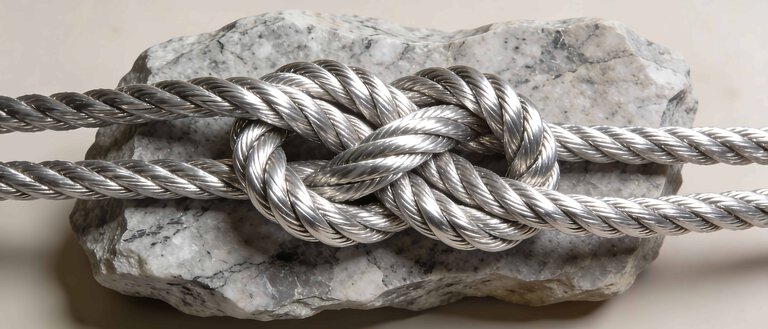
FUSED SUPERLINE · TERMINAL
Tie an ordinary Palomar on a reel spooled with NanoFil, pull-test it the way you would on mono, and you can watch it creep. Not fail outright — creep, a little at a time, which is almost worse because you don’t notice until it’s too late. NanoFil is slick enough that Berkley recommends a modified doubled-line knot for it instead of pretending ordinary nylon knots behave the same way on fused line. They don’t. Structurally it’s a Double Palomar, and the overhand stage gets two passes before the hardware goes through the large loop.
Five-stage Hook diagram
Berkley NanoFil and similar slick fused/superline context.
Hardware must accept doubled line.
The doubled loop passes through the overhand knot twice. Only then does the hardware go through the big loop, and that’s the whole difference.
This knot isn’t proof that every fused line wants the same wrap count or the same knot.
The second pass is the whole modification
A standard Palomar leans on doubled line and a single overhand lock. That’s plenty on most material. The NanoFil version sends the doubled loop back through that loose overhand a second time, which piles on line-on-line contact before anything gets closed down. On line this slick, contact is exactly what the ordinary version runs short of.
Two trips through the overhand before the hook goes in
- Double a generous section of NanoFil/superline and pass the loop through the eye.
- Tie a loose overhand knot with the doubled line.
- Pass the doubled working loop through that overhand knot a second time.
- Pass the hook/lure/swivel completely through the large loop.
- Wet if the manufacturer guidance permits, then pull both sides evenly until compact.
- Pull-test for slip before trimming.
What I test for
Only one overhand pass, crossed doubled line, hardware catching the large loop, or the knot getting treated like mono and never tested for superline slip. I load it hard before I trust it, every time, because a knot that looks tidy on slick line can still be creeping underneath.
Where fused line changes the answer
Use: NanoFil/fused superline terminal work. Skip: when manufacturer guidance for another line calls for a different knot. Compare: Palomar for conventional braid; Berkley Braid for an eight-wrap braid-specific structure.
How I verify it
Looking like the mono version doesn’t earn a knot any trust on fused line. The material behaves differently, and it won’t warn you when it’s slipping. NetKnots’ NanoFil / Double Palomar animation is where I go back to when I want to re-check the second pass.
Open the deeper knot workflowJob, material, route, dressing, seating, pull-test checks and the standardized comparison record.
THE SIX-MOVE CHECK
Job → Material → Route → Dress → Seat → Test
- Job. Name what the connection has to do before choosing the knot.
- Material. Confirm the line, leader, rope, wire, and hardware actually suit this structure.
- Route. Trace every pass before tightening anything.
- Dress. Put strands, wraps, and loops in their intended order with no accidental crossings.
- Seat. Tighten in the order this knot needs. More force does not repair bad geometry.
- Test. Inspect the finished shape, load it by hand when appropriate, and retie if anything moves or fails the article-specific checks.
Practice / pass test. Tie this knot three clean times without rushing. A tie passes only when it matches this article’s What to check before you trust it geometry, shows none of the listed failure clues, and survives the stated load/inspection test. If you cannot tell why one attempt is better than another, keep practicing—the lesson is recognition, not memorization.
KNOT SPEC
NanoFil Knot — the short answers
- ALSO CALLED
- Also called the Double Palomar, which describes it better than the brand name does. Named for the Berkley line it was published for; anglers on other slick fused lines use it too.
- KNOT TYPE
- Terminal knot tied in doubled line, Palomar with a second overhand pass
- WHAT IT CONNECTS
- Fused superline to hook, lure, swivel or snap. Not a line-to-line knot, not a leader knot, and not a spool knot.
- LINE TYPES
- Fused superline — NanoFil and comparably slick material. It works on conventional braid and mono, but on those a standard Palomar is enough and this adds bulk for nothing.
- STRENGTH BAND
- High on fused line, and clearly better than a standard Palomar there because the second pass adds line-on-line contact before anything closes. On ordinary mono it offers no advantage over the single-pass version.
- DIFFICULTY
- Beginner to Intermediate. If you can tie a Palomar you can tie this; the only new move is a second trip through the overhand. Children who know the Palomar pick it up quickly.
- STEPS AND WRAPS
- Six moves and no wrap count. The one number that matters is two — two passes of the doubled loop through the loose overhand before the hardware goes through the big loop.
- TIE TIME
- Moderate — a boat knot, slightly slower than a Palomar because of the second pass and the larger loop to manage. Forty seconds or so once learned.
- POOR CONDITIONS
- Reasonable in the cold and the dark because there is no wrap count to lose. The awkward part is handling a big doubled loop of very limp line in the wind, and getting the lure through it.
- THROUGH THE GUIDES
- Compact once seated, similar to a Palomar and it clears guides easily. It lives at the hardware, so guide passage seldom matters.
- LUBRICATION
- Wet it before the final draw where the line maker’s guidance allows. Fused superline does not scorch visibly, so the warning sign is absent, but the wet pull still lets the doubled strands seat evenly rather than jamming crossed.
- TAG END
- Leave a longer tag than you would on mono — a quarter inch at least — because slick fused line creeps. Trim only after the knot has been pull-tested.
- TOOLS
- None. Braid scissors or a dedicated cutter, because standard clippers crush fused line and leave a ragged stub rather than a clean cut.
- BEST SUITED TO
- Finesse and light-line fisheries where fused superline is the point — drop shot, small swimbaits, light spinning for bass, trout and panfish. Chosen by line type, not by species.
The strength bands are rough on purpose. Published knot tests don’t agree with each other — the same braid-to-leader knot has tested near ninety percent of line strength on one machine and under half on another, because the line brand, its diameter, how fast it got cinched, whether it was wet and whose hands tied it all move the number more than the knot does. Use the band to compare this knot with the others, not as a number to quote.
FIELD INTELLIGENCE
Where it earns its place, and where it costs you
Advantages
- It addresses a real, specific problem: ordinary knots creep on fused superline rather than failing outright, which is harder to spot.
- There is no wrap count, so it survives being tied in the dark by cold hands.
- It is a small modification of a knot most anglers already own, so it costs almost nothing to learn.
- The doubled line spreads the load at the hardware instead of asking one strand to take it.
Disadvantages
- The lure or hook has to pass all the way through the loop, and this loop is a large one to manage.
- The hardware eye must accept doubled line, which rules out small eyes and fine-wire hooks.
- On conventional braid, mono and fluoro it is extra bulk and extra work for no measurable gain.
- Fused line hides a poorly seated knot — there is no kink or scorch to warn you, so it must be pull-tested.
- The second overhand pass is easy to skip and produces a knot that looks correct.
Use a different knot when
- Palomar — when the line is conventional braid, mono or fluoro — the single-pass version is enough there
- Berkley Braid Knot — when the eye will not take a large pass-through loop and you need a wrapped braid-specific structure
- San Diego Jam — when the lure is too big or awkward to feed through a loop at all
- Whatever the line maker specifies — when their guidance for a particular fused line calls for a different knot — that outranks a general habit
WHAT TO CHECK BEFORE YOU TRUST IT
This knot earns its place on the slickest fused lines, and its value is a warning as much as a structure: a standard Palomar on NanoFil does not snap, it creeps, and creep is worse than a clean failure because you do not see it happening. The move here is to stop trusting a knot on fused line just because it looks like the mono version your hands already know. Load it hard before you trim and watch the tag for movement. The tradeoff is the large pass-through loop, which rules the knot out on big or trebled baits.
What actually makes it fail
- Only one pass through the overhand, which quietly downgrades it to a standard Palomar on line that needed more.
- Crossed doubled strands, so one strand grinds across the other instead of sharing the load.
- The hook, treble or split ring catching the large loop as it closes and twisting it.
- The knot never being load-tested, and creeping under a fish instead of at the bench.
- The loop finishing pinched below the eye rather than seated cleanly against it.
How to test it, and how it ages
Before you pull, check the loop went through the overhand twice — not once — and that the doubled strands are parallel rather than crossed. Then seat it by drawing both sides down evenly, wet where the line maker permits. Now load it hard, repeatedly, against the reel or a gloved hand, and watch the tag. On fused line the tag creeping a fraction under repeated pulls is the failure you are looking for, and it will not announce itself any other way. Trim only after that.
Over a session: Holds well over a session once properly seated, and does not loosen from casting the way wrapped knots can. Fused line still flattens where it turns through the eye, so check the line just above the knot after every fish and retie when it feels flat or fuzzy.
Troubleshooting
Why did my ordinary Palomar creep on this line?
Because fused superline is slicker than the material the knot was proven on. It does not break, it slides. The second overhand pass is the fix.
Did I actually make two passes?
Look at the overhand before you close it. The doubled loop should visibly enter and exit it twice. If you are not sure, back it out and redo it.
Why can I not get the lure through the loop?
You doubled too little line. Start with a longer doubled section; a few extra inches costs nothing and saves the whole knot.
Should I use this on regular braid?
There is no need. A standard Palomar handles conventional braid. Save this one for the really slick fused stuff.
How do I know it is seated if the line shows no damage?
You do not, by looking. That is the point. Load it hard several times and watch the tag; movement is the only reliable signal fused line gives you.