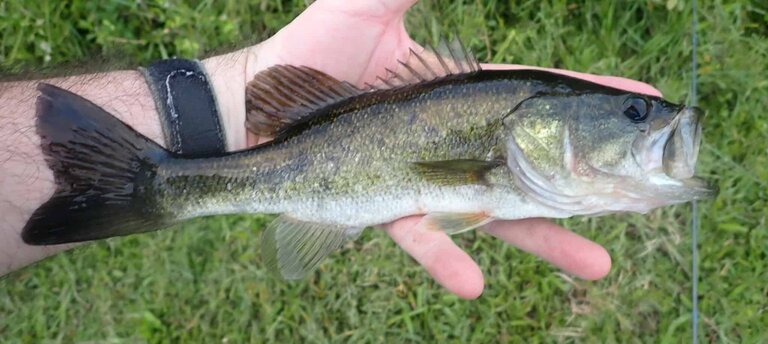
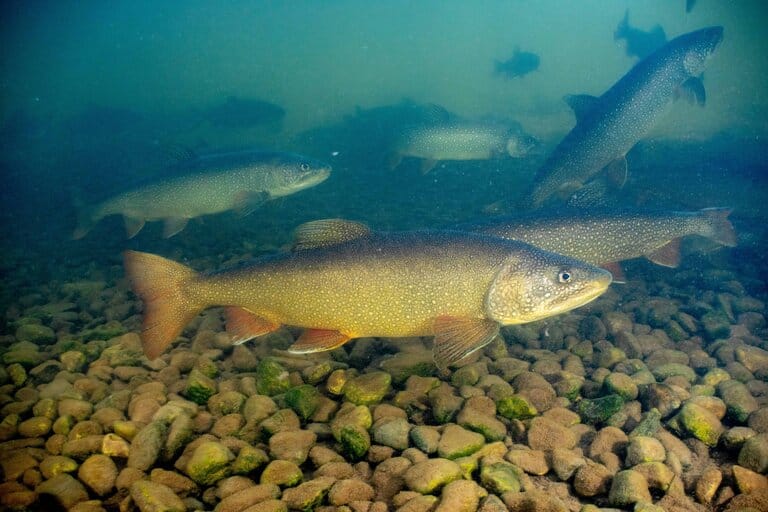
KOKANEE · SPECIES PROFILE
The problem this fish hands you is vertical.
Kokanee are sockeye that never went to sea. They hang somewhere over water far deeper than they’re using, and that somewhere moves with the season and again through the day. Montana has them, so this one’s closer to home than most, even though I haven’t made a season out of chasing them. Fair warning about the tackle section: nearly all the detailed kokanee gear talk lives in fishing magazines and blogs, and I kept to agency and research sources, so that part is thinner than the real fishing.
Profile basis: California Department of Fish and Wildlife · Montana Field Guide · Nevada Department of Wildlife
START BY THROWING SOME NUMBERS AWAY
A lot of what is published about this fish is about a different fish.
Kokanee and sockeye are the same species, Oncorhynchus nerka. One of them goes to the ocean, eats for two or three years in the richest water on the planet, and comes back enormous. The other stays in a lake its whole life and eats water fleas. Any database that reports a single set of figures for the species is reporting the ocean fish, and those numbers turn up constantly in writing about kokanee.
Four of them in particular. The maximum size of eighty-four centimeters and 7.7 kilograms: sockeye. The depth range down to two hundred and fifty meters: sockeye. The preferred temperature band of one to eight point four degrees: that spans the marine phase and should not be read as a kokanee preference. And the statement that adults eat primarily fish, which is flatly wrong for a landlocked kokanee and true of an ocean-phase sockeye.
Anyone quoting the FishBase maximum as a kokanee figure is quoting the wrong form of the species. It is worth being a little annoyed about, because those four numbers are exactly the ones that would change how you fished if you believed them.
What actually survives is smaller and more local. Ten to twelve inches on average in California’s reservoirs, up to twenty where the food is good. NOAA says they rarely exceed a foot and a bit. Montana has them at one to five pounds with the smaller end most common. And even those are lake numbers rather than species numbers, which is the second thing to get straight before reading on.
Sources: FishBase · California DFW · NOAA Fisheries
SIXTY DEGREES
When the surface passes sixty, they leave.
Kokanee prefer water between ten and thirteen degrees Celsius and will tolerate up to fifteen. In the spring that is the entire lake, top to bottom, and there is no thermal reason for them to be deep at all — which is why early season fish are near the surface and why low light keeps them there.
Then the lake stratifies. Nevada gives the threshold cleanly: once surface temperature goes past sixty Fahrenheit, kokanee move to deeper water. That’s the single most useful number here, because it is a thing you can measure from a boat with a cheap thermometer and it tells you roughly what happened to your fish.
They have not gone anywhere horizontally. They have gone down to stay inside the band, and the band has sunk below the warm layer. Everything about summer kokanee fishing follows from that one displacement.
Sources: Nevada Department of Wildlife · California DFW · Oregon DFW
AND THEN IT MOVES AGAIN
Whatever depth you found at seven in the morning is not the depth at two in the afternoon.
The seasonal answer is only half of it. Kokanee also migrate vertically through the day, which has been tracked acoustically in Okanagan Lake and recorded in Granby Reservoir in Colorado, and it is not random drifting.
Bevelhimer and Adams worked out what the fish is solving for. It isn’t sitting at its favorite temperature and it isn’t sitting where the food is. It is sitting wherever the net energy works out best — food in one direction, the metabolic cost of the water it is occupying in the other — and when prey and comfortable water are at different depths, moving between them beats staying put. The fish is doing arithmetic and the answer changes as the light does.
Which gives you the one piece of on-the-water advice I would put above everything else here: reset the depth through the day rather than trusting the number that worked at dawn. If they were at thirty feet in the morning and you are still at thirty feet at noon, that is not persistence. That is a decision you made hours ago and stopped checking.
Sources: Levy 1991 · Bevelhimer & Adams 1993
WATER FLEAS
Zooplankton for its entire life, which means nothing you troll is imitating anything.
Kokanee are plankton feeders start to finish. There is an ontogenetic shift but it happens entirely inside the plankton — juveniles on copepods, adults on cladocerans in Lake Pend Oreille — and in Flathead Lake Daphnia thorata in particular matters. Montana calls them strictly plankton feeders and means it.
So the pink hoochie is not a fry imitation. It is not imitating a water flea either, because nothing is. California is unusually direct about what is actually happening: the attractor is what brings the fish in, not the lure. The dodger or flasher does the work, the trailing hardware is small and bright, and the fish comes to investigate a disturbance rather than to eat something it recognizes.
That reframes the whole tackle argument. If nothing is imitating anything, then color and flash aren’t questions about realism. They’re questions about what gets noticed in that lake at that depth in that light. Which is probably why every kokanee angler you meet has extremely firm opinions and no two of them agree.
Sources: Montana Field Guide · Klein et al. 2020 · California DFW
THE TACKLE, AND THE HOLE WHERE THE REST OF IT SHOULD BE
0.8 to 1.5 miles an hour is the only speed anybody published.
Dodger sizes, scent, the endless argument about pink — most of that lives in fishing media, which is why it isn’t here. What’s left is agency advice. It’s accurate and it’s general, and on a fish this fussy about depth and speed, it’s where your own testing starts, not where it ends.
What did survive: troll between 0.8 and 1.5 miles an hour, slow enough that the dodger swings rather than spins. Run the attractor immediately ahead of the lure — Colorado calls the same rig cowbells, which is a better word for it. Small spinners, hoochies, small spoons. California names pink and orange as the most effective colors and I’m not going to pretend I can improve on that. Tip it with a kernel of white shoepeg corn, usually scented.
Depth control is downriggers, or leadcore, or lead if that is what you have. Ultra-light rod, because a kokanee has a soft mouth and a twelve-inch fish on a stiff rod is a fish you lose at the net. And it is a boat fishery in the plain sense that the fish are in open water and you cannot reach open water from the bank.
Sources: California DFW · Colorado Parks and Wildlife
PICK THE LAKE BEFORE THE BEADS
Lake trout and Mysis shrimp together is a combination no dodger color fixes.
The mate-guarding studies matter less to a rod than the predator study does. Corsi’s paper describes a biomass collapse when lake trout and Mysis were both up in the same lake, and no dodger color fixes that math. That is the variable I would want to know about a lake before I ever asked what beads to run.
The numbers behind that are worth seeing. In Lake Pend Oreille, Mysis shrimp were eating cladocerans at about 186 kilograms per hectare per year against the kokanee’s 45 — roughly four times as much of the same food. When the Mysis population crashed, modeled maximum annual kokanee production went from 224 tonnes to 408. It nearly doubled, without anyone stocking a thing.
The lake trout side is predation rather than competition, and it is not evenly spread: Schoen and colleagues found predation risk four to five times greater in the shallower basin of the same lake. Depth is protection.
Drawdown is the third lever. Relative kokanee abundance is negatively and exponentially related to it — drawing a reservoir down warms it and lowers its oxygen at the same time, and in the Idaho drought year the fish concentrated near a groundwater inflow where both were survivable. Colorado provides the counterweight, and it explains why kokanee got stocked into fluctuating reservoirs in the first place: the plankton they eat is unaffected by drawdown. The food does not care. The fish does.
Almost every habitat number for this fish comes back to temperature. The dissolved-oxygen number is the one nobody published, and it is probably the one that decides a bad summer — the Idaho drought study found kokanee refuge near a groundwater inflow without ever pinning an oxygen threshold to it. I would rather have that missing number and a bad thermometer than the other way around.
Sources: Corsi et al. 2019 · Chipps & Bennett 2000 · Schoen et al. 2015 · McLaren et al. 2023
THEY ALL DIE
Every adult dies after spawning, and two states have drawn opposite conclusions from that one fact.
Kokanee are semelparous. They spawn once and that is the end of it, and the carcasses go back into the lake as nutrients for whatever comes next. It is the same deal every Pacific salmon takes.
Before the run they stage — dense schools gathering near tributary mouths, which is the most findable this fish ever gets. Nevada notes that pre-spawn kokanee typically stop feeding but will still strike a lure, which is a distinction that only matters if you had been thinking of it as hunger. Females run on a crepuscular schedule, peaking at sunrise and sunset. And the flesh quality falls off as they color up, so the staging period is the practical end of the eating window.
Timing doesn’t generalize, and there’s no point pretending it does: Montana has it in November and December, Nevada gives a window from August all the way to January, California just says fall. Elevation and latitude and stock all move it. Eggs then sit for a hundred and ten days at forty-three degrees before anything hatches.
Now the interesting part. Colorado opens special snagging seasons on some waters during the spawning runs, on the reasoning that these fish are going to die in a few weeks regardless. Utah closes kokanee possession statewide from the tenth of September to the thirtieth of November, explicitly to protect them during the spawn. Same fish, same biology, same few weeks of the calendar, opposite rule — and neither state is being unreasonable. It is a genuine disagreement about what you owe an animal that is already finished, and it’s the clearest example I’ve found of a rule being an argument instead of a fact. Which also means there is no general answer here: whatever the water you are going to says, it says.
Sources: Montana Field Guide · Nevada Department of Wildlife · Colorado Parks and Wildlife · Utah Fishing Guidebook · Warren & Morbey 2012
WHERE THE SOURCES ARGUE
Most of the disagreement is two agencies describing two lakes.
Kokanee are stocked, managed and counted differently from one lake to the next, so a good deal of what reads as disagreement here is two agencies describing two populations. Growth rate and size at maturity in particular are close to meaningless as a species-wide number, because they answer to how much food is in that specific lake and how many kokanee are competing for it.
The size-at-maturity work makes the point better than any argument could. Patterson and colleagues found that fish reaching eighteen or nineteen centimeters by fall were reliable indicators of maturing the following year — a length threshold, not an age one. Age four is typical in Montana and Colorado; California describes a two-to-three-year cycle. Those are not competing claims. They are different lakes feeding their fish at different rates and getting them to the same size at different ages.
One identification conflict is worth flagging because it cuts against the main field mark. Most sources describe kokanee as having no strong spotting on the back or tail, and that absence is how you separate them from trout in the same water. Colorado describes black spots on the upper half. Both are recorded rather than reconciled, and it matters, because heavy black spotting is the classic way to tell other Pacific salmon from sockeye.
The whole fish comes down to finding a depth over water where depth has stopped meaning bottom. Get that and the rest is small adjustments. Miss it and you can troll a good lake all morning through empty water, which is a specific and fairly boring way to have a bad day.
Sources: Patterson et al. 2008 · Colorado Parks and Wildlife · California DFW
WHERE THIS CAME FROM
Sources
- California Department of Fish and Wildlife — Kokanee
- Montana Field Guide — Kokanee
- Nevada Department of Wildlife — Kokanee Salmon
- Colorado Parks and Wildlife — Kokanee Salmon
- Oregon Department of Fish and Wildlife — Kokanee Salmon
- Utah Division of Wildlife Resources — Fishing Guidebook
- FishBase — Oncorhynchus nerka
- NOAA Fisheries — Sockeye Salmon
- Washington Department of Fish and Wildlife
- McLaren et al. — Drawdown, habitat and kokanee populations
- Corsi et al. — Lake trout and Mysis influences on kokanee
- Chipps & Bennett — Zooplanktivory and nutrient regeneration
- Klein et al. — Ontogenetic diet shifts in a kokanee–Mysis system
- Patterson et al. — Sexual maturation in kokanee
- Schoen et al. — Temperature and depth mediate competition
- Levy 1991 — Acoustic analysis of diel vertical migration, Okanagan Lake
- Bevelhimer & Adams 1993 — A bioenergetics analysis of diel vertical migration
- Warren & Morbey 2012 — Timing of spawning migration
- Morbey 2002 — Male mate guarding in kokanee
- Lemay & Russello 2015 — Ecotype divergence in kokanee
Compiled 2026-09-11. Spawning-run rules in particular are set state by state and water by water and change between seasons — the managing agency for wherever you are fishing has the current answer.