The auger is the part nobody warns you about.
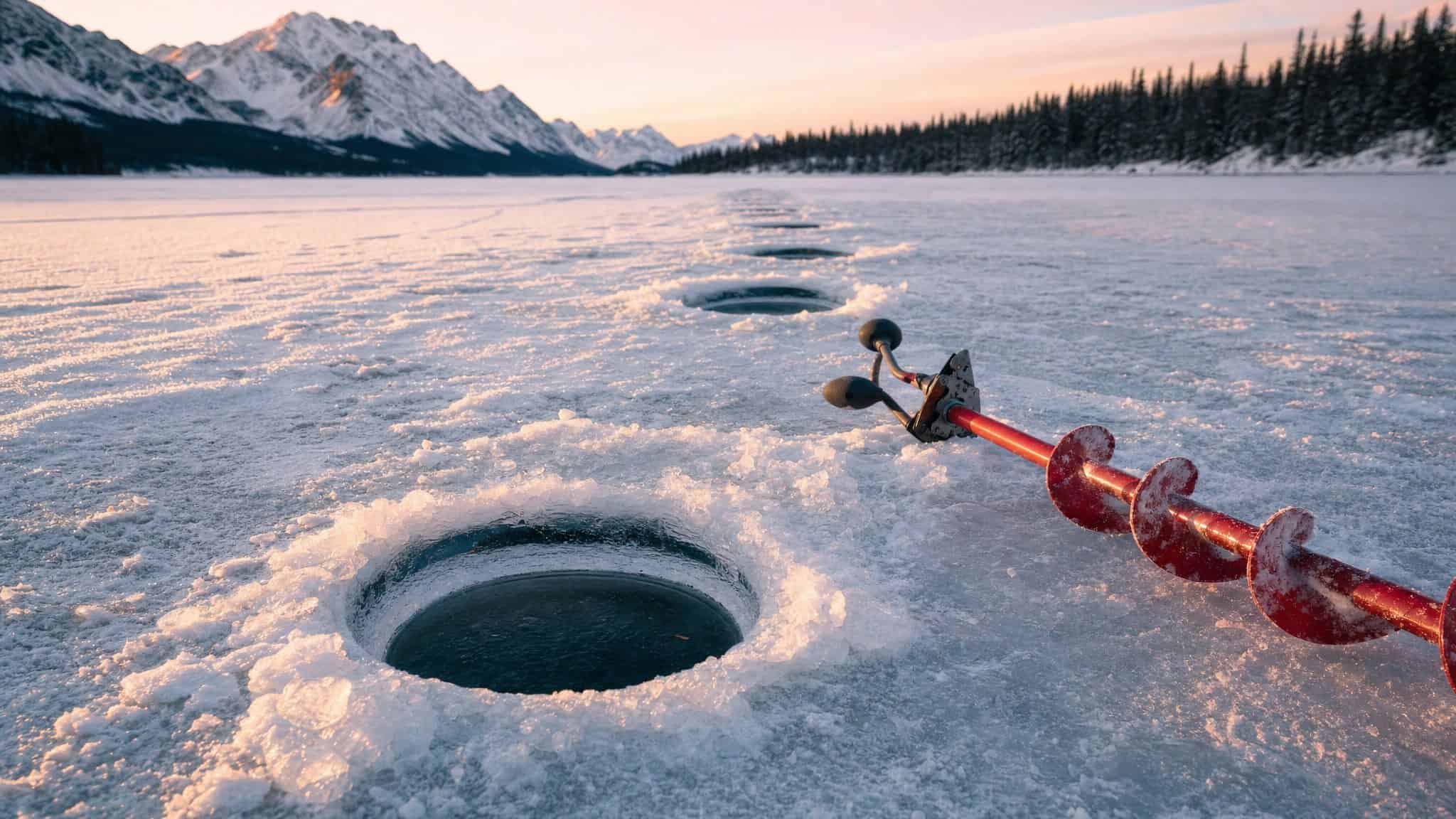
Not the cold, and not the sandwich that turns into a brick by ten. The auger. Eight inches of early ice is a short job and good exercise. Twenty inches in February on a hand auger, third hole, is a different relationship with the sport, and it’s right about then that your brain starts assembling a very reasonable argument for why this hole is probably fine.
It usually isn’t fine. It’s just close, and close is doing a lot of work in that sentence.
What one hole can actually tell you
A hole is a sample of one spot and one depth range at one slice of time. It answers a narrow question honestly and it refuses every other question you ask it, no matter how politely you ask.
So the useful move happens before the blades touch ice: decide what this hole is being asked. Is it on top of the break or down the face of it? Inside the weed edge or out past it? If you can’t say in one sentence what the hole is testing, it isn’t testing anything, and you’re going to spend forty minutes over it learning that your boots leak.
Drill the set, then fish the set
The habit worth building is drilling a group of holes before you fish any of them.
Six or eight, laid out to cross something — a contour, a weed line, the shoulder of a point — then fish them in order. This feels backwards the first time because it front-loads all the work. It also means your search isn’t competing with your comfort. Once you’re sitting down with a warm hand and a jig in the water, moving stops being a fishing decision and starts being a negotiation with yourself.
Drilling cold, before you’ve caught anything, is when you’re most honest.
Spacing is the part people get wrong
Holes five feet apart are the same hole. You’ve sampled one piece of bottom twice and paid for it in blisters.
What matters is that each hole lands on different water. On a steep break that might genuinely be fifteen feet of horizontal distance, because fifteen feet sideways is eight feet of depth change. On a flat basin it might be sixty yards before anything is meaningfully different. Let the contour set the spacing, not your legs.
A practical version: watch the depth as you drop through. If two holes read within a foot of each other and sit on the same kind of bottom, you drilled one hole and wasted a second.
How long to give a hole
Shorter than feels right. That’s the honest answer, not the exciting one.
Aggressive fish under ice generally show up quickly — inside a few minutes, sometimes on the first drop while the jig is still falling. If you’re running electronics and nothing rises to look, that’s information you already have and you’re just re-reading it. If you’re fishing blind, work the full column instead of the bottom six inches, give it a handful of minutes, and go.
The exception is a hole you drilled for a reason that hasn’t arrived yet. A travel route before the last hour of light is a waiting spot, not a search spot. Those are different jobs and it’s worth knowing which one you’re doing. Reading a fishing window runs on the same logic in open water.
Reading the pattern instead of the hole
Here’s where drilling a set pays you back.
One fish in one hole is luck or it’s a pattern, and you can’t tell which from one hole. Two fish in the two deepest holes on the break, nothing in the four shallower ones, is a depth answer. Three fish spread across holes that share a weed edge but not a depth is a cover answer, and fish only in the holes closest to the inflow is a different answer again.
The pattern is what you came for, and the individual fish is just how it signs its name.
Write the depths down. You won’t remember them in the truck, and the lake will be doing something slightly different next week anyway, so the note is the only part that survives. There’s more on that habit in writing down the decision instead of the fish.
Before any of that
None of this is a fishing decision unless the travel is safe.
Ice isn’t uniform. It can carry you in one place and not carry you thirty yards further on, and the reason is usually specific — current, a spring, a pressure ridge, snow that insulated one patch and kept it thin. Minnesota DNR is blunt about it: ice “can be two feet thick in one place and one inch thick a few yards away,” and the agency doesn’t measure ice for you. Their ice thickness guidance is worth reading before the season, not during it.
Measure as you move, not once at the access. Carry picks where you can reach them with a wet glove. The ice thickness guide has the numbers, and getting off the ice covers the part everyone skips.
The trade you’re actually making
Every extra hole costs effort and buys information, and sitting down trades that information back for comfort.
Neither one is wrong. What’s wrong is making the trade without noticing you made it — which is what happens when the hole gets chosen by whichever spot was easiest to walk back to.
And if the whole thing sounds like a lot of work for a fish that may not be there, that’s a fair read, and it does get easier. Not because the ice gets thinner, but because after a season you stop drilling randomly. You start drilling questions, and a question you can answer in four minutes is a much better use of an afternoon than a hole you sat on out of hope.
Pick the next hole before you’re tired. That’s the whole trick, and it’s the one thing your future self at three in the afternoon can’t do for you.
FIELD OBJECT
This one should leave the page.
The article is the long version. These are the pieces worth carrying into the next trip.
The 30-second version
A single hole only answers one small question, which is why the drilling is the actual search. The trick is deciding where the next one goes before you're too tired to care.
What to watch
- What one hole can actually tell you
- Drill the set, then fish the set
- Spacing is the part people get wrong
- How long to give a hole
Field card
- What one hole can actually tell you
- Drill the set, then fish the set
- Spacing is the part people get wrong
- How long to give a hole
- Reading the pattern instead of the hole
RIGHT TOOL, NEXT
Field Ops Desk
Turn the field note into a pre-trip, on-water, or debrief decision instead of leaving it as reading.