ICE FISHING · SAFETY
How Thick Is Actually Safe
Reading ice before you walk on it — a threshold, not a guess.
Everybody wants one number for ice. The published guidance does give you one, and it’s a floor. It comes from Minnesota DNR and Massachusetts state ice-safety guidance rather than somebody’s forum post, and it still can’t tell you what’s under your boots today. A spud bar or an auger and a tape measure, used at your spot right now, is the only thing that can.
THE CALCULATOR
Check a thickness against a job.
Pick what’s going on the ice and what the ice actually looks like, then enter what you measured.
Clear-ice thresholds follow the Minnesota DNR general ice thickness guidelines. The white/snow-ice doubling rule comes from the 2026 Massachusetts freshwater fishing guide, which states that white ice is about half as strong as new clear ice. Sources rechecked 10 September 2026. It’s a floor, not a guarantee — see below.
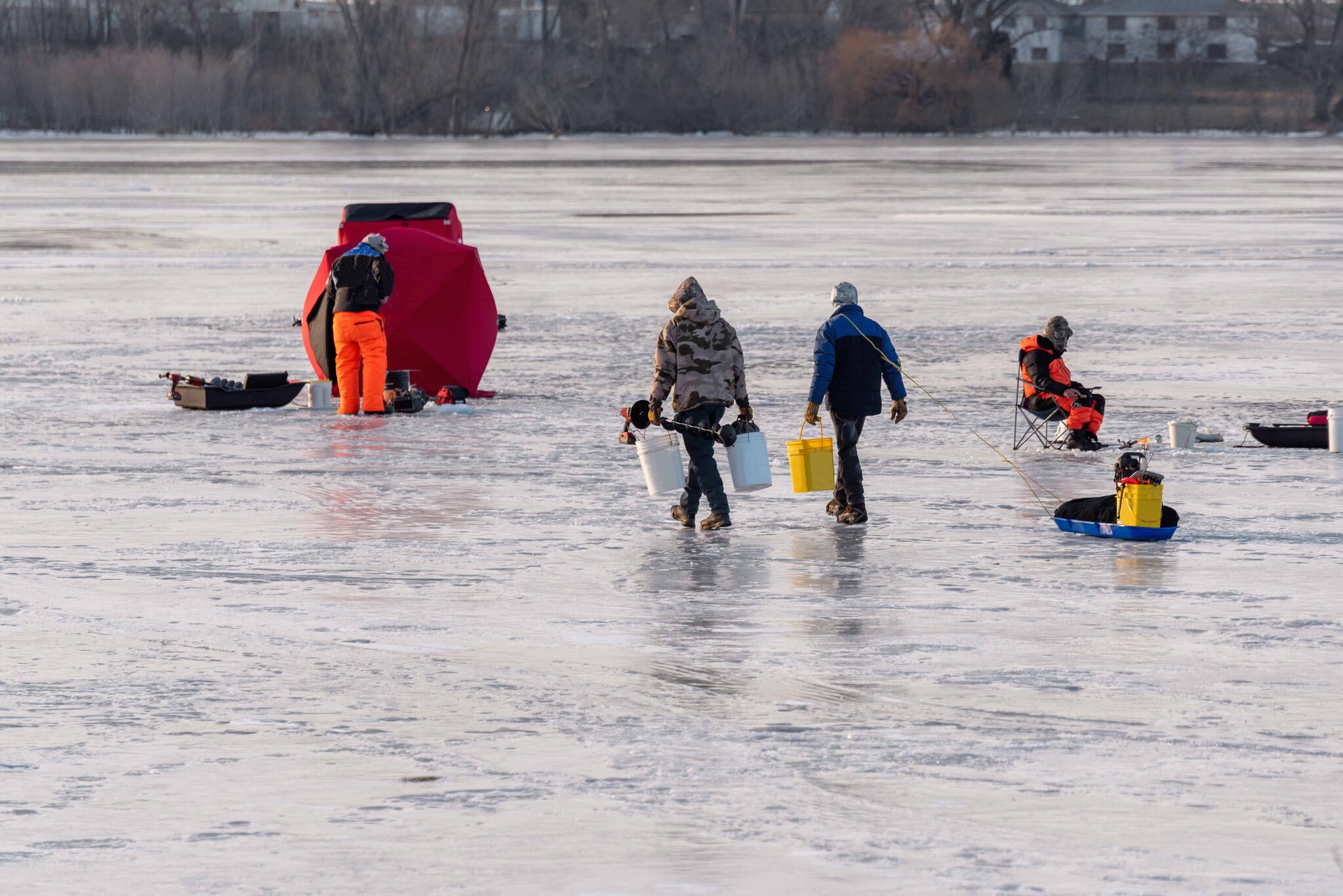
On foot. Walking, ice fishing, a spud bar in your hand the whole way out.
Snowmobile or ATV. Guidelines run 5–7"; the calculator uses the top of that range, and that's the number to plan around, not push against.
Small car or small SUV. Minnesota DNR puts that at 9–10"; the calculator won't clear less than 10. A medium SUV or small truck needs 11–12". If you're putting a vehicle on ice, this probably isn't your first winter out.
Medium truck. A heavy-duty truck needs 16–17", and more with a wheelhouse on it. If you're asking whether your truck qualifies, that's the wrong question to be guessing on.
WHAT THE CALCULATOR CAN'T SEE
Thickness is one variable. It's not the only one.
A lake isn't one number. It can run two feet thick off the ramp and one inch thick sixty yards away, over a spring, a current seam, or a narrows where the water's still moving under the lid. An average thickness for the whole lake is about as useful as an average depth when you're the one standing over the deep part.
White or "snow" ice forms when snow melts into slush and refreezes without ever going through a clean, cold freeze, and it's roughly half the strength of clear ice at the same thickness — which is why the calculator above doubles the requirement for it. If you can't tell which one you're looking at, treat it as white ice and check again somewhere you can actually judge the color through the hole.
None of this is a reason to skip the trip. It's why the guideline is a floor you check at every new spot, instead of a number you confirm once at the truck and carry around in your head all day.
Before you walk out
- Check a current local ice report or call a bait shop on that lake — not a memory from last winter.
- Bring a spud bar or auger and check thickness at the shoreline, then again as you move out. Not just once.
- Carry ice picks around your neck, not in a bag, and know how to self-rescue with them before you need to.
- Tell someone on shore where you're going and when you'll be back.
- Fish with a partner where you can, and stay off ice you can't personally see the color and texture of.
WHERE I LAND ON THIS
I trust the number over the vibe every time.
Plenty of water has looked fishable to me from the bank and turned out not to be, often enough that I quit trusting how things look. Ice is that same mistake with a much bigger bill attached. So on hard water the tape measure comes out before the rods do, at every new spot, and a nice-looking sheet of ice doesn't get a vote.

