Somebody hands you a flasher on your second trip and suddenly the lake has a television in it.
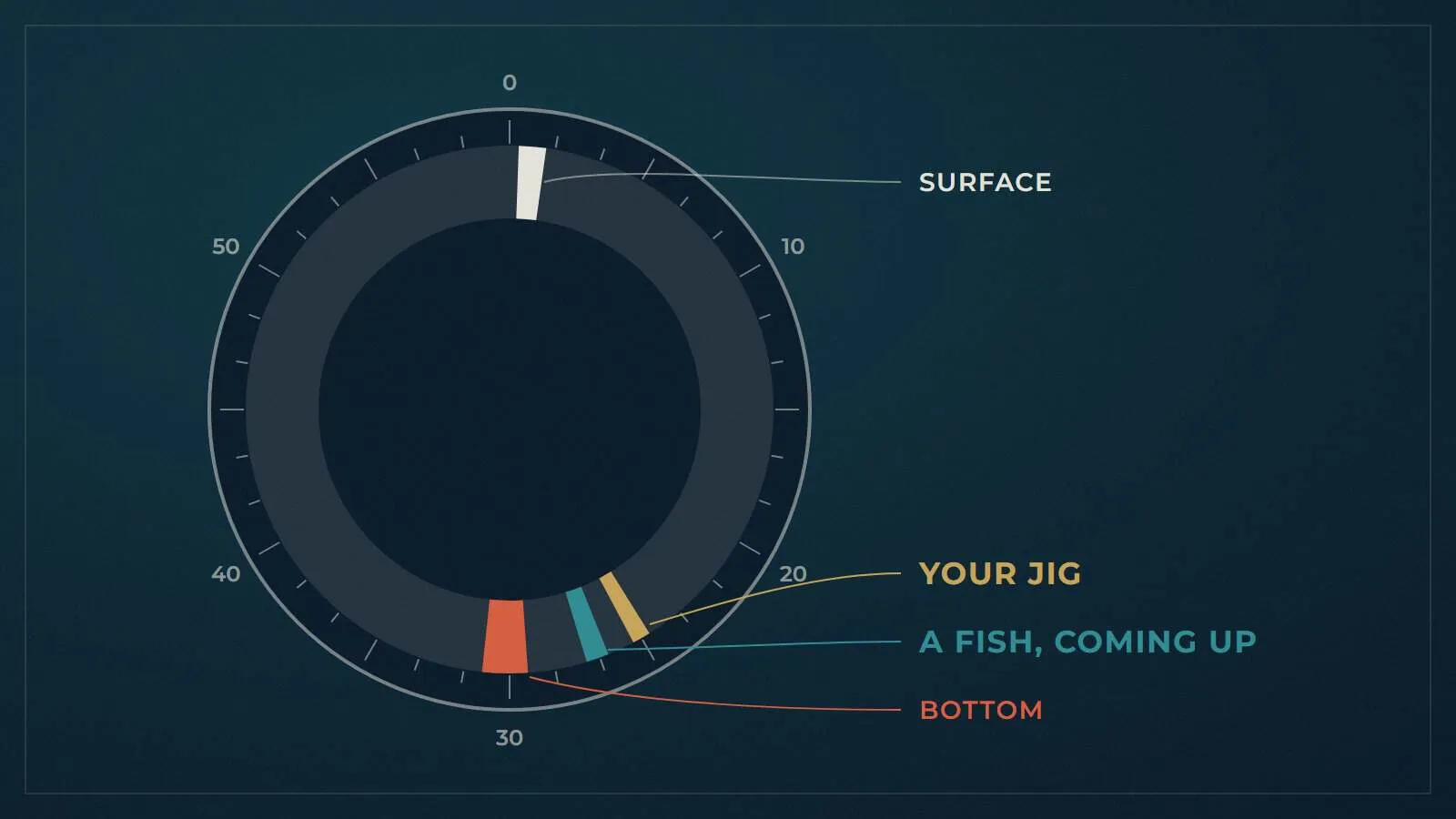
The red band at the bottom is the bottom. The thin green line hovering above it is your jig. And then a mark appears from nowhere, drifts up, hangs a foot under the jig, and doesn’t touch it. You stare at that mark for ninety seconds. It leaves. You have never felt worse about a fish you never saw.
That’s the flasher’s whole personality. It gives you enough to care and not quite enough to know.
It’s a sound, not a picture
The unit sends a pulse down and prints whatever comes back at the depth it came back from. Something dense returns a strong signal and shows wide and bright. Something soft returns less. A hard rock bottom and a soft mud bottom don’t look the same, and that difference is genuinely useful.
But the return doesn’t carry a species or a size, let alone an attitude. A wide mark can be a big fish, a small fish close to the cone’s center, or two fish stacked. A mark that won’t commit might be a walleye deciding, or a bullhead wandering through with no intention of eating anything you own.
What the screen gives you reliably is depth, and whether something showed up or left. That’s worth the money. The rest is you filling in the story.
Depth is the number that earns its keep
If you take one thing off the screen, take the depth the fish are using.
Under ice, a lot of the work is figuring out whether the fish are on the bottom, hanging in a band above it, or up in the middle of the column entirely. Crappie in particular will sit well off bottom and ignore anything below them, and there’s a whole piece on crappie refusing to be bottom fish. You can find that band with a flasher in about four minutes. Without one, it takes a deliberate search through the column and a lot of patience.
Once you have the band, the jig belongs at the top of it or slightly above. Fish look up much more willingly than they look down. Drop below a mark and you have quietly removed yourself from the conversation.
What a rising mark is telling you
A fish that lifts toward the jig has already made a decision to investigate. Whatever you were doing when it started rising is working. That’s the moment people most often ruin, because a rising mark makes you want to do something.
The general shape of it: keep the cadence that got the fish moving, then slow it or shorten it as the mark closes. Lifting the jig away a few inches often keeps a fish coming. Dropping it on their head often doesn’t.
If the mark rises, stalls and sinks back, you got a look and a refusal. That isn’t a failure. It’s a real answer: the location is fine and the presentation isn’t. Change one thing — size, weight, cadence, or bait instead of plastic — and watch whether the next mark behaves differently. Changing four things at once means the next refusal teaches you nothing. Same logic as changing one variable at a time, only with worse fingers.
The cone is narrower than you think
The transducer sees a cone, and the cone is small near the top and wider near the bottom. In shallow water the unit is looking at a dinner plate. In thirty feet it might be looking at a small room.
Two consequences. Shallow, a fish can be three feet away and completely invisible — an empty screen in eight feet of water is much weaker evidence than an empty screen in thirty. And deep, a mark at the edge of the cone is not under your hole, which is why a fish can look enormous on screen and then decline to exist.
Most units let you narrow the cone. In a crowd, narrow it, or you’ll spend the afternoon watching the neighbor’s jig and slowly losing your mind.
An empty screen is a location problem, not a tackle problem
This is the part worth tattooing somewhere.
If marks are showing and refusing, that’s presentation. If the screen has been empty through the whole likely depth range for repeated passes, that’s location, and no lure in the box fixes it. Nine colors won’t conjure a fish that isn’t in the cone.
The move is another hole that tests different water, down the break or out past the weed edge. Drilling a hole pattern covers how to lay those out so each one actually asks a new question.
You can do this without one
Plenty of fish get caught by people who never owned a flasher, and if the price tag is what’s keeping you off the ice this winter, it shouldn’t be.
Fishing blind just means the search moves from the screen to the rod. Count the jig down and work the whole column instead of parking on bottom. Note the depth where anything happens, even a tick. Pay attention to what the people catching fish are doing, because the useful part of a crowded lake is the free information.
You’ll be slower to find the band. You will not be worse at fishing it once you do.
The failure mode to watch for
The screen is easier to look at than the water, and that’s the risk.
You can spend a whole afternoon watching marks and admiring the bottom hardness, genuinely entertained, and come home having made about two actual decisions. The unit isn’t the measurement; it reports one. The device isn’t the measurement makes that case more generally, and it holds double on ice, where the screen is often the most interesting thing within a hundred yards.
Give the screen a job before you turn it on. It should tell you how deep the fish are and whether to move. Once it’s answered that, it’s done its work, and the rest of the afternoon belongs to your hands.
FIELD OBJECT
This one should leave the page.
The article is the long version. These are the pieces worth carrying into the next trip.
The 30-second version
The screen is a sonar return, not a fish. It's good at depth and at telling you when to move, and past that you're mostly telling yourself stories about a mark.
What to watch
- It's a sound, not a picture
- Depth is the number that earns its keep
- What a rising mark is telling you
- The cone is narrower than you think
Field card
- It's a sound, not a picture
- Depth is the number that earns its keep
- What a rising mark is telling you
- The cone is narrower than you think
- An empty screen is a location problem, not a tackle problem
RIGHT TOOL, NEXT
Field Ops Desk
Turn the field note into a pre-trip, on-water, or debrief decision instead of leaving it as reading.