Here’s how the trip actually ends.
The bite is fine. You’ve got two hours of light. You break off on something, sit down to retie, and your fingers won’t do it. Not won’t quite — won’t. The tag end goes through the eye on the fourth attempt, the wraps fall apart, you drop the jig in the snow, and somewhere in the middle of hunting for a size 12 tungsten in a white surface you decide the truck sounds pretty good.
Nobody writes that day up as a hand-management failure. They say the bite died.
Wet is the whole problem
Cold alone is manageable. Cold plus wet isn’t, and ice fishing is a sport that specializes in getting your hands wet in ten-second increments — unhooking, clearing slush, dropping a bait, reaching into a hole.
Which means the design goal isn’t warmth. It’s staying dry long enough to stay warm, and having a plan for the moment you don’t.
The setup most people land on has three parts, and the third is the one they skip. A thin liner glove that lets you tie and doesn’t come off constantly. A waterproof outer shell or a fingerless mitt to pull over it between fish. And a genuinely dry spare set in an inside pocket, not the sled, because the whole point of the spare is that you’re already too cold to want to walk.
Handwarmers do their job in the wrong place
Chemical warmers in the palm feel great and do almost nothing for dexterity, because the blood supply to your fingers is being regulated well upstream of your palm.
Putting one against the inside of your wrist, or in a pocket where you can park your hands between drops, does more. So does keeping your core warm — the body will shut down circulation to your extremities to protect the middle, and it doesn’t consult you. If your hands keep failing and your jacket is thin, the jacket is the problem.
Eat something and drink water. Cold days hide dehydration well and it shows up in your hands before it shows up anywhere you’d notice.
Make the knot a smaller job
The best move is needing your hands less.
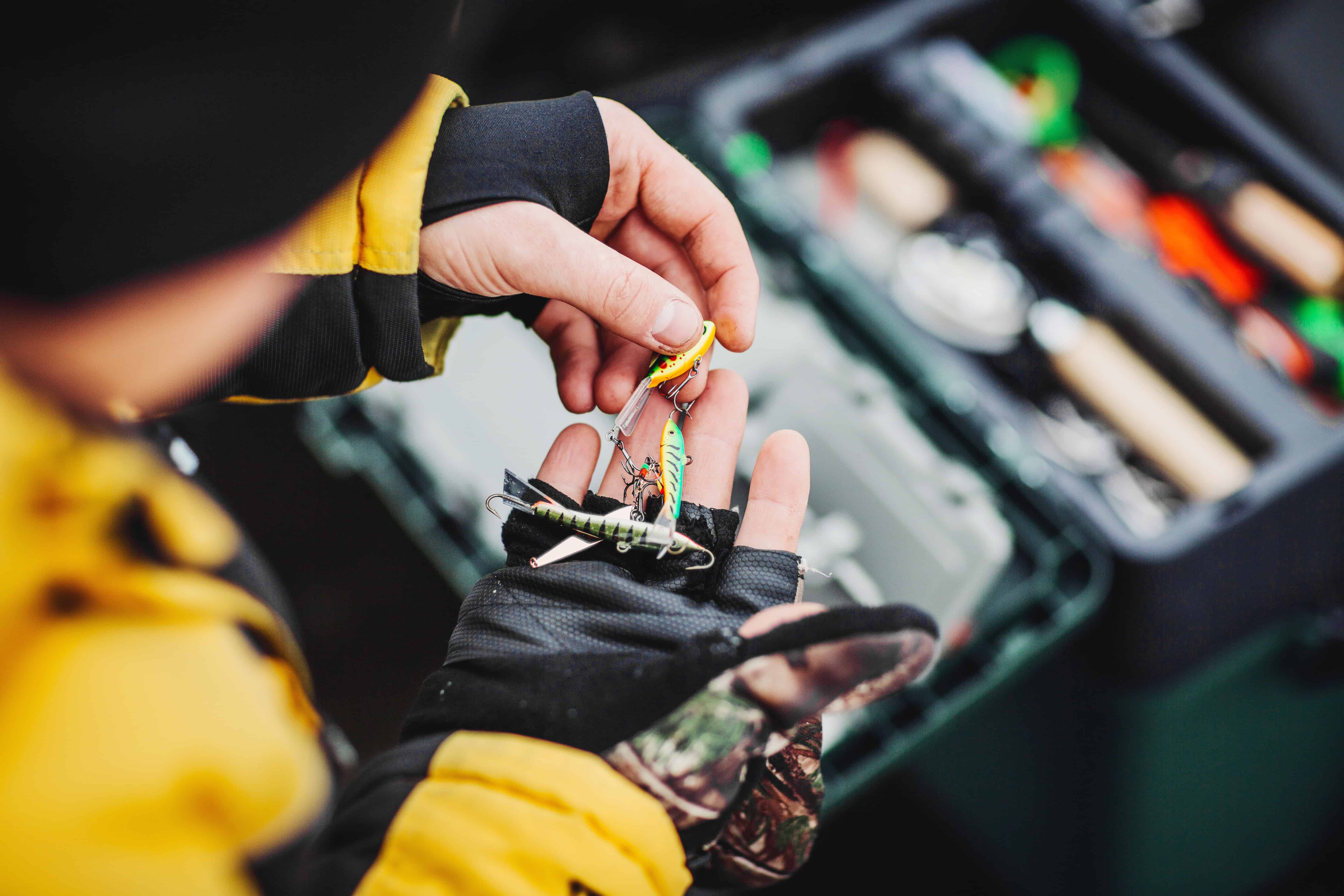
Pre-rig at home. Tie a handful of jigs onto leader sections in a warm room with good light and stash them where you can grab one. Retying becomes a loop-to-loop or a single clip instead of a four-wrap knot with a wet liner glove on.
Small clips are the other honest answer. Purists get twitchy about them, and there’s a real argument that a clip changes the action on very small jigs. There’s also a real argument that a knot you can’t tie catches nothing at all. Fish the clip in February and the knot in April if that’s where you land.
Keep the jig box somewhere you don’t have to open with two hands. A magnetic strip on the shelter wall, or a foam block in a chest pocket, will save you more fishing time than any lure in it.
The hole is a maintenance job
A hole left alone will skim over, and then every drop chips through a lens of ice that shaves your line.
A cheap slush ladle used often beats a good one used occasionally. Skim before it needs it. If you’re running a rod outside a shelter in real cold, a small handful of slush left floating actually slows the refreeze, which sounds backwards and works.
Line takes damage you don’t see. A nick from the ice edge shows up later as a break on the only decent fish of the day, and by then it looks like bad luck. Run the last few feet between your fingers now and then and cut back when it feels rough. The idea that tackle is a chain gets tested hard on hard water, because the cold attacks the connections before anything else.
Cold line has its own bad habits
Monofilament stiffens and holds coils, fluorocarbon gets brittle, and braid picks up water and then freezes into a wire. Knots seat differently at twenty degrees than they did at your bench.
That’s enough of a subject that it’s handled separately in what cold does to your line. The relevant part here: if your knots have been failing on ice and holding fine in summer, your hands might not be the whole story.
Layering the parts nobody mentions
Boots rated for standing, not walking. Walking generates heat and most boot ratings assume you’re doing some. Sitting on a bucket for three hours is a different requirement, and it’s worth a foam pad on the bucket, because a cold seat pulls heat out of you continuously and quietly.
Something on your head, obviously. And sunglasses, which sounds like a comfort item and is actually eye protection — a bright day on snow is a serious amount of reflected UV, and there’s no version of squinting for six hours that ends well.
Somebody else’s hands are your problem too
Anyone newer than you will run out of hand before you do, and they won’t mention it. Kids are especially bad at reporting cold and especially good at deciding, quietly, that this whole sport is miserable. Check their hands before they think to. That spare pair of dry gloves in your pocket isn’t for you.
Why it decides the day
The last hour is often the good one.
Walleye and pike frequently do their best work in the final stretch of light, and the person who can still tie a knot at four-thirty gets that hour. The person whose hands quit at two went home early for reasons that had nothing to do with the fish, and will probably tell you the bite died.
FIELD OBJECT
This one should leave the page.
The article is the long version. These are the pieces worth carrying into the next trip.
The 30-second version
Most ice trips don't end because the bite died. They end when your fingers can't tie the knot, and keeping your hands useful is most of a long day out there.
What to watch
- Wet is the whole problem
- Handwarmers do their job in the wrong place
- Make the knot a smaller job
- The hole is a maintenance job
Field card
- Wet is the whole problem
- Handwarmers do their job in the wrong place
- Make the knot a smaller job
- The hole is a maintenance job
- Cold line has its own bad habits
RIGHT TOOL, NEXT
Field Ops Desk
Turn the field note into a pre-trip, on-water, or debrief decision instead of leaving it as reading.