Green sunfish are what you fish for in the ditch or culvert pool nobody else bothers to look at twice. They tolerate conditions that push other sunfish out, use any piece of cover that makes a short ambush lane, and have a mouth big enough to go after prey that seems ambitious for their size. You aren’t looking for “panfish water.” You’re looking for the one object or depth change that gives a green sunfish shade and food with a body-length of safety right there.
Species: Green sunfish, Lepomis cyanellus. Native across much of central North America but introduced beyond that range, sometimes with ecological consequences.
The thirty-minute plan
- Start close: the first shade line, culvert mouth, riprap corner, dock post, root wad, or weed pocket may be better than the middle.
- Fish the object: place a small bait or lure within inches of cover, then pause or fall.
- Use a larger profile than for bluegill: their mouth handles small minnows, crayfish, beetles, and compact bass-style lures.
- Move after proof: one fish confirms the cover type; fish the next matching object instead of wearing out the same pocket.
- Check legal status: green sunfish can be native, nongame, regulated panfish, invasive, or prohibited as live bait depending on location.
Check the mouth, then the fins
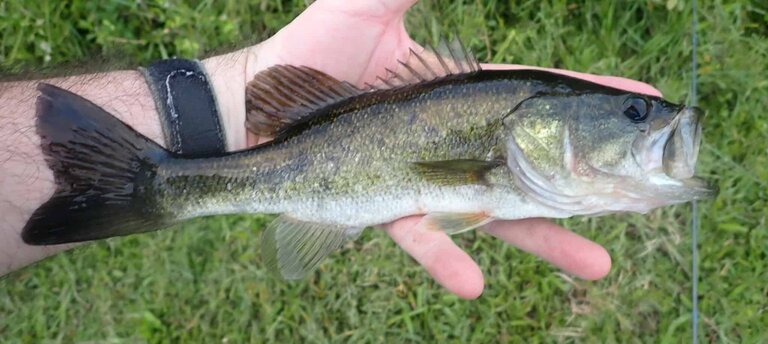
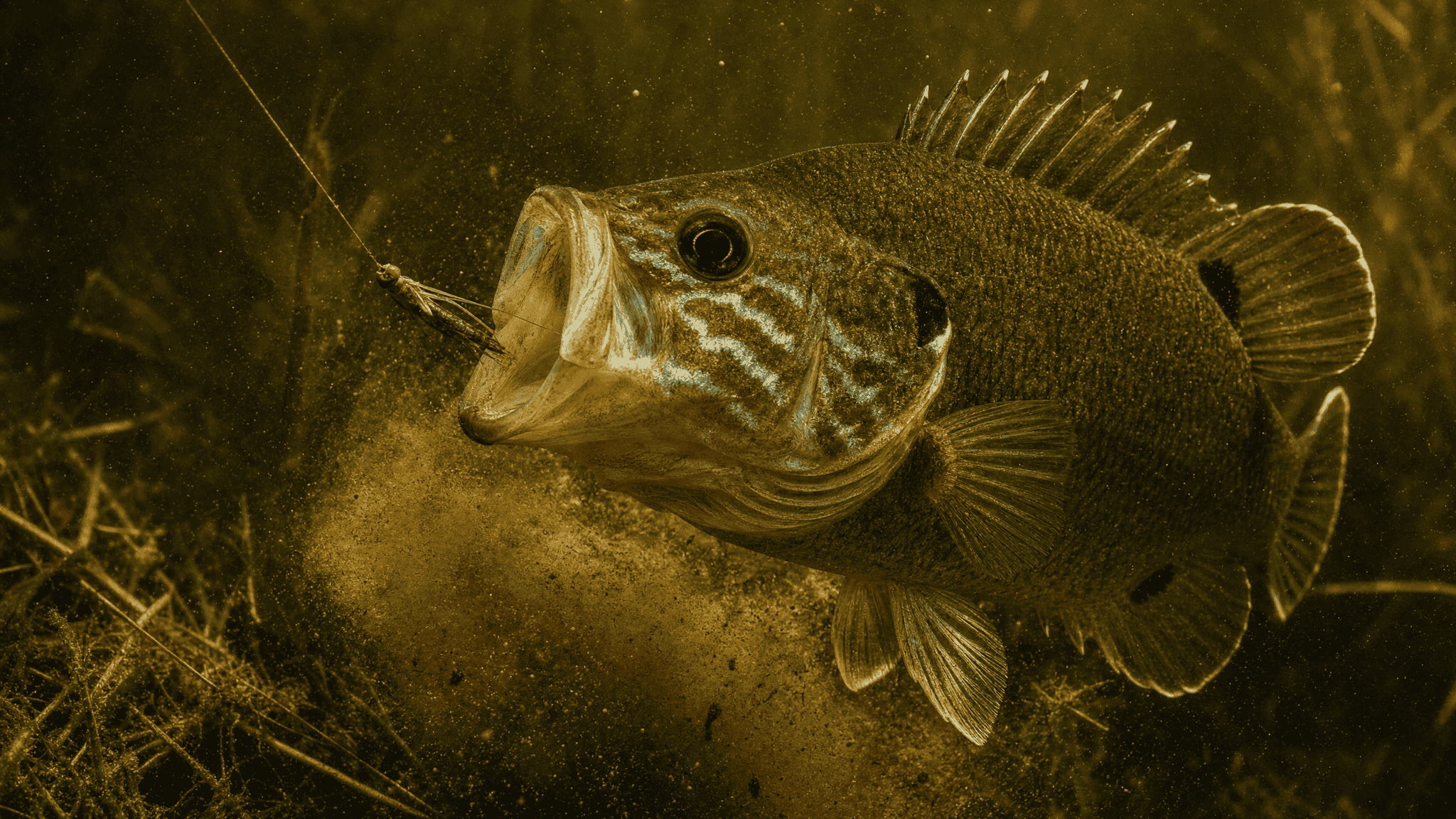
Green sunfish are thick-bodied but more elongated than a bluegill. The upper jaw reaches roughly to the middle of the eye, giving them a noticeably larger mouth. Blue-green lines mark the cheek, and pale yellow, white, or orange edging often appears on the dorsal, anal, and tail fins. The pectoral fin is short and rounded rather than long and pointed.
Hybrids are common where green sunfish share beds with bluegill or other Lepomis. A fish with mixed mouth size, ear flap, bars, and fin color may not be safely identified from one clue. Photograph the side, closed mouth, pectoral fin, and opercular flap. Do not move an uncertain sunfish between waters.
Where they hold when the water is ugly
Green sunfish use ponds, shallow lakes, ditches, backwaters, creeks, reservoir margins, and river edges. Their tolerance for turbidity, heat, low flow, and reduced oxygen lets them occupy isolated pools and disturbed water. That tolerance does not mean every stagnant pool is safe or productive. Look for the best remaining combination of shade, depth, inflow, and cover.
In a creek, the fish may hold beside a root, under a cut bank, behind one rock, or in the deepest part of a short pool. In a pond, check the first weed edge, drain, aerator influence, dock shade, and any hard object on otherwise soft bottom. In riprap, fish the transition between rock sizes and the point where current first touches the bank.
Small water should be approached quietly. A footstep on a hollow bank or shadow across a two-foot pool can move every fish under cover.
Seasonal movement without pretending every pond is identical
In spring, warming shoreline pockets and emerging cover bring insects and small prey shallow. Spawning begins as water warms—often around late spring into summer depending on latitude—and males may guard nests near shore. Avoid repeatedly removing guarding fish from a small population.
During summer, shade and oxygen become the real map. Early and late light may activate edges, while midday fish compress beneath mats, wood, culverts, or the deepest available pocket. After rain, a small inflow can deliver food and cooler water, but a flash-flooded creek can become unsafe and unfishable.
In autumn, dying vegetation reduces cover and prey can gather along the last healthy edge. In winter, slow down and concentrate on the deepest stable water or any warm, protected pocket. A tiny pond can change faster than a large lake, so observation outranks the calendar.
Natural bait: control the depth, not just the float
A piece of worm, cricket, grasshopper, grub, or other legal local bait catches green sunfish. Use a hook small enough for clean penetration but not so tiny that fish swallow it before the angler can react. Set a float only deep enough to place the bait beside the cover; a fixed “two feet down” rig fails when the useful pocket is eight inches deep.
For a vertical presentation beside a dock or culvert, use minimal weight and lower the bait quietly. Watch the line as it falls. Many bites are sideways movements, not a dramatic bobber disappearance. If fish swallow hooks repeatedly, increase hook size, shorten the wait, or use a small artificial.
Small artificials that fit a big little mouth
Compact jigs, beetle-style spins, tiny crankbaits, micro soft plastics, and small spinners let an angler search more water. Green sunfish often react to a lure that falls beside cover or changes direction. Cast beyond the target and bring it into the lane rather than striking the fish with the lure.
Start with a lure you can keep clean. An exposed hook is efficient around rock; a weedless micro plastic may reach holes in vegetation. A tiny spinner needs enough speed to turn the blade, while a jig can be crawled or paused. If fish follow but do not bite, change fall rate and pause length before cycling through colors.
Fly fishing in water barely wide enough to cast
A short leader and small foam beetle, hopper, nymph, or streamer can be more useful than a long conventional cast. Bow-and-arrow casts, short roll casts, and deliberate dapping reach pockets under branches. Keep false casting away from the pool.
Match the food that can realistically enter that water. Terrestrial insects matter beneath grass and trees; small crayfish and minnows matter around rock and wood. A flashy streamer may trigger the largest fish, but it can also spook a confined pool after one bad cast.
Tackle, hook removal, and fish size
Ultralight tackle makes these fish enjoyable, but line must still survive weeds, rock, and branches. Two- to six-pound line covers many situations; choose the stronger end when cover is abrasive. Use forceps because the dorsal spines are sharp and small hooks disappear easily in a large mouth.
Green sunfish are often small. That does not excuse lifting them high on light line, squeezing the body, or leaving them on dry dirt. Wet hands, control the lower jaw gently while supporting larger fish, remove the hook, and return unwanted fish quickly.
Next-pocket decisions
- Immediate bite at the first object: fish the next object with the same shade and depth.
- Small fish swarm the bait: use a slightly larger artificial or fish the outside edge for the dominant fish.
- No response in visible cover: test the deepest pocket, inflow, or shade before leaving.
- Fish follow but refuse: reduce splash, slow the fall, or switch from moving lure to suspended bait.
- Hooks are swallowed: react sooner, change hook style or size, and stop using a deeply fished bait rig.
- Water is hot and fish recover poorly: end the session rather than proving their tolerance has limits.
Ecology, transfer, and regulations
Green sunfish can be a native part of a fish community or an introduced competitor and predator. Their ability to colonize disturbed water is exactly why moving them as bait can create problems. Never release baitfish or bucket-caught sunfish into another waterbody. Follow transport, bait, possession, and panfish rules for the exact state and water.
In a small pond, harvest decisions have visible effects. Confirm ownership and permission, learn whether the manager wants fish removed, and do not assume “overpopulated” from the first few small catches.
FEEDING ECOLOGY · STANDARDIZED
How this fish gets fed.
Aggressiveness is not treated as proof that the fish feeds continuously.
Field notes and sources
Record water type, maximum pool depth, shade, cover object, clarity, temperature if available, bait or lure, fall depth, strike position, fish size, and release condition. The useful pattern may be “every fish on the shaded downstream side of concrete,” not “they liked worms.”
After a follow with no take, change the fall speed before you touch anything else. If a slower drop finally gets eaten, the fish wanted more time to look at it. If it still gets refused, rest that object and try the next one — one stump saying no isn’t every stump saying no.
Species and distribution references: USGS green sunfish profile, Missouri Department of Conservation field guide, and Iowa DNR species information. Always use current local fishing rules.