FLATHEAD CATFISH · SPECIES PROFILE
The first hard pull is already trying to put the fish back in the tree.
Flathead catfish are not channel cats with a larger bait. Adult fish are strongly predatory, spend daylight tight to heavy cover, and often leave that refuge after dark to hunt. The useful water usually gives a big fish both a secure hole and a short route to live prey.
Profile basis: Missouri Department of Conservation · USGS Nonindigenous Aquatic Species
IDENTIFICATION
The tail separates the three big North American catfish faster than color does.
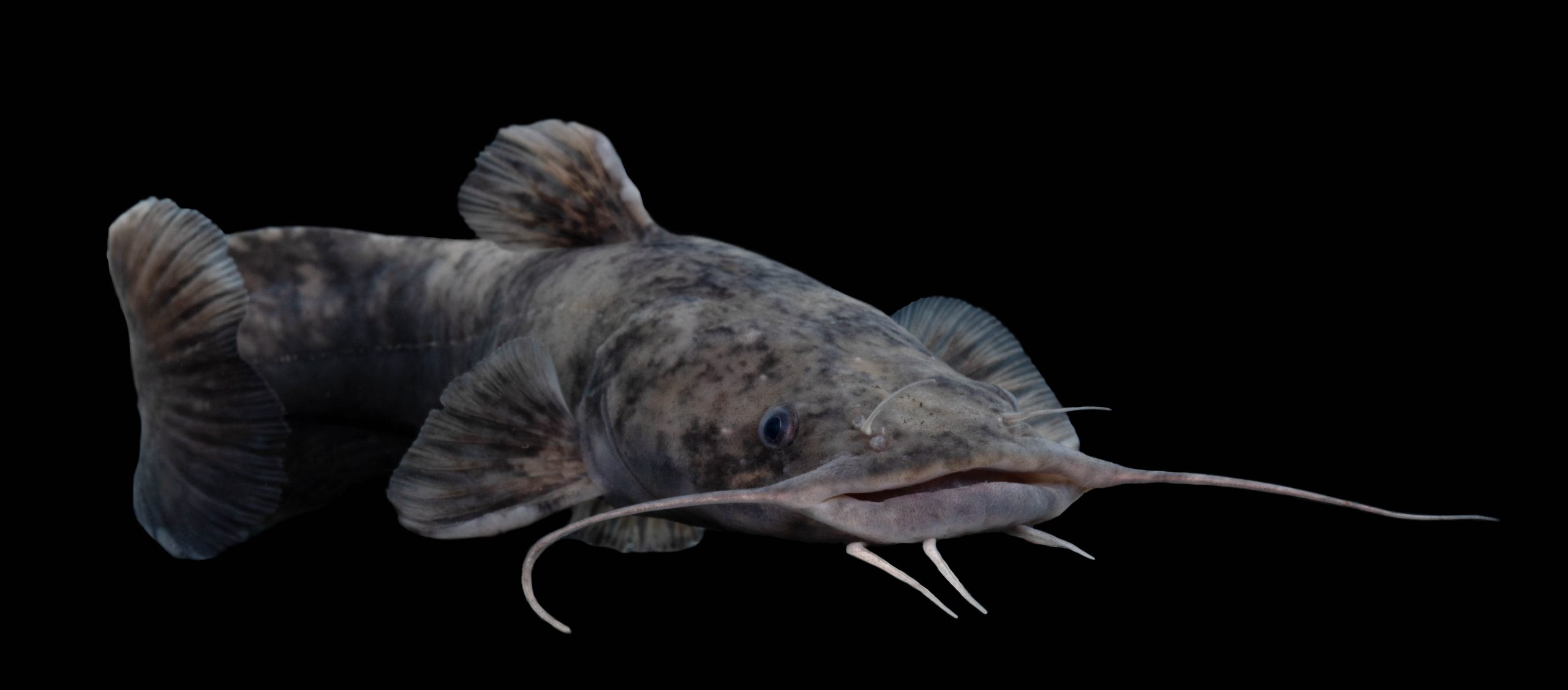
Flatheads can be yellow, olive, brown or almost black depending on the water. The structural combination is cleaner: broad flattened head, a lower jaw that projects beyond the upper jaw, small eyes and a square or shallowly notched tail.
Channel and blue catfish both have deeply forked tails. Channel cats often carry dark spots when young and usually have a rounded anal-fin margin. Blue cats lack the juvenile channel-cat spotting and have a longer, straighter anal fin. Flatheads look blockier through the head and do not carry the forked tail at all.
That distinction matters because regulations and management goals can differ among the three species, especially where flatheads were introduced outside their native drainage.
COVER IS THE DAYTIME ADDRESS
The best hole usually has something in it besides depth.
Flatheads use deep pools and holes, but depth alone is not the whole habitat. Wood, rock, undercut banks, bridge structure, submerged timber and current breaks give the fish somewhere to remain secure during daylight.
In rivers, outside bends and drift piles can combine deep water, current refuge and prey movement. In reservoirs, standing timber and submerged creek channels can create the same relationship without visible current at the surface.
A clean deep hole with no cover may hold fish. A smaller hole with a logjam, a soft edge beside current and a direct route to a feeding flat can be the more complete flathead situation.
NIGHT OPENS THE ROUTE
The fish may leave the best-looking cover after you finally can’t see it.
Flatheads are strongly nocturnal. After dark, adults often move from daytime refuge toward shallower banks, flats and current edges to hunt.
That makes the route between cover and feeding water more useful than treating the logjam as a twenty-four-hour coordinate. A bait placed directly in the wood can work, but so can one positioned just outside it where a moving fish can intercept without forcing the rig into the snag.
If one piece of cover is inactive, compare another cover-to-feeding-water relationship rather than soaking longer simply because the hole is famous.
LIVE PREY CHANGES THE CATFISH STORY
Adult flatheads are hunters.
Young flatheads eat insects, crayfish and small fish. As they grow, fish become the dominant prey. That’s the big split from channel cats, which lean much harder on scent and will eat nearly anything.
Where legal, live bait is therefore a biologically sensible presentation rather than a catfish tradition pasted onto every species. The bait has to stay lively, remain in the intended depth and avoid wrapping itself into the same cover the flathead is using.
Local bait laws matter. Some waters restrict live fish, transported bait or particular species. Verify what is legal before the bait bucket becomes part of the plan.
THE PLACEMENT PROBLEM
Close enough to get eaten. Far enough that you can still win the first move.
A flathead presentation around wood is an argument over distance. Too far from the cover and the fish may never encounter it. Too deep inside the cover and a hooked fish only has to move a few feet to end the fight.
Set the angle before the bite. Position the boat or bank cast so pressure can pull the fish away from the snag rather than directly through it. Use enough weight to keep the bait where you intended without turning the rig into an anchor that cannot move around debris.
A bait becoming suddenly nervous, pulling against the current or changing direction can be useful information before the rod loads. Repeated dead baits, fouling or instant snags tell you the placement is failing even if the habitat is right.
Change exact position, bait depth or approach angle before deciding the bait species is the problem.
THE FIRST TEN FEET
Heavier tackle is the kinder choice here, not just the stronger one.
A large flathead hooked beside timber doesn’t need a long light-tackle fight to prove anything. The first job is to keep the fish from reaching the cover, and the second is to shorten the total fight enough that release remains reasonable.
Strong line, abrasion-resistant leader where appropriate, heavy hooks and a rod with enough power to change the fish’s direction all serve that job. Drag still needs to protect the weakest connection; locked-down tackle that simply breaks isn’t control.
Large landing nets and long pliers make handling safer. Catfish spines can injure hands, and a heavy fish should be supported rather than hung vertically for a long photo.
SPAWNING
The cavity becomes a nest, and the male stays.
Flathead catfish spawn in warm weather in cavities and protected spaces such as hollow logs, undercut banks, rock openings and other enclosed cover. The male guards the eggs and young for a period after spawning.
That means the same kind of structure anglers target for adult fish can also become reproductive habitat. The exact spawning temperature and calendar vary by latitude and system; local water temperature is more useful than memorizing one national date.
NATIVE HERE, INTRODUCED PREDATOR THERE
A trophy catfish can also be the new apex predator in a river that never evolved with it.
Flatheads are native to much of the Mississippi, Missouri and Gulf-slope interior drainages. They have also been introduced widely outside that range.
USGS documents introduced populations and predatory impacts in eastern and western waters. Because adults become strongly piscivorous and can reach large size, new populations can alter native fish communities rather than simply add another sport fish.
Management therefore varies sharply. Some states cultivate trophy flathead fisheries; other waters encourage removal or place special concern on continued spread. Do not assume catch-and-release is automatically the conservation answer outside the native range.
KEEPING ONE
The river decides the rule and the health advisory.
Flathead catfish are widely regarded as good table fish, but large old predators can accumulate contaminants in some systems. Check the local fish-consumption advisory before making a giant fish the default keeper.
Harvest rules also vary widely. Trophy fisheries may use restrictive limits or protected lengths, while introduced populations may be managed more liberally. The current water-specific regulation belongs in the trip plan.
DEEP REFERENCE · RECORDS, MOVEMENT AND BAIT
Good to know, just not first.
How large and old can flatheads get?
Exceptional fish can live for decades and exceed fifty pounds, with much larger records documented. Those extremes explain why large adults are valuable in trophy fisheries but don’t improve the first decision around a logjam.
How far do they move?
Telemetry studies show both strong cover use and substantial seasonal/night movement. A flathead can repeatedly use a particular refuge while still leaving it to feed or shifting among seasonal habitats.
Live bait versus cut bait
Adult flatheads are strongly fish-oriented and agency guidance often favors live bait where legal. They can take cut bait and artificials as well. Live bait gets the edge, but nobody should pretend a flathead won’t eat something that’s already dead.
Moon phase and the barometer
No defensible source supports one universal flathead response to barometric pressure, moon phase, cloud cover or one exact night-time feeding window. Cover, prey, current, darkness and seasonal movement have much stronger support.
SOURCES
FEEDING · LIVE FISH, AFTER DARK
Daylight keeps it buried in the logjam. Dark is when it comes out onto the flat looking for something still swimming.
Spawning temperature and warm-water activity are kept separate from a feeding-temperature optimum.
The source shelf.
Here’s what nobody can hand you from a desk: the exact water temperature that flips a spawning male from feeding to guarding a cavity on your river. That number moves with latitude and the system, and the only way to pin it down is a thermometer at your own hole across the season it happens.
Profile reviewed 2026-09-02. Live-bait rules, harvest limits, introduced-species management and fish-consumption advisories are water-specific. Check the current managing agency before the trip.
FIELD OBJECT
This one should leave the page.
The article is the long version. These are the pieces worth carrying into the next trip.
The 30-second version
Big flatheads sit in the wood by day, hunt live fish after dark, and head straight back for the snag the second they’re hooked. Where to put the bait, and why heavier tackle is the kinder choice.
What to watch
- The first hard pull is already trying to put the fish back in the tree.
- The tail separates the three big North American catfish faster than color does.
- The best hole usually has something in it besides depth.
- The fish may leave the best-looking cover after you finally can’t see it.
Field card
- Missouri Department of Conservation — Flathead Catfish
- USGS NAS — Flathead Catfish
RIGHT TOOL, NEXT
Species & Presentation
Carry the species behavior and presentation question into a narrower water-to-fish-to-presentation handoff.