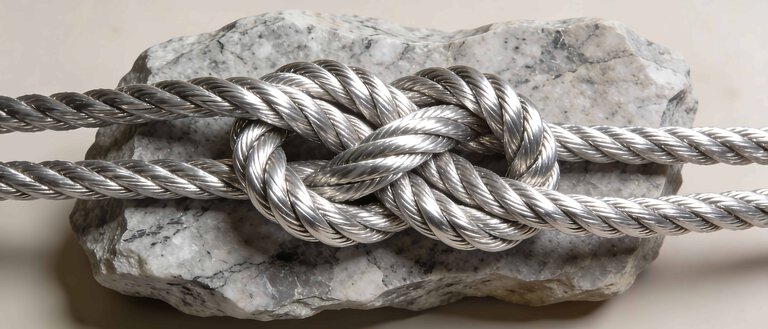
STOPPER · THE BARE END
Most rope that goes over the side doesn’t break first. A line pays out through the chock while everybody’s looking at something else, keeps going, and the end slides off the stern. The rope just ran out of rope, and nothing on the end of it said stop.
ORIGINAL HOOK DIAGRAM
One step separates it from an overhand, and it’s the step people skip.
Panel two is the whole difference. The end goes behind the standing part before it turns back for the loop — skip that and it’s just an overhand wearing a costume.
What I reach for it on
The bare end of anything that runs through a hole. Dock lines, the bitter end of an anchor rode, a line rove through a block, a chock or a ring.
Why not an overhand
An overhand stops a line just as well, right up until I load it hard and it sets into a lump I end up cutting off. This one still opens.
Sizing it
It has to be fatter than the gap it’s guarding. A stopper that slips through the fairlead isn’t stopping anything.
How I know it’s wrong
It doesn’t look like an eight. If the end came back through the loop without going behind the standing part first, that’s an overhand — close, but not this knot.
LOSS PREVENTION
Rope leaves quietly.
Gear on a boat mostly gets lost in the least interesting way available. A dock line goes slack, the wind takes the loose end, it feeds out through the chock a foot at a time, and by the time I look up it’s gone. There’s no bang and no lesson in it. Just a rope I now have to buy again.
A stopper in the end costs about four seconds and takes care of that whole problem. The knot usually isn’t carrying the working load — it just has to be too fat to fit through the opening. One limitation matters, though: a figure eight can work itself loose when it’s unloaded and shaken around. On slippery rope, or anywhere the stopper absolutely can’t disappear, I use a larger, more stable stopper instead of treating the figure eight as automatic.
One place I’m careful. On an anchor rode, a stopper at the bitter end is a last line of defense and not a substitute for the rode being properly made fast inside the boat. If I ever have to pay out everything I have, I want that far end attached to the vessel, not just knotted.
How I tie it
- Leave a decent tail at the end of the line, a hand’s length at least.
- Make a loop near the end, with the working end crossing over the standing part.
- Pass the working end behind the standing part.
- Bring it back down through the loop.
- Pull on the standing part and the tail together to set it.
- Work the crossings flat so the finished knot reads as an eight rather than a bundle.
When it’s the wrong knot
It stops a line and that’s all it does. It won’t make a loop, it won’t join two ropes, and it won’t make anything fast to anything. Those jobs belong to a bowline, a sheet bend, and a round turn and two half hitches.
The other case is a line I want to be able to run free. If there’s any situation where the whole length needs to pay out and go, a stopper in the end is the exact thing that’ll prevent it, whether or not I meant it to. Worth thinking about which lines those are before I knot every end aboard.
So it’s a knot you tie the day the rope comes out of the bag, then glance at now and then, because a figure eight on a line that flogs around unloaded doesn’t stay put forever. The ends most worth a look are the ones already on the boat before you got to them.
EXTERNAL PRACTICE / CROSS-CHECK
A clean figure eight is not automatically the most secure stopper.
Animated Knots: Figure Eight Stopper shows the route and documents the useful limitation: the knot is easy to untie after loading, but that same mobility means it can work loose. Compare it with a larger stopper when the line is slippery or the consequence of losing the stopper is high.
THE SIX-MOVE CHECK
Job → Material → Route → Dress → Seat → Test
- Job. Name what the connection has to do before choosing the knot.
- Material. Confirm the line, leader, rope, wire, and hardware actually suit this structure.
- Route. Trace every pass before tightening anything.
- Dress. Put strands, wraps, and loops in their intended order with no accidental crossings.
- Seat. Tighten in the order this knot needs. More force does not repair bad geometry.
- Test. Inspect the finished shape, load it by hand when appropriate, and retie if anything moves or fails the article-specific checks.
Practice / pass test. Tie this knot three clean times without rushing. A tie passes only when it matches this article’s What to check before you trust it geometry, shows none of the listed failure clues, and survives the stated load/inspection test. If you cannot tell why one attempt is better than another, keep practicing—the lesson is recognition, not memorization.
KNOT SPEC
Figure-Eight Stopper — the short answers
- ALSO CALLED
- Figure-eight knot, figure of eight, Flemish knot — all the same knot. Climbers use the same shape rethreaded to make a loop, which is a different knot with a similar name.
- KNOT TYPE
- Stopper knot tied in the end of a single rope
- WHAT IT CONNECTS
- Stopping a bare rope end running out through a chock, fairlead, block, ring or eye. It makes no loop, joins nothing, and makes nothing fast to anything.
- LINE TYPES
- Any rope: three-strand nylon, double-braid, polyester, polypropylene. In very stiff or very thick rope it can end up small in proportion to the hole it guards, in which case double it. Slick rope is the one to watch: unloaded and shaken around, a figure eight can work itself loose in it, so use a larger, more stable stopper where losing the stop would matter.
- STRENGTH BAND
- Not a strength knot — it carries no working load and its job is bulk, not holding. As a bend in the rope it’s one of the gentler ones, which is why it survives being driven hard against a fairlead and still opens afterward.
- DIFFICULTY
- Beginner, and the first knot worth teaching a child on a boat. The only confusion is with the overhand, and the difference between them is a single move.
- STEPS AND WRAPS
- Four moves and no wraps: loop, end behind the standing part, back down through the loop, dress it flat. No rope-type variation. Follow the same path a second time if you need more bulk.
- TIE TIME
- About four seconds. A boat knot in every sense, though the sensible moment to tie it is on the dock when the rope comes out of the bag, not when an end is already disappearing through a chock.
- POOR CONDITIONS
- As good as knots get in cold hands, gloves and the dark. Nothing to count and nothing to dress precisely. Getting it wrong produces an overhand, which still stops a rope even though it jams afterwards.
- THROUGH THE GUIDES
- No rod guides. The whole point is that it does not pass the hardware: it must be visibly fatter than the chock, fairlead or block it guards. Check it against the actual hole rather than assuming, especially with thin line and a big chock.
- LUBRICATION
- Lubrication is irrelevant. It handles wet and frozen rope better than most knots because it is never loaded to the point of jamming. Even after being driven hard against a fairlead it still unties, which is the whole reason to use it over an overhand.
- TAG END
- A hand’s length beyond the knot. Too short and it can capsize or shake out on a flogging line; too long and there is loose rope flapping. Whip or melt the raw end so it cannot unlay.
- TOOLS
- None to tie. A lighter or whipping twine for the raw end is genuinely useful, since a stopper on a frayed end is treating the symptom rather than the problem.
- BEST SUITED TO
- Every bare end aboard: dock lines, spring lines, the bitter end of an anchor rode, sheets, halyards, a line rove through a block. Not for a line that must be able to run free and go, and never as the rode’s actual attachment to the boat.
The strength bands are rough on purpose. Published knot tests don’t agree with each other — the same braid-to-leader knot has tested near ninety percent of line strength on one machine and under half on another, because the line brand, its diameter, how fast it got cinched, whether it was wet and whose hands tied it all move the number more than the knot does. Read the band as where this knot sits next to its neighbors, not as a figure to quote.
FIELD INTELLIGENCE
Where it earns its place, and where it costs you
Advantages
- It unties after being driven hard against hardware, which an overhand often doesn’t.
- Four seconds of work closes an entire category of quietly losing rope over the side.
- Nothing to remember. The finished knot either reads as an eight or it doesn’t.
- It ties the same way in any common rope, wet, dry or frozen.
Disadvantages
- It does exactly one job. No loop, no join, nothing made fast.
- The same mobility that lets it untie lets it work loose when it’s unloaded and flogging, and slick rope makes that worse.
- Too small for the gap it guards and it does nothing at all, which is easy to get wrong on thin line.
- It stops a line running free, which is the wrong outcome on a line that may need to be let go entirely.
- It is one move away from an overhand, and the wrong one jams.
Use a different knot when
- Double figure eight, or a bulkier stopper — when the knot is too small for the fairlead or hole it has to jam against
- Bowline — when what you actually want is a loop rather than a stop
- Sheet bend — when you are trying to join two ropes rather than end one
- Round turn and two half hitches — when the end needs to be made fast to something rather than merely stopped
WHAT TO CHECK BEFORE YOU TRUST IT
This is the cheapest insurance on a boat. Rope is rarely lost dramatically. A line goes slack, the wind takes the loose end, it feeds out through the chock a foot at a time, and by the time anyone looks up it is gone. Treat it as a sweep rather than a knot: walk the boat once before launch and look at every raw end that has a hole to run through. Lines that came with a boat somebody else rigged are the likeliest to be bare. The tradeoff is real though — a stopper is exactly what prevents a line running free when you want it to.
What actually makes it fail
- Tied as an overhand instead, which stops the line and then sets into a lump that gets cut off.
- Too small in proportion to the chock, fairlead or block, so it pulls straight through.
- A tail too short, or slick rope, letting the knot capsize or shake out on a flogging line.
- Trusted as the rode’s attachment to the boat, when it’s a last defense and not a made-fast end.
- Left in a line that later needed to run free, jamming at the fairlead at the worst moment.
How to test it, and how it ages
Read it: a figure eight looks like an eight, with the working end crossing behind the standing part before it comes back through. An overhand doesn’t. Then hold it up against the actual hole it guards — the chock, the fairlead, the block cheek — and confirm it’s visibly fatter. Load-test it with a firm steady pull against that hardware. The useful part of the test comes afterward: a good figure eight still opens in your fingers once the load is off.
Over a session: Not a tie-it-and-forget-it knot. On a line that flogs around unloaded it can work loose over time, faster in slick rope, so glance at it now and then. The other way it disappears is somebody untying it and not putting it back, so re-check any line that’s been off the boat.
Troubleshooting
Why did my line still run out with a knot in the end?
The knot was smaller than the hole. Double it, or use a bulkier stopper sized to the chock rather than to the rope.
Why won’t this one untie?
You tied an overhand, not a figure eight. The end has to pass behind the standing part before it comes back through the loop.
Do I need one on every line?
On every bare end that runs through hardware. Leave it off any line that must be able to pay out completely and go.
Is a stopper enough to hold the bitter end of the anchor rode?
No. The rode has to be made fast inside the boat. A stopper there is the last line of defense, not the attachment.
Why does it keep shaking out on a flogging line?
Usually the tail is too short. Leave a hand’s length and whip or melt the end so it can’t unlay. If the rope is slick and it still works loose, switch to a larger, more stable stopper.