DOUBLED BRAID · DOUBLE UNI
In a perfect world every braid rod gets an FG, slim and quiet through the guides. Then the light starts going, a leader needs retying, and the knot that demands perfect tension the whole way through loses to the one your hands already know. This is that one. Slick PE has never been keen on holding a knot. This Double Uni answers that by doubling the braid before it builds its Uni barrel, so there’s more surface area in contact and a thicker package clamped around the mono or fluorocarbon leader. If your braid isn’t slipping, or you’re joining mono to mono, the plain Double Uni does the job with less bulk at the guides.
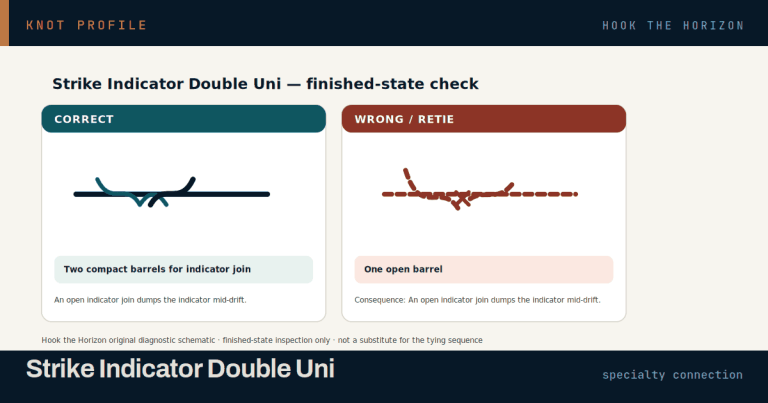
Two barrels, and only one of them is doubled
What it actually does
Joins doubled braid main line to a mono or fluorocarbon leader.
Wrap guidance
About eight braid-side turns and five to six leader-side turns, in the method I follow.
Tradeoff
More grip than a basic Double Uni, but also more bulk through guides. I don’t pretend otherwise.
What it’s best suited for
Situations where I want Uni mechanics I already know cold, without holding FG-style tension the whole way through — bad light, cold hands, a leader that needs retying fast.
Each line builds its own barrel, but the braid barrel gets doubled first
The two opposing Uni knots slide together the way they always have. Doubling the braid only changes what happens on the braid side of that meeting; the leader side is still a standard mono or fluoro Uni, tied exactly the way you’d tie it anywhere else. What you end up with is secure and physically larger than an FG or an Alberto, and that extra size shows up every time the knot has to pass through a guide. I’ve made peace with that trade on the rods where it doesn’t cost me distance.
Eight wraps on one side, five or six on the other
- Overlap braid and leader, then double the working braid section.
- Make a Uni loop with doubled braid and wrap it around both leader and braid about eight times.
- On the leader side, make a normal Uni loop and wrap about five to six times.
- Moisten leader material; close each barrel separately.
- Pull standing braid and leader so both barrels slide together firmly.
- Check braid tag movement and guide bulk before trimming.
Failure clue
The usual problem is braid that was doubled going in but isn’t doubled all the way through the barrel, which quietly removes the reason you tied this version to begin with. Too few braid wraps costs you the same grip. Then there’s letting one Uni close down before you’ve dressed it, which locks in whatever shape it happened to be sitting in. Bulky tags will keep striking guides for as long as you leave them there. And if your first couple come out lumpy, that’s normal for this one — the doubled strand wanders while you’re wrapping it, and it takes a few tries before your fingers stop fighting it and start pinching it along.
When the bulk is an acceptable price
Use it: braid to mono or fluoro when familiar Uni tying matters more than minimum diameter. Skip it: constant guide passage on micro guides, where every bit of bulk costs you. Compare: Double Uni for simpler, Alberto for slimmer, FG for the slimmest connection when it’s tied well and you’ve got the light and patience for it.
Two barrels, two tests
I pull-test both barrels separately before I trust the connection, because a good-looking barrel on one side doesn’t tell me anything about the other. NetKnots has a clean reference for the Double Double Uni if you want to compare wrap counts against your own at the kitchen table, before the version that happens with fading light and cold hands.
Open the deeper knot workflowJob, material, route, dressing, seating, pull-test checks and the standardized comparison record.
THE SIX-MOVE CHECK
Job → Material → Route → Dress → Seat → Test
- Job. Name what the connection has to do before choosing the knot.
- Material. Confirm the line, leader, rope, wire, and hardware actually suit this structure.
- Route. Trace every pass before tightening anything.
- Dress. Put strands, wraps, and loops in their intended order with no accidental crossings.
- Seat. Tighten in the order this knot needs. More force does not repair bad geometry.
- Test. Inspect the finished shape, load it by hand when appropriate, and retie if anything moves or fails the article-specific checks.
Practice / pass test. Tie this knot three clean times without rushing. A tie passes only when it matches this article’s What to check before you trust it geometry, shows none of the listed failure clues, and survives the stated load/inspection test. If you cannot tell why one attempt is better than another, keep practicing—the lesson is recognition, not memorization.
KNOT SPEC
Double Double Uni Knot — the short answers
- ALSO CALLED
- Double Uni with doubled braid, sometimes written Double-Double Uni. No widely used alternative name and no accepted inventor. Used mostly by braid anglers who want Uni mechanics rather than an FG.
- KNOT TYPE
- Line-to-line knot — a Uni barrel of doubled braid opposing a single-strand leader Uni
- WHAT IT CONNECTS
- Doubled braid main line to a mono or fluorocarbon leader. Not a terminal knot, and there is no point doubling the braid if you are joining two lines of the same material.
- LINE TYPES
- Braid to mono or fluorocarbon. The doubling exists because slick modern braid grips poorly, so this is aimed squarely at thin, round, coated PE. On mono to mono the doubled strand adds bulk and nothing else.
- STRENGTH BAND
- Solid. The doubled braid gives more surface in contact than a plain Double Uni, which is where the gain is. It stays below a well-tied FG on both strength and profile, and published rankings for this group disagree widely.
- DIFFICULTY
- Intermediate. The Uni itself is beginner-level; keeping a doubled braid strand tidy through eight wraps is not. Learnable by a teenager who already ties a clean Uni, but not a first knot.
- STEPS AND WRAPS
- Six moves. Around eight wraps on the doubled braid barrel and five to six on the leader barrel. The braid side takes more turns because braid needs them, and the doubling does not remove that need.
- TIE TIME
- A boat knot, but the slowest of the Uni family. A minute or so once learned. Faster than an FG and slower than a plain Double Uni, which is the whole reason it exists.
- POOR CONDITIONS
- Good. There is no sustained tension to hold and it can be set down mid-tie. The doubled braid does wander while you wrap, which costs you in wind and with gloves on, so expect a lumpy one now and then.
- THROUGH THE GUIDES
- The bulkiest connection in this batch. Two barrels, one of them built from doubled braid, make a knot that strikes guides audibly and can hang on micro guides. Keep it outside the tip. Do not choose it for long-leader casting.
- LUBRICATION
- Yes, and wet the leader barrel especially. Closing a fluorocarbon Uni dry is the classic way to break a leader at the knot. Wet the braid barrel too; doubled braid closing dry still generates heat.
- TAG END
- Trim the braid tag around a quarter inch, longer than you would on mono, because braid creeps and this barrel has more of it to give. Trim the leader tag close so it does not stand across the join and catch guides.
- TOOLS
- None. Nippers to trim. A finger or a hook to hold the doubled braid loop steady while you wrap helps more than any tool.
- BEST SUITED TO
- Not species-specific — chosen by tackle rather than fish. It suits braid anglers on inshore, bass and light saltwater gear where the leader join sits outside the rod tip between casts.
The strength bands are rough on purpose. Published knot tests don’t agree with each other — the same braid-to-leader knot has tested near ninety percent of line strength on one machine and under half on another, because the line brand, its diameter, how fast it got cinched, whether it was wet and whose hands tied it all move the number more than the knot does. Use the band to compare this knot with the others, not as a number to quote.
THE FAT ONE THAT HOLDS
It grips slick braid better than a plain Uni and needs no steady tension the way an FG does, so you can tie it on a moving deck. It is also the biggest join in this group, which is the exact complaint people have about Uni knots to begin with.
Advantages
- More braid surface in the barrel, which is the honest answer to slick PE slipping in a plain Uni.
- Built on Uni mechanics most anglers already know, so it can be tied in bad light without relearning anything.
- No sustained tension to hold, unlike the FG, so it survives being tied on a moving deck.
- Each barrel closes separately, so both can be inspected before they are joined.
- A reasonable middle ground when a plain Double Uni has slipped on you and an FG is not practical.
Disadvantages
- The bulkiest connection in this group, and bulk is the whole argument against Uni-family leader knots.
- The doubled braid wanders while you wrap it, so lumpy first attempts are normal.
- If the strand is not doubled all the way through the barrel, the knot has no advantage over a plain Double Uni.
- Uses more braid than the alternatives, which matters on a short leader.
- It solves a grip problem that better wrap counts on a plain Double Uni often solve on their own.
Use a different knot when
- Double Uni — when the braid is not especially slick and you would rather have less bulk and a faster tie
- FG Knot — when the leader has to run through the guides on every cast
- Alberto Knot — when you want a slim braid-to-leader connection that still tolerates rough conditions
- Slim Beauty — when the leader is heavy stiff fluorocarbon and a doubled-braid barrel would be enormous
WHAT TO CHECK BEFORE YOU TRUST IT
This one belongs on the rod where a plain Double Uni has actually slipped on you and an FG is not going to happen — failing light, cold hands, a leader to rebuild now. Check that the braid is genuinely doubled through every wrap of its barrel, not doubled at the start and single by the fourth turn, because that detail is the whole point of the knot. Then pull hard and watch the braid tag for creep. The tradeoff is size. You are buying grip with bulk, and on small guides that bill comes due on every cast.
What actually makes it fail
- The braid doubling coming apart partway through the barrel, leaving a plain Uni with extra untidiness.
- Too few braid wraps, so the barrel slides down the leader under load.
- A barrel closed down before the wraps were dressed, locking in crossed turns.
- Closing the leader barrel dry, which breaks fluorocarbon at the knot on the first hard load.
- Long or proud tags striking the guides until one of them lifts the barrel open.
How to test it, and how it ages
Before you close anything, look down the braid barrel and confirm the doubled strand runs through every wrap. Wet both barrels, close each one separately and dress the turns while they are still loose enough to move. Slide them together and check that they meet square rather than at an angle. Then pull the standing braid and leader apart hard and watch the braid tag: any creep at all means it gets cut and retied. Finish with a steady load against a bent rod.
Over a session: Holds up over a session, but the braid barrel is the part that works loose, so check it after every few fish. The extra bulk collects weed and grit, which grinds at the leader where it enters the join.
Troubleshooting
Is this actually better than a plain Double Uni?
Only on slick braid, and only if the doubling survives the whole barrel. On ordinary braid, adding a wrap or two to a plain Double Uni usually does the same job with less bulk.
Why does my doubled braid keep separating as I wrap?
You are letting the loop go between turns. Pinch the doubled section against the leader and move the pinch along with the wraps.
Why does it bang through my guides?
Because it is a large knot, and that cannot be trimmed away. If it has to pass guides on every cast, tie an FG or an Alberto.
Why did the leader break at the knot?
The leader barrel was closed dry, or it was crossed and never dressed. Wet it and straighten the turns before drawing it down.
How many wraps should each side get?
About eight on the doubled braid and five or six on the leader. The braid side always gets more; matching the counts is the common mistake.
FIELD OBJECT
This one should leave the page.
The article is the long version. These are the pieces worth carrying into the next trip.
The 30-second version
Doubling the braid before its Uni barrel gives slick PE more to grip than a plain Double Uni does. You pay for it in bulk at the guides, so save it for braid that keeps slipping.
What to watch
- Two barrels, and only one of them is doubled
- Each line builds its own barrel, but the braid barrel gets doubled first
- Eight wraps on one side, five or six on the other
- Seat check
Field card
- Overlap braid and leader, then double the working braid section.
- Make a Uni loop with doubled braid and wrap it around both leader and braid about eight times.
- On the leader side, make a normal Uni loop and wrap about five to six times.
- Moisten leader material; close each barrel separately.
- Pull standing braid and leader so both barrels slide together firmly.
RIGHT TOOL, NEXT
Knot Analyst
Carry the connection problem into a knot choice built around line, hardware, conditions, and failure mode.