COMMON CARP · SPECIES PROFILE
A mudding fish is feeding. A cruising fish may just be going somewhere.
Carp fishing is mostly watching. When one’s rooting hard enough to push a mud plume off the bottom, that fish is working, and that’s a much better reason to drop a bait there than a big bronze back sliding past that you’ve decided must be hungry.
Profile basis: Missouri Department of Conservation · New York DEC · University of Minnesota MAISRC
IDENTIFICATION
If it has barbels, it is not a buffalo.
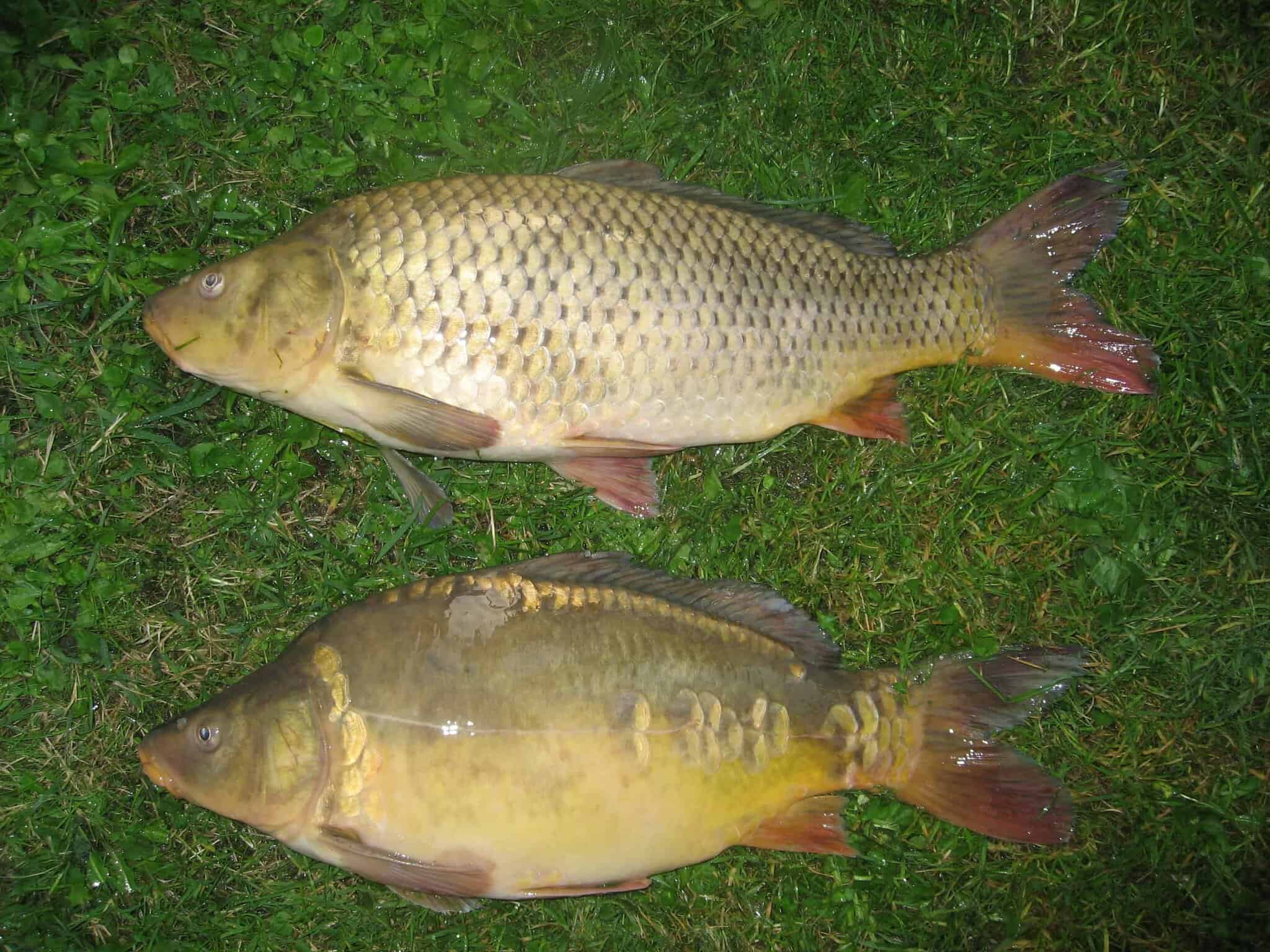
Common carp are deep, thick fish with large scales whose dark edges create a crosshatched look. The dorsal fin is long and carries a stout serrated spine at the front. The mouth is soft, protrusible and built for rooting and sucking food from the bottom.
The easiest field check is the face: common carp have two pairs of barbels on the upper jaw. Bigmouth and smallmouth buffalo do not. Buffalofishes are native North American suckers; common carp are introduced cyprinids. A one-second barbel check can therefore matter more than a whole debate about body color.
Goldfish also lack barbels and can overlap with small carp in shape and color. Common carp and goldfish can hybridize, which makes borderline individuals awkward. The barbel check works right up until hybridization blurs it.
Grass carp, silver carp, bighead carp and black carp are separate introduced Asian species and don’t share the common carp’s two-pair barbel arrangement. “Carp” is a loose angler word covering fish that aren’t interchangeable biologically or legally.
Sources: Missouri Department of Conservation · Missouri Department of Conservation — Bigmouth Buffalo · Iowa DNR
SOFT WATER, SOFT BOTTOM
The carp version of structure can be the mud itself.
Common carp do especially well in warm, slow and standing water over soft sediment: lowland rivers, reservoirs, natural lakes, backwaters, coves, weedy pools and deeper slow pools in rivers. Iowa and Missouri both point away from clear, high-gradient streams.
That fits the feeding mechanics. Carp root into sediment for insect larvae, crustaceans, snails, detritus and plant material. A soft silty flat can be feeding habitat even though it looks like featureless nothing to somebody who only knows how to look for rock, wood and drop-offs.
In a river, current still matters because it changes how expensive the water is to occupy. Early spring snowmelt can make the main channel cold and heavy; Connecticut’s agency-hosted carp primer directs anglers toward coves, backwaters and eddies until flows settle. Iowa notes carp exploring newly flooded water as rivers rise.
A big open lake also doesn’t mean the fish are evenly spread across it. Warming shallows, submerged cover, soft-bottom food and protected water can make one corner much more interesting than the rest.
WATCH THE FISH BEFORE YOU BAIT THE HOOK
The best visual clue isn’t just seeing a carp.
A carp cruising three feet under the surface can be traveling, spawning, sunning or simply moving between areas. A carp with its head down and sediment boiling behind it is doing something much more specific.
Because carp find food heavily by taste and touch and can feed in extremely turbid water, a mud plume isn’t the handicap it would be for a sight-feeding predator. The fish may be making the cloud precisely because it’s feeding.
Bubbles, repeated tailing, a moving patch of disturbed sediment, several fish returning to one small flat and fish visibly tipping forward all add weight to the idea. Put the bait where the feeding is happening and leave it long enough to belong there.
That’s a different rhythm from bass fishing. Constantly retrieving a lure through the area can turn a feeding fish into a cruising fish, which feels like progress only because the rod stayed busy.
Sources: Missouri Department of Conservation · U.S. Fish & Wildlife Service
THE BAIT DOES NOT NEED TO SWIM
Static bottom fishing isn’t “doing nothing.” It’s the presentation.
State carp guidance is built around bait rather than conventional lures. New York lists corn, bread, dough balls, pack bait, cereal, dog food and other prepared baits. Iowa and Missouri include worms and dough. Texas even publishes carp-bait recipes.
The common presentation is stationary bottom fishing. The bait sits where a feeding carp can find it without having to chase a moving object. New York recommends free-running or low-resistance setups so the fish can move with the bait without immediately feeling the full weight.
A hair rig moves the bait off the hook bend. New York gives three practical advantages: the hook point stays exposed, a fish trying to spit the bait can still be hooked, and the rig tends to reduce deep hooking. That’s specialized carp gear doing an actual job instead of serving as a membership badge.
Sources: New York DEC · University of Minnesota MAISRC
SPRING
Warming shallows and rising water can open a completely new feeding map.
Spring is when carp move from deeper winter water toward warming margins and eventually into shallow vegetated areas to spawn. State and federal sources generally place spawning in the roughly 59–68°F / 15–20°C range, with local seasons stretching from early spring into summer.
Before the spawn, newly warmed coves and backwaters can be the more useful fishing water than the cold main river. Rising river water also gives carp access to newly flooded margins, and Iowa explicitly notes fish exploring and feeding in those areas.
Spawning itself looks different from feeding. Carp broadcast adhesive eggs over submerged vegetation with no nest or parental care, and the shallow-water activity can be loud and chaotic. A fish crashing through weeds in a spawning group is not automatically a fish worth placing a bottom bait in front of.
The visual clue still matters: is the fish feeding or is it occupied with something else?
THE FIGHT
The reel needs line because the first run may use a surprising amount of it.
New York DEC describes carp as hard fighters that make long runs. The Connecticut agency-hosted primer puts common first runs around 20–40 yards and sometimes farther. That is why both sources prefer reels with real line capacity and usable drag rather than tiny panfish equipment attached to optimism.
The mouth is fleshy, so pulling as hard as possible creates a different failure. Let the drag do the work, keep steady pressure and land the fish when it is controllable.
If the fish is going back, keep it off hot rock and hard ground, wet your hands, support the body and unhook it over water or a soft mat when possible. The carp-specific European-style landing equipment can look excessive until the fish on the bank is twenty pounds and has decided it dislikes gravity.
THE ECOLOGICAL PROBLEM
The same rooting behavior that makes the fish fun to watch can wreck a shallow lake.
Common carp are introduced across almost the entire contiguous United States and are considered a high-risk invasive species by U.S. Fish and Wildlife Service. Their main ecological effect isn’t predation. It’s re-engineering the habitat with their mouths.
Rooting resuspends sediment, uproots shallow vegetation and releases nutrients such as phosphorus into the water column. In shallow lakes and wetlands, enough carp biomass can shift the system from clear, plant-rich water toward turbid, algae-dominated water.
The quantified work is ugly. In an Illinois shallow-lake study, plant cover fell from more than 90% at low carp biomass to 17% when biomass exceeded about 250 kg/ha; waterfowl use fell with it. Minnesota researchers describe the same broad mechanism across degraded shallow lakes and wetlands.
That impact depends on density and habitat. Missouri Department of Conservation explicitly cautions that some nuisance claims may be exaggerated, and a big-river carp problem isn’t identical to a shallow-wetland carp problem. Keeping that disagreement is more honest than picking whichever sentence sounds tougher on carp.
Sources: U.S. Fish & Wildlife Service · Bajer, Sullivan & Sorensen 2009 · University of Minnesota MAISRC
CARP IS NOT BUFFALO
The identification error is more serious than the nickname makes it sound.
Common carp are introduced. Bigmouth and smallmouth buffalo are native across large parts of North America. Yet all three are large, deep-bodied fish living in similar turbid or slow-water systems and all have spent decades being called “rough fish.”
The easiest correction is visible in the hand: common carp have barbels; buffalo don’t. Carp have serrated spines at the front of the dorsal and anal fins; buffalo don’t. Carp scales also carry the darker crosshatched edge pattern.
This matters most in harvest methods that don’t allow release. A bowfisher who calls a native buffalo “just a carp” can’t take the mistake back after the arrow lands.
It matters for tackle, too. What works on common carp shouldn’t get copied onto buffalo. Common carp are active benthic omnivores that readily take prepared bait. Bigmouth buffalo are filter-feeding native suckers that are rarely caught on hook and line. Similar body shape isn’t similar fishing.
KEEP OR RELEASE?
There’s no national carp ethic, because the goal changes from water to water.
Many states classify common carp as nongame or invasive and allow liberal harvest. Others simultaneously promote rod-and-line carp fishing because the fish grow large and fight hard. The same state can legally permit catch-and-release angling while encouraging removal in habitat-restoration programs.
Method can change the rule too. Texas prohibits release of edible or bait-usable fish, including common carp and buffalo, once taken by lawful archery equipment. Minnesota’s invasive-species rules prohibit introducing carp to new water while allowing fish caught by angling to be returned to the same water body.
Those are examples, not a national rule. Before keeping, releasing, moving or using a carp for bait, check the current law for that state and water. “Invasive” does not automatically answer every handling question legally.
Food is just as culturally split. New York calls carp extremely good to eat and notes its importance as food around the world; other North American sources dismiss it. The concrete health issue is easier to settle: carp appear in contaminant advisories in some waters because long-lived bottom-feeding fish can accumulate PCBs and other pollutants. Check the local fish-consumption advisory before treating a big old carp as dinner.
DEEP REFERENCE · THE PARTS THAT DO NOT NEED TO LEAD
The carp arguments are more interesting once the fishing profile already makes sense.
How old can a common carp get?
FishBase reports a maximum age of 38 years, while U.S. Fish and Wildlife Service summaries describe much shorter typical wild lifespans and far longer captive lives. Those numbers are measuring different populations and settings. The profile no longer uses one “maximum age” card because it adds little to the fishing decision.
How damaging is carp biomass?
The shallow-lake literature describes a gradient rather than one magic threshold: effects are small around very low biomass, substantial around roughly 100 kg/ha and severe above about 250 kg/ha in the best-known Illinois work. Those values are system-specific and should not be turned into a universal river rule.
Carp as invasive fish versus carp as sport fish
Minnesota and USFWS emphasise ecological damage and control. New York DEC teaches catch-and-release carp angling and hair-rig technique. Missouri is more cautious about the scale of nuisance effects. Those positions can all be real because management objective, habitat and angling culture differ.
When did common carp first reach North America?
Some agency histories give 1831; USFWS treats an 1872 California import as the first major documented introduction; the continent-wide expansion came later through U.S. Fish Commission distribution. Interesting history, almost no bearing on where to place the bait today.
What this profile deliberately does not claim
The original research did not establish universal common-carp responses to barometric pressure, cold fronts, wind, cloud cover or angling pressure. It also did not support a conventional lure category. Feeding behaviour, soft bottom, water level, temperature and bait placement are supported much more directly.
Two seconds checking for barbels is the difference between removing a carp and killing a buffalo that never had a vote in it. The mouth is the first thing I check on any bronze fish that size, because no barbels means the whole legal picture changed, not just the label.
SOURCES
FEEDING ECOLOGY · STANDARDIZED
How this fish gets fed.
A mudding fish is feeding evidence; water temperature and weather are supporting conditions, not on/off switches.
The source shelf.
- Missouri Department of Conservation — Common Carp
- Iowa DNR — Common Carp
- National Park Service — Common Carp
- New York DEC — Carp Fishing
- New York DEC — Carp Fishing in New York
- Connecticut DEEP-hosted carp primer
- U.S. Fish & Wildlife Service — Ecological Risk Screening Summary
- University of Minnesota MAISRC — Common Carp Research
- Bajer, Sullivan & Sorensen 2009 — carp biomass and shallow-lake effects
- New York State Department of Health — fish-consumption advice
- Missouri Department of Conservation — Bigmouth Buffalo comparison
- Texas Parks and Wildlife — Bowfishing Regulations
Profile reviewed 2026-09-02. Carp harvest, bowfishing, chumming, bait and release rules vary sharply by state and water. Check the current managing agency before the trip.