Atka Mackerel Is a Greenling Wearing a Mackerel’s Name
Atka mackerel is a greenling relative, not a true mackerel. It schools over Aleutian reefs eating krill and copepods most of the year, then moves shallow to spawn while males guard eggs stuck to rock.
By HunterUpdated September 19, 2026Read 7 min
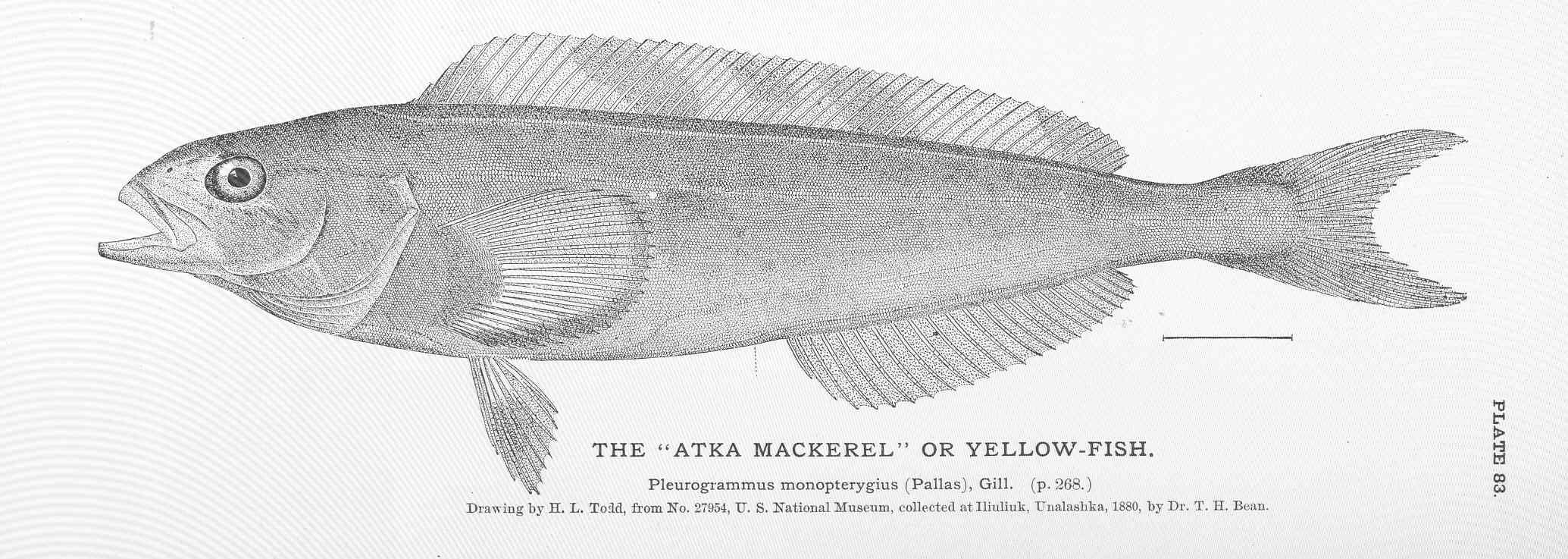
Atka Mackerel (Pleurogrammus monopterygius) drawn from U.S. National Museum specimen 27354, collected at Iliuliuk, Unalaska, in 1880 — the single unbroken dorsal fin running the length of the back is the greenling giveaway, and there is not a finlet on the fish. Illustration: H. L. Todd / U.S. Commission of Fish and Fisheries, public domain.
Don’t let the name do your identification for you.Pleurogrammus monopterygius belongs to the same family as lingcod and kelp greenling, not the fast, finlet-covered mackerels most people picture when they hear the word. It spends much of the year as a schooling semipelagic fish around Aleutian shelf breaks and reefs, then flips its whole routine to spawn: adults move shallower, eggs stick to rock, and males stay behind to guard the nests. That switch is the part worth building everything else around.
At a glance · The short version
Scientific name
Pleurogrammus monopterygius
Family
Hexagrammidae: a greenling relative, not a true mackerel.
Center of abundance
Central and western Aleutian Islands.
Normal behavior
Gregarious, schooling, semipelagic to semidemersal over continental-shelf habitat.
Spawning
Moves into shallow rocky habitat; adhesive eggs are placed in crevices and guarded by males.
Main prey
Copepods and euphausiids (krill), connecting plankton production to large predators.
The name sends identification in the wrong direction
Identification
Not a scombrid
Atka mackerel lacks the narrow tuna-like body and finlets of true mackerels. It has the deeper, elongated greenling-family body, a long continuous-looking dorsal profile and a forked tail suited to schooling over reefs and shelf habitat.
Adults can show dark vertical or oblique banding over gray-green to yellow-brown sides, with stronger contrast in some fish and conditions. Color varies enough that body form and the Aleutian capture context should carry more weight than one photograph.
Family comparison
Kelp greenling is a nearshore relative with strong sex-specific color patterns; lingcod is the giant-mouthed member of the same family. Atka mackerel is the schooling, plankton-feeding Aleutian branch of that comparison.
The scientific name monopterygius points toward a single dorsal-fin arrangement. That helps separate the species from cod-family fish such as pollock, which carry three distinct dorsal fins.
An Aleutian fish with a broad North Pacific map
Range & Habitat
Across the northern Pacific
ADF&G describes a range from the Kuril and Kamchatka region east through the Bering Sea, Aleutian chain and Gulf of Alaska to Southeast Alaska. The center of abundance is the central and western Aleutians.
Atka mackerel school above and around shelf and reef habitat rather than living permanently either on bottom or in featureless open water. “Reef fish” and “pelagic school” can both describe the same animal at different moments.
Current matters
Aleutian passes, banks and reef edges experience strong flow. Current can aggregate planktonic prey and define where a school can hold efficiently beside structure.
Dense local patches
The species can concentrate strongly around suitable habitat. That patchiness is ecologically important because predators and fisheries may depend on where the fish are distributed, not only on the basin-wide biomass total.
Spawning changes a pelagic fish into a nest fish
Reproduction & Nest Guarding
Shallow migration
ADF&G reports movement from the shelf edge toward coastal water roughly 5–30 meters deep for spawning. Along the Aleutians, spawning is generally described from July through October.
Females place eggs in rocky crevices rather than releasing them to drift freely. The spawning habitat therefore depends on bottom type as well as water temperature and depth.
Male guard
Males defend nests until hatching, commonly about 40–45 days in the ADF&G summary. Removing a guarding male can expose an egg mass to predation and cannibalism.
Unknown nesting geography
ADF&G is explicit that spawning and nesting locations within Alaska remain incompletely known. Russian observations from Kamchatka help describe the system but should not be copied across the entire range as though every Aleutian nest uses the same depth and temperature.
Fourteen years is a different clock from pollock
Growth & Maturity
Age
Atka mackerel first appear regularly in trawl surveys and fisheries around ages two to three, and many survive to roughly age 14. They are neither an extremely short-lived forage fish nor a century-old rockfish.
ADF&G reports about half of females mature near 31 centimeters and approximately 3.6 years. Size and age at maturity are population summaries, not a ruler that identifies whether one fish has spawned.
Aggregation risk
Spawning brings adults together in predictable shallow habitat. That creates a monitoring and management problem: a large catch rate can reflect temporary concentration rather than a coastwide population boom.
Krill turns the species into an ecosystem bridge
Diet & Predators
Copepods and euphausiids
ADF&G describes a diet dominated by copepods and euphausiids. The fish is built to exploit dense plankton layers carried across shelf edges and reefs.
Atka mackerel is eaten by marine fishes, birds and mammals, including Steller sea lions. Its value cannot be measured only in pounds landed; spatial availability to predators is part of the ecological equation.
A reef is not enough
Rock provides spawning and holding structure, but plankton supply helps determine whether a school can feed there. The productive feature is habitat plus flow plus prey.
How I would read unfamiliar Atka water
Field Decisions
Evidence level. No firsthand basis for any of this. These are inferences from agency descriptions of schooling, prey and habitat.
Search the shoulder, not only the rock inference
I would look for schools on the current-facing shoulder or water column beside a bank before dropping into the roughest center. The fish is semipelagic much of the year, so the mark may sit above relief.
Match small prey inference
A compact jig or fly-like profile makes more ecological sense than an oversized bait when the school is feeding on krill and copepods. Hook and tackle strength still have to match depth, current and bycatch.
Treat spawning water differently decision rule
Dense shallow aggregations in the July–October spawning window may include nesting fish. Legal access does not erase the biological reason for concentration.
Separate school depth from bottom depth worth testing
If the reef is 250 feet deep and the school tops at 170, the useful number is 170. Sending every lure to bottom can miss fish and increase snag or bycatch exposure.
Strong current magnifies small mistakes
Tackle & Handling
Control line angle
Current can sweep light gear away from a narrow school. Use enough weight and low-drag line to reach the observed layer while keeping the presentation active.
Identify before retention
Atka mackerel may share northern groundfish catches with cod, pollock and rockfish. Confirm the one-dorsal greenling-family body and current regional rule before keeping it.
Deep-water bycatch
Mixed groundfish can suffer barotrauma. Carry the required or agency-recommended descending equipment and know the release procedure for protected bycatch before fishing deep structure.
Food care
If legally retained, bleed and chill promptly. A cold-water fish still warms quickly on a deck, and poor care can erase the quality advantage of harvesting it from cold habitat.
Keep the strange fish strange
Easy Assumptions That Don’t Hold Up
that Atka mackerel is a true mackerel
that it lives permanently on bottom because it nests there
that every Alaska nesting site is already mapped
that a dense spawning aggregation proves record stock abundance
that all Aleutian reef fish eat large fish-shaped prey
The one thing worth being scared of here isn’t the fish, it’s the identification call on deck — a mixed groundfish haul puts Atka mackerel next to cod, pollock and rockfish that carry different rules. That single dorsal fin is the whole trick, and once you’ve checked it once you won’t need the source link again.
— · Sources
FEEDING · PLANKTON OVER HARD BOTTOM
It feeds on drifting crustaceans in the water over Aleutian reef rather than picking through it. Nest guarding moves the fish around too, and that is not feeding.
What it eats
Euphausiids, copepods, amphipods and other zooplankton are important, with small fishes and squid also taken.
How and where it hunts
A schooling predator associated with rocky Aleutian shelf and island habitat, feeding above and around hard bottom rather than functioning as a purely bottom-bound fish.
When it feeds
The profile does not establish one universal diel feeding window. Seasonal spawning and nest guarding change adult behavior and local concentration; those reproductive events are kept separate from ordinary feeding.
What changes as it grows
Early life stages rely on small planktonic prey. The profile does not support a precise size-based adult diet transition beyond broadening toward larger zooplankton, fishes and squid.
Male nest guarding is reproductive behavior, not a feeding station.
Compiled 2026-09-11. Limits and advisories are set per water and per state and change between seasons — the managing agency for wherever you are fishing has the current answer.
Strip off the misleading half of the name and the rest lines up. Most of the year you’re looking for a school eating plankton somewhere above Aleutian structure, so the useful number is the depth of the school, not the depth of the rock. Come July, the same fish is tied to the bottom, and a guarding male may be sitting on adhesive eggs for weeks. A shallow crowd in that window is a bunch of nests, not a pile of interchangeable fish.
FIELD OBJECT
This one should leave the page.
The article is the long version. These are the pieces worth carrying into the next trip.
The 30-second version
Atka mackerel is a greenling relative, not a true mackerel. It schools over Aleutian reefs eating krill and copepods most of the year, then moves shallow to spawn while males guard eggs stuck to rock.
What to watch
Identification
Range & Habitat
Reproduction & Nest Guarding
Growth & Maturity
Field card
that Atka mackerel is a true mackerel
that it lives permanently on bottom because it nests there
that every Alaska nesting site is already mapped
that a dense spawning aggregation proves record stock abundance
that all Aleutian reef fish eat large fish-shaped prey
RIGHT TOOL, NEXT
Species & Presentation
Carry the species behavior and presentation question into a narrower water-to-fish-to-presentation handoff.
We use necessary cookies to operate the site. With your choice, we may also use analytics and advertising cookies. Choose Accept All, Reject, or Preferences.
Contains information related to marketing campaigns of the user. These are shared with Google AdWords / Google Ads when the Google Ads and Google Analytics accounts are linked together.
90 days
__utma
ID used to identify users and sessions
2 years after last activity
__utmt
Used to monitor number of Google Analytics server requests
10 minutes
__utmb
Used to distinguish new sessions and visits. This cookie is set when the GA.js javascript library is loaded and there is no existing __utmb cookie. The cookie is updated every time data is sent to the Google Analytics server.
30 minutes after last activity
__utmc
Used only with old Urchin versions of Google Analytics and not with GA.js. Was used to distinguish between new sessions and visits at the end of a session.
End of session (browser)
__utmz
Contains information about the traffic source or campaign that directed user to the website. The cookie is set when the GA.js javascript is loaded and updated when data is sent to the Google Anaytics server
6 months after last activity
__utmv
Contains custom information set by the web developer via the _setCustomVar method in Google Analytics. This cookie is updated every time new data is sent to the Google Analytics server.
2 years after last activity
__utmx
Used to determine whether a user is included in an A / B or Multivariate test.
18 months
_ga
ID used to identify users
2 years
_gali
Used by Google Analytics to determine which links on a page are being clicked
30 seconds
_ga_
ID used to identify users
2 years
_gid
ID used to identify users for 24 hours after last activity
24 hours
_gat
Used to monitor number of Google Analytics server requests when using Google Tag Manager
1 minute
Jetpack's built-in visitor analytics. It records page views, referring sites, search terms, and outbound link clicks, and also carries the shared visitor-tracking library used by Jetpack Instant Search and WooCommerce Analytics.