Lingcod are giant greenlings with 18 serious teeth, and the males guard egg masses for eight to ten weeks. The deeper side of their pinnacle often belongs to yelloweye rockfish, so where the jig goes matters.
By HunterUpdated September 14, 2026Read 6 min
Image: luxury editorial portrait
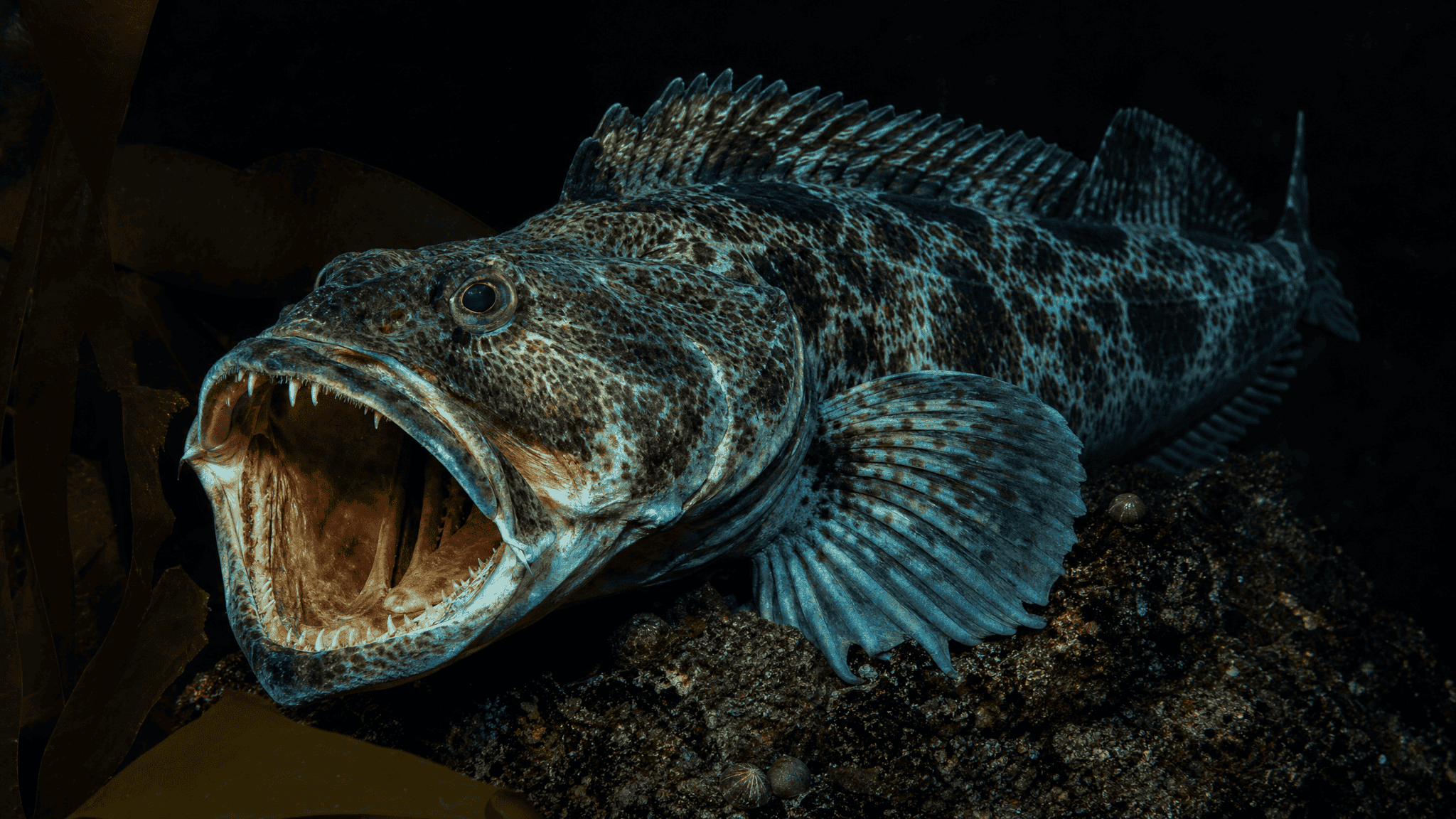
Forget the color. Lingcod come gray, brown, green or copper, and the feature worth looking at is the mouth. Ophiodon elongatus isn’t a cod at all; it’s a giant greenling that ambushes around rock with enough jaw to swallow fish that look too big to fit. The catch — the other kind — is that a good lingcod pinnacle often has slow-growing, sometimes protected rockfish living down its deeper sides.
At a glance · The short version
Scientific name
Ophiodon elongatus
Family
Hexagrammidae: a greenling, not a true cod.
Maximum size
NOAA: up to about 5 ft and 80 lb; females attain much larger sizes than males.
Longevity
More than 20 years.
Spawning
Late fall through spring in shallow rocky habitat; males guard egg masses for roughly 8-10 weeks.
What fish is this?
Bucket Head, Long Body, Eighteen Serious Teeth
Structure
NOAA and Alaska both describe a large head and mouth, long body tapering toward the tail, and 18 large sharp teeth. Color can run dark gray, brown, greenish, or copper-mottled. That variability is exactly why the head/body proportions are better identification traits than whether the fish happens to be green.
Some lingcod have striking blue-green raw flesh. NOAA’s current seafood page notes the flesh turns snow white when cooked. The color is a normal occurrence, not evidence the fish is spoiled by default.
NOAA places juveniles on nearshore sandy bottom around eelgrass and kelp before older fish shift toward rocky habitat, kelp, and other structure. That nursery-to-reef transition is one reason a healthy lingcod fishery depends on more habitat than offshore pinnacles alone.
Young adults and adults use rocky habitat, kelp, seaweed, and other structure with abundant prey. Males can be strongly resident; NOAA notes immature fish may move more than 60 miles and females make seasonal spawning movements.
NOAA summarizes male maturity around age two and almost 20 inches, while females mature around age three and roughly 30 inches. That sex difference is part of why the largest fish skew female.
Males establish territories in shallow rocky spawning habitat. Females visit briefly to deposit egg masses in crevices or under ledges; males then guard the eggs for about eight to ten weeks.
NOAA reports that unguarded nests can be heavily consumed within about 48 hours by rockfish, starfish, sculpins, greenling, and cod. Removing a male from a nest can affect an entire egg mass, not just one adult fish.
Predator First, Scavenger Only When Opportunity Says So
Adult prey
NOAA lists bottom-dwelling fishes—including smaller lingcod—plus squid, octopus, and crab. This is a large-prey ambush predator with no requirement that the presentation be tiny or delicate.
A substantial swimbait, jig, or legal natural bait makes ecological sense when the fish is hunting larger benthic prey. The important part is getting it close to the rock without spending every retrieve buried in it.
Working the pinnacle
Top and Edge Before the Deep Side
Lingcod sideinference
On a pinnacle, figure out where the top, the shoulder and the sharp edge are before a jig goes into the deepest crack. Lingcod often sit where a short move can intercept prey and still return to rock.
Rockfish bycatch
ADF&G specifically warns that lingcod often occupy the same pinnacles as yelloweye rockfish, with lingcod commonly nearer the top and yelloweye on deeper sides. Avoiding unnecessary deep passes can reduce protected-rockfish bycatch while still targeting lingcod.
Turn the fish away from structure early. Once line rubs rock, the fight is no longer between tackle and fish. That means drag, knots, leader, and hook all need their load test before the drop.
The decision layer
After the First Rockfish Bycatch
Yelloweye/protected rockfish appear
Stop probing the deep side of that pinnacle. Shift shallower/topside or leave the structure.
Jig keeps snagging
Lift the working zone a few feet above relief and adjust boat angle/weight before abandoning the profile.
Blue flesh appears
Do not discard a legally harvested, otherwise sound fish because of color alone; NOAA documents the blue-green raw tint turning white with cooking.
— · Not established
What the Pinnacle Does Not Prove
a claim that every male stays on one rock for life
a universal best jig weight
that blue-green flesh means anything about freshness by itself
The pinnacle advice above is the agencies’ biology run through the logic of those teeth; I haven’t had a lingcod on myself. What I keep coming back to is that the mouth isn’t there at the start. A newly hatched lingcod drifts near the surface with none of that jaw, and nothing in the record says exactly when the switch happens.
Bring a release tool longer than feels necessary. Nobody wants to reach into that mouth twice.
Pinnacle logic · Fish the top without mining the side
The Better Lingcod Pass Avoids the Deep Rockfish
First pass
Cross the crown and upper edge with the lure just above relief. That keeps a mobile bait visible to lingcod while reducing time in the deeper rockfish band.
Bycatch signal
If Quillback Rockfish or other sensitive rockfish appear, do not repeat the same deep track. Shift shallower, lift the lure, or leave the structure.
Nearby look-alikes
Lingcod’s long body and large toothed mouth separate it from Cabezon and California Scorpionfish. Those identifications change handling and food-safety decisions.
— · Sources
FEEDING ECOLOGY · STANDARDIZED
The Ambush Lane Above the Rock
Primary prey
Fishes dominate the adult diet, with squid, octopus, crabs and other large benthic or near-bottom prey also taken.
Feeding mode / location
A large ambush predator using rocky reef, kelp, wrecks, ledges and hard-bottom relief. It commonly holds close to structure and attacks fishes moving through the same depth lane.
Diel / seasonal pattern
The profile does not establish one universal daily feeding window. Seasonal spawning moves adults into shallower nesting habitat, and guarded nests are reproductive stations rather than ordinary feeding stations.
Ontogenetic diet shift
Young lingcod begin with planktonic and small crustacean prey, then add small fishes; larger adults become strongly piscivorous and take larger fishes and cephalopods.
Nest guarding is kept separate from the feeding pattern even when a male is conspicuous and catchable.
Reviewed 2026-09-14. Lingcod rules change with state, management area, depth, season, size, and platform. California’s 2026 summary shows area-specific seasons and a 22-inch minimum, but emergency action can supersede a static number. Read the current agency page before departure and keep a descending device ready for rockfish bycatch.
Saltwater & CoastalSurf, shoreline, nearshore, offshore, and deep-sea fishing — technique, gear, and safety content spanning the full range from the beach to blue water.103 articles
Species & BehaviorFish behavior, habitat, depth, forage relationships, and species-specific field decisions. Start with the Freshwater Fish Species field guide.159 articles
Cookie Consent
We use cookies to improve your experience on our site. By using our site, you consent to cookies.
Contains information related to marketing campaigns of the user. These are shared with Google AdWords / Google Ads when the Google Ads and Google Analytics accounts are linked together.
90 days
__utma
ID used to identify users and sessions
2 years after last activity
__utmt
Used to monitor number of Google Analytics server requests
10 minutes
__utmb
Used to distinguish new sessions and visits. This cookie is set when the GA.js javascript library is loaded and there is no existing __utmb cookie. The cookie is updated every time data is sent to the Google Analytics server.
30 minutes after last activity
__utmc
Used only with old Urchin versions of Google Analytics and not with GA.js. Was used to distinguish between new sessions and visits at the end of a session.
End of session (browser)
__utmz
Contains information about the traffic source or campaign that directed user to the website. The cookie is set when the GA.js javascript is loaded and updated when data is sent to the Google Anaytics server
6 months after last activity
__utmv
Contains custom information set by the web developer via the _setCustomVar method in Google Analytics. This cookie is updated every time new data is sent to the Google Analytics server.
2 years after last activity
__utmx
Used to determine whether a user is included in an A / B or Multivariate test.
18 months
_ga
ID used to identify users
2 years
_gali
Used by Google Analytics to determine which links on a page are being clicked
30 seconds
_ga_
ID used to identify users
2 years
_gid
ID used to identify users for 24 hours after last activity
24 hours
_gat
Used to monitor number of Google Analytics server requests when using Google Tag Manager
1 minute
Jetpack's built-in visitor analytics. It records page views, referring sites, search terms, and outbound link clicks, and also carries the shared visitor-tracking library used by Jetpack Instant Search and WooCommerce Analytics.