Alligator Gar and the Flood That Has to Show Up First
Every monster-gar photo shows you teeth. The part that matters is harder to photograph: a fish that can live past fifty and only builds a strong year class when the river floods the grass.
By HunterUpdated September 19, 2026Read 8 min
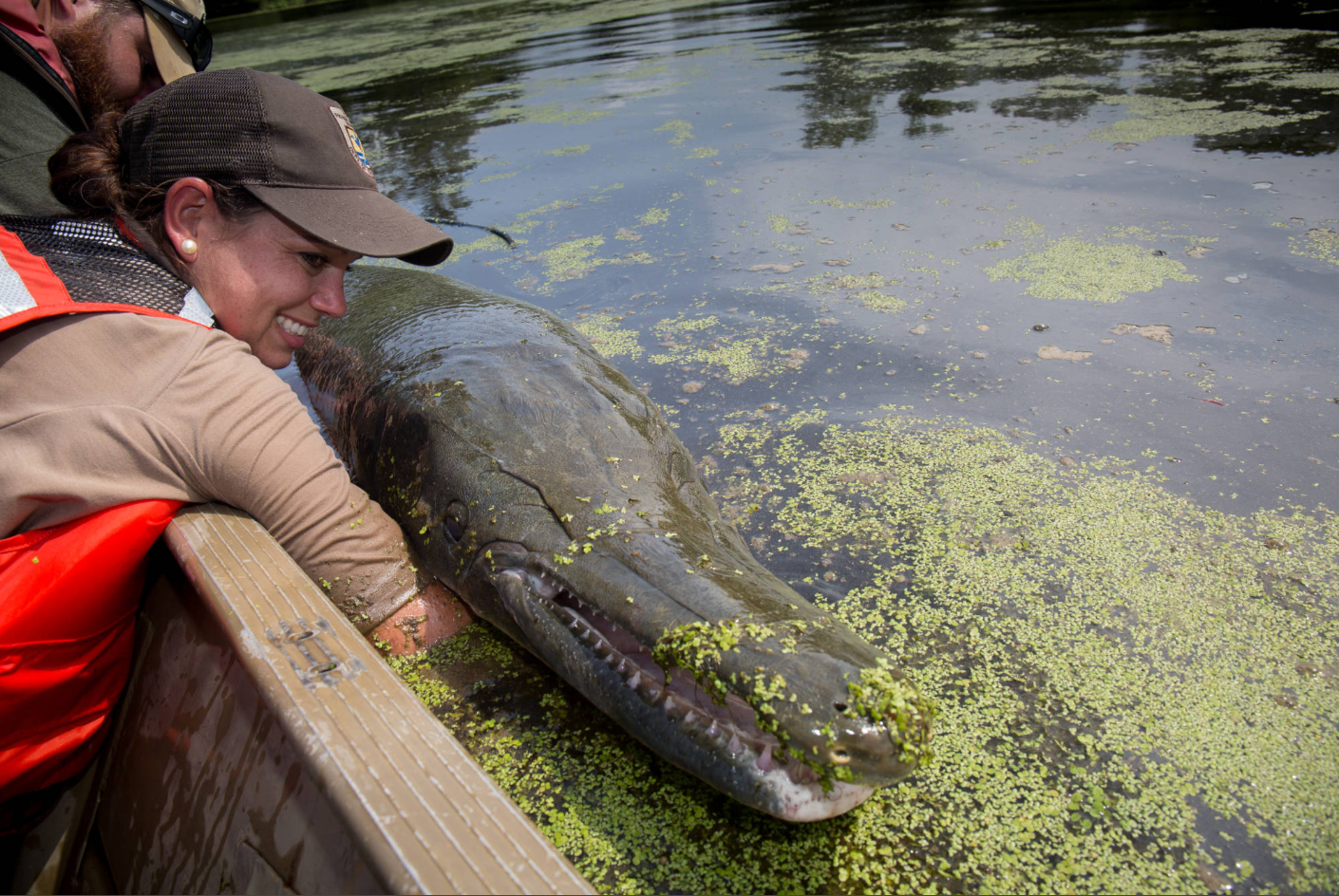
Alligator Gar (Atractosteus spatula) held against the gunwale of a survey boat in duckweed-covered backwater, the broad, short, alligator-like snout resting at the surface. Photo: Ryan Hagerty / U.S. Fish and Wildlife Service, public domain.
I’ve never caught an alligator gar, and I don’t live anywhere near one. What I’ve seen is the photos, and they’re all built from the same kit: huge fish, teeth, armor, somebody grinning behind it, and a caption working overtime to make the thing sound prehistoric. The teeth are real. They’re just not the interesting part. Atractosteus spatula makes a lot more sense once you quit staring at the deep hole in the picture and look at the flooded grass half a mile away, because a long-lived adult population can sit in the river for years while successful reproduction waits on a flood that may or may not happen.
At a glance · The short version
Scientific name
Atractosteus spatula
Maximum reported length
About 3 m / 10 ft in USGS and U.S. Fish & Wildlife Service accounts.
Adult lifespan
Females can live more than 50 years; very old individuals may approach a century.
Maturity
Slow. Texas management material places female maturity roughly in the 5–10+ year range depending on population and source.
Recruitment trigger
Large spring/early-summer overbank floods that connect the river to shallow, vegetated floodplain habitat.
Management consequence
Low annual recruitment plus long life means a population can absorb far less harvest than bass or crappie and may take decades to rebuild.
What fish is this?
Identification
Body and scales
Alligator gar are long, torpedo-shaped fish armored in hard, diamond-shaped ganoid scales. That armor identifies a gar, not necessarily an alligator gar; the snout and upper-jaw teeth do more of the separating work.
The snout is broad and relatively short compared with the long, narrow beak of a longnose gar. Size is not a safe shortcut because juvenile alligator gar still need to be identified structurally.
Upper-jaw teeth
Alligator gar have two rows of large teeth in the upper jaw, another classic distinction from other North American gar. Keep hands out of the mouth regardless of species.
Size
USGS lists a maximum around 3 m, while USFWS gives a common length around 79 in and maximum reported length around 10 ft. Texas routinely manages fish over 200 lb. Those numbers explain the spectacle; they do not explain the population biology.
USGS places the native range through the lower Mississippi basin and Gulf Coastal Plain from the southeastern United States into Mexico. The species uses major coastal rivers and estuarine systems and can occur in fresh, brackish, and occasionally saline water.
Lower Trinity River telemetry found many fish with high site fidelity to particular main-channel pools. Some individuals used more than 100 km of river, but most home ranges were under about 60 river km. During high flows, fish changed habitat and sought refuge.
Texas research has identified river-resident, transient, and bay-resident life histories within Gulf Coast systems. That makes alligator gar a poor fit for a single deep-hole stereotype: some populations are tightly riverine, while others use a freshwater-to-estuary gradient.
The floodplain is reproductive habitat, not decorative overflow. Dams, levees, channelization, and altered hydrographs can leave adult habitat intact while cutting fish off from the shallow vegetated areas needed to produce strong year classes.
Texas research links successful reproduction to spring and early-summer floods that inundate floodplain habitat. One research summary defines suitable conditions as flooded habitat more than about 1 m deep for at least five days, water roughly 68–86 F, and access to shallow herbaceous vegetation under relatively open canopy.
In the Texas work summarized by TPWD, strong reproduction occurred only in about 30% of years studied, and two exceptionally strong year classes made up roughly half of the population. That is the demographic fact behind the conservation concern: an adult fishery can look stable between the rare years that actually build the next generation.
At flood peak, groups of adults move onto shallow grassy floodplain. Eggs are deposited over inundated vegetation. Texas reports hatching after roughly 48 hours; larvae remain attached to vegetation for another few days before moving with receding water.
Gar eggs are toxic if eaten. Texas explicitly warns that the flesh can be edible where local contaminant advisories allow it, but the eggs should not be consumed.
Fish dominate the diet. Texas summaries list common prey such as carp, gizzard shad, buffalo, tilapia, and freshwater drum and note that sport fish like catfish and bass occur much less often. USGS also records crabs, carrion, and occasional birds.
Juveniles start smaller, taking plankton, invertebrates, amphibians, and fish as they grow. The diet therefore scales with body size rather than beginning with giant prey because the adult eventually gets giant.
Texas states that there is no evidence alligator gar have negative population-level effects on sport fishes in the way the old predator-eradication narrative assumed. Large predator does not automatically mean bass destroyer.
Preparation is part of the method. A fish this large changes landing, release, tools, partner choice, and safe handling before lure selection ever matters.
Tackleconvention
Where legal, anglers commonly use substantial natural baits or large fish-imitating presentations with heavy tackle. Undergunned gear is not automatically more sporting; it can simply prolong the fight and make control at the boat or bank worse.
Landing plan
Choose a bank or boat position where a large fish can actually be landed without dragging it over unsafe surfaces. Have pliers, cutting tools, measuring gear, and any legal tagging/reporting material ready before the fish is hooked. Keep hands away from the jaws.
Experience gap
If the largest fish someone has handled so far fits in one hand, an alligator gar is a poor species for improvising. Going with an experienced angler or guide is the sensible bridge between knowing the biology and safely handling a fish that may weigh more than the person catching it.
Why are the rules different?
Management & Conservation
Harvest capacity
TPWD estimates many alligator-gar populations can sustain harvest of only about 5% annually, far below the rates commonly possible for faster-maturing bass or crappie. Remove too many mature fish and recovery can take decades.
Whether a legal fish is safe to eat is water-specific. Texas lists systems with consumption advisories for alligator gar and directs anglers to current health guidance. The eggs remain toxic regardless.
TPWD identifies overharvest and loss of floodplain spawning habitat from dams, levees, and river alteration as major reasons populations declined across much of the historic range. Texas still retains comparatively strong fisheries, which is exactly why management is proactive rather than a sign that the species is invulnerable.
Successful year classes depend on how long floodplain habitat remains connected; adults may shift with flow.
High-water refuge, river-floodplain connection, and local oxygen/temperature conditions.
Fall
Receding flows pull habitat back toward persistent channel, reservoir, and bay water.
Main-channel pools, forage concentration, and local movement patterns.
Where the sources aren’t tidy
Still unsettled
Age at maturity
Texas summaries give somewhat different maturity ranges depending on population, sex, and publication date. The safe conclusion is slow maturity relative to most sport fish; the final number should stay attached to the source and population.
One river is not another
Texas research shows different proportions of river-resident, transient, and bay-connected fish. A Lower Trinity movement result should not be presented as a universal daily-movement rule for every Gulf Coast population.
What nobody knows yet
Nobody has settled this one
a universal preferred depth
a universal daily movement distance
a single best bait independent of river and legal method
barometric-pressure response
cold-front response
FEEDING · THE RIVER DECIDES
Gizzard shad and carp, taken wherever flow has stacked them up. Nobody has pinned down a feeding hour for this fish and this page is not going to invent one.
What it eats
Adults feed predominantly on fishes, including carp, gizzard shad, buffalo, tilapia, and freshwater drum in Texas studies, with crabs, carrion, and occasional other vertebrate prey also documented. Juveniles begin with much smaller prey.
How and where it hunts
A large ambush/opportunistic predator using main-channel pools, river margins, connected floodplain water, reservoirs, and in some Gulf systems estuarine habitat. Feeding position follows fish concentrations and flow rather than one permanent “deep hole.”
When it feeds
Nobody has pinned down a universal daily feeding period. Seasonally, spring and early-summer floods can move adults onto connected floodplain habitat for spawning; receding water returns the population toward persistent river, reservoir, or bay habitat where forage concentration again becomes the main feeding clue.
What changes as it grows
Juveniles start with plankton, invertebrates, amphibians, and small fish. As body size increases, fish become the dominant prey class and the potential prey size expands substantially.
Spawning-flood thresholds are kept separate from feeding biology.
Compiled 2026-09-11. Limits and advisories are set per water and per state and change between seasons — the managing agency for wherever you are fishing has the current answer.
A long-lived fish that only produces a strong year class when the river leaves its banks doesn’t replace itself on anybody’s fishing schedule. That’s the part I’d want in my head if I ever get down to gar country: the fish in front of me may have come out of one unusually good flood decades ago, and the flood that replaces it isn’t on any calendar.
FIELD OBJECT
This one should leave the page.
The article is the long version. These are the pieces worth carrying into the next trip.
The 30-second version
Every monster-gar photo shows you teeth. The part that matters is harder to photograph: a fish that can live past fifty and only builds a strong year class when the river floods the grass.
What to watch
Identification
Range & Habitat
Reproduction & Recruitment
Diet
Field card
a universal preferred depth
a universal daily movement distance
a single best bait independent of river and legal method
barometric-pressure response
cold-front response
RIGHT TOOL, NEXT
Species & Presentation
Carry the species behavior and presentation question into a narrower water-to-fish-to-presentation handoff.
We use necessary cookies to operate the site. With your choice, we may also use analytics and advertising cookies. Choose Accept All, Reject, or Preferences.
Contains information related to marketing campaigns of the user. These are shared with Google AdWords / Google Ads when the Google Ads and Google Analytics accounts are linked together.
90 days
__utma
ID used to identify users and sessions
2 years after last activity
__utmt
Used to monitor number of Google Analytics server requests
10 minutes
__utmb
Used to distinguish new sessions and visits. This cookie is set when the GA.js javascript library is loaded and there is no existing __utmb cookie. The cookie is updated every time data is sent to the Google Analytics server.
30 minutes after last activity
__utmc
Used only with old Urchin versions of Google Analytics and not with GA.js. Was used to distinguish between new sessions and visits at the end of a session.
End of session (browser)
__utmz
Contains information about the traffic source or campaign that directed user to the website. The cookie is set when the GA.js javascript is loaded and updated when data is sent to the Google Anaytics server
6 months after last activity
__utmv
Contains custom information set by the web developer via the _setCustomVar method in Google Analytics. This cookie is updated every time new data is sent to the Google Analytics server.
2 years after last activity
__utmx
Used to determine whether a user is included in an A / B or Multivariate test.
18 months
_ga
ID used to identify users
2 years
_gali
Used by Google Analytics to determine which links on a page are being clicked
30 seconds
_ga_
ID used to identify users
2 years
_gid
ID used to identify users for 24 hours after last activity
24 hours
_gat
Used to monitor number of Google Analytics server requests when using Google Tag Manager
1 minute
Jetpack's built-in visitor analytics. It records page views, referring sites, search terms, and outbound link clicks, and also carries the shared visitor-tracking library used by Jetpack Instant Search and WooCommerce Analytics.