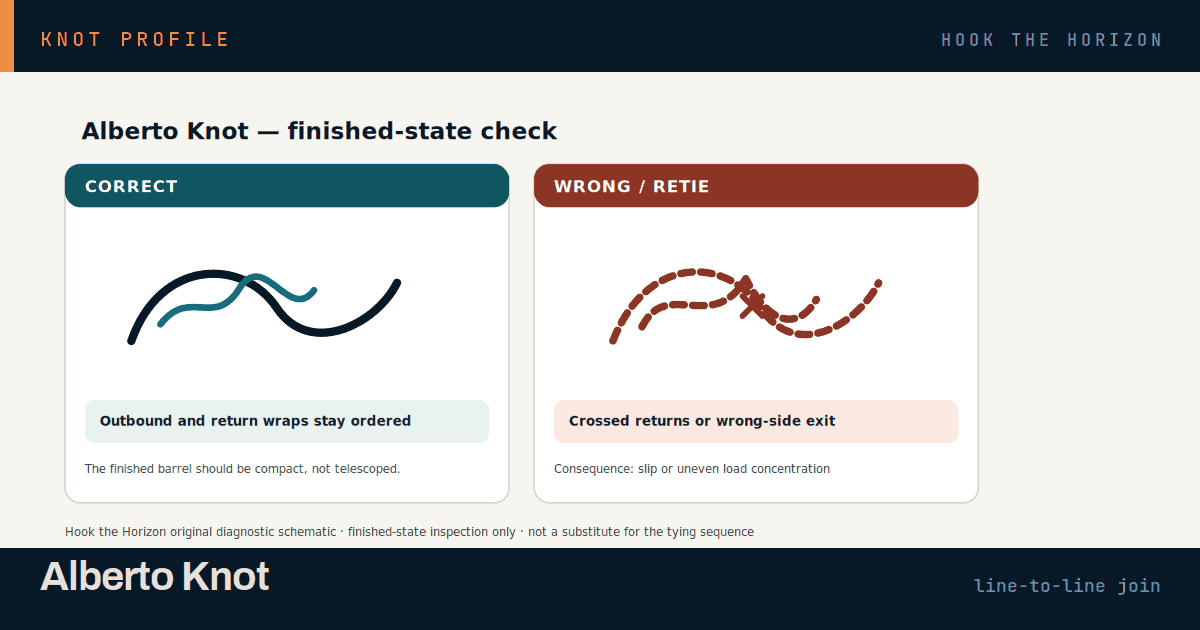
ORIGINAL HOOK DIAGRAM
The return wraps have to retrace the first set. Wander beside them and it isn’t an Alberto.
Original Hook the Horizon schematic. It isolates the direction reversal and same-side exit because those are the two things a finished-knot photo can’t show you.
Best jobJoining braid to mono or fluorocarbon leader when I want something compact without signing up for the full tension choreography of an FG.
Critical path
After the out-and-back wraps, the braid has to leave the leader loop on the same side it went in. Miss that and whatever you tied, it isn’t an Alberto.
Guide passage
Usually slimmer than a Double Uni. If this knot’s going to cross guides, the leader tag and wrap stack still need a clean finish, not just a knot that holds.
Failure clue
Loose return wraps, crossed coils, or exiting the wrong side of the loop — any one of those and I cut it off and start over. No half-measures on a leader knot.
THE WRAPS HAVE A DIRECTION
Out, back, same-side exit.
The Alberto starts with the thicker leader folded into a loop. Braid passes through that loop, wraps around both leader legs moving away from the loop, then reverses direction and wraps back toward the loop over the first set. The braid tag then exits the leader loop from the same side it entered.
That last detail is the easy one to lose, because a wrong exit still looks like a perfectly respectable bundle of wraps from the outside. It isn’t cosmetic. It’s part of what actually holds the thing together, so it’s the first thing to check before you trust one.
Out along the leader, back over yourself, out the same side
- Fold the mono or fluorocarbon leader back on itself to make a loop.
- Pass a generous length of braid through that loop.
- Wrap the braid around both leader legs about seven times, moving away from the loop.
- Reverse direction and wrap back toward the loop, over the first set of wraps.
- Pass the braid tag back through the leader loop, exiting the same side it originally entered. Losing track of which side that was is normal early on — happened to me plenty. Pinch the entry point between thumb and finger while you wrap and it stops being a guess.
- Snug the wraps, pull braid and leader hard in opposite directions to lock the structure, inspect, then trim.
Where the Alberto goes sideways
Wrong-side exit
The tag leaves the loop on the opposite side from where it went in. It’s tempting to talk yourself into believing this one is fine. It isn’t, and there’s no rescuing it — cut it off and start again.
Return wraps separate
The second set should track back over the first, not build a second independent coil beside it.
Leader loop collapses unevenly
Stop and reorganize before you tighten hard. The wraps should load both legs.
Guide clicks get worse
Check the trimmed leader tag and the wrap stack. A knot that’s technically holding can still cast like garbage through the guides, and that’s still worth fixing.
WATCH + VERIFY
Watch the direction change and same-side exit — that’s the part worth slowing the video down for.
NetKnots — Alberto animation · Take Me Fishing — Alberto guide · Wired2Fish — Alberto field-use video
These are worth pulling up after a long break from the Alberto, mostly to remind your hands which way the return wraps go. Watch the same-side exit twice before you try it once yourself, and do that again any time you’ve gone a season without tying one.
Open the deeper knot workflowJob, material, route, dressing, seating, pull-test checks and the standardized comparison record.
THE SIX-MOVE CHECK
Job → Material → Route → Dress → Seat → Test
- Job. Name what the connection has to do before choosing the knot.
- Material. Confirm the line, leader, rope, wire, and hardware actually suit this structure.
- Route. Trace every pass before tightening anything.
- Dress. Put strands, wraps, and loops in their intended order with no accidental crossings.
- Seat. Tighten in the order this knot needs. More force does not repair bad geometry.
- Test. Inspect the finished shape, load it by hand when appropriate, and retie if anything moves or fails the article-specific checks.
Practice / pass test. Tie this knot three clean times without rushing. A tie passes only when it matches this article’s What to check before you trust it geometry, shows none of the listed failure clues, and survives the stated load/inspection test. If you cannot tell why one attempt is better than another, keep practicing—the lesson is recognition, not memorization.
KNOT SPEC
Alberto Knot — the short answers
- ALSO CALLED
- Also called the Alberto Special, and often described as a modified Albright. Attribution to Florida captain Alberto Knie is widely repeated but not formally documented. Common with inshore, flipping and light offshore anglers.
- KNOT TYPE
- Line-to-line knot — braid wrapped out and back over a folded leader loop
- WHAT IT CONNECTS
- Braid main line to a mono or fluorocarbon leader. Not a terminal knot, and not the right choice for joining two lines of the same material and diameter.
- LINE TYPES
- Braid to mono or fluorocarbon. It wants a clear diameter gap; with a light leader the braid beds in and cuts rather than grips. Very stiff heavy leader makes the loop hard to keep tidy, and slick braid needs the wraps packed tight.
- STRENGTH BAND
- Solid to High. Sits below a well-tied FG on profile and usually alongside it on holding power, and it is far more consistent than an FG tied in a hurry. Published rankings for this group disagree sharply, so treat the order as approximate.
- DIFFICULTY
- Intermediate. Easier than the FG because nothing depends on holding tension throughout. A teenager can learn it in an afternoon; the one thing to drill is which side of the loop the braid exits.
- STEPS AND WRAPS
- Six moves. Roughly seven wraps away from the loop and seven back over them, so about fourteen turns in total. Slick or thin braid does better with a wrap or two more in each direction.
- TIE TIME
- A boat knot. Around a minute once learned, and it can be rebuilt in wind without a fixed tension point, which is its main practical advantage over the FG.
- POOR CONDITIONS
- Good. It can be tied on a rolling deck and with cold hands because you can set it down mid-wrap without losing the knot. In low light the risk is losing track of the entry side, so pinch the entry point while you wrap.
- THROUGH THE GUIDES
- Slimmer than a Double Uni, bulkier than a clean FG. It will pass guides on a cast, though on light rods with small guides you hear it tick. Trim the leader tag flush, keep the braid tag short, and taper the finish if the knot has to run in and out on every cast.
- LUBRICATION
- Yes. Wet the wraps before drawing them together. Pulled together dry, the braid saws heat into the leader legs and the leader breaks at the knot on the first hard load.
- TAG END
- Trim the braid tag close, about an eighth of an inch, and the leader tag as flush as you can without nicking the wraps. Braid creeps under load, so leave it a hair longer than you would on mono.
- TOOLS
- None. Nippers to trim. A pair of pliers helps hold heavy leader while you pack the wraps down on twenty-pound test and up.
- BEST SUITED TO
- Inshore and light offshore work — snook, redfish, tarpon on lighter leaders, striped bass, bass anglers flipping heavy cover, and anyone building a shock leader between drifts.
The strength bands are rough on purpose. Published knot tests don’t agree with each other — the same braid-to-leader knot has tested near ninety percent of line strength on one machine and under half on another, because the line brand, its diameter, how fast it got cinched, whether it was wet and whose hands tied it all move the number more than the knot does. Use the band to compare this knot with the others, not as a number to quote.
EASIER THAN THE FG
You can build it on a rocking boat, set it down halfway through, and pick it back up, which the FG will never let you do. It comes out thicker, so a long leader crossing the guides on every cast is not its job.
Advantages
- Much easier to tie than an FG for a knot that is only slightly bulkier.
- No continuous tension needed, so it can be built on a rocking boat or set down halfway through.
- Easy to inspect: crossed wraps, a separated return set and a wrong-side exit are all visible before you trim.
- Fast enough to be a genuine bite-window leader knot.
- Handles a wide range of leader weights without changing the structure.
Disadvantages
- The same-side exit is easy to lose track of, and a wrong-side exit still looks like a tidy bundle of wraps.
- Bulkier than an FG, so it is the wrong pick when a long leader must cross the guides on every cast.
- Return wraps can lie beside the first set instead of over it, which quietly halves what the knot is doing.
- It needs a real diameter difference; on light leader the braid cuts in.
- The leader tag stands proud if trimmed carelessly and picks up weed.
Use a different knot when
- FG Knot — when the leader must run through the guides on every cast and profile is the whole problem
- Double Uni — when you want the simplest structure to teach, inspect or relearn under pressure. That is a real argument, not a consolation prize, and it wins more often than the ranking lists suggest.
- Albright Knot — when the size gap is extreme, such as light braid to very heavy shock leader
- Slim Beauty — when the leader is heavy stiff fluorocarbon and you want a faster compact connection
WHAT TO CHECK BEFORE YOU TRUST IT
The Alberto is the knot for the day the FG is not worth the fight: wind, chop, cold hands, or a leader that has to be rebuilt three times before lunch. If you’re tying it fast, don’t make wrap count the only check — watch the exit side and the return set. Pinching the entry point through the whole sequence is the habit that separates a knot that holds from one that looks right. The honest tradeoff is bulk. You give up some slimness against an FG, and in return you get a connection you can build on a bad day and check with your eyes.
What actually makes it fail
- Braid exiting the leader loop on the wrong side, which leaves the wraps with nothing locking them.
- Return wraps laid beside the outbound set rather than back over it.
- Wraps drawn together dry, burning the leader legs where the braid crosses them.
- Leader too light for the braid, so the wraps bed in and cut it under load.
- Loose wrap stack that packs down further under the first fish and then slips.
How to test it, and how it ages
Look before you pull: the wraps should be tight and even against both legs of the leader loop, the return set sitting over the outbound set, and the braid leaving the loop on the side it entered. Then wet it, draw everything down, and pull braid against leader steadily and hard. A good one locks and does not move; a bad one gives a little, then a little more. Finish with a firm pull against a bent rod. Never trust a leader knot you have not loaded.
Over a session: Holds up well over a session and does not loosen with casting the way some wrapped knots do. Check the leader tag and the wrap stack after fish and after any contact with structure, since a lifted tag is the first sign it is working loose.
Troubleshooting
How do I know I came out the right side?
Pinch the loop where the braid entered and keep pinching it through every wrap. If you have already let go and cannot tell, cut it off. There is no way to inspect your way to certainty afterward.
Why does my leader keep breaking at the knot?
Either the wraps were pulled down dry or the leader is too light for the braid. Wet it, and step the leader up if the braid is biting into it.
Why does it click through the guides?
The leader tag is standing proud or the wrap stack is uneven. Trim the tag flush and pack the wraps tight against each other before the final pull.
Do I need more wraps on thin braid?
Yes. Thin, slick braid benefits from an extra wrap or two in each direction. Adding wraps will not rescue a loose stack, though.
Is this the same as an Albright?
It is close and often described as a modified Albright. Both finish by exiting the loop on the same side the tag entered. The difference is the Alberto’s return set of wraps laid back over the first, which is a big part of why it grips braid well.
FIELD OBJECT
This one should leave the page.
The article is the long version. These are the pieces worth carrying into the next trip.
The 30-second version
The Alberto gets you most of an FG’s slimness without the FG’s running fight over tension, so it survives cold hands and a rocking boat. The exit side of the leader loop is what you have to get right.
What to watch
- The return wraps have to retrace the first set. Wander beside them and it isn't an Alberto.
- Out, back, same-side exit.
- Out along the leader, back over yourself, out the same side
- Why choose this over FG?
Field card
- Fold the mono or fluorocarbon leader back on itself to make a loop.
- Pass a generous length of braid through that loop.
- Wrap the braid around both leader legs about seven times, moving away from the loop.
- Reverse direction and wrap back toward the loop, over the first set of wraps.
- Pass the braid tag back through the leader loop, exiting the same side it originally entered. Losing track of which side that…
RIGHT TOOL, NEXT
Knot Analyst
Carry the connection problem into a knot choice built around line, hardware, conditions, and failure mode.