Alaska Pollock, Before It Turns Into a Fish Sandwich
Alaska pollock ends up as fillets and surimi, but alive it’s a schooling cod whose young ride midwater while older fish settle toward bottom. That split, plus a barbel check against Pacific cod, is where the fishing sense lives.
By HunterUpdated September 12, 2026Read 7 min
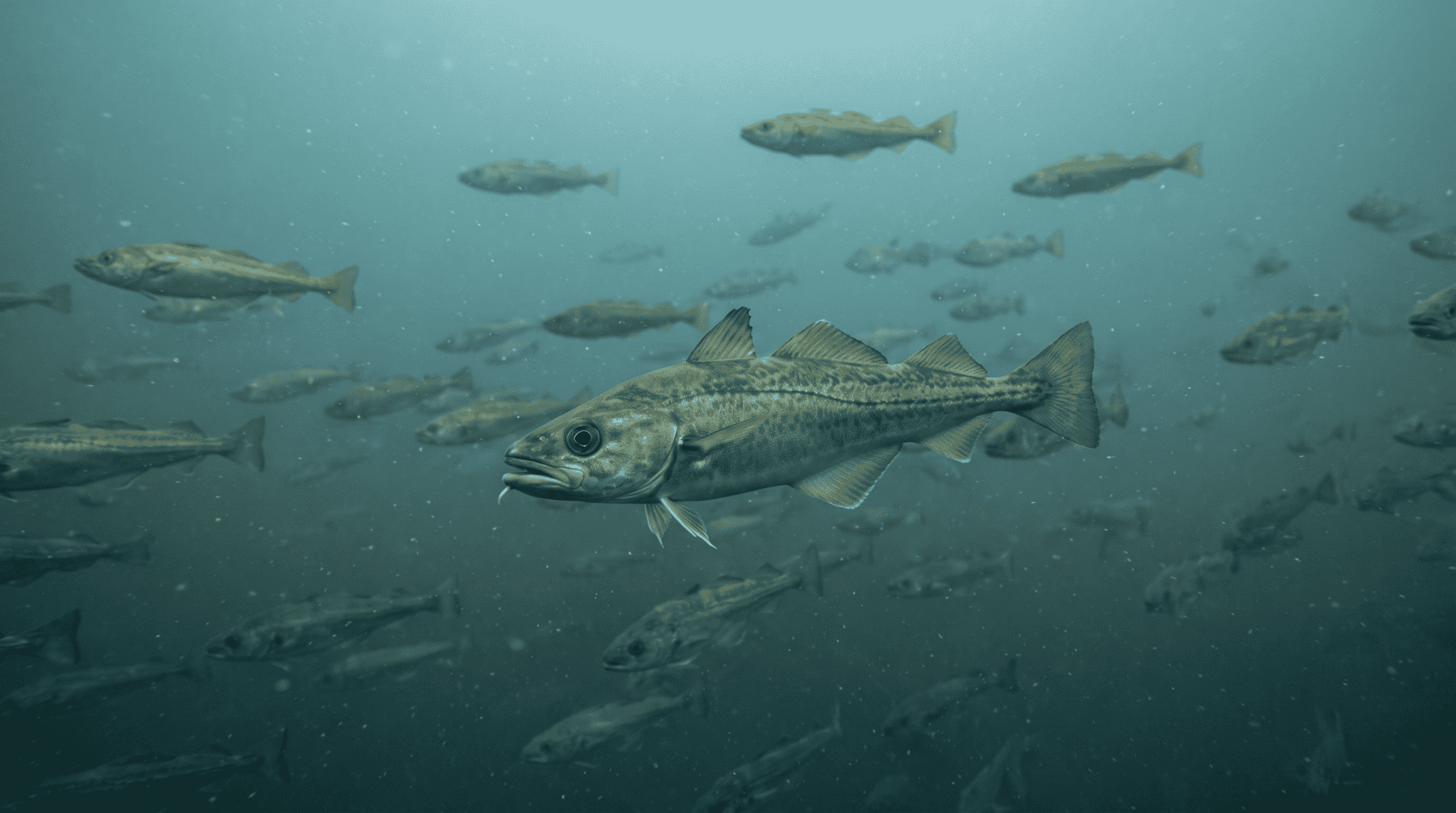
Image: midwater school in the Bering Sea
Plenty of people eat Alaska pollock without ever seeing one with the head still on.Gadus chalcogrammus becomes fillets, fish sandwiches and surimi, but in the Bering Sea it’s a semipelagic schooling fish that eats, gets eaten, and can swing hard in numbers from one generation to the next. For anybody holding a rod, the useful part is vertical: young fish and older fish don’t use the same layer, so the bottom depth on a chart only gets you halfway.
At a glance · The short version
Scientific name
Gadus chalcogrammus (also called walleye pollock).
Family
Gadidae: a true cod-family fish.
Best distinction
Speckled slender cod body, three dorsal fins and a small or inconspicuous chin barbel; commonly forms large midwater schools.
Habitat
North Pacific, especially the Bering Sea; juveniles commonly midwater, older fish more bottom-associated.
Life history
Fast growth, about 12-year life span, some maturity by age 3–4, highly variable recruitment.
Ecosystem role
Major prey for marine mammals, seabirds and fishes, while older pollock also eat fish—including younger pollock.
A cod that often lives above the cod
Identification
Cod-family architecture
Pollock have three dorsal fins and two anal fins, with a relatively slender speckled body. They can reach about three feet, but NOAA says typical fish are closer to 12–20 inches and one to three pounds.
Pacific cod carry a long obvious chin barbel. Pollock may have a small barbel that is easy to miss. That difference, together with body shape and where the school is holding, is more useful than trying to judge two gray fish by color alone.
NOAA describes speckled coloring that helps pollock blend with the seafloor. Pattern strength changes with light and condition, so the fin arrangement, barbel and capture context should finish the identification.
Name choice
“Alaska pollock” and “walleye pollock” refer to the same species. The scientific name prevents confusion with Atlantic pollock, a different fish in a different genus.
The school has a vertical structure
Range & Habitat
North Pacific center
The species occurs across the North Pacific, with its largest concentrations in the eastern Bering Sea. Distribution is broad; fishery-scale density is not.
Younger pollock commonly occupy the midwater zone. That means a sonar school well clear of bottom can be perfectly consistent with the species, not evidence the fish finder is wrong.
Older fish near bottom
NOAA reports that fish age five and older are typically more bottom-oriented. The habitat transition is gradual rather than a wall: pollock remain semipelagic and can move through the water column with prey, temperature and time of day.
Depth range
Large schools commonly occupy roughly 330–985 feet and have been recorded much deeper. A depth number without a layer is incomplete information; the same 600-foot bottom can hold pollock at 450 feet.
Spring shallower, winter deeper
Seasonal Movement & Spawning
Spring movement
NOAA summarizes an inshore movement toward shallower water in spring for breeding and feeding. The useful implication is not a universal shoreline date; it is that water mass and spawning stage can move the target horizontally and vertically.
Pollock return toward warmer, deeper water in winter. “Cold-water fish” does not mean they choose the coldest available layer regardless of physiology and prey.
Early maturity
Some fish begin reproducing at age three or four. Combined with fast growth and high fecundity, that supports quicker population turnover than in long-lived rockfish.
Recruitment can still swing
Food availability, temperature, transport and predation make survival of young fish highly variable. A productive species can fluctuate rapidly because each successful or failed year class matters.
Predator, prey and cannibal
Diet & Food-Web Role
Juvenile diet
Young pollock feed on zooplankton and small fish. Their position in midwater matches a food supply carried by currents rather than buried in sediment.
Older pollock eat other fish and can cannibalize juvenile pollock. That makes the school both a feeding aggregation and a size-structured risk field.
The prey base of the Bering Sea
Steller sea lions, other marine mammals, seabirds and predatory fishes all consume pollock. Removing “commercial commodity” from the description reveals a central forage species connecting plankton production to larger animals.
School density is not unlimited abundance
A trawl can encounter an enormous school while another stock or year class remains weak. Local density and stockwide biomass answer different questions.
Read the marks before choosing bottom
Field Decisions
Evidence level. The moves below are inference, built off NOAA’s habitat and feeding descriptions rather than off a rod in my hand on this fish.
Stop the drop in the schoolinference
If sonar shows a defined midwater aggregation, I would present through that layer rather than automatically going to bottom. The fish’s semipelagic biology makes vertical accuracy more important than bottom contact.
Match prey scale and depthinference
Zooplankton-feeding juveniles and fish-eating adults do not create the same presentation problem. Fish size, forage marks and school depth should change lure profile and hook size.
Use season as a starting hypothesisworth testing
Spring inshore and winter deeper are regional patterns, not coordinates. I would pair them with current temperature, survey information and actual sonar rather than forcing the calendar onto the water.
Confirm the catchdecision rule
A gadid from bottom with a heavy chin barbel may be Pacific cod rather than pollock. Identification comes before any species-specific retention decision.
Deep water changes the equipment problem
Tackle, Handling & Release
Line angle
At several hundred feet, current and line diameter can move a presentation far from the sonar mark. The system has to reach and remain in the school layer without becoming so heavy that every fish is dragged up unnecessarily.
Pressure change
Deep capture can create barotrauma. Use the jurisdiction’s current release method and any required descending device for affected bycatch rather than treating every unwanted fish as a simple overboard release.
Food care
Pollock is lean, mild fish. If retained, prompt chilling protects texture and quality; a fish left warm on deck should not be used to judge the species’ eating value.
Food products
Fillets, roe and surimi account for much of the catch. “Imitation crab” is therefore not a fake-fish story; it is one of the major ways a real North Pacific species enters the food system.
Leave the shortcuts out
Where the Easy Version Goes Wrong
that all pollock stay in midwater or all older fish stay on bottom
that a huge school proves unlimited stock abundance
that spring movement creates one coastwide fishing date
that Alaska pollock and Atlantic pollock are interchangeable
that a productive life history eliminates recruitment failure
Standing over a pollock mark, the first thing I’d check is whether the school is riding clear of bottom or pinned against it. Riding clear, I’d leave the presentation in that midwater layer and not go looking for another decision to make. Pinned to bottom is a different problem. Every fish coming up then gets treated as a possible Pacific cod until the chin barbel proves otherwise, and that’s not a call I’d want to get wrong on someone else’s boat.
— · Sources
FEEDING ECOLOGY · STANDARDIZED
How this fish gets fed.
Primary prey
Euphausiids/krill, copepods and other zooplankton are important, with fishes and squid becoming increasingly important in larger pollock.
Feeding mode / location
A schooling pelagic-to-demersal predator of shelf and slope waters, feeding through the water column and around prey concentrations rather than remaining fixed to bottom structure.
Diel / seasonal pattern
Vertical movement and school depth can change with prey and light, while seasonal spawning and distribution shift the population across shelf waters. The profile does not assert one universal daily feeding window.
Ontogenetic diet shift
Young pollock rely heavily on copepods, krill and other planktonic prey; larger fish become increasingly piscivorous and also take squid.
School depth is treated as a feeding-layer question, not a fixed species depth.
Compiled 2026-09-11. Limits and advisories are set per water and per state and change between seasons — the managing agency for wherever you are fishing has the current answer.
Take the sandwich out of it and what’s left is a school with an age structure, and it moves. Younger fish ride midwater while fish five and older lean toward bottom, spring pulls them shallower, and one strong or failed year class can change the whole picture. The chart tells you where the bottom is. It takes the sounder to tell you where the pollock are.
Saltwater & CoastalSurf, shoreline, nearshore, offshore, and deep-sea fishing — technique, gear, and safety content spanning the full range from the beach to blue water.103 articles
Species & BehaviorFish behavior, habitat, depth, forage relationships, and species-specific field decisions. Start with the Freshwater Fish Species field guide.159 articles
Cookie Consent
We use cookies to improve your experience on our site. By using our site, you consent to cookies.
Contains information related to marketing campaigns of the user. These are shared with Google AdWords / Google Ads when the Google Ads and Google Analytics accounts are linked together.
90 days
__utma
ID used to identify users and sessions
2 years after last activity
__utmt
Used to monitor number of Google Analytics server requests
10 minutes
__utmb
Used to distinguish new sessions and visits. This cookie is set when the GA.js javascript library is loaded and there is no existing __utmb cookie. The cookie is updated every time data is sent to the Google Analytics server.
30 minutes after last activity
__utmc
Used only with old Urchin versions of Google Analytics and not with GA.js. Was used to distinguish between new sessions and visits at the end of a session.
End of session (browser)
__utmz
Contains information about the traffic source or campaign that directed user to the website. The cookie is set when the GA.js javascript is loaded and updated when data is sent to the Google Anaytics server
6 months after last activity
__utmv
Contains custom information set by the web developer via the _setCustomVar method in Google Analytics. This cookie is updated every time new data is sent to the Google Analytics server.
2 years after last activity
__utmx
Used to determine whether a user is included in an A / B or Multivariate test.
18 months
_ga
ID used to identify users
2 years
_gali
Used by Google Analytics to determine which links on a page are being clicked
30 seconds
_ga_
ID used to identify users
2 years
_gid
ID used to identify users for 24 hours after last activity
24 hours
_gat
Used to monitor number of Google Analytics server requests when using Google Tag Manager
1 minute
Jetpack's built-in visitor analytics. It records page views, referring sites, search terms, and outbound link clicks, and also carries the shared visitor-tracking library used by Jetpack Instant Search and WooCommerce Analytics.