Pacific cod head toward the shelf edge to spawn in winter and move onto shallower soft bottom to feed in summer. Pick your depth by the season, and count dorsal fins before you call it a cod.
By HunterUpdated September 13, 2026Read 7 min
Image: feeling along the cold bottom
Most people meet Pacific cod as a pale fillet with the species name stuck on afterward. The live fish is more interesting than that. Gadus macrocephalus is a cold-water bottom fish that moves between deep winter spawning areas and shallower summer feeding grounds, feels its way along the seafloor with a chin barbel, and supports several North Pacific stocks that are managed separately. A waypoint that held cod in July is a weak guess for January.
At a glance · The short version
Scientific name
Gadus macrocephalus
Best ID clues
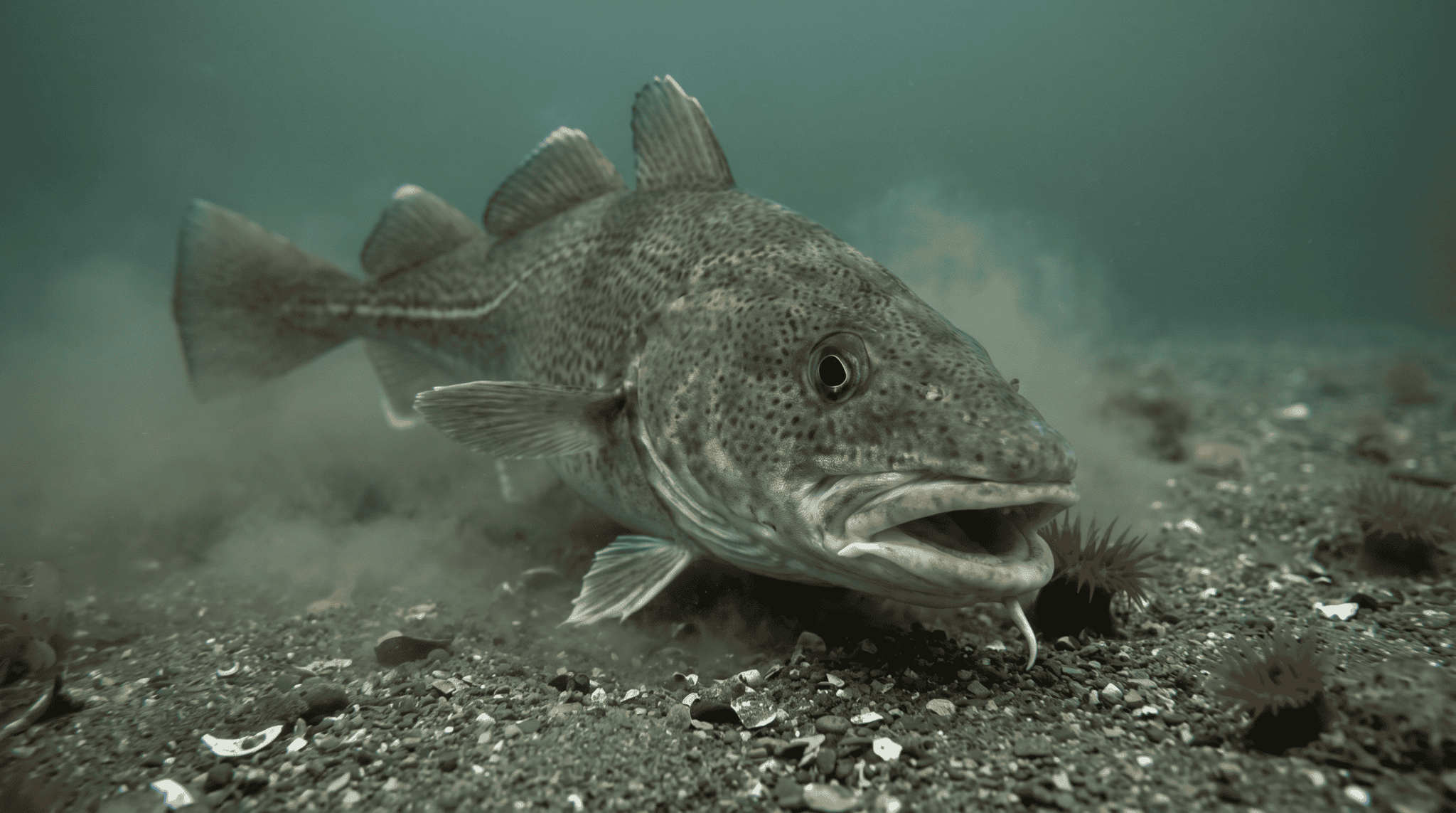
Long chin barbel, mottled brown-gray sides, pale belly, three dorsal fins and dusky fins edged in white.
Adult habitat
Near soft bottom on continental shelves and upper slopes; generally deeper in winter and shallower in summer.
Spawning
January–May, commonly around the shelf edge and upper slope in roughly 300 to more than 800 ft.
Diet
Clams, worms, crabs, shrimp and juvenile fish.
Start with the barbel, then count the dorsals
Identification
Chin barbel
Pacific cod carry a prominent whisker-like barbel beneath the lower jaw. It is a useful field clue because Alaska pollock usually show a much smaller, less obvious barbel. The barbel is sensory equipment for a fish that spends much of adult life working close to the seafloor.
The back carries three separate dorsal fins, matched by two anal fins underneath. That cod-family layout separates it from Atka mackerel and most other North Pacific bottom fish before color enters the argument.
Color is supporting evidence
NOAA describes brown or grayish sides with dark spots or mottling, a paler belly and dusky fins with white edging. Mud, depth, lighting and stress can shift how obvious those markings look, so color should support the body and fin check rather than replace it.
Common names and market labels are not enough for a field identification. Confirm the capture region and physical traits, especially where several gadids can enter the same catch.
The season changes the depth
Range & Habitat
North Pacific distribution
Pacific cod range across the coastal North Pacific, from the Bering Sea south along North America and west toward the Sea of Japan. NOAA notes that they become less common in central California and rare in Southern California.
During winter, adults use the continental shelf edge and upper slope, commonly from about 300 to more than 800 feet. That deeper distribution overlaps the spawning period and makes a summer waypoint a weak winter prediction.
Summer shelf
In summer they move toward shallower feeding grounds, often 300 feet or less. NOAA describes large juveniles and adults close to bottom over mud, sand and clay, while larvae and small juveniles use the water column.
Soft bottom is not empty bottom
A featureless-looking mud or sand shelf can hold burrowing worms, clams, crabs and shrimp. The habitat is defined by prey and bottom type, not by whether the sonar screen shows a dramatic rock pinnacle.
A winter spawning fish
Growth & Reproduction
Life span and size
NOAA reports a life span of 20 years or less and maximum length approaching six feet, although most fish encountered are much smaller. Maximum size is biological capacity, not an average catch expectation.
Females generally become capable of reproduction around age four or five, at approximately 1.6–1.9 feet. Removing a large fish is therefore not identical to removing a young fish that has not yet contributed to spawning.
Egg production
A female can release more than one million eggs. High egg count does not guarantee strong recruitment: survival through larvae and juvenile stages still depends on temperature, food, transport and predation.
January through May
NOAA places spawning from January into May, generally near the shelf edge and upper slope. Exact timing and depth vary across the Bering Sea, Aleutian Islands, Gulf of Alaska and Pacific Coast stocks.
The mouth and barbel match the menu
Diet & Ecological Role
Bottom prey
Clams, worms, crabs and shrimp make the soft-bottom association logical. Juvenile fish expand the menu beyond what can be dug from sediment.
A large cod can take larger mobile prey than a juvenile. Presentation size should therefore follow the prey field and fish size instead of assuming one “cod bait” fits every shelf and season.
Cod also become prey
Young Pacific cod support larger fishes, marine mammals and seabirds. The species is both a commercial target and part of the transfer of shelf production into larger predators.
How I would approach unfamiliar cod water
Field Decisions
Evidence level. I have not targeted Pacific cod. Habitat and diet are sourced; the next-cast layer below is explicit inference.
Start with season and depthinference
I would use winter spawning depth and summer feeding movement as the first filter, then look for local survey, charter or regulation information. Starting at the same depth all year ignores the most useful part of the biology.
Fish contact, not burialinference
A bait or jig should stay close enough to the bottom to enter the feeding lane without plowing continuously through mud or hanging in debris. Weight should hold depth and signal contact, not turn the rig into an anchor.
Read the school verticallyworth testing
Cod school, but the fish may not all be glued to bottom. If marks rise or bites occur on the drop, I would test the layer instead of sending every presentation automatically to the seafloor.
A heavy school on the sounder is where I’d hold off on making a rule. It could mean the cod are up. It could also mean bait is up while the cod stay glued to the mud underneath it, and a drop at each layer settles that faster than staring at the screen.
Separate cod from pollockdecision rule
A dense midwater school is more consistent with pollock than a bottom-oriented Pacific cod group. Confirm the fish in hand before applying a stock story, rule or harvest label.
The rod and reel must control the total system: sinker or jig, current drag, line angle and fish. Light tackle that cannot hold the feeding layer is not automatically sporting; it can simply lengthen the fight and increase release stress.
Barotrauma risk
Fish brought rapidly from deep water may show pressure-related injury. Follow the current jurisdiction’s release guidance and carry any required descending equipment where mixed groundfish can be caught. Do not puncture a fish by improvisation unless current agency guidance specifically directs it.
Species ID before retention
Cold-water groundfish can arrive together. Count dorsal fins, inspect the barbel and confirm the local species rules before the fish enters the cooler.
From whole fish to white fillet
Food & Handling
Chill early
Pacific cod is lean and delicate enough that warm handling costs quality quickly. If retained, bleed and chill it promptly under a legal, humane routine and protect the flesh from deck heat and freshwater soak.
Market familiarity hides biology
NOAA describes mild flavor, lean flaky cooked texture and white flesh. Those qualities explain its commercial value, but they should not erase the identification, stock and habitat story attached to the fish.
that every Pacific cod stock has the same abundance or assessment status
that adults remain on one depth contour year-round
that every cod-family fish in Alaska is Pacific cod
that a million eggs guarantees strong recruitment
that the deepest part of the shelf is always the best place to start
I can’t tell you from here whether that Pacific Coast gap means a healthy stock or a quiet decline — nobody has run the formal assessment that would answer it. NOAA’s precautionary catch limit is a placeholder, not a verdict, and it doesn’t confirm the population is thriving, shrinking, or holding steady. It just sits there until somebody funds the survey.
— · Sources
FEEDING ECOLOGY · STANDARDIZED
How this fish gets fed.
Primary prey
Clams, worms, crabs, shrimp and other benthic invertebrates, plus juvenile and small fishes.
Feeding mode / location
A demersal bottom forager using continental shelf and upper-slope habitat, commonly near soft bottom. The chin barbel helps investigate the seafloor while the fish searches close to bottom for invertebrates and fishes.
Diel / seasonal pattern
The profile supports a strong seasonal depth shift rather than a universal daily clock: deeper winter spawning habitat and generally shallower summer feeding grounds. Local prey and bottom type then determine the useful layer.
Ontogenetic diet shift
Young Pacific cod rely more heavily on small invertebrates; larger fish broaden toward larger crustaceans, mollusks, and fishes.
Spawning depth and season are kept separate from the summer feeding-ground pattern.
Compiled 2026-09-11. Limits and advisories are set per water and per state and change between seasons — the managing agency for wherever you are fishing has the current answer.
The useful Pacific cod story is not “big mouth, cold bottom.” It is movement: deep winter spawning ground, shallower summer feeding ground, soft-bottom prey. Once those pieces are visible, the next drop becomes a test of season, depth and layer instead of a blind descent to whatever the depth finder calls bottom.
Saltwater & CoastalSurf, shoreline, nearshore, offshore, and deep-sea fishing — technique, gear, and safety content spanning the full range from the beach to blue water.103 articles
Species & BehaviorFish behavior, habitat, depth, forage relationships, and species-specific field decisions. Start with the Freshwater Fish Species field guide.159 articles
Cookie Consent
We use cookies to improve your experience on our site. By using our site, you consent to cookies.
Contains information related to marketing campaigns of the user. These are shared with Google AdWords / Google Ads when the Google Ads and Google Analytics accounts are linked together.
90 days
__utma
ID used to identify users and sessions
2 years after last activity
__utmt
Used to monitor number of Google Analytics server requests
10 minutes
__utmb
Used to distinguish new sessions and visits. This cookie is set when the GA.js javascript library is loaded and there is no existing __utmb cookie. The cookie is updated every time data is sent to the Google Analytics server.
30 minutes after last activity
__utmc
Used only with old Urchin versions of Google Analytics and not with GA.js. Was used to distinguish between new sessions and visits at the end of a session.
End of session (browser)
__utmz
Contains information about the traffic source or campaign that directed user to the website. The cookie is set when the GA.js javascript is loaded and updated when data is sent to the Google Anaytics server
6 months after last activity
__utmv
Contains custom information set by the web developer via the _setCustomVar method in Google Analytics. This cookie is updated every time new data is sent to the Google Analytics server.
2 years after last activity
__utmx
Used to determine whether a user is included in an A / B or Multivariate test.
18 months
_ga
ID used to identify users
2 years
_gali
Used by Google Analytics to determine which links on a page are being clicked
30 seconds
_ga_
ID used to identify users
2 years
_gid
ID used to identify users for 24 hours after last activity
24 hours
_gat
Used to monitor number of Google Analytics server requests when using Google Tag Manager
1 minute
Jetpack's built-in visitor analytics. It records page views, referring sites, search terms, and outbound link clicks, and also carries the shared visitor-tracking library used by Jetpack Instant Search and WooCommerce Analytics.