White Bass: The Gauge Tells You More Than the Calendar Does
A spring white bass run moves faster than most people change lures. Check the gauge, the water temperature and where the shad went before deciding the fish quit. Summer schools are a different hunt out in open water.
By HunterUpdated September 12, 2026Read 8 min
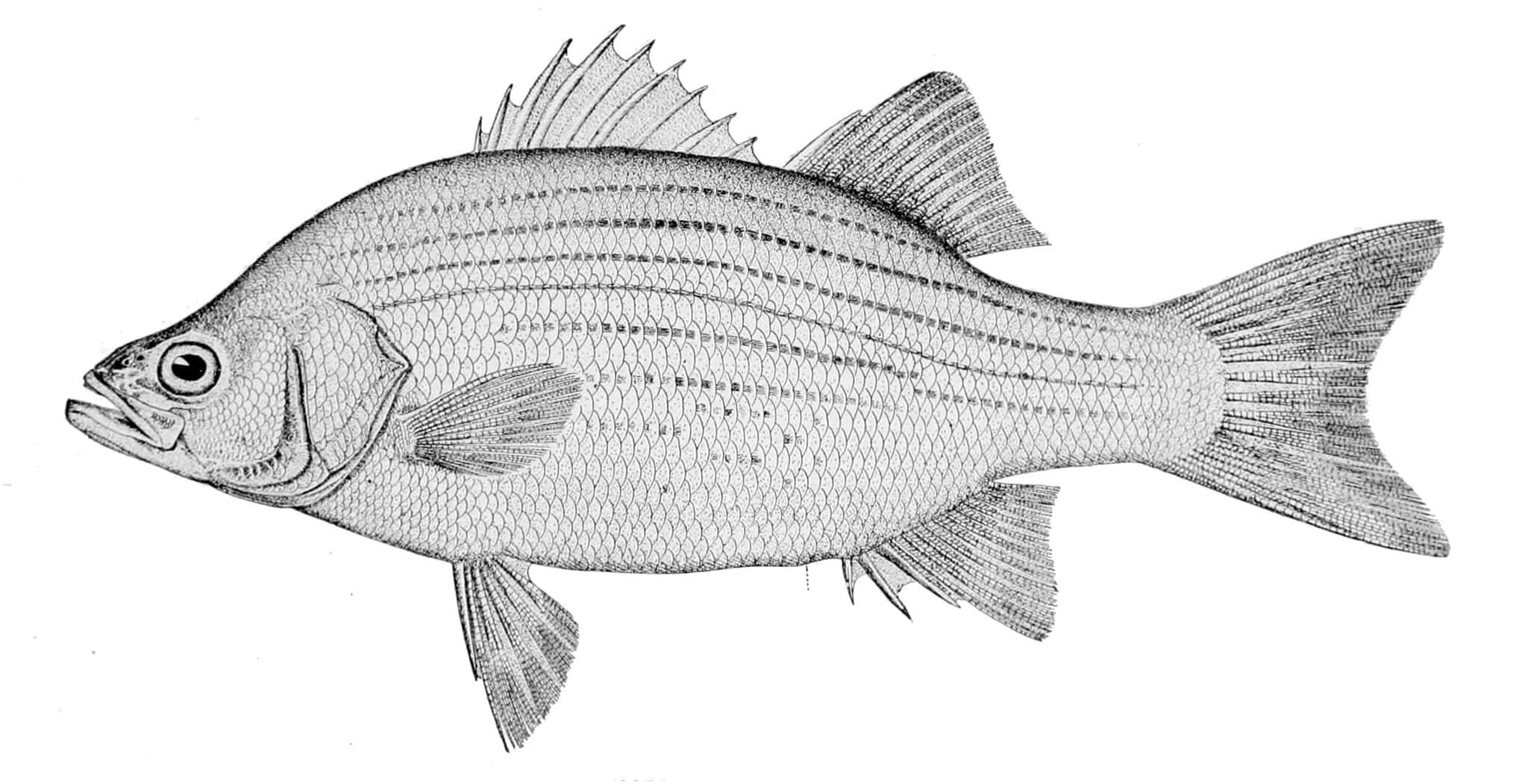
Image: public-domain species reference
Blaming a cold front for a dead white bass morning is easy, and it’s usually a bigger conclusion than the morning earned. A sharp temperature drop can change where a migrating school is staged. That isn’t the same as white bass hating cold fronts. Morone chrysops is a schooling, migratory predator, and a spring river only looks like it’s holding still from the bank. The same fish can be staged deep below a tributary one day, running upstream the next, and drifting back toward the reservoir or main river once the spawning pulse passes. The gauge and the water temperature, plus wherever the shad went, usually explain more than the date does.
At a glance · The short version
Scientific name
Morone chrysops
Typical size
Missouri reports commonly about 9–15 in and roughly 1/4–1 1/4 lb, with larger fish possible.
Core habitat
Large rivers, deep stream pools, reservoirs, and open water; firm sand or rock is common, and continuously turbid water is less favored.
Spawning strategy
Early-spring upstream migration; broadcast spawning in current over rock or gravel with no nest.
Forage
Fish dominate adult feeding, especially gizzard and threadfin shad; crustaceans and emerging insects also matter.
Fishing clue
Find the school and the forage before refining the lure. One fish is evidence of more fish nearby.
What fish is this?
Identification
Body and stripes
White bass are silvery, deep but elongated temperate bass with several dark horizontal streaks. Missouri notes the back is blue-gray and the body profile is strongly arched forward of the dorsal fin.
The upper surface of the tongue usually carries one heart-shaped tooth patch. That trait becomes useful when white bass share water with striped bass or hybrids, but identification should combine several features rather than depend on one patch.
Hybrid striped bass often show more sharply broken or offset stripes. Body depth, stripe pattern, tooth patches, and the stocking history of the water all help. Where regulations differ, use the current state identification guide rather than a single photograph from a search result.
Do not call every silver school a white bass
Striped bass, hybrid striped bass, white perch, and other schooling fish can overlap visually or behaviorally. The school boiling on shad is a feeding clue, not an identification.
Where do I find them?
Range & Habitat
Native range
Texas places the native range across the central United States west of the Appalachians, including Great Lakes and Ohio-Mississippi drainage systems; in Texas the species is native to the Red River drainage. Stocking and reservoir development have expanded fisheries beyond the original distribution.
Missouri describes white bass in deeper stream pools, big rivers, and firm sandy or rocky bottom. In river systems, tributary mouths, tailwaters, channel edges, deeper pools, and current corridors become especially important during migration.
Outside the spawn, white bass are open-water fish as much as shoreline fish. They roam with forage, use deep basin and channel water, and can push shad to the surface on points, flats, and wind-driven edges.
Turbidity
Missouri notes the species tends to avoid continuously turbid water. That does not mean a temporary muddy pulse makes a river empty; it means persistent visibility, forage behavior, and river history can influence where schools settle.
White bass are early-spring spawners. Texas and Missouri both describe males moving upstream first, sometimes about a month before females. That creates a staged run rather than one synchronized river-wide event.
Spawning occurs near the surface or in midwater, usually over gravel or rock and often in current. Adults do not prepare a nest. Several males crowd a female as eggs and sperm are released into the water column.
After fertilization, eggs sink and adhere to rock. Texas gives a hatch time of roughly two to three days, while Missouri’s 2026 profile reports about two days. That is fast enough that a brief favorable window can move the run from staging fish to hatched fry quickly.
Large females may release close to a million eggs in a spawning season. The reproductive strategy is numbers plus current and substrate rather than parental guarding.
White bass grow quickly; Texas notes first-year fish can reach eight or nine inches, and both Texas and Missouri say fish older than about four years are uncommon. That life-history pace helps explain why strong and weak year classes can show up visibly in a fishery.
Texas identifies gizzard and threadfin shad as preferred food items and also lists crustaceans and emerging insects. Missouri similarly describes fish, small crustaceans, and aquatic insects.
Adults often feed near the surface when forage is available. That is why a summer or fall school can appear suddenly as shad are compressed upward, then disappear as both predator and prey sink out of sight.
Adults are usually found in schools. That changes the search problem. One strike tells you where a school was standing, which is worth more than the fish itself. Depth, direction of travel, current edge, and bait position immediately become more important than changing lure color after every missed bite.
The river is a moving corridor. During the run, location can change faster than lure preference. Before changing tackle, ask whether the school is staged below you, has already moved upstream, or has dropped back after a temperature or flow change.
Cold or unstable waterinference
After a sharp temperature or flow change, test lower and deeper staging water before assuming the run is absent. This is a migration-corridor hypothesis to test, not a universal cold-front rule.
Tributary mouthsinference
A tributary mouth is valuable because it is a decision point: fish can stage below it, move into it, or use the current seam where two waters meet. If the main stem has changed rapidly, temperature or clarity differences at the mouth can become even more useful.
Luresconvention
Small jigs, jig-and-minnow rigs, spoons, spinners, blade baits, swimbaits, small crankbaits, and streamers all fit a shad-and-small-fish predator. Texas specifically recommends spoons and spinners for surface schools.
When a school is holding in a seam, swinging a jig or blade bait through the lane can cross the feeding corridor while naturally changing speed as the lure enters and leaves current.
Table quality
Texas calls white bass excellent table fare. As with any fish, local contaminant advisories and water-specific consumption guidance override a general species reputation.
In summer and fall, the productive object may be a moving bait school rather than permanent cover. Surface activity, birds, sonar, wind lanes, current, and nearby channel structure can all reveal where predators have compressed forage.
Boat positionconvention
Position for drift and casting range instead of driving directly over a surface school. Cast past the edge and retrieve through it; unnecessary boat traffic through a short-lived feed can disturb the school.
When the surface goes blankinference
Do not assume the school left the county. Count the lure down or use sonar to check directly below and downwind/downcurrent of the last surface activity. The same school can resume feeding minutes later from a different depth.
Seasonal working map
What Changes
Period
Primary movement
Best question
Late winter
Schools stage in deeper main-lake, river, and lower tributary water before the run.
Where is the closest stable depth to the spawning corridor?
Early spring
Males push upstream first; females follow later as conditions progress.
Is the school staged below the run, moving through, or already above me?
Spawn
Broadcast spawning in current over rock or gravel; no nest.
Which shoal, riffle, or rocky run has enough current and access to concentrate fish?
Summer
Schools roam open water with shad and other forage.
Where is the bait, and at what depth is it being compressed?
Fall
Cooling water can concentrate bait and trigger aggressive schooling again.
Which wind, current, or channel edge is moving forage into a catchable lane?
Winter
Fish commonly settle deeper and feed less visibly.
Can I locate the school vertically before I change lure families?
— · What we are not filling with guesses
Not Established Here
a nationwide single spawning-temperature trigger
a fixed spring-run calendar independent of latitude and flow
a universal summer depth
a barometric-pressure rule
a rule that every cold front pushes fish downstream
a single ideal lure color independent of forage and clarity
— · Sources
FEEDING ECOLOGY · STANDARDIZED
How this fish gets fed.
Primary prey
Small fishes—especially shad and minnows—become major adult prey, with aquatic insects and crustaceans contributing more strongly in smaller fish and when fish prey is scarce.
Feeding mode / location
A schooling open-water predator that tracks bait through reservoirs and large rivers. Current seams, humps, points, tributary mouths, and surface boils matter when they concentrate forage rather than because the fish is permanently attached to structure.
Diel / seasonal pattern
Spring spawning runs concentrate fish in tributaries and current; outside the run, schools follow forage through seasonal depth changes. Surface feeding can intensify during low light or active bait events, but no universal clock is asserted.
Ontogenetic diet shift
Young white bass rely more on zooplankton and aquatic invertebrates, then shift increasingly toward fish as they grow.
Spawning-run timing is kept separate from ordinary feeding behavior.
Compiled 2026-09-11. Limits and advisories are set per water and per state and change between seasons — the managing agency for wherever you are fishing has the current answer.
None of that is really about cold fronts. A school that’s moving through a river that’s moving shouldn’t get fished like it’s parked. Look at the temperature and which way the gauge is trending, then work the corridor from top to bottom before you call the bite off or start swapping lures. White bass also make more sense sitting next to the other river species, which is why River Fish of the United States keeps their habitat and movement side by side.
Losing ten minutes to read the river is cheaper than losing the whole morning proving the fish should have been where I wanted them.
River FishRiver-fish species profiles covering habitat, behavior, seasonal movement, fishing approaches, conservation status, and regional variation across the United States.49 articles
Species & BehaviorFish behavior, habitat, depth, forage relationships, and species-specific field decisions. Start with the Freshwater Fish Species field guide.159 articles
Cookie Consent
We use cookies to improve your experience on our site. By using our site, you consent to cookies.
Contains information related to marketing campaigns of the user. These are shared with Google AdWords / Google Ads when the Google Ads and Google Analytics accounts are linked together.
90 days
__utma
ID used to identify users and sessions
2 years after last activity
__utmt
Used to monitor number of Google Analytics server requests
10 minutes
__utmb
Used to distinguish new sessions and visits. This cookie is set when the GA.js javascript library is loaded and there is no existing __utmb cookie. The cookie is updated every time data is sent to the Google Analytics server.
30 minutes after last activity
__utmc
Used only with old Urchin versions of Google Analytics and not with GA.js. Was used to distinguish between new sessions and visits at the end of a session.
End of session (browser)
__utmz
Contains information about the traffic source or campaign that directed user to the website. The cookie is set when the GA.js javascript is loaded and updated when data is sent to the Google Anaytics server
6 months after last activity
__utmv
Contains custom information set by the web developer via the _setCustomVar method in Google Analytics. This cookie is updated every time new data is sent to the Google Analytics server.
2 years after last activity
__utmx
Used to determine whether a user is included in an A / B or Multivariate test.
18 months
_ga
ID used to identify users
2 years
_gali
Used by Google Analytics to determine which links on a page are being clicked
30 seconds
_ga_
ID used to identify users
2 years
_gid
ID used to identify users for 24 hours after last activity
24 hours
_gat
Used to monitor number of Google Analytics server requests when using Google Tag Manager
1 minute
Jetpack's built-in visitor analytics. It records page views, referring sites, search terms, and outbound link clicks, and also carries the shared visitor-tracking library used by Jetpack Instant Search and WooCommerce Analytics.