A fluke buries in sand with both eyes on its left side and eats whatever swims over it. That upward ambush explains the bucktail, and the fall offshore spawn explains why the bay empties out.
By HunterUpdated September 12, 2026Read 7 min
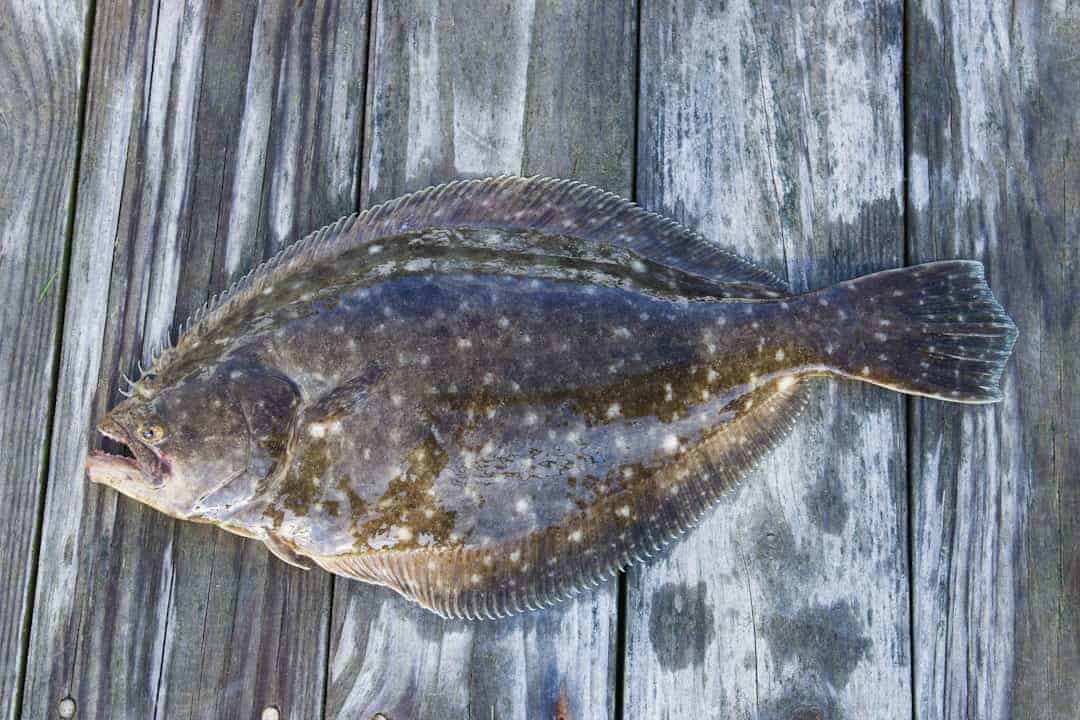
Summer Flounder (Paralichthys dentatus), Great South Bay, Long Island. Photo: Brian Yurasits / Unsplash.
A fluke lies on the bottom with both eyes on the left side of its head, and it isn’t down there grazing.Paralichthys dentatus buries in sand, watches the water overhead, and hits fish and crustaceans that pass through that window. That’s the reason a bucktail bouncing just off bottom tends to get eaten while the same bait plowing flat through the sand gets ignored. Everything else about the fish, from the estuary nurseries to the fall run offshore, makes more sense once you picture it looking up.
At a glance · The short version
Scientific name
Paralichthys dentatus
Field ID
Left-eyed flatfish; at least five dark spots on the eyed side form a characteristic X-like pattern.
Adult habitat
Sand/mud bottom, marsh creeks, seagrass beds and flats inshore; outer continental shelf in winter/early spring.
Spawning
Offshore in fall and early winter; NOAA lists peak spawning in October and November.
Life history
Mature around age 2–3; lifespan about 12–14 years; females grow substantially larger than males.
Both eyes migrate to the left
Identification
Left-eyed flatfish
Summer Flounder begin life swimming upright with an eye on each side. During metamorphosis the right eye migrates across the top of the head to the left side, and the fish settles permanently onto its right side. “Left-eyed” is therefore a developmental trait, not a casual nickname.
NOAA notes at least five dark spots arranged in a rough X pattern on the eyed side. That pattern is a useful field separator from other flatfish, especially when color alone changes with bottom type and stress.
Fluke carry a much larger predatory mouth than a bottom-sifting flatfish stereotype suggests. The teeth belong to a fish that eats fish as well as crustaceans, which is why a careless thumb and a lightly abraded leader are both real problems.
Sex changes the size expectation
NOAA reports males growing to more than two feet and females up to about three feet. NOAA ageing guidance similarly shows females growing faster and living longer in sampled populations. A large fluke is therefore disproportionately likely to be female.
Larvae and juveniles use estuaries and coastal lagoons. NOAA specifically lists marsh creeks, seagrass beds, mud flats and open bays as juvenile habitat. That makes estuarine water quality part of the species’ survival system long before a fish reaches recreational size.
Adults move into bays, inlets, marsh creeks and nearshore flats as waters warm. Sand and mud are the background; productive breaks within that bottom—channel lips, bars, grass edges, creek mouths and current funnels—are where prey delivery improves.
In winter and early spring, adults are found offshore along the outer edge of the continental shelf. That movement is linked to spawning and seasonal temperature change. A favorite summer bay flat is not expected to hold the same adult population through the entire winter.
NOAA lists reproductive maturity around age two or three. That is relatively early compared with many long-lived reef fish, but the fish still depends on estuarine nursery habitat and successful offshore spawning migrations to build each new year class.
Summer Flounder spawn offshore in fall and early winter, with NOAA identifying October and November as peak spawning months. Females spawn multiple times during the season rather than releasing the entire reproductive investment at once.
NOAA estimates roughly 460,000 to more than four million eggs depending on female size. Eggs are released into the water column over the continental shelf, hatch offshore, and the larvae eventually ride currents back toward coastal nursery areas.
The current NOAA species page gives a lifespan around 12–14 years. Ageing guidance notes sampled females can reach around 12 years while males in those data top out younger. Treat those as observed life-history patterns, not a guarantee that every female is older than every male of the same length.
Adults eat both fish and crustaceans and are described by NOAA as opportunistic feeders. Juveniles use smaller crustaceans and fish; larvae begin on zooplankton and small crustaceans. The diet scales upward as the mouth, habitat and body size change.
A fish concealed in sediment is not limited to food crawling on the sediment. NOAA explicitly describes adults ambushing prey that swims by. That is the ecological reason a bucktail or bait rising and falling just above bottom can be more visible than something dragging flat and lifeless through the sand.
Evidence level. The life history above is sourced. The drift, bucktail and bite-timing material below is reasoned from that ambush-predator biology and from what other anglers and agencies describe, tagged as inference rather than promoted into universal rules.
The drift is the searchinference
One buried fish on a broad flat is a small target, so the boat is what covers water, not one lucky cast. The whole flat should not get treated equally: channel lips, bar edges, creek mouths and depth changes are where I’d want the drift to intersect moving prey.
Cross the edge, do not live in empty middleinference
A drift that crosses a productive transition at an angle should tell more than one that runs parallel through featureless sand. When fish come from the same depth break, that line is worth repeating before changing bait.
Tick bottom without dragging deadinference
If the rig never touches bottom, it may be above the fish. If it drags so heavily that every movement plows the sand, it can lose the lift-and-fall behavior that gets the bait into the fish’s upward window. Weight should follow current rather than one sinker size getting treated as part of the species.
The bite can feel like weightinference
A good fluke bite often feels less like a strike than like the bottom gained weight. An early swing pulls the bait away from a fish that hasn’t committed to it yet. Let the fish load the rod, then come tight with a controlled sweep. Current, bait type and hook style can change that timing, so this is reasoning from the geometry, not a universal command.
Check the leader
The mouth is toothier than a flatfish stereotype suggests. After a solid fish, the final section of leader is worth checking, with pliers around the mouth rather than a finger proving the point.
Not established here
What this profile will not claim
that every fluke bite requires the same delay before coming tight
that featureless sand is always unproductive
one drift speed independent of depth, current and tackle
that every large fluke is female, only that females generally grow larger
— · Sources
FEEDING ECOLOGY · STANDARDIZED
How this fish gets fed.
Primary prey
Small fishes, squid, shrimp and other crustaceans are major prey, with larger summer flounder increasingly fish-oriented.
Feeding mode / location
A bottom ambush predator that lies on sand or mud and attacks upward into the water column. Channels, drop-offs, inlet edges, depressions and current lanes matter when prey passes over the fish’s holding bottom.
Diel / seasonal pattern
Tide, current and seasonal migration are stronger feeding context than one universal clock. Fish move between estuarine/inshore feeding grounds and deeper offshore winter/spawning habitat.
Ontogenetic diet shift
Young flounder use more small crustaceans and tiny fishes; larger fish become increasingly piscivorous and also take squid.
“Looking up” is the geometry of the ambush, not proof that the fish feeds far off bottom.
Compiled 2026-09-11. Limits and advisories are set per water and per state and change between seasons — the managing agency for wherever you are fishing has the current answer.
Waiting on that weight is the part that feels wrong, because every reflex says swing the second something changes down there. I’d still rather lose a fluke to a slow hookset than an eager one. Miss a few by swinging early and you start to feel the difference between the bottom and a fish sitting on your bait, which is something no paragraph can hand you.
Saltwater & CoastalSurf, shoreline, nearshore, offshore, and deep-sea fishing — technique, gear, and safety content spanning the full range from the beach to blue water.103 articles
Species & BehaviorFish behavior, habitat, depth, forage relationships, and species-specific field decisions. Start with the Freshwater Fish Species field guide.159 articles
Cookie Consent
We use cookies to improve your experience on our site. By using our site, you consent to cookies.
Contains information related to marketing campaigns of the user. These are shared with Google AdWords / Google Ads when the Google Ads and Google Analytics accounts are linked together.
90 days
__utma
ID used to identify users and sessions
2 years after last activity
__utmt
Used to monitor number of Google Analytics server requests
10 minutes
__utmb
Used to distinguish new sessions and visits. This cookie is set when the GA.js javascript library is loaded and there is no existing __utmb cookie. The cookie is updated every time data is sent to the Google Analytics server.
30 minutes after last activity
__utmc
Used only with old Urchin versions of Google Analytics and not with GA.js. Was used to distinguish between new sessions and visits at the end of a session.
End of session (browser)
__utmz
Contains information about the traffic source or campaign that directed user to the website. The cookie is set when the GA.js javascript is loaded and updated when data is sent to the Google Anaytics server
6 months after last activity
__utmv
Contains custom information set by the web developer via the _setCustomVar method in Google Analytics. This cookie is updated every time new data is sent to the Google Analytics server.
2 years after last activity
__utmx
Used to determine whether a user is included in an A / B or Multivariate test.
18 months
_ga
ID used to identify users
2 years
_gali
Used by Google Analytics to determine which links on a page are being clicked
30 seconds
_ga_
ID used to identify users
2 years
_gid
ID used to identify users for 24 hours after last activity
24 hours
_gat
Used to monitor number of Google Analytics server requests when using Google Tag Manager
1 minute
Jetpack's built-in visitor analytics. It records page views, referring sites, search terms, and outbound link clicks, and also carries the shared visitor-tracking library used by Jetpack Instant Search and WooCommerce Analytics.