Spotted Sand Bass: The Dock Bite Happens on the Fall
Around docks, spotted sand bass will often grab the bait before it reaches bottom. Pitch into the darkest corner, give it enough slack to drop straight instead of swinging away, watch the line, and move on if a few bottom hops turn up nothing.
By HunterUpdated September 12, 2026Read 7 min
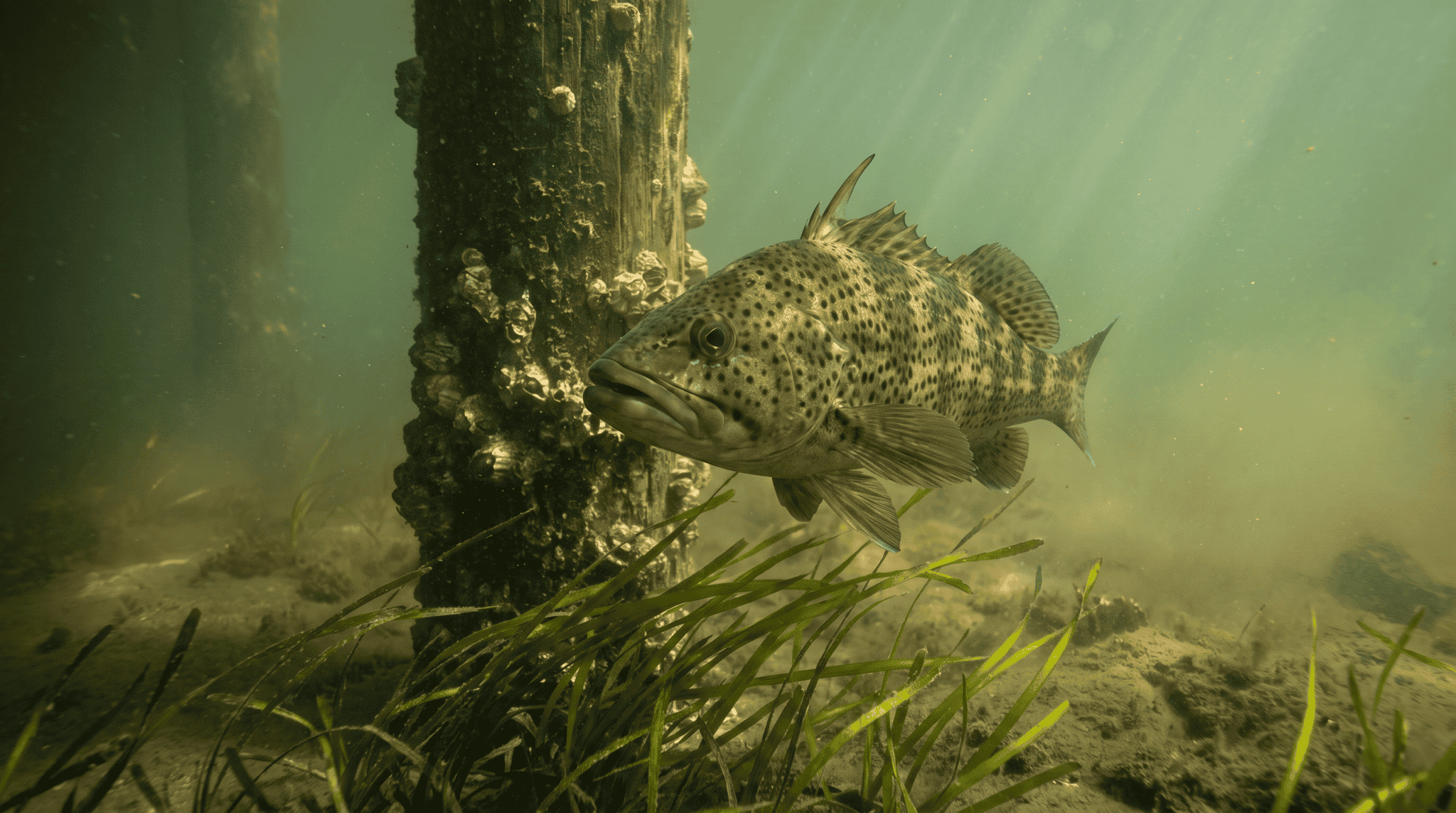
Image: dock piling and eelgrass
Spotted Sand Bass reward inches more than yards.Paralabrax maculatofasciatus lives in bays and estuaries where pilings, dock shadows, eelgrass, riprap, mooring hardware and little current breaks create a short ambush lane. Landing the lure in that lane is only half of it. It has to stay there on the drop instead of swinging back toward you, and once a fish eats, you’ve got to get it moving before it finds mussels, rock or the next piling.
At a glance · Fish this first
First target
The hardest-to-reach dark side of a dock piling, ladder, mooring, riprap corner or eelgrass edge with moving water.
First presentation
Pitch a 3 in swimbait, tube or creature-style bait tight to the target and let it fall on loose line so it drops vertically instead of swinging away.
2026 dock setup example
7–7½ ft rod rated roughly 8–17 lb and 1/8–1 oz; 12–20 lb fluorocarbon leader depending cover. Under 10 ft: 1/8–1/4 oz; most 10–20 ft docks: about 1/4 oz; carry 3/8 oz for more current/depth.
If no fall bite
Drag or hop the bait along bottom a few times, then retrieve and hit the next target. Do not spend ten minutes proving one empty piling is empty.
Second method
Long-cast swimbait/fluke or deep crankbait along bottom, eelgrass edge or parallel to docks when fish are spread rather than pinned to one object.
The best target is often the one that makes the cast annoying
How to Read a Dock
Shadow + object + current
A single piling is better when it also has shade and moving water. Prioritize the down-current pocket behind the object, the leading face receiving current, ladder corners and small gaps that create an ambush point.
Hard-to-reach water gets less pressure
A current 2026 Spotted Bay Bass dock guide emphasizes casting accuracy because fish can sit in the darkest, most protected part of the structure. The easy outside piling may be worth one cast; the gap six inches inside the shadow may be the real target.
Do not cast onto boats, lines, people, ladders in use or restricted property. If access is questionable or someone asks you to leave, move. Good dock fishing depends on keeping access open.
After the bait lands beside the piling or shadow, keep enough slack that it can sink nearly straight down. Holding the line tight turns the drop into a pendulum and pulls the lure away from the cover—the exact opposite of the cast you worked to make.
The bite may be a tick, a sudden stop before the bait should reach bottom, or line sliding sideways. Be ready to stop the spool and come tight immediately because the fish is already beside structure.
No bite on the fall
Drag or hop the bait along bottom a few times. If nothing happens, retrieve and hit the next target. This is high-percentage target fishing; mobility is part of the method.
One current Southern California dock guide uses a rod around 7–7½ feet, rated roughly 8–17 lb and 1/8–1 oz, with a 2–4 ft fluorocarbon leader. Leader runs roughly 12–20 lb depending how much piling, mussel, rock and abrasion is in the target.
In less than about 10 feet, the same guide uses roughly 1/8–1/4 oz tube-style baits. The lighter weight slows the fall and keeps the bait in the strike window longer.
About 1/4 oz is a practical starting point; carry 3/8 oz when current or depth prevents a clean vertical drop. A 3-inch swimbait on a 1/4-oz head is another current local baseline.
The 2026 guide explicitly notes that heavier line can slow sink. If a 1/4-oz bait will not reach the target cleanly on 20 lb leader, decide whether the cover truly requires that leader before automatically adding more lead.
When fish are spread, stop pitching one piling at a time
Long-Cast Bottom and Reaction Methods
Swimbait or fluke along bottom
The second basic Spotted Bay Bass soft-plastic presentation is a long cast with a swimbait or fluke retrieved along bottom. Use it across eelgrass edges, channel margins and open bay structure when fish are not locked to one dock target.
Experienced bay-bass anglers use deep-diving crankbaits that can contact bottom and structure. The point is not a specific model; it is a lure that reaches the lane. A crankbait that runs five feet over fish in fifteen feet is not reaction fishing. It is empty-water fishing.
Speed-cranking a reaction bait parallel to docks or over eelgrass can trigger fish even in colder water. If a slow bottom method marks fish but will not produce, a faster reaction pass is a legitimate change of category rather than another minor color swap.
Around eelgrass, seawalls and rock, use the current to decide which edge is receiving prey and which side provides a slack pocket. A dock that was perfect on incoming water can fish completely differently after the current reverses.
Eelgrass edge
Work the clean margin first with swimbait, crankbait or reaction lure. If fouling becomes constant, a weedless or shallower-running presentation is better than dragging vegetation through every cast.
Seawall or riprap
Parallel casts keep the lure near the hard edge longer than a perpendicular cast that crosses it for two feet. The strike zone is often a line, not a point.
What to change first
Failure Diagnosis
Lure lands perfectly but swings away
Add slack after the pitch or reduce line tension. Do not change the lure; fix the fall geometry.
Bites happen halfway down
Use a lighter head or repeat short pitches that maximize fall time at that depth. Stop forcing the bait to bottom if the fish keep intercepting it above bottom.
Fish break off on pilings
Increase leader within the presentation’s limits, shorten the cast, tighten the line angle and apply side pressure sooner. The lure worked. The extraction system failed.
Ten targets, no bites
Change the habitat lane—dock to eelgrass, seawall or current edge—or change from target-drop to moving reaction bait. A second lure color through ten empty pilings is not new information.
Fight starts before the hookset
Line Choice and Extraction
Leader follows cover
Experienced bay anglers use roughly 12–15 lb leader around many docks, 15–17 lb or more around rock or seawall, and lighter 8–12 lb around cleaner grass. A 2026 dock guide extends the practical dock range up to 20 lb around heavier cover. These are working ranges, not legal or biological limits.
A small fish beside mussel-covered pilings can break line faster than a larger fish in open water. Come tight and use side pressure to move it into the lane immediately; do not give a hooked dock fish several feet of sporting slack.
Twenty-pound leader around a barnacle-crusted piling is cheap insurance, right up until a quarter-ounce bait won’t sink cleanly to the fish anymore. Before you tie on more lead, ask whether that piling really needs twenty.
Identification after the fishing plan
Spotted Sand Bass
Field marks
Many small dark spots cover the head, body and fins, often over a brown or olive background. Kelp Bass show blockier pale blotches or checkering; Barred Sand Bass show stronger vertical bars. Use the full-body pattern rather than one mark.
— · Sources
FEEDING ECOLOGY · STANDARDIZED
How this fish gets fed.
Primary prey
Small fishes, shrimp, crabs and other crustaceans, and benthic invertebrates are important prey.
Feeding mode / location
An ambush predator using docks, pilings, eelgrass, riprap, channels, bridge structure, and shadowed current pockets. Fish can hold very tight to shade or structure and intercept prey as it falls or moves through the edge.
Diel / seasonal pattern
Shade, current, tide, and prey movement are stronger feeding clues than a universal clock. Seasonal spawning and bay temperature can change distribution, but the profile does not establish one species-wide daily feeding period.
Ontogenetic diet shift
Young fish rely more heavily on small crustaceans and invertebrates; larger spotted sand bass broaden toward larger fishes and crustaceans.
“The dock bite happens on the fall” remains a presentation observation, not a claim that the species only feeds that way.
Compiled 2026-09-11. Limits and advisories are set per water and per state and change between seasons — the managing agency for wherever you are fishing has the current answer.
Saltwater & CoastalSurf, shoreline, nearshore, offshore, and deep-sea fishing — technique, gear, and safety content spanning the full range from the beach to blue water.103 articles
Species & BehaviorFish behavior, habitat, depth, forage relationships, and species-specific field decisions. Start with the Freshwater Fish Species field guide.159 articles
Cookie Consent
We use cookies to improve your experience on our site. By using our site, you consent to cookies.
Contains information related to marketing campaigns of the user. These are shared with Google AdWords / Google Ads when the Google Ads and Google Analytics accounts are linked together.
90 days
__utma
ID used to identify users and sessions
2 years after last activity
__utmt
Used to monitor number of Google Analytics server requests
10 minutes
__utmb
Used to distinguish new sessions and visits. This cookie is set when the GA.js javascript library is loaded and there is no existing __utmb cookie. The cookie is updated every time data is sent to the Google Analytics server.
30 minutes after last activity
__utmc
Used only with old Urchin versions of Google Analytics and not with GA.js. Was used to distinguish between new sessions and visits at the end of a session.
End of session (browser)
__utmz
Contains information about the traffic source or campaign that directed user to the website. The cookie is set when the GA.js javascript is loaded and updated when data is sent to the Google Anaytics server
6 months after last activity
__utmv
Contains custom information set by the web developer via the _setCustomVar method in Google Analytics. This cookie is updated every time new data is sent to the Google Analytics server.
2 years after last activity
__utmx
Used to determine whether a user is included in an A / B or Multivariate test.
18 months
_ga
ID used to identify users
2 years
_gali
Used by Google Analytics to determine which links on a page are being clicked
30 seconds
_ga_
ID used to identify users
2 years
_gid
ID used to identify users for 24 hours after last activity
24 hours
_gat
Used to monitor number of Google Analytics server requests when using Google Tag Manager
1 minute
Jetpack's built-in visitor analytics. It records page views, referring sites, search terms, and outbound link clicks, and also carries the shared visitor-tracking library used by Jetpack Instant Search and WooCommerce Analytics.