MONO MAIN · FLUOROCARBON LEADER
When a Seaguar Knot lets go, it’s almost polite about it. No snap. The leader just slides out of the join partway through a fight, and that usually traces back to two lines that were never close enough in diameter to lock. The knot has one job: monofilament main line to fluorocarbon leader, and it doesn’t pretend to cover anything else. Both lines form a shared double loop and pass through together, which is why reasonably similar diameters leave you with a much cleaner finished knot — and why I don’t bother tying it when they aren’t.
Four pictures is all this one needs
Monofilament main line to fluorocarbon leader. Nothing else.
Best when mono and fluoro diameters are reasonably close. I hold the two spools side by side before I decide whether this is even the right knot.
Don’t read this page as a braid-to-fluoro recommendation.
Compact shared loop knot with both lines loading evenly.
Why the two diameters have to be close
Mono and fluorocarbon overlap, a loop doubles back, and both lines pass through the doubled opening together. Neither line gets a set of turns of its own. That only works when the two diameters are close enough to compress evenly against each other. Where the mismatch is large, the thinner line has nothing to brace against, and it starts to cut or migrate instead of locking. Put a fish on that pulls harder than the mismatch can handle and nothing dramatic happens — the knot just quietly stops being a knot.
Overlap, loop, both ends through twice
- Overlap mono main line and fluorocarbon leader.
- Form a generous shared loop with both lines.
- Pass both working ends through the loop together twice, keeping the strands parallel.
- Moisten it, the fluorocarbon especially, and start closing from all four ends.
- Pull the standing lines firmly while you dress the knot into a compact center lock.
- Look for uneven strand cutting, then trim.
Four tag ends and four directions to pull is more hands than most people have. Anchoring two of them under a finger while you draw the other two isn’t cheating, it’s just how the knot gets dressed, and fighting that is how people end up with a lopsided one.
When the mono and the fluoro part company
It’s usually one of four things. Extreme diameter mismatch, by a long way the most common. One line taking a different number of passes than the other. A dry cinch that damaged the fluoro on the way down. Or braid substituted for the mono, which isn’t what this knot was built for.
Mono to fluoro, and nothing past that
Use: mono main to fluorocarbon leader of similar diameter. Skip: braid main or extreme mismatch. Compare: Alberto/FG/Double Uni for braid; Blood/Surgeon’s for mono-fluoro leader/tippet systems.
The narrow job description is the point. Match the diameters, keep the passes even, and this junction stops being something you think about mid-fight — which is the whole reason I still hold two spools up next to each other before I commit to tying it.
HOW I CHECK IT
The diameter check happens before I ever pick up the line.
NetKnots has a solid animation of the whole sequence if you want to see the double loop from a few angles before trying it cold. Past that, my own habit is simple: hold the two spools next to each other before I even cut line off either one, and if the fluoro looks like it’s disappearing next to the mono, I go find a different knot instead of forcing this one to do a job it wasn’t built for. Once it’s tied, I run it between two fingers looking for one strand riding higher than the other. If I can feel a step, I cut it off.
Open the deeper knot workflowJob, material, route, dressing, seating, pull-test checks and the standardized comparison record.
THE SIX-MOVE CHECK
Job → Material → Route → Dress → Seat → Test
- Job. Name what the connection has to do before choosing the knot.
- Material. Confirm the line, leader, rope, wire, and hardware actually suit this structure.
- Route. Trace every pass before tightening anything.
- Dress. Put strands, wraps, and loops in their intended order with no accidental crossings.
- Seat. Tighten in the order this knot needs. More force does not repair bad geometry.
- Test. Inspect the finished shape, load it by hand when appropriate, and retie if anything moves or fails the article-specific checks.
Practice / pass test. Tie this knot three clean times without rushing. A tie passes only when it matches this article’s What to check before you trust it geometry, shows none of the listed failure clues, and survives the stated load/inspection test. If you cannot tell why one attempt is better than another, keep practicing—the lesson is recognition, not memorization.
KNOT SPEC
Seaguar Knot — the short answers
- ALSO CALLED
- Seaguar Knot, named after the fluorocarbon brand that promoted it rather than after a person. No widely used alternative name. Mostly seen among mono-and-fluorocarbon anglers in bass and inshore fishing.
- KNOT TYPE
- Line-to-line knot — both lines share one doubled loop and pass through it together
- WHAT IT CONNECTS
- Monofilament main line to a fluorocarbon leader of similar diameter. Not a terminal knot, and not a braid connection despite the brand association.
- LINE TYPES
- Mono to fluorocarbon, and mono to mono at a push. It needs the two diameters reasonably close. Where the mismatch is large the thinner line has nothing to brace against and migrates or cuts. Do not use it with braid.
- STRENGTH BAND
- Solid when the diameters match, Variable when they do not — technique and line pairing dominate. It is a narrower-purpose knot than the rest of this group, and published rankings for line-to-line knots disagree by wide margins.
- DIFFICULTY
- Intermediate. The sequence is short, but closing four ends in four directions at once is awkward. Kids can learn the shape; the dressing is the part that needs adult patience.
- STEPS AND WRAPS
- Six moves and no wrap count in the usual sense — both working ends pass through the shared loop together, twice. There is no braid variation, because the knot is not for braid.
- TIE TIME
- A boat knot on paper, closer to a home knot in practice. Around a minute. The delay is dressing four ends evenly, not the tying.
- POOR CONDITIONS
- Fair. Nothing to hold under tension and nothing to count, which helps. Four ends to manage at once is what costs you with cold hands or gloves; anchor two under a finger and draw the other two.
- THROUGH THE GUIDES
- Compact and symmetrical, so it runs through guides better than a Double Uni and about as well as an Alberto. Both lines are similar diameter, so there is no shoulder for a guide to catch on.
- LUBRICATION
- Yes, and especially for the fluorocarbon. Closing dry clouds the fluorocarbon inside the knot, which is visible heat damage, and that is where it breaks.
- TAG END
- Trim both tags close, around an eighth of an inch, and trim them at the same length so neither stands proud of the other. There is no braid version, so there is no braid allowance to make.
- TOOLS
- None. Nippers to trim. Holding the two spools side by side before you cut anything is the genuinely useful habit here, and it costs nothing.
- BEST SUITED TO
- Not species-specific — chosen by line pairing rather than fish. Common in bass fishing and inshore work where anglers run mono main line with a fluorocarbon leader.
The strength bands are rough on purpose. Published knot tests don’t agree with each other — the same braid-to-leader knot has tested near ninety percent of line strength on one machine and under half on another, because the line brand, its diameter, how fast it got cinched, whether it was wet and whose hands tied it all move the number more than the knot does. Use the band to compare this knot with the others, not as a number to quote.
ONE PAIRING, DONE WELL
For mono to fluorocarbon of similar size it is short, even, and easy to check by feel in the dark. Step outside that one pairing and it has nothing to offer you.
Advantages
- Compact and symmetrical, so it passes guides cleanly for a line-to-line knot.
- Both lines load evenly, with neither one asked to be the wrapping line.
- Short sequence with no wrap count to lose track of.
- Well suited to the specific mono-to-fluorocarbon pairing it was designed for.
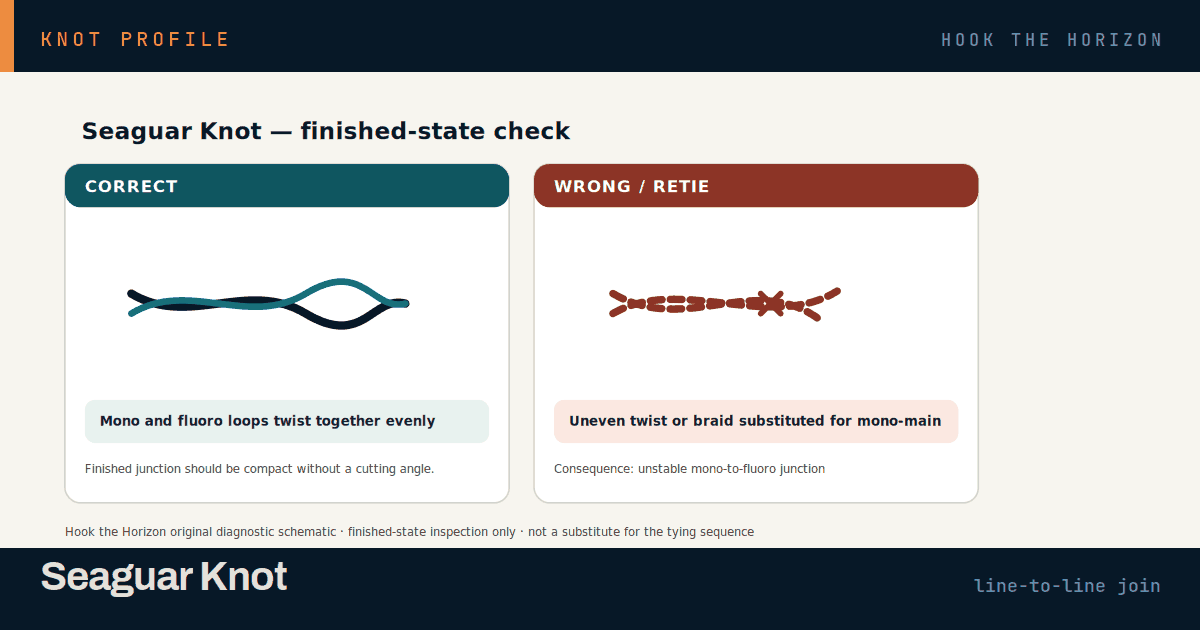
- Easy to inspect by feel: a step between the two strands means it is wrong.
Disadvantages
- Narrow purpose. It fails outside the mono-to-fluorocarbon pairing and it is not a braid knot.
- Needs the two diameters close together, which limits the leaders you can build with it.
- Four ends have to be drawn down together, which is awkward with cold hands.
- Its failure is quiet migration rather than a clean break, so you find out during a fight.
- Less widely taught than the Uni family, so fewer anglers can check your work.
Use a different knot when
- Double Uni — when you want a mono-to-fluoro join that tolerates a wider diameter spread
- Blood Knot — when both lines are mono of similar diameter and you want the smoothest in-line join
- FG Knot or Alberto Knot — when the main line is braid, which this knot is not built for
- Slim Beauty — when the leader is much heavier than the main line
WHAT TO CHECK BEFORE YOU TRUST IT
The Seaguar earns its keep in one narrow case: mono main line to a fluorocarbon leader of similar diameter, where you want a low, symmetrical join that runs through guides without a shoulder. The habit that makes it work is done before any line is cut — holding the two spools together and deciding whether the diameters are close enough to use it at all. The tradeoff is scope. It does one pairing well and everything else badly, and its failure is a quiet slide rather than a bang, which is the worst kind of warning to get during a fight.
What actually makes it fail
- A large diameter mismatch, so the thinner line buries into the thicker one and migrates instead of locking.
- One line taking a different number of passes through the loop than the other.
- Closing it dry, which clouds and weakens the fluorocarbon inside the knot.
- Braid substituted for the mono, which the structure has no grip on.
- Strands crossed rather than parallel through the loop, so the knot never seats square.
How to test it, and how it ages
Look at the two strands before you load it: parallel through the loop, both lines carrying the same shape, with neither buried sharply under the other. Check the fluorocarbon is still clear rather than clouded, since clouding is heat damage from a dry pull. Wet it, close it from all four ends together, then run it between two fingers. If you can feel a step where one strand rides higher, cut it off. Finish with a firm steady pull against a bent rod.
Over a session: Holds well over a session in the pairing it suits, and it does not loosen with casting. Watch for the join creeping after a hard fight, because migration is how this knot ages rather than an obvious break.
Troubleshooting
Can I use this with braid?
No, despite the brand name on fluorocarbon packaging. It has no grip on braid. Tie an FG, an Alberto or a Double Uni instead.
Why did my leader slide loose without breaking?
The diameters were too far apart, so the thinner line migrated through the knot instead of locking. Match the spools more closely or change knot.
Why does the fluorocarbon look cloudy at the knot?
Heat from a dry pull. Wet it and close it gradually. Cloudy fluorocarbon at the knot is damage, and it will break there.
How do I close four ends at once?
Anchor two under a finger and draw the other two, then swap. Dressing it in two stages is normal and is how the knot comes out square.
Is this better than a Double Uni?
Slimmer and neater in its own narrow pairing. The Double Uni is more versatile and far easier to tie in bad conditions.
FIELD OBJECT
This one should leave the page.
The article is the long version. These are the pieces worth carrying into the next trip.
The 30-second version
The Seaguar Knot joins mono main line to a fluorocarbon leader of about the same diameter. Push the mismatch and it doesn't snap, it slides, which is a worse thing to find out mid-fight.
What to watch
- Four pictures is all this one needs
- Why the two diameters have to be close
- Overlap, loop, both ends through twice
- Seat check
Field card
- Overlap mono main line and fluorocarbon leader.
- Form a generous shared loop with both lines.
- Pass both working ends through the loop together twice, keeping the strands parallel.
- Moisten it, the fluorocarbon especially, and start closing from all four ends.
- Pull the standing lines firmly while you dress the knot into a compact center lock.
RIGHT TOOL, NEXT
Knot Analyst
Carry the connection problem into a knot choice built around line, hardware, conditions, and failure mode.