ʻŌpakapaka Hold Above the Bottom, So Your Hooks Should Too
ʻŌpakapaka sit on the shallower side of Hawaiʻi’s Deep-7 water and often school above hard-bottom slopes. Mark how high the fish are, then hold the branch rig so the baited hooks cross them instead of the sinker dragging rock.
By HunterUpdated September 13, 2026Read 7 min
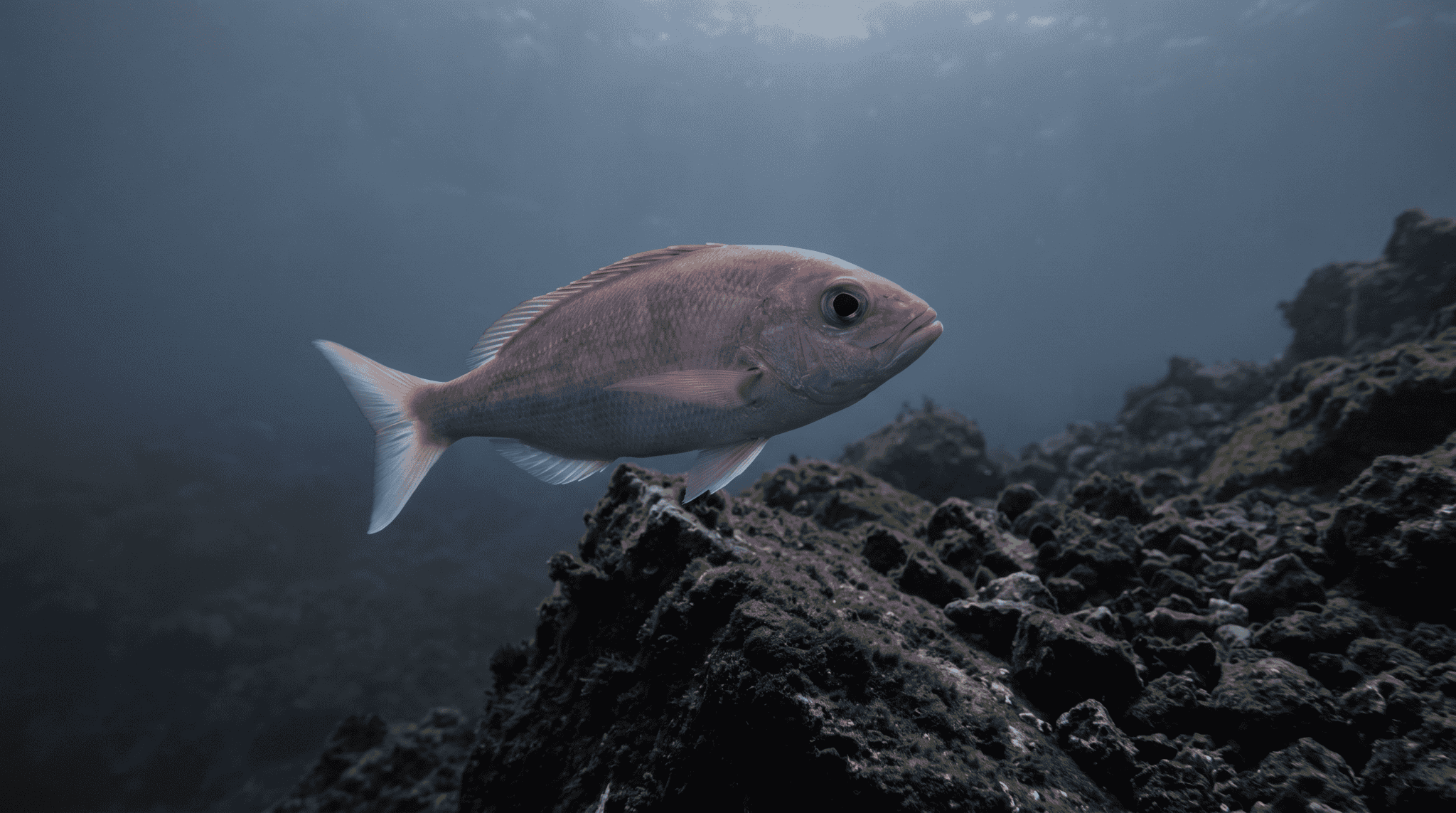
Image: deep Hawaiian slope
Bottomfish is a category, not an instruction. These fish will school above the hard bottom, so a rig with every hook on the floor is fishing underneath them. Everything about rigs and depth below grows out of that one idea, and it’s reasoning from the sources rather than hours on a Hawaiʻi slope.
The sinker finds the bottom. The hooks are supposed to find the fish. Crimson Jobfish (Pristipomoides filamentosus) are commonly targeted on the shallower side of Hawaiʻi’s Deep-7 fishery and can school above hard-bottom slopes. Mark the relief, mark the fish height, then put the baited hook stack through the school instead of leaving the sinker to dictate the presentation.
At a glance · Fish this first
First water
Hard rocky slope, ledge shoulder, contour break or high-relief patch in the shallower Deep-7 band. NOAA gives roughly 240–720 ft for ʻŌpakapaka.
Opaka vs Onaga clue
Hawaiʻi fisher data separates shallower ʻŌpakapaka targeting from deeper ehu/onaga targeting around 188 m (~617 ft). Use that as a search boundary, not a hard species wall.
Basic rig
Strong main leader, several short baited branches, weaker lead line and enough terminal weight to keep the rig nearly vertical.
Bait
Firm squid or fish bait that survives the drop and leaves the hook point exposed. NOAA Deep-7 research uses both squid and anchovy.
Depth decision
If marks are 20–60 ft above bottom, lift or stop the rig so the hooks—not merely the sinker—cross that layer.
Target the shallower Deep-7 band first
Where to Search
NOAA species range
ʻŌpakapaka run roughly 240–720 ft, with the broader Deep 7 complex on hard rocky bottom about 75–400 m. Start on contour breaks, slope shoulders and hard patches rather than featureless deep mud.
A NOAA-linked analysis of Hawaiʻi fisher targeting found depth could distinguish shallower ʻŌpakapaka targeting from deeper ehu/onaga targeting at about 188 m. Do not turn 188 m into a biological cutoff; use it to decide where to start.
A beautiful ledge with no fish or bait marks is only habitat. Survey across the feature before committing a long drop. Save bottom depth, fish height and current direction when the meter shows a school.
Repeat the drift line
A bite is a position plus a moving-water event. Reset up-current and reproduce the crossing angle over the productive shoulder rather than returning to a GPS dot from a different direction.
Build the rig so one snag does not destroy the system
Branch Rig, Lead Line and Attractor
Main leader stronger than branches
Hawaiʻi DAR’s basic bottom-fishing rig uses a strong main leader with several hook branches and a separate lead line. Making branch and lead sections sacrificial protects the main system when a hook or sinker catches rock.
Keep branches short enough that adjacent baits cannot wrap one another during a several-hundred-foot descent. A long natural-looking branch on deck can arrive as a knot.
Light or chum above the upper hook
Deep-7 gear can suspend a light or a bag of chopped squid/fish above the highest hook. Put the attractor where it draws fish toward the hook stack rather than below it.
Use enough lead to know where the hooks are. If current scopes the line far off vertical, add weight or reset the boat. If the rig pounds and hangs on every drop, move off the crest or lighten when conditions allow.
Bait has to survive the drop
Squid, Fish Bait and Hook Exposure
Firm bait first
Squid strips and firm fish baits stay on the hook through a long descent. NOAA’s Deep-7 research handline work uses squid and anchovy on standardized hooks, confirming both as credible attractants.
Leave the point open
A huge wad of squid can spin, tangle and hide the point. Use enough bait to create scent/profile without turning the hook gap into bait storage.
Treat each branch as a depth sensor
If the upper branch catches ʻŌpakapaka while the lower hook repeatedly takes another species, record it. A branch rig tells you vertical position as well as species.
The hook stack is the real fishing depth
How to Fish Suspended Marks
Calibrate on bottom, then lift
Touch bottom to establish the reference, then recover enough line to center the baited branches on the marked band. Leaving the sinker bouncing on rock simply because the fish is called a bottomfish creates snags without improving the presentation.
Account for rig height
If the branch rig already spans twenty feet vertically and fish mark forty feet above bottom, the sinker may need to rise only about twenty feet to center the hooks. Think in hook depth, not sinker depth.
School disappears
Check boat drift first. A deep school can remain on the feature while the boat has moved away. Reposition over the productive line before changing bait.
No bites after repeat drops
Rotate spots. Hawaiʻi fishing education specifically teaches rotating bottomfish areas instead of repeatedly pounding one location.
If the goal is ʻŌpakapaka and the catch is consistently deeper red-snapper species, test a shallower hard-bottom band before changing bait.
Rig tangles
Shorten branches and control deployment. A tangled rig is a rig-design/deployment problem.
Constant snags
Lift the hook stack, change drift angle or move off the roughest crest. Stronger line does not fix a rig dragged through rock.
Untouched bait
Verify marks and hook depth. If there are no marks, move. If marks are present but the hooks miss them, fix depth before bait.
Only one branch gets bites
Use that branch position to refocus rig height or hold the whole system higher/lower. The fish is telling you the productive vertical slice.
Deep fish make release planning part of the tackle
Fight, Retrieval and Barotrauma
Steady retrieval
Keep hooks loaded without pumping slack into a multi-hook rig. Electric reels are common, but drag and terminal-gear control still matter.
Slow the last ten feet
Branches, hooks and heavy lead arrive together. Reduce retrieve speed near the boat and keep hands away from loaded branch lines.
Descending device ready
At several hundred feet, unwanted fish can be barotraumatized. Have a descending device assembled before the first drop if release is possible.
Stop when release quality collapses
If the aggregate bag is reached, depredation is high or released fish cannot be returned well, continued exploratory dropping creates avoidable mortality.
Identification after the fishing plan
ʻŌpakapaka / Crimson Jobfish
Field look
Pink to lavender snapper body, large eye and forked tail, with yellow/brownish pectorals and orange/yellow accents often visible when fresh. Deep-water color fades, so use whole-body structure and a Deep-7 identification guide.
Onaga is a vivid red Etelis snapper with elongated pointed tail lobes and is generally targeted deeper. Identify every fish before counting it toward the five-fish Deep-7 aggregate.
NOAA describes spawning June–December with an August peak. That is biological context, not a separate recreational closure.
A branch rig only works as a depth sensor if somebody actually writes down which hook ate. Skip that and every bite is just a bite. Now say the upper hook keeps taking ʻŌpakapaka for a few drops, then the lower hook starts taking them at the same sinker depth. Maybe the school dropped, maybe current bent the rig — either way, the reference you set earlier has stopped being trustworthy, and that’s the moment to touch bottom and set it again.
— · Sources
FEEDING ECOLOGY · STANDARDIZED
How this fish gets fed.
Primary prey
Fishes, shrimp and other crustaceans, and squid are important prey.
Feeding mode / location
A deep slope and hard-bottom predator that often feeds above bottom rather than pinned to it. Branch-rig and sonar decisions work best when they target the fish’s actual suspended layer over rocky or sloping habitat.
Diel / seasonal pattern
The profile does not establish one universal diel feeding window. Current, prey position, depth, and relief provide stronger feeding context than a clock.
Ontogenetic diet shift
The sources behind this page don’t spell out how the diet shifts from young fish to adult.
“Shallower Deep 7 water” is a relative depth description, not a feeding-temperature or feeding-time rule.
Compiled 2026-09-11. Limits and advisories are set per water and per state and change between seasons — the managing agency for wherever you are fishing has the current answer.
Saltwater & CoastalSurf, shoreline, nearshore, offshore, and deep-sea fishing — technique, gear, and safety content spanning the full range from the beach to blue water.103 articles
Species & BehaviorFish behavior, habitat, depth, forage relationships, and species-specific field decisions. Start with the Freshwater Fish Species field guide.159 articles
Cookie Consent
We use cookies to improve your experience on our site. By using our site, you consent to cookies.
Contains information related to marketing campaigns of the user. These are shared with Google AdWords / Google Ads when the Google Ads and Google Analytics accounts are linked together.
90 days
__utma
ID used to identify users and sessions
2 years after last activity
__utmt
Used to monitor number of Google Analytics server requests
10 minutes
__utmb
Used to distinguish new sessions and visits. This cookie is set when the GA.js javascript library is loaded and there is no existing __utmb cookie. The cookie is updated every time data is sent to the Google Analytics server.
30 minutes after last activity
__utmc
Used only with old Urchin versions of Google Analytics and not with GA.js. Was used to distinguish between new sessions and visits at the end of a session.
End of session (browser)
__utmz
Contains information about the traffic source or campaign that directed user to the website. The cookie is set when the GA.js javascript is loaded and updated when data is sent to the Google Anaytics server
6 months after last activity
__utmv
Contains custom information set by the web developer via the _setCustomVar method in Google Analytics. This cookie is updated every time new data is sent to the Google Analytics server.
2 years after last activity
__utmx
Used to determine whether a user is included in an A / B or Multivariate test.
18 months
_ga
ID used to identify users
2 years
_gali
Used by Google Analytics to determine which links on a page are being clicked
30 seconds
_ga_
ID used to identify users
2 years
_gid
ID used to identify users for 24 hours after last activity
24 hours
_gat
Used to monitor number of Google Analytics server requests when using Google Tag Manager
1 minute
Jetpack's built-in visitor analytics. It records page views, referring sites, search terms, and outbound link clicks, and also carries the shared visitor-tracking library used by Jetpack Instant Search and WooCommerce Analytics.