Moi (Pacific Threadfin) Feel for Food in the Surf Trough
Moi probe soft sand with six free rays under each pectoral fin, so fish the inside trough, cut or whitewater sand pocket with a small bait on bottom. Use the lightest sinker that holds, and move before you start cycling baits.
By HunterUpdated September 19, 2026Read 8 min
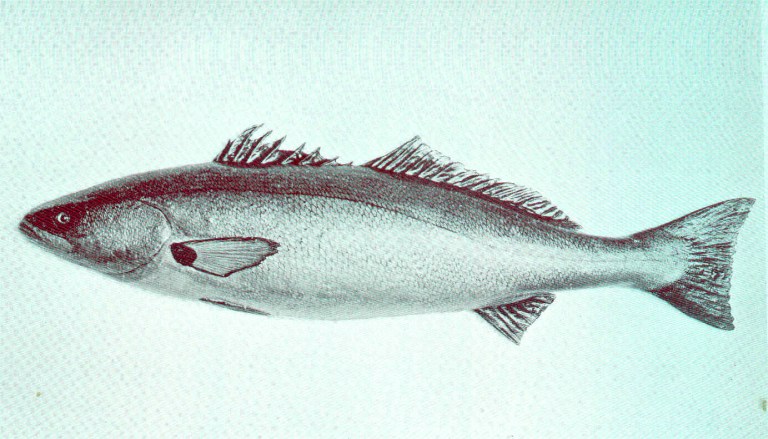
Pacific Threadfin (Polydactylus sexfilis) drawn in lateral view with all six free pectoral filaments spread out below the body, the feelers the fish drags through soft bottom. Illustration: George Henry Ford, from Francis Day’s The Fishes of India, public domain.
Six threads under each pectoral fin tell you most of what you need to know about where a moi bait belongs. Those rays are for feeling around in soft bottom, so the fish is going to be wherever moving water is turning sand over, and a bait swinging several feet above that is mostly decoration. What no species summary can hand you is how a trough looks with real surf running through it. That part comes from watching a few sets roll in before the first cast, and treating everything below as a method to test on that beach.
Moi don’t need an encyclopedia first; they need the right strip of sand. Pacific Threadfin (Polydactylus sexfilis) work soft bottom for crustaceans, worms and small prey. From shore that turns into a pretty simple search: find a trough, cut, sand pocket or whitewater edge where moving water is exposing food, then keep a compact bait close to bottom without letting the surf drag it out of the lane.
At a glance · Fish this first
First water
Inside surf trough, darker sand pocket, cut through a bar, channel margin, reef/sand opening or whitewater pocket with clean sand beneath it.
Best first window
Low light and night are useful shore windows, especially when wave energy is manageable. Current local beach guidance also points to evening surf fishing during the open season.
First method
Dunk a small natural bait on bottom or slowly work a compact whipping bait/lure through the same sand lane. Start close before trying to cast over the first trough.
Baits
Sand crabs, shrimp, small squid/cut bait and other legal crustacean-sized offerings fit the documented bottom diet. Use a small single hook that leaves the point clear.
Weight
Use the lightest sinker that keeps the bait in the chosen pocket. If it rolls out of the trough, add holding power; if it buries and never moves, reduce weight or change lane.
Fish the first feeding lane before maximum distance
How to Read a Moi Beach
Inside trough
A darker band running parallel to shore can be the first depression where wave wash deposits and exposes prey. Put one bait there before assuming the fish are outside the break.
Cut through the bar
A gap where waves break differently can move crustaceans and worms across the sand. Fish beside the strongest flow so the bait stays controllable rather than directly in a rip that tumbles the rig down the beach.
Whitewater reef pocket
Local Hawaiʻi shore tradition also targets moi in protected holes, trenches and sand pockets inside rough whitewater. The useful feature is not the foam by itself; it is a small piece of softer bottom or reduced-current shelter beside turbulent water.
NOAA describes Pacific Threadfin as a coastal species using surf zones, lagoons, estuaries and soft substrate. Very small fish concentrated close to shore may be nursery fish. Move rather than repeatedly handling juveniles, especially near protected habitat.
Dunking gives the sensory fish a stationary target
Bottom Rig and Bait
Compact bait, clear hook point
Moi feed by probing the bottom, so make the bait easy to find and easy to take: a small sand crab, shrimp piece, squid strip or similar legal bait sized to the fish’s mouth. Do not turn a threadfin bait into a large ulua package.
Small single hook
Local shore guidance favors small circle or compact J-style hooks for moi. The exact size should follow the bait; the important part is that the hook point remains exposed and the fish can take the bait without dragging a large hook through a relatively soft mouth.
Use only enough lead to keep the bait in the pocket. More weight is useful when sweep moves the bait out of the trough; it is not useful when it pins the rig under sand or makes every bite feel like the bottom.
Short accurate casts can be better
The first trough and inner sand pocket are often within easy casting distance. A long cast that lands beyond the prey lane can be less effective than a short cast held precisely where the wash is exposing food.
Whipping is the search version
Moving Bait or Small Lure
Basic Hawaiʻi whipping system
DAR’s Hawaiʻi fishing manual describes whipping with light spinning gear, a long leader, small hook or soft plastic, and an optional sinker or floater depending depth and snag risk. For moi, keep the offering near sand rather than high over reef.
If the lure reaches the trough, reduce speed enough that it tracks near bottom without plowing. A fish built to probe sand for prey does not require a bait racing several feet above it.
Fan-cast before changing lure
Make a short cast through the inside lane, a middle cast across the cut and one outside cast. Once a bite identifies a lane, repeat that geometry before changing bait or color.
Night is useful only if the water is fishable
Timing and Surf Conditions
Low light / night
Local Hawaiʻi shore-fishing practice commonly targets moi after dark, when fish can work shallow sand with less visual pressure. Treat night as a window, not a guarantee; heavy surge can make the best trough impossible to fish accurately.
If every set drags the sinker out of the pocket, either add a modest amount of holding power or move to a protected cut. Do not respond to dangerous surf by simply using heavier gear and wading farther.
Surf safety
Fish from a stable position and keep your escape route clear. Hawaiʻi’s shorebreak, reef ledges and nighttime swell can make an otherwise good moi hole a bad place to stand.
The bite can be smaller than the fish
Bite, Hookset and Landing
Tap versus load
Local anglers describe moi bites as taps or small shakes before the fish commits. Keep enough contact to feel the bait without pulling it out of the lane. With a circle hook, let steady pressure load the rod; with a J-style hook, set only after real weight is established.
Use a smooth drag and steady pressure. The fish can use a receding wave to tear a small hook free if the angler pulls harder at exactly the wrong moment.
Land with the wash
Guide the fish shoreward with an incoming wave rather than dragging it against the outgoing surge. Protect the free pectoral filaments from tangling or being crushed during handling.
What to change first
Failure Diagnosis
Rig rolls down the beach
Add sinker or switch to a shape that holds better. If that still fails, the lane is too turbulent for the presentation.
No bites in a good-looking trough
Move twenty to fifty yards or fish a different cut before cycling through several baits. Moi can school and a nearby depression may hold the fish while your current trough is empty.
Bait comes back buried or fouled
Reduce weight, shorten the soak or change the cast angle. The problem is presentation position, not bait flavor.
Only small fish
Move away from obvious nursery concentrations rather than trying to sort through juveniles. Hawaiʻi’s size/season structure exists partly because reproductive size structure matters for this sex-changing species.
Every one of these failure calls is the same diagnostic I’d run on a river seam: is the water moving too much for the rig, or not enough. Swap “trough” for “eddy” and the logic doesn’t change, even though I still can’t tell you what the trough looks like from a beach chair.
Identification after the fishing plan
Count the Six Threads
Field mark
Moi are streamlined silver fish with a forked tail and six separate thread-like sensory rays below each pectoral fin. Those six free rays are the fastest identification clue.
What the threads do
They are sensory structures used to locate prey along soft substrate. That is the biological reason this page keeps returning to sand position and bottom presentation.
Hawaiʻi DAR has long highlighted that moi are among the Hawaiian fishes that change sex, with larger fish becoming female. Large legal fish therefore are not biologically interchangeable with the same number of small fish.
Those loose pectoral rays feel for crabs and worms the wash has knocked free. Hawaii anglers fish for moi after dark, though nobody has proved the fish keeps that schedule.
What it eats
Crustaceans, worms and other benthic invertebrates, plus small fishes, are the core prey categories supported for Pacific threadfin.
How and where it hunts
A sensory bottom and near-bottom forager using sandy surf troughs, cuts, protected holes, trenches, and reef-adjacent sand pockets where wave wash or current exposes prey. The free pectoral rays help locate food in turbulent or low-visibility water.
When it feeds
Local Hawaiʻi fishing practice often targets moi after dark, but the profile does not treat that as a species-wide experimentally established feeding clock. Surf condition, current, prey exposure, and seasonal closure/spawning context remain separate variables.
What changes as it grows
The sources behind this page don’t spell out how the diet shifts from young fish to adult.
The June–August closed season is a management/spawning issue, not a feeding-temperature or feeding-time claim.
Compiled 2026-09-11. Limits and advisories are set per water and per state and change between seasons — the managing agency for wherever you are fishing has the current answer.
FIELD OBJECT
This one should leave the page.
The article is the long version. These are the pieces worth carrying into the next trip.
The 30-second version
Moi probe soft sand with six free rays under each pectoral fin, so fish the inside trough, cut or whitewater sand pocket with a small bait on bottom. Use the lightest sinker that holds, and move before you start cycling baits.
What to watch
How to Read a Moi Beach
Bottom Rig and Bait
Moving Bait or Small Lure
Timing and Surf Conditions
Field card
Hawaiʻi DAR — Fishing in Hawaiʻi — general shore whipping rig framework.
NOAA — Pacific Threadfin species summary — soft-substrate habitat and sensory feeding.
Hawaiʻi DLNR — Hands Off Moi — sex change and closure rationale.
Hawaiian Shore Fishing — Moi — local traditional method examples, used only for technique.
RIGHT TOOL, NEXT
Species & Presentation
Carry the species behavior and presentation question into a narrower water-to-fish-to-presentation handoff.
We use necessary cookies to operate the site. With your choice, we may also use analytics and advertising cookies. Choose Accept All, Reject, or Preferences.
Contains information related to marketing campaigns of the user. These are shared with Google AdWords / Google Ads when the Google Ads and Google Analytics accounts are linked together.
90 days
__utma
ID used to identify users and sessions
2 years after last activity
__utmt
Used to monitor number of Google Analytics server requests
10 minutes
__utmb
Used to distinguish new sessions and visits. This cookie is set when the GA.js javascript library is loaded and there is no existing __utmb cookie. The cookie is updated every time data is sent to the Google Analytics server.
30 minutes after last activity
__utmc
Used only with old Urchin versions of Google Analytics and not with GA.js. Was used to distinguish between new sessions and visits at the end of a session.
End of session (browser)
__utmz
Contains information about the traffic source or campaign that directed user to the website. The cookie is set when the GA.js javascript is loaded and updated when data is sent to the Google Anaytics server
6 months after last activity
__utmv
Contains custom information set by the web developer via the _setCustomVar method in Google Analytics. This cookie is updated every time new data is sent to the Google Analytics server.
2 years after last activity
__utmx
Used to determine whether a user is included in an A / B or Multivariate test.
18 months
_ga
ID used to identify users
2 years
_gali
Used by Google Analytics to determine which links on a page are being clicked
30 seconds
_ga_
ID used to identify users
2 years
_gid
ID used to identify users for 24 hours after last activity
24 hours
_gat
Used to monitor number of Google Analytics server requests when using Google Tag Manager
1 minute
Jetpack's built-in visitor analytics. It records page views, referring sites, search terms, and outbound link clicks, and also carries the shared visitor-tracking library used by Jetpack Instant Search and WooCommerce Analytics.