Pacific Ocean Perch Live a Century and Rebuild Slowly
Pacific ocean perch can live about a century, gather in patchy schools on the outer shelf and slope, and lift off bottom to follow krill. Find the school and its depth band before you blame the jig.
By HunterUpdated September 12, 2026Read 6 min
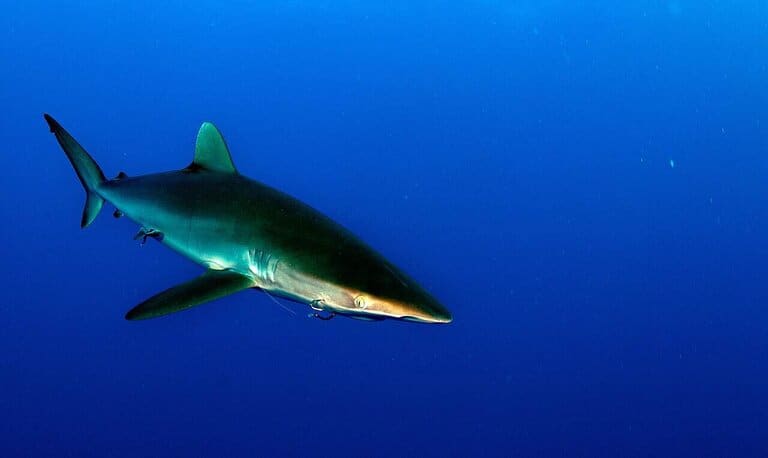
Image: deep schooling rockfish
Pacific ocean perch got fished down hard and took decades to climb back, and once you read the biology the slow part stops being much of a mystery. Sebastes alutus isn’t just another deep red rockfish parked on bottom. It can live around a century, matures late, releases live larvae, forms dense localized aggregations on the shelf and slope, shifts depth seasonally, and can lift off bottom to follow krill. That makes the search three-dimensional — and it means one big school can be a big share of the fish in that patch of ocean.
At a glance · The short version
Scientific name
Sebastes alutus
Maximum age
NOAA: about 98 years; ADF&G identification reference: about 100 years.
Maturity
Roughly age 8-10+, depending on stock/source; NOAA Alaska work reports female 50% maturity around 10.5 years in the Gulf of Alaska.
Adult habitat
Outer continental shelf and upper slope, often roughly 150-420 m in Alaska research.
Behavior
Patchy localized schools; adults can move off bottom to follow krill.
What fish is this?
The Lower-Jaw Knob Is More Useful Than ‘Red’
Color
Pacific ocean perch are pale to bright red with darker diffuse markings over the back. That is a poor standalone ID in a family full of red fish.
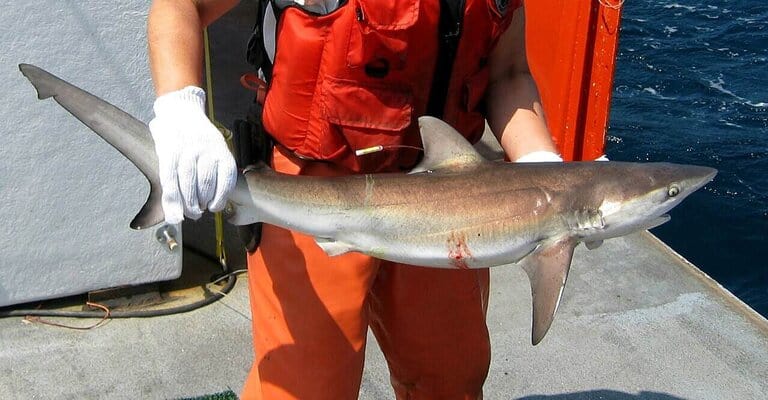
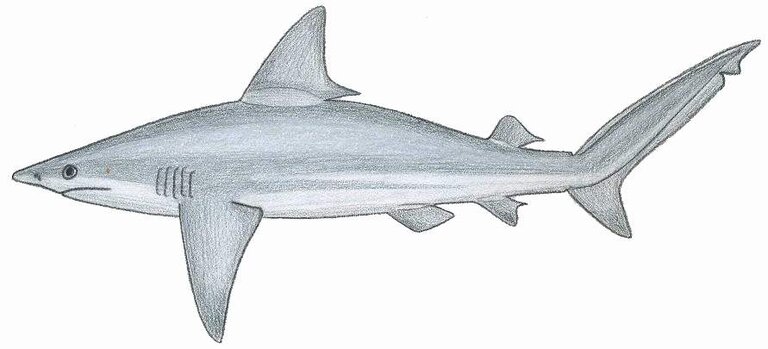
NOAA and ADF&G call out the prominent cone-shaped knob on the projecting lower jaw. That structural feature is one of the fastest ways to move from ‘red rockfish’ toward Pacific ocean perch.
Alaska places Pacific ocean perch in its nonpelagic/slope rockfish category. California likewise lists it with slope rockfish. That agreement is useful because it separates POP from pelagic-schooling black/dusky rockfish even though POP itself can suspend off bottom to feed.
One species, three vertical phases
Surface Young, Demersal Juveniles, Slope Adults
Larvae / young-of-year
NOAA has positively identified post-larval and early young-of-year POP in offshore surface waters of the Gulf of Alaska. The first stage of life is therefore pelagic and exposed to currents, not anchored to slope habitat.
Transformation toward a demersal life may occur within the first year. Small juveniles use inshore high-relief rocky habitat, then begin moving toward deeper offshore shelf water by roughly age three.
Adults occupy outer shelf and upper-slope water, with Alaska research commonly placing them around 150-420 m. Older fish therefore do not simply scale up the juvenile habitat; the usable landscape shifts offshore and deeper with age.
Most adults occur in patchy localized aggregations rather than being spread evenly across every piece of suitable slope. That means finding the school is more important than finding generic ‘good-looking deep rock.’
NOAA documents adults moving off bottom to follow daily krill movements. A sounder mark suspended over slope structure can therefore be the target, not noise above the target.
Juveniles and adults eat copepods and krill; adults also take small fish. The vertical behavior makes sense once the food is treated as mobile rather than attached to the seabed.
NOAA Alaska research describes adults shallower in summer, especially around 150-300 m, then moving farther offshore/deeper in fall to roughly 300-420 m and staying deep until about May. The pattern is thought to connect summer feeding with winter spawning.
A waypoint that produced in August can be biologically correct and empty in January. Before changing jig color, check whether the adult depth band itself should have moved.
Reproduction
A Hundred-Year Fish That Releases Live Larvae
Maturity
ADF&G lists maturity around age eight; NOAA Alaska work estimates female 50% maturity around 10.5 years in the Gulf of Alaska. The difference is exactly why this page gives a range/source context instead of pretending maturity is one coastwide birthday.
POP mate in fall. Females retain sperm; embryos develop internally, and larvae are released in spring. NOAA describes 10,000-300,000 eggs/embryos per female depending on size.
NOAA Alaska work reports oogenesis continuing at advanced ages and slightly higher egg dry weight in older fish compared with middle-aged fish. An old POP is therefore not biologically obsolete simply because it has survived decades.
Evidence level. I’ve never dropped a jig on POP, so treat this as a translation, not a report: documented schooling, depth, and krill-following behavior turned into an order of operations.
Find the aggregationinference
Cover slope/shelf water with sonar until a real aggregation appears. A beautiful piece of bottom with no marks is less useful than a plain slope carrying a dense suspended school.
Match the vertical layerinference
Stop the jig where the school is. If fish are 20 m off bottom, repeated bottom contact adds snag and barotrauma exposure without putting the lure in more fish.
When the school disappearsinference
Change depth band and search distance before changing presentation. A schooling fish problem is often absence/presence first.
Barotrauma
Deep Water Makes Release Equipment Part of the Trip
Pressure change
Slope rockfish brought hundreds of feet upward can suffer severe barotrauma. If retention is prohibited or the fish is outside a legal limit, the release needs to return the fish toward depth rather than leave it positively buoyant at the surface.
California
California requires a descending device aboard any boat/floating device taking or possessing federal groundfish. POP is a slope rockfish in the RCG complex, so that requirement is directly relevant when it is part of the catch.
Fish the school layer; do not bottom-bounce by habit.
Summer waypoint dies in winter
Shift deeper/offshore before assuming the stock disappeared.
Mixed red rockfish
Use the lower-jaw knob and current key before retention; red is not an ID.
Deep non-keeper appears
Descend it promptly and reconsider whether repeated deep bycatch justifies changing depth or species.
— · Not established
What Stays Unclaimed
a single coastwide age at maturity
a fixed adult depth independent of season and stock
a claim that POP are always on bottom
California’s descending-device rule is the difference between a released POP making it back down to depth and one bobbing at the surface with a swollen swim bladder. Skip that step enough times and you’re chipping away at a stock that already needed decades to climb back once.
— · Sources
FEEDING ECOLOGY · STANDARDIZED
How this fish gets fed.
Primary prey
Euphausiids/krill, copepods, amphipods and other pelagic crustaceans are important, with fishes and squid also taken.
Feeding mode / location
A schooling slope and shelf predator that often feeds above rocky bottom rather than directly on it. Schools can suspend along deep contours where zooplankton and small fishes concentrate.
Diel / seasonal pattern
The profile does not establish one universal daily feeding window. School depth and feeding layer can change with prey, light, season and water structure.
Ontogenetic diet shift
Young Pacific ocean perch rely heavily on small planktonic crustaceans; larger fish broaden toward larger euphausiids, fishes and squid.
A stock’s recovery history is kept separate from the feeding biology that determines where fish actually sit.
CDFW 2026 Groundfish Summary — current California recreational category, season/depth, and descending-device requirement.
Compiled 2026-09-11. Limits and advisories are set per water and per state and change between seasons — the managing agency for wherever you are fishing has the current answer.
Saltwater & CoastalSurf, shoreline, nearshore, offshore, and deep-sea fishing — technique, gear, and safety content spanning the full range from the beach to blue water.103 articles
Species & BehaviorFish behavior, habitat, depth, forage relationships, and species-specific field decisions. Start with the Freshwater Fish Species field guide.159 articles
Cookie Consent
We use cookies to improve your experience on our site. By using our site, you consent to cookies.
Contains information related to marketing campaigns of the user. These are shared with Google AdWords / Google Ads when the Google Ads and Google Analytics accounts are linked together.
90 days
__utma
ID used to identify users and sessions
2 years after last activity
__utmt
Used to monitor number of Google Analytics server requests
10 minutes
__utmb
Used to distinguish new sessions and visits. This cookie is set when the GA.js javascript library is loaded and there is no existing __utmb cookie. The cookie is updated every time data is sent to the Google Analytics server.
30 minutes after last activity
__utmc
Used only with old Urchin versions of Google Analytics and not with GA.js. Was used to distinguish between new sessions and visits at the end of a session.
End of session (browser)
__utmz
Contains information about the traffic source or campaign that directed user to the website. The cookie is set when the GA.js javascript is loaded and updated when data is sent to the Google Anaytics server
6 months after last activity
__utmv
Contains custom information set by the web developer via the _setCustomVar method in Google Analytics. This cookie is updated every time new data is sent to the Google Analytics server.
2 years after last activity
__utmx
Used to determine whether a user is included in an A / B or Multivariate test.
18 months
_ga
ID used to identify users
2 years
_gali
Used by Google Analytics to determine which links on a page are being clicked
30 seconds
_ga_
ID used to identify users
2 years
_gid
ID used to identify users for 24 hours after last activity
24 hours
_gat
Used to monitor number of Google Analytics server requests when using Google Tag Manager
1 minute
Jetpack's built-in visitor analytics. It records page views, referring sites, search terms, and outbound link clicks, and also carries the shared visitor-tracking library used by Jetpack Instant Search and WooCommerce Analytics.