You’re probably not going to go out and catch an opah on purpose. Most people who’ve seen one saw it while they were fishing for something else, so the useful stuff here sits closer to natural history than tactics. The part worth sticking around for is the whole-body warming, because it explains how a fish keeps working cold depth that slows other predators down. That’s a mechanism, not a trick.
No lure color or famous spot turns opah into a reliable trip. These big, deep-ranging fish mostly show up as incidental catch in pelagic fisheries, and a lot of their movement and population biology is still under study. What you can actually get ready for is recognizing one, knowing what kind of water makes an encounter plausible, handling heavy tackle safely, and having a plan when a fish nobody expected comes up to the boat.
Species group: Opahs, Lampris species. More than one species exists, and field identification to species can be difficult. “Moonfish” is used for other fishes too, so photograph the full fish and note capture location.
Quick field plan
- Set expectations: treat opah as a rare incidental opportunity unless a legitimate regional fishery and experienced operator say otherwise.
- Fish the water, not folklore: productive pelagic edges, prey layers, and deep scattering layers are more defensible clues than a universal “opah depth.”
- Prepare heavy gear: capacity, connections, terminal tackle, and lifting plan must handle a large, broad-bodied fish from depth.
- Record the catch: depth, temperature, lure or bait, time, location, and photographs can be valuable where reporting programs exist.
- Verify rules: regulations and reporting differ by region; confirm before retention.
Identification: a round fish built for open water
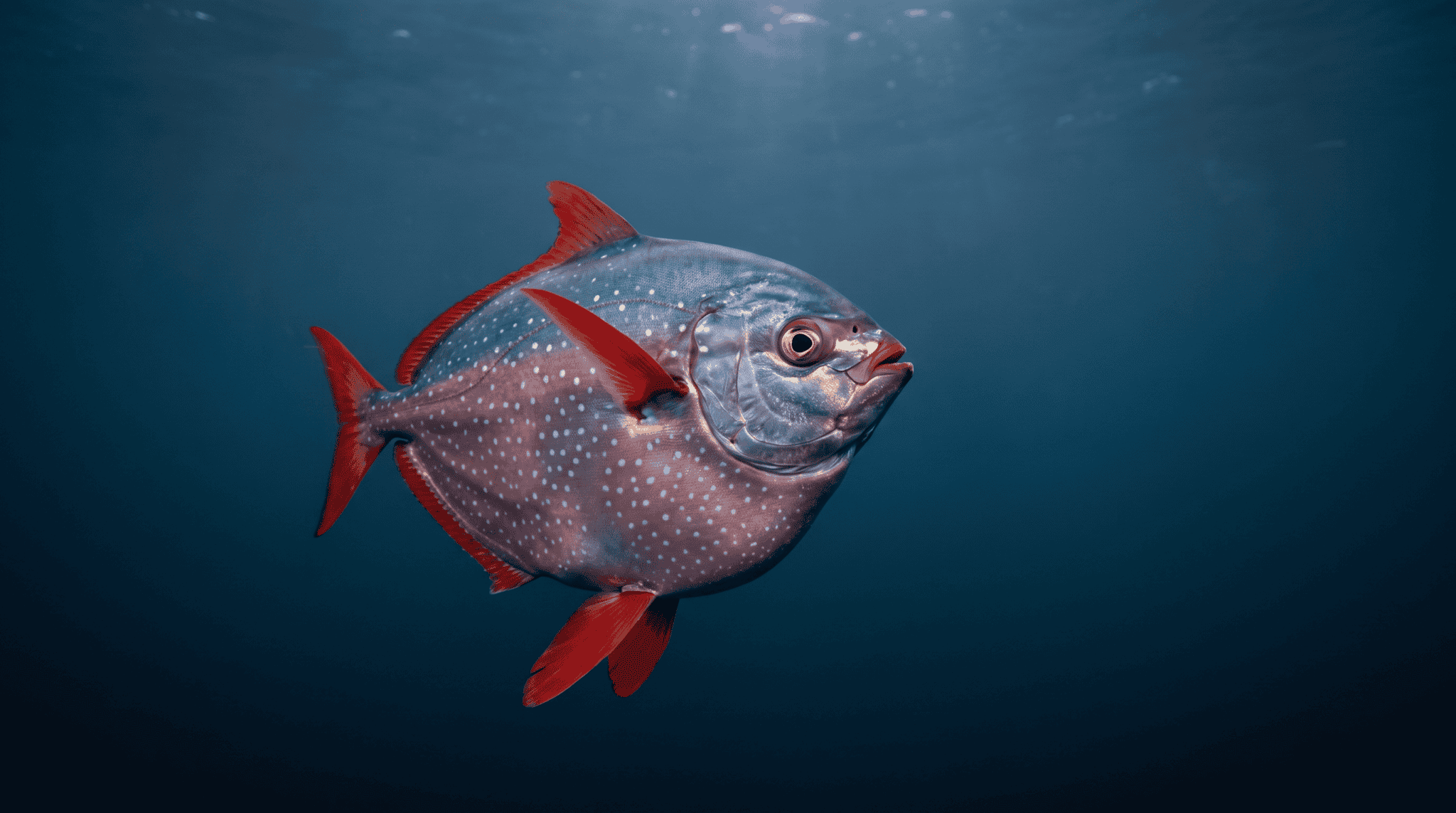
Opah have a striking disk-shaped, laterally compressed body, long red-orange fins, large eyes, and pale spots over a blue-to-silver body. The pectoral fins are long and reddish, and the tail is strongly forked. Their profile is much deeper than a tuna and lacks the long bill or spear of billfish.
Color is vivid when the fish is fresh, but photographs can exaggerate or flatten it. Use body shape, fin placement, spotting, and capture region together. Scientific work has shown that what anglers once treated as a single worldwide species includes multiple forms, so avoid a confident species-level label from color alone.
Why this fish can work cold depth
NOAA research documented opah as the first known fish to circulate warmed blood throughout its body. Heat generated by swimming is conserved through specialized blood-vessel arrangements in the gills, allowing the fish to keep muscles, eyes, and brain warmer than the surrounding deep water. That does not make opah a mammal or give it a constant human-like body temperature; it gives the fish a performance advantage in cold water.
With a rod in your hand, that means an opah can keep moving and hunting below the bright surface layer, where a lot of other big pelagic predators slow down. A surface temperature reading only tells you about the top of the ocean. Subsurface structure and prey depth are what the fish is working with.
Where an encounter is plausible
Opah live in open-ocean waters and move vertically through a broad depth range. Encounters are associated with pelagic food webs, deep prey layers, and fisheries using baits or lures well below the surface. They are caught in several oceans, including waters around Hawaiʻi and the U.S. West Coast, often in longline fisheries directed at other species.
A recreational search should begin with regional evidence: recent verified catches, local bathymetry, current edges, bait marks, and advice from captains who actually fish the area. A single capture does not prove a repeatable spot. Do not invent precision where the data are sparse.
Sonar marks at depth are not species identification. Use them to choose a presentation depth, then let the catch and documented context refine the pattern.
A mark at three hundred feet tells you something is home, not what it is. I’d fish the depth off that screen and let the actual catch do the identifying, never the pixels.
Presentations: think depth control first
There is no universal recreational opah rig. Deep baits and heavy jigs used in broader pelagic or deep-water fisheries are plausible encounter methods, but claims that one color, moon phase, or exact depth “targets opah” should be treated skeptically unless supported locally.
The controllable variables are depth, time in the strike zone, bait or lure integrity, and connection strength. Use a marked line, line-counter information, or a repeatable drop method so “deep” becomes a number. Account for current and scope: 300 feet of line out does not mean the lure is 300 feet down.
Natural bait must remain streamlined and secure through a long drop. A jig must reach depth without tumbling and still work at the intended cadence. Glow can help an angler track or believe in a lure, but it is not a substitute for reaching prey.
Tackle and connection planning
A large opah presents more drag in the water than a streamlined tuna of similar weight. Choose rod, reel, line, and terminal gear for sustained pressure and lifting, not just the initial bite. Line capacity must include working depth, current-driven scope, and a safety reserve.
Inspect every crimp, knot, swivel, hook, guide, and leader before deployment. Deep fishing magnifies small failures because the system is loaded for a long time. Set drag deliberately and know how much pressure the rod, line, and angler can sustain. A harness may help on suitable conventional gear, but it must be fitted and used safely.
Keep terminal tackle legal for the region and compatible with bycatch release. Large circle hooks can reduce deep hooking in some bait fisheries when rigged and fished correctly.
Fight the body, not just the line
An opah may make powerful runs, but the late fight can become a heavy, circling lift. Use the boat to keep the line clear of the hull and props. Pump with short, efficient strokes and recover line on the downstroke without unloading the rod. High-sticking a heavy fish is a rod-breaking shortcut.
Watch for changing line angle. A fish rising under the boat can create slack; a fish circling under the hull can abrade line. Communicate depth and direction aloud. The operator, angler, and landing crew need one plan before the fish reaches color.
The tuna comparison holds right up until that late circling lift, and then it breaks. A round body drags harder for its weight than a torpedo-shaped one does, so gear that stops a tuna clean can still get outmuscled by the shape of the fish alone, never mind its strength.
Landing a large round fish safely
Decide retention before using a gaff. If release is required or chosen, avoid gaffing and use a dehooker or other regionally appropriate method while the fish remains supported in water. A large opah is awkward at the rail; improvised tail grabs or leader wraps can injure people.
For legal retention, use experienced crew, strong legal landing equipment, and a clear lift path. Keep feet out of loose line and hooks. Once aboard, control the fish, remove tackle only when safe, and move directly to dispatch and chilling. The broad body retains heat.
A next-drop decision matrix
- No verified regional catches: do not build the trip around opah; fish the legitimate local pelagic target and treat opah as possible bycatch.
- Marks are deep but scattered: choose one measured depth band and fish it cleanly before changing.
- Line scopes heavily: increase weight, reduce drag-producing hardware, or change boat angle; do not pretend line-out equals depth.
- Bait returns twisted: repair the rig, improve bait stitching, or add a quality swivel before redeploying.
- Fight becomes a dead lift: shorten strokes, use boat position, verify drag, and rotate anglers only if the handoff is safe and legal.
- Identification is uncertain: photograph both sides, fins, head, and whole body; report conservatively.
Food care and full use
Opah are valued for distinct cuts with different textures and colors. That makes careful processing important. Dispatch promptly, bleed if recommended locally, and chill the core quickly with enough ice. A cooler sized for tuna may not fit a broad opah; measure the box before the trip.
Keep the fish out of sun, maintain clean tools and surfaces, and plan to use more than the most familiar loin cuts. Local processors may be the best option for a large fish. Follow seafood-safety guidance, especially when travel time is long.
Management, reporting, and uncertainty
NOAA notes that opah are not generally the main target of a large U.S. commercial fishery but occur as valuable catch in pelagic longline fisheries. Population information and management context vary by ocean and fishery. Recreational rules may be embedded in general pelagic regulations rather than a species page.
Verify license, method, area, retention, and reporting requirements with the responsible agency. If a tagging, sampling, or voluntary reporting program is active, a rare capture can contribute more knowledge when documented accurately. Never delay a required release to collect data.
Field notes worth keeping
Record coordinates within any reporting rules, bottom depth, actual presentation depth, line out, current, surface and subsurface temperature if available, time, light, prey marks, bait or lure, hook placement, fight duration, fish dimensions, sex if responsibly determined, and clear photographs. Label estimates as estimates.
FEEDING ECOLOGY · STANDARDIZED
How this fish gets fed.
Whole-body endothermy expands the usable environment; it is not itself a feeding trigger.
Sources and limits
Biology, distribution, fishery context, and whole-body warming research: NOAA Fisheries Opah and NOAA Opah Science.
For an actual trip plan, the regional agency rules and local operators who fish that water are the source, not a species page.
Most of what makes opah interesting doesn’t turn into a tactic, and making one up would be worse than stopping here. If you ever meet one, odds are you’ll be fishing for something else entirely — which is why the drag setting, the cooler size and a camera within reach matter more than any opah rig somebody swears by.